DocumentsStaff ReportJun 15, 2026Pages 214–272
Background Report: BYLAW NOS. 2275, 2270 & 2271 (Amenity Cost Charge and Inclusionary Zoning Bylaws)
Background report accompanying proposed bylaws including City of Langford Amenity Cost Charge Bylaw No. 2275, Inclusionary Zoning Bylaw No. 2270, and Reserve Funds Establishment Bylaw Amendment No. 3, Bylaw No. 2271, presented for readings.
Key facts
- Bylaw Nos: 2275 (Amenity Cost Charge), 2270 (Inclusionary Zoning), 2271 (Reserve Funds Amendment)
- Listed for FIRST, SECOND AND THIRD READINGS
- Report begins page 214 and runs through page 272
- Purpose: implement amenity contributions and inclusionary zoning mechanisms
Background Report: BYLAW NOS. 2275, 2270 & 2271 (Amenity Cost Charge and Inclusionary Zoning Bylaws)
Page 214
t 250.478.7882 e administration@langford.ca 2nd Floor, 877 Goldstream Avenue Langford, BC V9B 2X8
Staff Report to Special Council
DATE: Monday, June 15, 2026 DEPARTMENT: Planning SUBJECT: Amenity Cost Charge and Inclusionary Zoning Bylaw No. 2275 and 2270
EXECUTIVE SUMMARY: The purpose of this report is to introduce Inclusionary Zoning (IZ) and Amenity Cost Charge (ACC) bylaws that update how affordable housing and community amenity contributions are secured from new development, and to ensure compliance with recent provincial housing legislation. Together, these bylaws modernize the City’s existing approaches to affordable housing and amenity contributions, align existing policy with provincial requirements, and provide greater clarity and transparency in the development process. These bylaws represent a shift away from the City’s existing density bonus framework, under which affordable housing and community amenities are secured in exchange for increases in allowable density through the City’s Affordable Housing and Community Amenity Policy, and in the case of the Attainable Home Ownership Program Policy, negotiated as a condition of rezoning. This report, together with the associated bylaws, advance the conversion of these existing policies that can only be secured through the rezoning process into two separate, standalone bylaws that would apply outright to new development. As part of this transition, all general, non-site-specific density bonusing provisions are being removed from Zoning Bylaw No. 300 through a related body of work, Omnibus Bylaw No. 2274 – Local Government Housing Initiatives. Local governments must bring existing density bonus bylaws into compliance with provincial legislation by June 30, 2026. Based on the information provided in this report, the associated bylaws, and the accompanying presentation that will be presented at this Council meeting, Council may wish to consider granting first, second, and third readings to ACC and IZ Bylaw No. 2275 and 2270 as drafted and amending the existing Affordable Housing and Amenity Policy (POL-0011-PLAN) and the Attainable Home Ownership Policy Program (POL-0166-PLAN) to clarify that they only apply to previous rezoning approvals.
Page 214 of 304
Page 215
Bylaw No. 2275 and 2270 – ACC and IZ Bylaws 20260615 Special Council Report Page 2 of 10
BACKGROUND: Between 2023 and 2025, the Province of British Columbia introduced a suite of legislative amendments commonly referred to as the local government housing initiatives. Collectively, these initiatives change how local governments plan for housing, regulate land use, and finance growth, with the goal of enabling housing to be delivered more efficiently and consistently across the province. A key component of this provincial framework was introduced through Bill 46 (2023): Housing Statutes (Development Financing) Amendment Act. This legislation modernized how local governments finance growth by establishing a new framework to finance community amenities, now referred to as Amenity Cost Charges (“ACCs”). ACCs help municipalities fund the community amenities required to support population growth, including facilities such as community centres, recreation facilities, and other public spaces.
The Housing Statutes Amendment Act, 2024 built on this framework by introducing an Inclusionary Zoning (IZ) tool and restructuring how density bonusing may be used. These changes shift municipalities away from negotiated, site-by-site rezoning practices toward more standardized systems established through standalone bylaws. Together, these changes reflect the Province’s intent to separate land use regulations from development financing mechanisms. Prior to these legislative changes, municipalities could not require affordable housing or community amenity contributions outright and instead relied on the increased density granted through the rezoning process to obtain such contributions from new development. Contributions to the General Amenity Reserve Fund and Affordable Housing Reserve Fund were secured as a density bonus in the Zoning Bylaw, as guided by the Affordable Housing and Amenity Contribution Policy, while the inclusion of below-market housing within the development was secured in a Section 219 Covenant and guided by the Attainable Home Ownership Policy. Please refer to the staff report for Bylaw No. 2273 and 2274 for additional background information on the City’s existing density bonus framework. The recommendations in this report, presentation, and associated bylaws are informed by the following: ● Alignment with the City’s Official Community Plan and Housing Needs Report; ● Engagement with interest-holders, including developers, real estate professionals, non-profit housing agencies, and members of the public (see Appendix A - Interest-holder Engagement Summary); ● Compliance with the Local Government Act (LGA) and Provincial guidance, including Inclusionary Zoning and Density Bonusing Comprehensive Guidance (June 2025), and Amenity Cost Charge Best Practice Guide (August 2025); ● A financial impact analysis conducted by Mulholland Parker Land Economists; and Page 215 of 304
Page 216
Bylaw No. 2275 and 2270 – ACC and IZ Bylaws 20260615 Special Council Report Page 3 of 10
● Review of the City’s existing approach to securing affordable housing and amenity contributions through the Attainable Home Ownership Policy, the Affordable Housing and Amenity Contribution Policy, and Zoning Bylaw 300. The proposed bylaws were developed over an eight-month period in accordance with applicable provincial guidelines and legislation. A key requirement of this work was a financial impact analysis to confirm that the proposed bylaw requirements would not deter development. The analysis concluded that maintaining existing contribution rates would not impact development viability but also identified limited capacity to increase contribution levels at this time. Consultation with affected parties was another central component of the bylaw development process. Staff undertook engagement with both interest holders and the wider public to help shape the proposed approach. This included a public survey available between April 10 and May 3, as well as two virtual workshops held in April with developers and non-profit housing providers. The public survey focused on identifying housing priorities in Langford and the types of amenities most important to residents. The interest-holder workshops provided insight into challenges related to housing delivery, opportunities to better support development, and amenity priorities from the perspective of the development and non-profit housing sectors. This was informed by market demand and the needs of residents buying or renting in Langford across the housing continuum (everything from non-profit affordable rental housing to market ownership housing). A summary of engagement results is provided in Appendix C. A high level overview is provided in the commentary below and will be discussed in more detail during the accompanying presentation. COMMENTARY: Inclusionary Zoning (IZ) Bylaw Inclusionary Zoning allows municipalities to require that a portion of new development be delivered either as affordable (non-market) housing units or through cash-in-lieu contributions. These requirements would apply to all new residential development that is not already subject to prior zoning approvals. While this approach builds on Langford’s long-standing practice of securing affordable housing contributions through the rezoning process, it differs in that requirements are now proposed to be applied outright, rather than being incentivized through increases in allowable density or negotiated at the time of rezoning. The proposed IZ Bylaw largely carries forward the existing rates, thresholds, and housing requirements contained in the City’s Attainable Home Ownership Program Policy, and Affordable Housing and Amenity Contribution Policy. These elements have been translated into the proposed bylaw, updated where necessary to comply with new provincial legislation, respond to the City’s Housing Needs Report, and better reflect community priorities identified through engagement. Page 216 of 304
Page 217
Bylaw No. 2275 and 2270 – ACC and IZ Bylaws 20260615 Special Council Report Page 4 of 10
As updated, the bylaw establishes a clear and consistent framework that addresses, but is not limited to, the following elements: The amount of affordable housing required with new development Tenure and affordability conditions The duration that units must remain affordable Requirements related to unit ownership Requirements for family-sized units, and Alternatives to on-site delivery, such as cash-in-lieu contributions or unit transfers Together, these provisions maintain continuity with the City’s existing approach while improving clarity, consistency, and transparency. Engagement Highlights for Inclusionary Zoning Feedback from engagement activities revealed several consistent themes. A key finding from the public survey was the need to increase the supply of family-sized housing, defined as units with two or more bedrooms, along with a stronger emphasis on housing that supports deeper levels of affordability. Participants also highlighted the importance of encouraging a wider range of housing types. Many public survey respondents expressed a preference for achieving a balance between affordable housing delivery and the provision of community amenities. From the developer and non-profit housing provider perspective, there was support for alternatives to delivering built affordable units within individual developments. In particular, cash-in-lieu contributions were identified as a practical option when funds are directed toward projects that deliver deeper affordability. Allowing developers the option to provide cash-in-lieu rather than on-site units was viewed as a way for the City to more effectively support affordable housing projects led by non-profit housing providers. Key Recommendations for Inclusionary Zoning Consistent with the engagement feedback noted above, it is anticipated that supportive and more heavily subsidized housing will continue to be delivered primarily by non-profit providers, with the City assisting through funds secured via cash-in-lieu contributions. As this approach provides greater flexibility in addressing deeper affordability needs, the proposed IZ Bylaw allows a cash-in-lieu option for developments that would otherwise secure fewer than five affordable rental units, or ten attainable ownership units. In addition, recognizing that Langford has a significant population of families, and that one-parent families are among the households most likely to experience core housing need, the proposed IZ Bylaw requires that 50 percent of affordable or attainable units be provided as family-friendly units. For the purposes of the bylaw, family-friendly units are defined as units containing a minimum of two bedrooms. Page 217 of 304
Page 218
Bylaw No. 2275 and 2270 – ACC and IZ Bylaws 20260615 Special Council Report Page 5 of 10
Based on the results of the financial impact analysis, staff recommend retaining the current contribution levels rather than increasing rates. The proposed approach converts existing contribution rates established through current policies into percentage-based affordable housing requirements. As noted above, a cash-in-lieu option is proposed for developments that would otherwise deliver fewer than five affordable rental units or ten attainable ownership units. The proposed IZ requirements would apply city-wide to all residential housing types, with the exception of new homes subject to existing zoning approvals identified in Schedule AD of Zoning Bylaw No. 300 and other Comprehensive Development Zones. Atypical developments would be addressed on a case- by-case basis and would require a site-specific financial analysis. Under this framework, variations to the rates established in the IZ Bylaw may be considered by Council where supported by a third-party financial analysis prepared in accordance with a City-established terms of reference. The rates and criteria set out in the bylaw represent the minimum contribution expected. Amenity Cost Charge (ACC) Bylaw Amenity Cost Charges allow municipalities to collect funds from new development for community amenities required to support population growth. Eligible amenities can include facilities such as community and recreation centres, libraries, childcare spaces, and public gathering places. Amenities related to new development in British Columbia have historically been financed through negotiations at the time of rezoning or through a density bonus framework; both of which generally depend on development density exceeding some base threshold. Through a related but separate body of work, the City is removing general density bonusing provisions from Zoning Bylaw No. 300 to align with the Province’s updated framework. For more background information, please refer to the staff report for Bylaw No. 2273 and 2274. By contrast, once established through a standalone bylaw, ACCs apply broadly to new development and are collected in a standardized manner. This provides a more predictable and reliable funding source for community amenities while offering greater clarity and certainty for developers. Of particular note, funds collected through an ACC Bylaw can only be used towards the capital costs of the particular amenities included in the ACC Bylaw, similar to how Development Cost Charge Bylaws function. The proposed ACC bylaw sets out a comprehensive framework that includes, but is not limited to, the following:
- ACC contribution rates per structure type and land use
- ACC eligible projects and costs
- The municipal assist factor (the City’s contribution to funding amenities)
- ACC program timeframe
- Waivers and exemptions
Page 218 of 304
Page 219
Bylaw No. 2275 and 2270 – ACC and IZ Bylaws 20260615 Special Council Report Page 6 of 10
Together, these components support a consistent, and proactive approach to funding community amenities in support of future growth. Engagement Highlights for Amenity Cost Charges (ACCs) Input from the public survey, together with feedback from the development and non-profit housing sectors, confirmed several priority amenities that align with the Official Community Plan and other related City master plans. A consistent theme was the desire for a more walkable community, stronger social gathering and recreation spaces, and convenient access to amenities and services. These elements were consistently identified as key contributors to overall livability and as important factors influencing real estate marketability. At the same time, developers and non-profit housing providers noted that current costs and requirements are already challenging. Participants cautioned that any additional requirements—such as increases to contribution rates—could further impact residential project financial feasibility. Feedback also highlighted the benefit of refining the City’s definition of affordability to better align with other levels of government and neighbouring municipalities. Survey results further indicated support for a balanced approach to securing both amenities and affordable housing, rather than placing a strong emphasis on one over the other, with a slight preference expressed for amenities. Key Recommendations for Amenity Cost Charges (ACCs) As with the IZ Bylaw and based on both the financial impact analysis and input received through consultation, staff recommend retaining the current contribution levels rather than increasing rates. The proposed rates would blend and convert the City’s existing Affordable Housing and Amenity Contribution Policy and Attainable Home Ownership Policy to this new format. In addition, the bylaw approach expands existing charges to commercial, industrial, and other employment uses across the city, recognizing that growth in these sectors will also increase demand for community amenities. The proposed ACC requirements would apply city-wide to new development, except in cases involving previous zoning approvals and certain Comprehensive Development Zones. In accordance with provincial requirements, the bylaw establishes ACC rates for new housing and commercial/industrial space based on housing form and land use, rather than geographic area. The rates are intended to be proportionate to the population and employment growth associated with each category of development. Amenities eligible for ACC funding include facilities and features that provide social, cultural, heritage, recreational, or environmental benefits to the community. Consistent with the engagement feedback summarized above, and informed by expected Amenity Cost Charge revenues, three primary priorities emerged and are reflected in the proposed bylaw:
Page 219 of 304
Page 220
Bylaw No. 2275 and 2270 – ACC and IZ Bylaws 20260615 Special Council Report Page 7 of 10
- Transformed streets and enhanced public realm and safety improvements
- A new community recreational facility
- A new community hall and public plaza
Additional details on these priorities and the proposed ACC framework are provided in the accompanying presentation and the associated bylaw. The draft bylaw also allows developers to provide eligible in-kind amenities or land in lieu of ACCs, where agreed to by the City and where those amenities or lands are identified in the ACC Bylaw. As with the IZ Bylaw, atypical developments would be addressed on a case-by-case basis and would require a site-specific financial analysis. FINANCIAL IMPLICATIONS: As noted, the ACC contribution rates included in Bylaw No. 2275 represent rates that blend and convert the existing contributions to the General Amenity Reserve Fund outlined in the Affordable Housing and Amenity Contribution Policy. These new ACC rates have been tested as part of the financial impact analysis conducted for this project to ensure that the bylaw does not deter development and that the bylaw is in compliance with the requirements of the Local Government Act.
Similarly, the terms of Inclusionary Zoning Bylaw No. 2270 represent a conversion of the City’s existing Affordable Housing and Amenity Contribution Policy and Attainable Housing Policies. The terms of this Bylaw was also included in the financial impact analysis conducted for this project.
It is important to note that while the financial impact analysis supported the inclusion of the proposed rates into the ACC and IZ Bylaws, development viability is very challenging at the present time. As such, increasing rates beyond what is proposed in the bylaws is not recommended at this time. It is, however, recommended that both the ACC and IZ Bylaws be reviewed when market conditions change, or as needed to address any adjustments that are deemed appropriate prior to that time.
Projected ACC revenues are in the range of $32.673 million from residential and another $4.237 million from employment, resulting in $36.91 million in ACCs projected to be collected 2027 through 2048.
Costs associated with the expected ACC projects are as follows:
- A new community recreational facility - $28,000,000
- A new community and/or arts centre with public plaza - $7,000,000
- Transformed streets and enhanced public realm and safety improvements - $1,000,000
LEGAL IMPLICATIONS: Page 220 of 304
Page 221
Bylaw No. 2275 and 2270 – ACC and IZ Bylaws 20260615 Special Council Report Page 8 of 10
These bylaws were developed in accordance with all applicable provincial legislative requirements.
The proposed ACC Bylaw has been developed in accordance with the requirements of the Local Government Act. Section 570.3 requires that, during the development of an ACC bylaw, the City provide one or more opportunities it considers appropriate for consultation with the public, as well as with any persons, public authorities, and organizations it considers may be affected. Similarly, Section 482.2 of the Local Government Act requires that, in developing the proposed IZ Bylaw, the City consult with affected interest holders, such as developers and non-profit housing providers, where it deems such consultation necessary. Provincial legislation also requires that a financial impact analysis be completed when developing or updating IZ and ACC bylaws. In addition to the IZ and ACC bylaws, council must, by bylaw, establish a reserve fund pursuant to section 188 of the Community Charter. This bylaw sets out how the collected funds may be expended.
STRATEGIC PLAN ALIGNMENT: 1b – Update Amenity Contribution Policy. 1m – Pursue Programs and Partnerships for Affordable Housing.
OPTIONS: Option 1 THAT Council:
- Give first, second, and third readings to Amenity Cost Charge Bylaw No. 2275, 2026;
AND
- Give first, second, and third readings to Inclusionary Zoning Bylaw No. 2270, 2026;
AND
- Direct staff to bring forward any necessary corresponding amendments to POL-0011-PLAN “Affordable Housing and Community Amenity Policy” and POL-0166-PLAN “Attainable Home Ownership Policy Program”.
AND 4. Give first, second, and third readings to City of Langford Reserve Fund Establishment Bylaw, 2004, Page 221 of 304
Page 222
Bylaw No. 2275 and 2270 – ACC and IZ Bylaws 20260615 Special Council Report Page 9 of 10
Bylaw No. 857, Amendment No. 3, Bylaw No. 2271, 2026”.
OR Option 2 THAT Council:
- Give first, second, and third readings to Bylaw No. 2275 and 2270 with the following amendments:
a. _______________; b. _______________; c. _____________.
AND
- Direct staff to bring forward any necessary corresponding amendments to POL-0011-PLAN “Affordable Housing and Community Amenity Policy” and POL-0166-PLAN “Attainable Home Ownership Policy Program”
AND
- Give first, second, and third readings to City of Langford Reserve Fund Establishment Bylaw, 2004, Bylaw No. 857, Amendment No. 3, Bylaw No. 2271, 2026”.
SUBMITTED BY: David Sametz, RPP, MCIP, Manager of Community Planning Concurrence: Melisa Miles, Manager of Legislative Services Concurrence: Donna Petrie, Senior Manager of Communications & Economic Development Concurrence: Yari Nielsen, Director of Parks, Recreation and Facilities Concurrence: Leah Stohmann, RPP, MCIP, Director of Community Planning and Development Concurrence: Katelyn Balzer, P.Eng., Director of Engineering and Public Works Concurrence: Michael Dillabaugh, CPA, CA, Director of Finance Concurrence: Marie Watmough, Director of Legislative & Protective Services Concurrence: Braden Hutchins, Deputy Chief Administrative Officer Concurrence: Darren Kiedyk, Chief Administrative Officer Attachments:
- Bylaw No. 2275
- Bylaw No. 2270
- Bylaw No. 2271 Page 222 of 304
Page 223
Bylaw No. 2275 and 2270 – ACC and IZ Bylaws 20260615 Special Council Report Page 10 of 10
- ACC and IZ Engagement Summary Report
Page 223 of 304
Page 224
CITY OF LANGFORD
BYLAW NO. 2275
AMENITY COST CHARGE BYLAW
WHEREAS, pursuant to the Local Government Act, a local government may, by bylaw, impose Amenity Cost Charges;
AND WHEREAS the Council of the City of Langford has consulted with interest-holders;
AND WHEREAS, Amenity Cost Charges may be imposed for the purposes of providing funds to assist the municipality in paying the capital costs of providing, constructing, altering, or expanding a facility or feature (amenity) that provides social, cultural, heritage, recreational or environmental benefits to a community and service, directly or indirectly, the development for which the charges are imposed;
AND WHEREAS Council has taken into consideration:
a) Future land use patterns and development, b) The provision of facilities and amenities described in the Official Community Plan, c) Increases in population growth of residents and workers, d) The City’s 5-Year Financial Plan; e) The capital costs of amenities that will receive funding from the charge and phasing of amenities; and f) Whether the charges: i. Are excessive in relation to the capital cost of prevailing standards of service in the City ii. Will deter development in the City, and iii. Will discourage the construction of reasonably priced housing or the provision of reasonably priced serviced land.
NOW THEREFORE BE IT RESOLVED that the Council of the City of Langford, in open meeting assembled, hereby enacts as follows:
Interpretation
In the event of a conflict with any term of this bylaw with the provisions of the Local Government Act authorizing the imposition of Amenity Cost Charges, this bylaw is to be interpreted so that it is consistent with the authority set out in the Local Government Act.
In this Bylaw, the words or phrases that are not defined in this section but are defined in the Zoning Bylaw shall have the meaning assigned to them in the Zoning Bylaw.
In this bylaw:
“Amenity Cost Charges” means the applicable rates prescribed in Schedule “A” of this bylaw.
“Building Permit” means a building permit under the City of Langford Building Bylaw 1160, as amended, repealed, and replaced from time to time.
“City” means the City of Langford.
Page 224 of 304
Page 225
Bylaw No. 2275
Page 2 of 7
“Construction” means constructing a new building, or altering, reconstructing, demolishing, removing, repairing, or relocating an existing building.
“Development” means approval of a Subdivision, or a Building Permit authorizing the Construction, alteration, reconstruction, demolition, removal, repair, relocation or extension of a building or structure.
“Official Community Plan” means Bylaw 2200.
“Previously Approved Development” means a Development that is subject to a site-specific conditional density rule, either as specified in a Comprehensive Development Zone or Schedule AD to the Zoning Bylaw.
“Subdivision” means a subdivision as defined in the Local Government Act.
“Zoning Bylaw” means Zoning Bylaw No. 300.
Amenity Cost Charges
- Pursuant to section 570.2(1) of the Local Government Act for the purpose of providing funds to assist the City in paying the capital costs of providing, constructing, altering, or expanding the amenities set out in Schedule B of this bylaw to service, directly or indirectly, the increased population of residents or workers that results from the Development for which the charge is being imposed, the Amenity Cost Charges set out in Schedule “A”, attached hereto and forming part of this bylaw, are hereby imposed on every person who obtains:
a) Approval of a Subdivision which results in two or more lots on which the Zoning Bylaw permits the Construction of a one-family dwelling.
b) A Building Permit authorizing the Construction of a building or structure for a residential use other than a one-family dwelling, commercial, light industrial or general industrial use.
and the Amenity Cost Charge shall be paid upon the approval of a Subdivision or issuance of a Building Permit, as the case may be.
- For clarity, the charges set out in Schedule “A” apply to the entire area of the City.
Calculation of Amenity Cost Charges
The amount of Amenity Cost Charges payable in relation to a particular Development shall be calculated using the applicable charges set out in Schedule “A”.
The amount of Amenity Cost Charges payable to the City in relation to a Development with a mix of uses shall be calculated separately for each portion of the Development, in accordance with Schedule “A”, based on the mix of uses included in the Building Permit application and the total Amenity Cost Charges payable shall be the sum of the charges payable for each type.
Page 225 of 304
Page 226
Bylaw No. 2275
Page 3 of 7
- Where a type of Development is not specifically identified in Schedule “A” the amount of Amenity Cost Charges to be paid to the City shall be equal to the Amenity Cost Charges that are payable for the most comparable type of Development.
Exemptions
- A charge is not payable in relation to the following situations: a) Where a Building Permit authorizes the Construction, alteration or extension of a building or part of a building that is, or will be after the Construction, alteration or extension, exempt from taxation under either of the following provisions of the Community Charter: section 220 (1) (h) [statutory exemption for places of public worship or section 224 (2) (f) [permissive exemptions in relation to places of public worship]. b) In relation to affordable and special needs housing units that are required under an Inclusionary Zoning Bylaw. c) If no increase in the population of residents or workers is expected to result from the Development. d) In respect of a particular amenity, if an Amenity Cost Charge in respect of that amenity has previously been paid for the same Development, unless further Development is expected to result in an increase in the population of residents or workers. e) In relation to a Development for any class of affordable housing prescribed in the Prescribed Classes of Affordable Housing (Local Government Act) Regulation.
f) Where the Local Government Act or any regulations thereunder provide that no Amenity Cost Charge is payable.
g) A Subdivision or Building Permit application for a Previously Approved Development.
h) For a Subdivision or Building Permit application for a lot that was subject to an Official Community Plan amendment which resulted in a change of use or density, and that use and density is reflected in the Subdivision approval or Building Permit;
i. For clarity, contribution requirements referred to in section 9. h) must provide equal or greater public benefit than the conditions of this bylaw, and is subject to financial analysis of the Development and the registration of a Section 219 Covenant on title securing such amenities or amenity contributions.
Alternative Compliance
The City may enter into an agreement for the provision, Construction, alteration, or expansion of an amenity or land in lieu of an Amenity Cost Charge payment. An amenity referred to in this section must: a) be an amenity that is specified in the Amenity Cost Charge bylaw under section 570.7 (1) (b) of the Local Government Act, and b) have a location acceptable to the City.
An agreement referred to in section 10. must specify: Page 226 of 304
Page 227
Bylaw No. 2275
Page 4 of 7
a) the amenity to be provided, constructed, altered, or expanded, or the land to be provided for the amenity; b) the location of the amenity or land; c) who is to provide, construct, alter, or expand the amenity or provide the land; d) when the amenity is to be provided, constructed, altered, or expanded or when the land is to be provided; e) the value of the amenity or land and how the local government and the person that determined that value; f) any remainder of the Amenity Cost Charge to be paid; g) the payment or crediting to the person of the amount, if any, by which the value of the amenity or land exceeds the amount of the Amenity Cost Charge; and h) any other information prescribed by Provincial regulation.
If partial payment of an Amenity Cost Charge is made by providing, constructing, altering, or expanding an amenity, or providing land for an amenity, the value of such payment shall be approved by the City, and the remainder must be paid in accordance with the Amenity Cost Charge bylaw.
If land for an amenity is to be provided under section 10, a registrable transfer of the land must be provided to the local government.
Refunds
- Under no circumstances shall any charges collected under this bylaw be refunded. When an approved Subdivision plan is not deposited or no Construction is commenced pursuant to an approved Building Permit that later expires, charges collected shall be credited toward charges payable in respect of a future charging event under Table 1, Schedule “A”
Effective date
- This bylaw shall come into force and effect on the date of adoption, except charges do not apply to any Development that has submitted a complete application for Building Permit, Subdivision, development permit, or zoning amendment prior to adoption of the bylaw.
Severance
- In the event a portion of this bylaw is set aside by a court of competent jurisdiction, the portion is deemed to be severed from the bylaw such that the remaining portions of the bylaw continue in force and effect.
Page 227 of 304
Page 228
Bylaw No. 2275
Page 5 of 7
Citation
- This Bylaw may be cited for all purposes as “City of Langford Amenity Cost Charge Bylaw No. 2275, 2026".
READ A FIRST TIME this day of, 2026. READ A SECOND TIME this day of, 2026.
READ A THIRD TIME this day of_, 2026. ADOPTED this _____day of _____, 2026.
PRESIDING COUNCIL MEMBER CORPORATE OFFICER
Page 228 of 304
Page 229
Bylaw No. 2275
Page 6 of 7
SCHEDULE A - ATTACHED TO AMENITY COST CHARGES BYLAW 2275, 2026
Amenity Cost Charges
The Charges to be levied and paid are in the amounts specified in Columns B and C of Table 1 in respect of the class of Development specified in Column A:
Amenity Cost Charges Column “A” Class of Development Column “B” Building Permit (per new dwelling unit) Column “C” Subdivision (per new lot) One-family dwelling lot <400 m2
$3,300 One-family dwelling lot >400 m2
$5,000 Two-family dwelling unit $3,300
Townhouse dwelling unit $3,050
Apartment dwelling unit $3,050
Commercial Use or Industrial Use $10.75/m2 ($1.0/ft2) Gross Floor Area
Page 229 of 304
Page 230
Bylaw No. 2275
Page 7 of 7
SCHEDULE B - ATTACHED TO AMENITY COST CHARGES BYLAW 2275, 2026
List of Amenities
Recreation centre 2. Community and arts centres 3. Transformed streets and public realm improvements, including plazas, squares, street furniture, enhanced landscaping, bike parking, wayfinding and art
Page 230 of 304
Page 231
CITY OF LANGFORD
BYLAW NO. 2270
INCLUSIONARY ZONING BYLAW
WHEREAS, pursuant to the Local Government Act, a local government may, by bylaw, require through a Zoning Bylaw the provision of special needs and affordable housing within residential development;
AND WHEREAS the Council of the City of Langford has consulted with interest-holders;
AND WHEREAS Council has taken into consideration:
a) Future land use patterns and development, b) The housing policies and desired outcomes described in the Official Community Plan, c) Increases in population growth of residents, d) The capital costs of providing attainable home ownership dwelling units and affordable rental housing dwelling units; and e) Whether the charges: i. Will deter housing development in the City, and ii. Will discourage the construction of reasonably priced housing or the provision of reasonably priced serviced land.
NOW THEREFORE BE IT RESOLVED that the Council of the City of Langford, in open meeting assembled, hereby enacts as follows:
Interpretation
In the event of a conflict with any term of this bylaw with the provisions of the Local Government Act authorizing zoning bylaws for affordable housing and special needs housing, this bylaw is to be interpreted so that it is consistent with the authority set out in the Local Government Act.
In this Bylaw, the words or phrases that are not defined in this section but are defined in the Zoning Bylaw shall have the meaning assigned to them in the Zoning Bylaw.
In this bylaw:
“Affordable Housing Units” includes ‘Affordable Rental Housing Units’ and ‘Attainable Ownership Housing Units’.
“Affordable Rental Housing Unit” means a below-market rental dwelling unit, where: a) The maximum cost of rent is either: i. At least 10% below the median monthly rental rate for the City, as published and updated by the Canadian Mortgage and Housing Corporation on an annual basis, and the affordability level is maintained for a period of at least 25 years; or ii. No more than 30% of the median renter household income as published and updated by Statistics Canada every four years, and the affordability level is maintained for a period of at least 10 years; and b) The registered owner has granted to the City a Housing Agreement for the housing commitments required by the City.
Page 231 of 304
Page 232
Bylaw No. 2270
Page 2 of 6
“Attainable Ownership Housing Unit” means a below-market fee simple or strata dwelling unit, where: a) The purchase price, exclusive of GST, is at least 10% below the benchmark price for a unit of a given size as published by the Victoria Real Estate Board and updated annually on its website, and the affordability level is maintained for a period of at least 25 years; b) The total monthly shelter cost, including strata fees, heating and property tax (based on a 25- year amortization, 10% downpayment and mortgage rate for a conventional 5-year mortgage term as reported by the Bank of Canada for the applicable year) is no more than 30% of the qualifying household’s before-tax monthly income; and c) A Housing Agreement is registered on title for the housing commitments required by the City.
“Building Permit” means a building permit under the City of Langford Building Bylaw 1160, as amended, repealed, and replaced from time to time.
“Development” means approval of a Subdivision, or a Building Permit authorizing the Construction, alteration, reconstruction, demolition, removal, repair, relocation or extension of a building or structure.
“City” means the City of Langford.
“Construction” means constructing a new building, or altering, reconstructing, demolishing, removing, repairing, or relocating an existing building.
“Housing Agreement” means an agreement registered on title in a form satisfactory to the City, and establishes conditions related to the use of a residential dwelling unit, including but not limited to occupancy of the dwelling unit to persons, families, and households that qualify for affordable housing based on their household income level, restricting the tenure of the dwelling unit, and prescribing minimum costs for occupying or selling a dwelling unit, including establishing a maximum sales price or monthly rental rate, and the rate of increasing future sales price or monthly rental rates for the dwelling unit.
“Market Ownership Development” includes: a) Construction of a dwelling unit on a lot registered in accordance with the Land Titles Act, or, b) In the case of a two-family dwelling, townhouse, or apartment where each dwelling unit is intended to be used as a permanent residence of one household which are sold at market rates: i. A building or land subdivided pursuant to the Strata Property Act; or ii. A building or land subdivided pursuant to the Land Title Act, where dwelling units are separated by party walls as defined by the BC Building Code.
“Market Rental Development” means any lot or building with two or more dwelling units which are held under a single legal title, but does not include a secondary suite, garden suite or a carriage suite.
“Official Community Plan” means Bylaw 2200.
“Previously Approved Development” means a Development that is subject to a site-specific conditional density rule, either as specified in a Comprehensive Development Zone or Schedule AD to the Zoning Bylaw.
“Subdivision” means a subdivision as defined in the Local Government Act.
“Zoning Bylaw” means Zoning Bylaw No. 300.
Page 232 of 304
Page 233
Bylaw No. 2270
Page 3 of 6
Inclusionary Zoning
Unless exempted in Section 9, a Building Permit or Subdivision, as applicable, will not be approved for any residential dwelling unit in any zone, unless: a) For a Market Ownership Development: a minimum of: i. 5% of all one-family dwelling units, two-family dwelling units, or dwelling units in an apartment building with 5 or more storeys are developed and secured as Attainable Ownership Housing Units; and ii. 2% of all townhouse dwelling units or dwelling units in an apartment building with up to 4 storeys are developed and secured as Attainable Ownership Housing Units; and b) For a Market Rental Development: a minimum of 10% of all dwelling units are developed and secured as Affordable Rental Housing Units.
Notwithstanding the requirements in section 4.a), where the calculation of Attainable Ownership Housing Units required: a) Results in a fraction, the calculation will be rounded up to the nearest whole unit, or, at the developer’s option, the calculation can be rounded down to the nearest whole number provided that the balance of the contribution is paid in an amount equal to the capital cost of providing the required portion of the Attainable Ownership Housing Unit in accordance with the rates listed in Attachment “A”, and b) Results in fewer than ten whole Attainable Ownership Housing Units, the developer may instead pay an amount equal to the capital cost of providing the required Attainable Ownership Housing Units in accordance with the rates listed in Attachment “A”.
Notwithstanding the requirements in section 4.b), where the calculation of Affordable Rental Housing Units required: a) Results in a fraction, the calculation will be rounded up to the nearest whole unit, or, at the developer’s option, the calculation can be rounded down to the nearest whole number provided that the balance of the contribution is paid in an amount equal to the capital cost of providing the required portion of the Affordable Rental Housing Unit in accordance with the rates listed in Attachment “A”, and b) Results in fewer than five whole Affordable Rental Housing Units, the developer may instead pay an amount equal to the capital cost of providing the required Affordable Rental Housing Units in accordance with the rates listed in Attachment “A”.
Cash contributions pursuant to sections 5 and 6 are payable to the City’s Inclusionary Housing Reserve Fund at the time of issuance of the Building Permit or Subdivision approval, as applicable.
Where a building includes both Market Ownership Development and Market Rental Development, the number of Affordable Housing Units required to be developed and secured shall be calculated separately for each portion of the building as provided within the Building Permit application.
Exemptions
- Despite section 4., the inclusionary zoning requirements do not apply where:
Page 233 of 304
Page 234
Bylaw No. 2270
Page 4 of 6
a) A contribution has been made previously for the same Development, unless further Development is expected to result in an increase in the number and/or size of units;
b) A Development in which all the dwelling units will be owned by any of the following: i. a corporation incorporated by, or in which shares have been acquired by, a municipality or regional district for a purpose that includes providing affordable housing; ii. a society, other than a member-funded society as defined in section 190 of the Societies Act; iii. a housing cooperative, within the meaning of the Cooperative Association Act, that is not-for-profit; iv. a board within the meaning of the Health Authorities Act; v. an agent of the government or the government of Canada; vi. a registered charity as defined in section 248 (1) of the Income Tax Act (Canada); vii. a body within a prescribed class of bodies.
c) A Subdivision or Building Permit application for a Previously Approved Development;
d) A Subdivision or Building Permit application for a lot that was subject to an Official Community Plan amendment which resulted in a change of use or density, and that use and density is reflected in the Building Permit;
i. For clarity, contribution requirements referred to in section 9 (d) must provide equal or greater public benefit than the conditions of this bylaw, and is subject to financial analysis of the Development and the registration of a Housing Agreement on title which restricts housing tenure and/or affordability.
Configuration of Affordable Housing Units
The Affordable Housing Units developed and secured in a Development must generally reflect the size, finish, and configuration of the market component of the Development, as appropriate, and,
A minimum of 50% of the Affordable Housing Units in a Development must be configured with two or more bedrooms.
Alternate Sites or Contributions
- The City may consider allowing the transfer of the required affordable units between properties where the requirements for affordable housing meet or exceed the requirements listed in section 4 or exceed the minimum level of affordability outlined within this bylaw. If approved, the agreement must be secured through a Section 219 covenant on title specifying: a) The number of units to be built on another parcel of land; b) The legal address, and where applicable, street address, of the parcel of land where the Affordable Housing Units will be located; c) The registered legal name of the individual or corporation delivering the Affordable Housing Units; d) When the Affordable Housing Units will be delivered; and e) How the agreement will meet or exceed the requirements established in this Inclusionary Zoning Bylaw. Page 234 of 304
Page 235
Bylaw No. 2270
Page 5 of 6
- The City may consider amending the requirements of this bylaw for any other Building Permit where, in the opinion of City Council, the Development provides equal or greater public benefit than the conditions of this bylaw, subject to financial analysis and the registration of a Housing Agreement on title which restricts housing tenure and/or affordability.
Refunds
- Under no circumstances shall any charges collected under this bylaw be refunded. When no Construction is commenced pursuant to an approved Building Permit that later expires, charges collected shall be credited toward charges payable in respect of a future Building Permit under this bylaw.
Effective date
- This bylaw shall come into force and effect on the date of adoption, except charges do not apply to any Development that has submitted a complete application for Building Permit, Subdivision, development permit, or zoning amendment prior to adoption of the bylaw, unless the applicant for the Building Permit agrees in writing that it should have effect.
Severance
- In the event a portion of this bylaw is set aside by a court of competent jurisdiction, the portion is deemed to be severed from the bylaw such that the remaining portions of the bylaw continue in force and effect.
Citation
- This Bylaw may be cited for all purposes as “City of Langford Inclusionary Zoning Bylaw No. 2270, 2026".
READ A FIRST TIME this day of, 2026. READ A SECOND TIME this day of_, 2026.
READ A THIRD TIME this _day of, 2026. ADOPTED this day of, 2026.
PRESIDING COUNCIL MEMBER CORPORATE OFFICER Page 235 of 304
Page 236
Bylaw No. 2270
Page 6 of 6
SCHEDULE A - ATTACHED TO INCLUSIONARY ZONING BYLAW 2270, 2026
INCLUSIONARY ZONING CASH-IN-LIEU CHARGES
- The Charges to be levied and paid are in the amounts specified in Columns B and C of Table 1 in respect of the class of Development specified in Column A:
Column “A” Class of Development Column “B” Cash- in-Lieu Charge (per new dwelling unit) Column “C” Cash- in-Lieu Charge (per new lot) One-family dwelling lot
$1,387 Two-family dwelling unit $1,387
Townhouse dwelling unit $1,355
Apartment dwelling unit, buildings up to 4 storeys $1,355
Apartment dwelling unit, Market Ownership Development over 4 storeys $3,689
Apartment dwelling unit, Market Rental Development over 4 storeys $3,862
Page 236 of 304
Page 237
CITY OF LANGFORD
BYLAW NO. 2271
A BYLAW TO AMEND RESERVE FUNDS ESTABLISHING BYLAW NO. 857
Part II of Schedule “A” of City of Langford Reserve Funds Establishment Bylaw No. 857, 2004 is amended by adding: Amenity Cost Charge Reserve Fund Funds collected may be expended on the capital costs of providing, constructing, altering or expanding the amenities specified in the Amenity Cost Charge Bylaw, in accordance with the Amenity Cost Charge provisions of the Local Government Act Inclusionary Zoning Reserve Fund Funds collected may be expended on the capital costs of providing, constructing, altering or expanding affordable or special needs housing in accordance with Section 482.91 of the Local Government Act Transportation Demand Management Reserve Fund For funding related to facilities that support walking, cycling and transit or other alternative transportation options, or for the provision of public parking spaces 2. This Bylaw may be cited for all purposes as “City of Langford Reserve Funds Establishment Bylaw, 2004, Bylaw No. 857, Amendment No. 3, Bylaw No. 2271, 2026”.
READ A FIRST TIME this day of, 2026.
READ A SECOND TIME this day of, 2026.
READ A THIRD TIME this day of, 2026.
ADOPTED this of, 2026.
PRESIDING COUNCIL MEMBER
CORPORATE OFFICER
Page 237 of 304
Page 238
JUNE 5, 2026 Engagement Summary City of Langford Amenity Cost Charge, Inclusionary Zoning, and Housing Strategy FROM INSIGHT TO IMPACT Page 238 of 304
Page 239
Table of Contents Introduction 1 Project Background 1 Engagement Purpose & Objectives 1 What We Did 3 Public Feedback Survey 3 External Interest-Holder Workshops 3 Who We Heard From 5 Public Feedback Survey 5 External Interest-Holder Workshops 7 What We Heard 8 Engagement Results at a Glance 8 Public Feedback Survey Results 10 External Interest-Holder Workshops 26 Appendix A 32 Interest-Holder Workshop Breakout Room Questions 32
Page 239 of 304
Page 240
Introduction Project Background Over the last two decades, Langford has been a leader in developing innovative housing policies and programs that have resulted in the delivery of affordable home ownership and rental units. Despite this success, housing is still needed across the housing continuum to meet local and regional demand - Langford has a projected need for 17,000 new housing units by 2044. The City’s 2020 Housing Needs Assessment also shows many households are in core need1, particularly renter households, single parent households, Indigenous households, and newcomers.
The City is working on two major initiatives to help deliver the housing and community amenities, such as public spaces and services, that make our city livable and inclusive. These initiatives include: ● Langford’s first-ever Housing Strategy; and ● New bylaws to support the delivery of affordable housing and community amenities.
These initiatives align with OCP objectives for housing and complete communities, and will help ensure that housing and community amenities keep pace with growth. Engagement Purpose & Objectives An Engagement Strategy was drafted at the outset of these projects to identify objectives, audiences, and engagement methods, and has informed all engagement activities undertaken to date.
In support of developing a Housing Strategy and IZ and ACC Bylaws for Langford, the purpose of engagement is to: ● Understand existing systems and municipal-level barriers to a range of housing needs; ● Build or support existing or new relationships in the housing sector; ● Gain local insights and knowledge about building and operating housing in Langford; and ● Seek public and interest-holder feedback on the direction of the Housing Strategy and the implementation of Inclusionary Zoning/Amenity Charge Contribution Bylaws.
1 Core housing need occurs when people are living in housing that is not affordable, adequate or suitable and would have to spend 30% or more of their total before-tax income to pay the median rent of alternative local housing that is acceptable.
Langford Housing Strategy, IZ and ACC Bylaw Update: Engagement Summary Report 1 Page 240 of 304
Page 241
Insights gathered through engagement make up one of several important streams of information that will be considered alongside technical analysis and policy review to inform the development of the best possible Housing Strategy and bylaws.
Langford Housing Strategy, IZ and ACC Bylaw Update: Engagement Summary Report 2 Page 241 of 304
Page 242
What We Did Engagement for the Housing Strategy and the IZ/ACC bylaws occurred in April 2026 and consisted of two streams: a Public Feedback Survey and External Interest-Holder Workshops. Public Feedback Survey Engagement Period: April 10 2026 - May 3 2026
The Public Feedback Survey was available on the City’s Let’s Chat Langford webpage with the purpose of gaining public opinions and insights on: ● Priorities for new housing; ● The types of housing people need most (for example, apartments, larger family homes, seniors’ housing, or affordable rental housing); ● Which people or groups don’t have enough good housing options right now; and ● Which community amenities are the most important to provide as the community grows.
The survey included three open-ended questions and six close-ended questions, and included questions on both the Housing Strategy and the development of IZ and ACC bylaws. The survey concluded with seven demographic questions on housing tenure, income, neighbourhood, mode of transportation, and identity for the purpose of understanding the audience that responded to the survey and their background. External Interest-Holder Workshops The purpose of these workshops was to engage with external interest holders that deliver, operate, or advocate for housing in Langford. External interest holders consisted of two groups:
- developers, builders, and real estate professionals; and 2) non-profit developers, operators and advocates.
In April 2026, a separate workshop was held online for each group. Each workshop was 2 hours long and followed the same format: 1. Welcome and introductions 2. Project Background 3. Existing and proposed approaches to Housing Strategy and Bylaws
Langford Housing Strategy, IZ and ACC Bylaw Update: Engagement Summary Report 3 Page 242 of 304
Page 243
4. Breakout Sessions - Now, Wow, How a. Session A: Developing a Housing Strategy for Langford b. Session B: Inclusionary Zoning and Amenity Cost Charge Bylaws
Separate breakout sessions were held for discussion on the Housing Strategy and IZ and ACC bylaws (Session A and Session B). In each breakout session, participants were led through questions on the “Now” (current needs and challenges), the “Wow” (hopes for the future) and the “How” (how do we get from ‘now’ to ‘wow’) of housing in Langford. Break-out Session questions can be found in Appendix A.
Langford Housing Strategy, IZ and ACC Bylaw Update: Engagement Summary Report 4 Page 243 of 304
Page 244
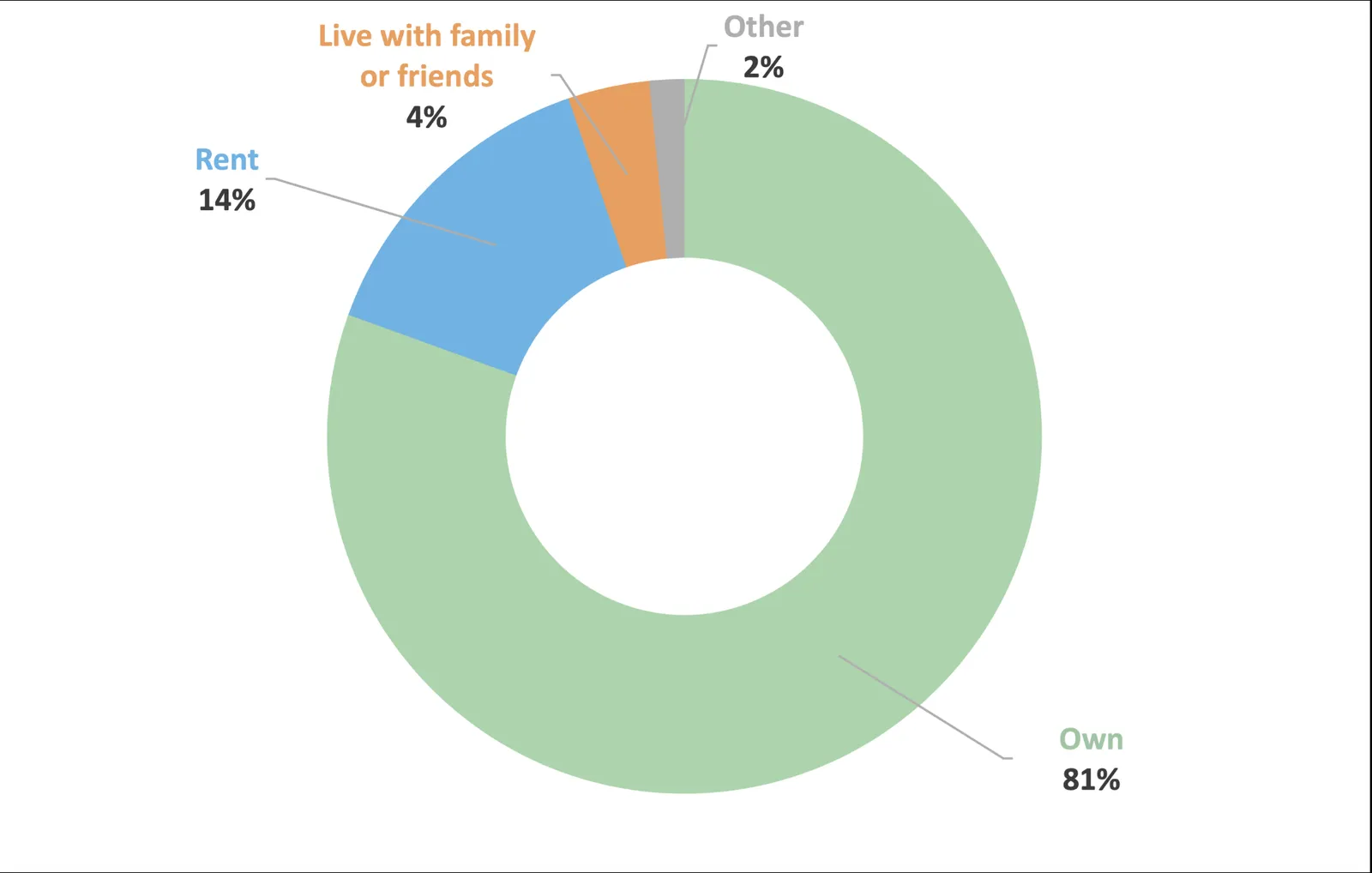
Who We Heard From Public Feedback Survey 192 Total Respondents Housing Tenure The majority of survey respondents (81%) own their home. 14% of survey respondents are renters, and 4% live with family or friends. Other respondents (2%) own their home but lease the land, or live in co-operative housing. While the 2021 Census2 reports more owners (65%) than renters (35%) in Langford, owners are still over-represented in the results of this survey.
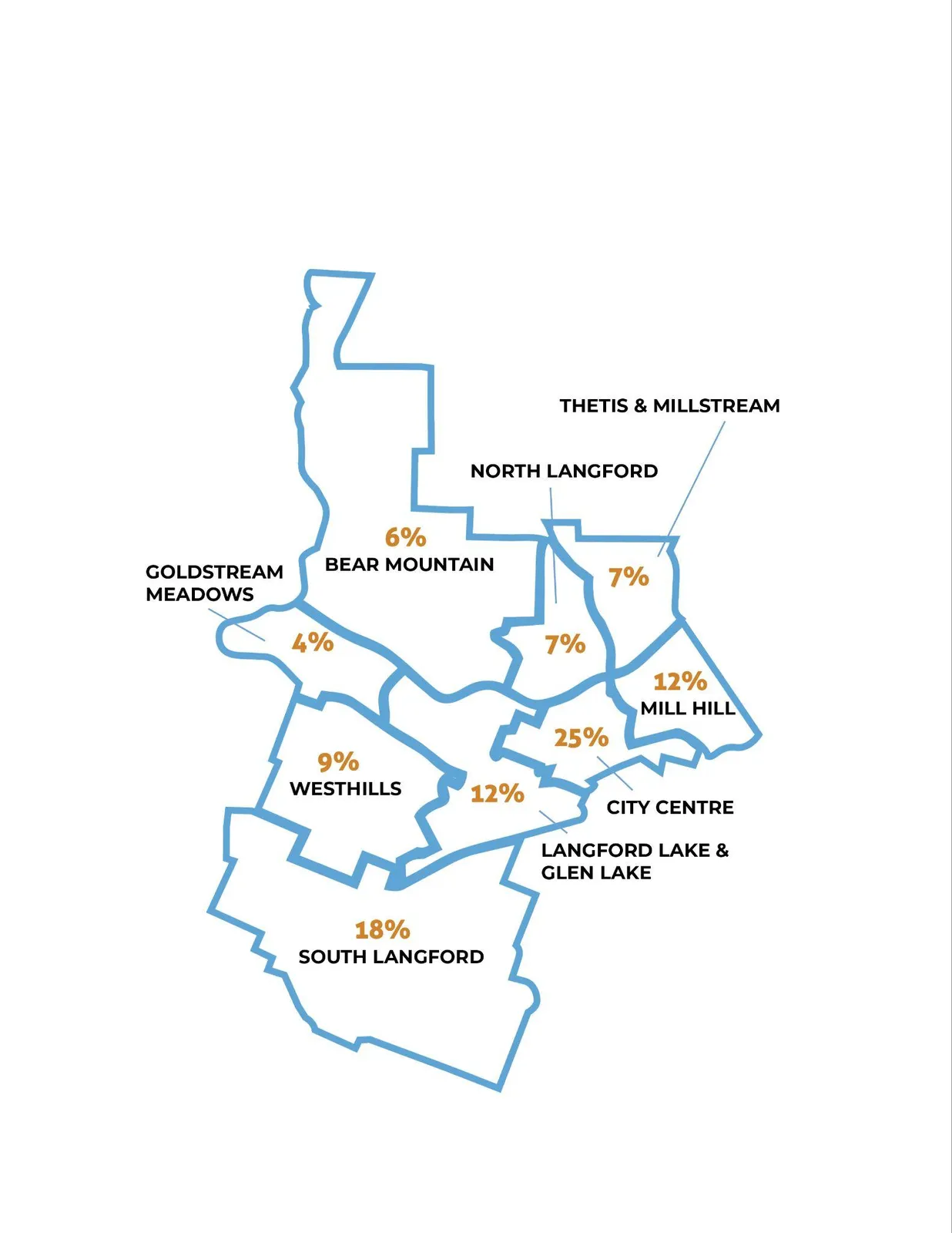
Neighbourhoods The highest number of survey respondents (25%) live in the City Centre neighbourhood. A moderately high percentage (18%) live in South Langford, Langford Lake & Glen Lake (12%), and Mill Hill (12%) neighbourhoods. The smallest percentage of respondents live in the Westhills (9%), North Langford (7%), Thetis & Millstream (7%), Bear Mountain (6%), and Goldstream Meadows (4%) neighbourhoods.
2 Statistics Canada. 2023. (table). Census Profile. 2021 Census of Population. Statistics Canada Catalogue no. 98-316-X2021001. Ottawa. Released November 15, 2023. https://www12.statcan.gc.ca/census-recensement/2021/dp-pd/prof/index.cfm?Lang=E (accessed May 14, 2026).
Langford Housing Strategy, IZ and ACC Bylaw Update: Engagement Summary Report 5 Page 244 of 304
Page 245
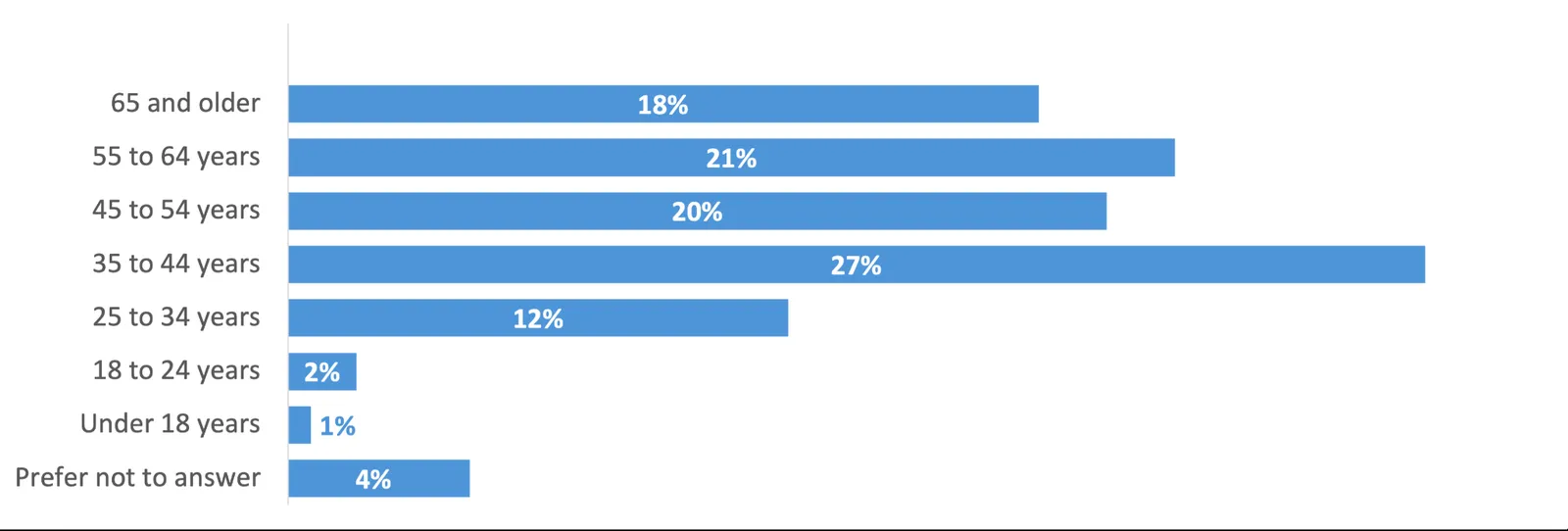
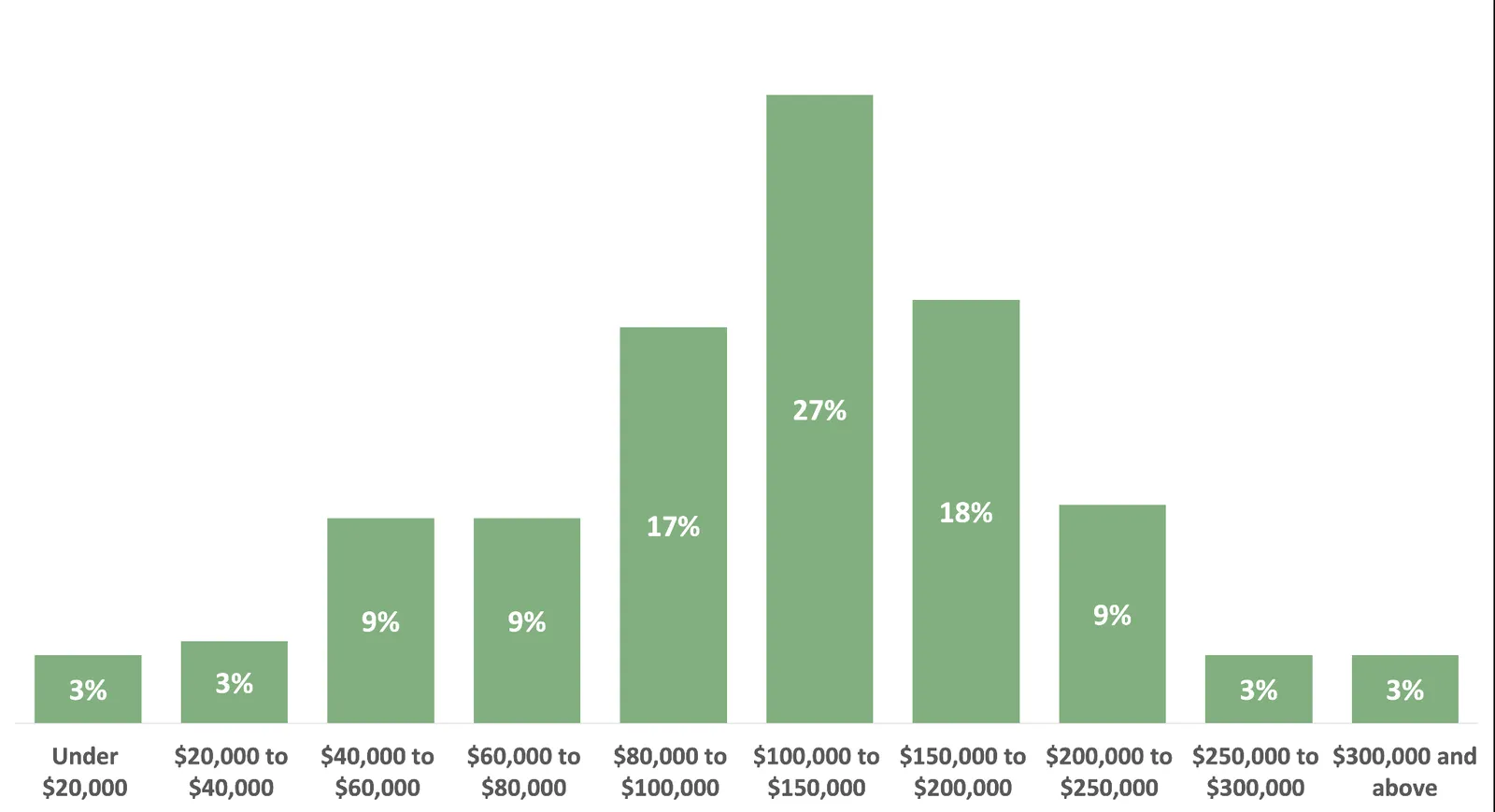
Age Groups The vast majority of survey respondents (86%) are over the age of 35 with 39% being over the age of 55. A smaller percentage of respondents (15%) are under the age of 35. 4% of respondents preferred not to disclose their age. Household Income The majority of survey respondents (60%) have an annual before-tax total household income of over $100,000, and 40% of respondents have an annual household income of less than $100,000. 15% of respondents have an annual household income of less than $60,000.
Langford Housing Strategy, IZ and ACC Bylaw Update: Engagement Summary Report 6 Page 245 of 304
Page 246
External Interest-Holder Workshops A wide variety of local developers, builders, real estate professionals, non-profit, local government, and advocacy groups were invited to participate in the virtual interest-holder workshops.
Langford Housing Strategy, IZ and ACC Bylaw Update: Engagement Summary Report 7 Page 246 of 304
Page 247
What We Heard This section summarizes what we heard from respondents who took the Public Feedback Survey and from attendees at external interest-holder workshops. Engagement Results at a Glance Several themes were repeatedly heard from public and community interest-holder comments. A summary of these common themes, and direct quotes from engagement, are described below: Family-Friendly Housing “There seems to be lots of rentals lately, but very few that are both affordable and suitable for a family (3 bedrooms+) - this is a big problem and in my mind the most urgent housing one.” - Public Feedback Survey Respondent While Langford has delivered a lot of new housing, we frequently heard about the need for more affordable, family-friendly housing with 3 or more bedrooms. Family-friendly housing with storage, private outdoor space, adequate parking, and easy-access to shops and services was also frequently mentioned. Parks & Greenspace “With the development of new housing, neighbourhoods (regardless of average household income and housing density) still require amenities like safe parks, greenspace, canopy, and walkable/bikeable routes.” - Public Feedback Survey Respondent
We frequently heard how much Langford residents value easy-access to quality outdoor spaces in the form of parks, trails, wooded-areas, and community gardens. Complete Communities "The focus is often on providing the 'unit' of housing rather than 'home' – rather than creating a home in Langford for them, and that involves their community, their building, and where they live." - Interest-Holder Workshop Participant
Langford Housing Strategy, IZ and ACC Bylaw Update: Engagement Summary Report 8 Page 247 of 304
Page 248
While we heard that new housing development is appreciated and necessary, we also heard that complete communities with walkable streets, cycling infrastructure, and easy-access to shops, services, and amenities are highly desired. Intergovernmental Collaboration “[Affordable housing]... needs to be a collaborative effort from all levels of government, developers, and supported by non-profit organizations.” - Public Feedback Survey Respondent
Both survey respondents and interest-holder workshop attendees recognize that building affordable housing is a challenging task in the current real estate market. Their reflections highlight the importance of a collaborative, synchronized effort between multiple levels of government and non-profit organizations towards developing affordable housing development.
Langford Housing Strategy, IZ and ACC Bylaw Update: Engagement Summary Report 9 Page 248 of 304
Page 249
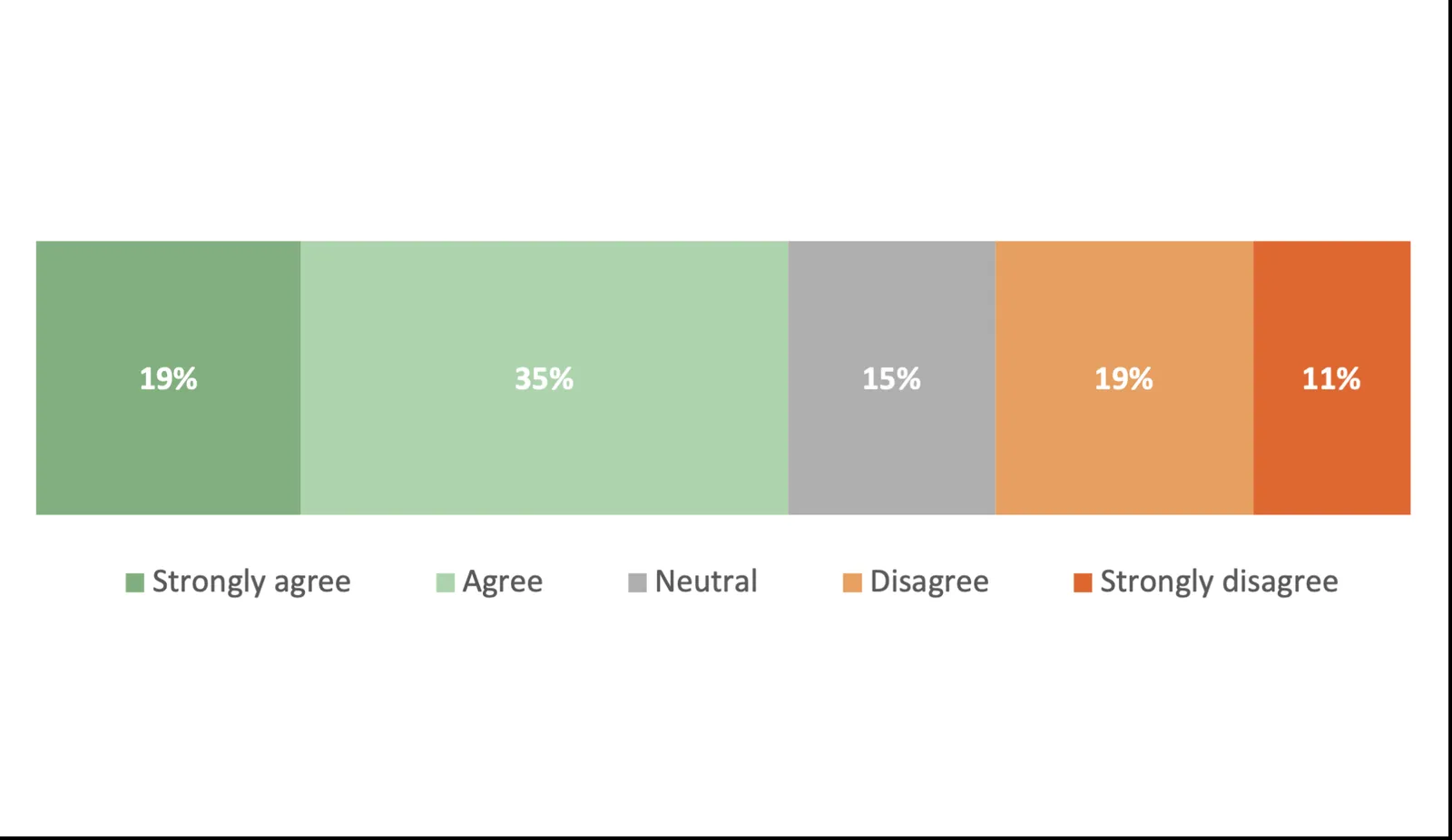
Public Feedback Survey Results Housing Affordability Q1. Housing is generally considered affordable if it costs less than 30% of your household income. “When I consider all of my expenses, my housing is generally affordable to me.” To what extent do you agree with this statement?
The majority of respondents (54%) strongly agree or agree that their housing is generally affordable to them. 30% of respondents disagree or strongly disagree that their housing is generally affordable to them, and 15% are neutral.
Langford Housing Strategy, IZ and ACC Bylaw Update: Engagement Summary Report 10 Page 249 of 304
Page 250
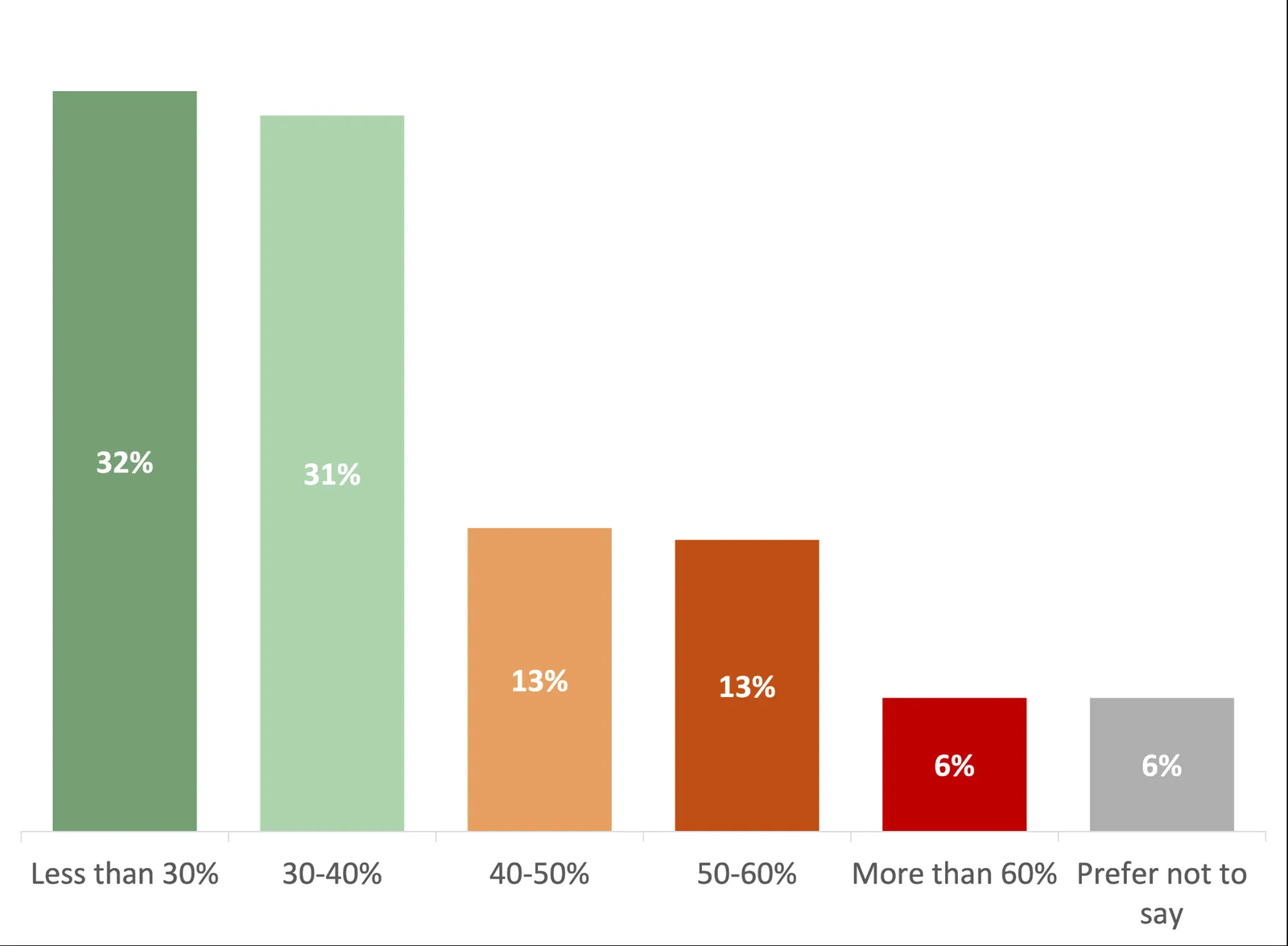
Q2. Approximately how much of your monthly income is spent on housing costs? Paying no more than 30% of income on housing is a common metric of affordability. The highest number of respondents (32%) spend less than 30% of their monthly income on housing costs, followed closely by 31% of respondents who spend between 30-40%. 32% of respondents are spending over 40% on their housing costs, with 13% spending between 40-50%, and 13% spending between 50-60%. 6% of respondents are spending more than 60% of their monthly income on housing costs. 6% of respondents selected the option 'prefer not to answer', which may include respondents that don't know what percentage of their monthly income goes towards housing cost. The 2021 Census3 shows that 74% of Langford households spend less than 30% of their income on shelter costs, and 26% spend 30% or more. This data suggests that Langford residents who spend more than 30% of their household income on housing costs are either over-represented in the results of this survey, or housing costs have become less affordable since the release of the 2021 Census. 3 Statistics Canada. 2023. (table). Census Profile. 2021 Census of Population. Statistics Canada Catalogue no. 98-316-X2021001. Ottawa. Released November 15, 2023. https://www12.statcan.gc.ca/census-recensement/2021/dp-pd/prof/index.cfm?Lang=E (accessed May 14, 2026).
Langford Housing Strategy, IZ and ACC Bylaw Update: Engagement Summary Report 11 Page 250 of 304
Page 251
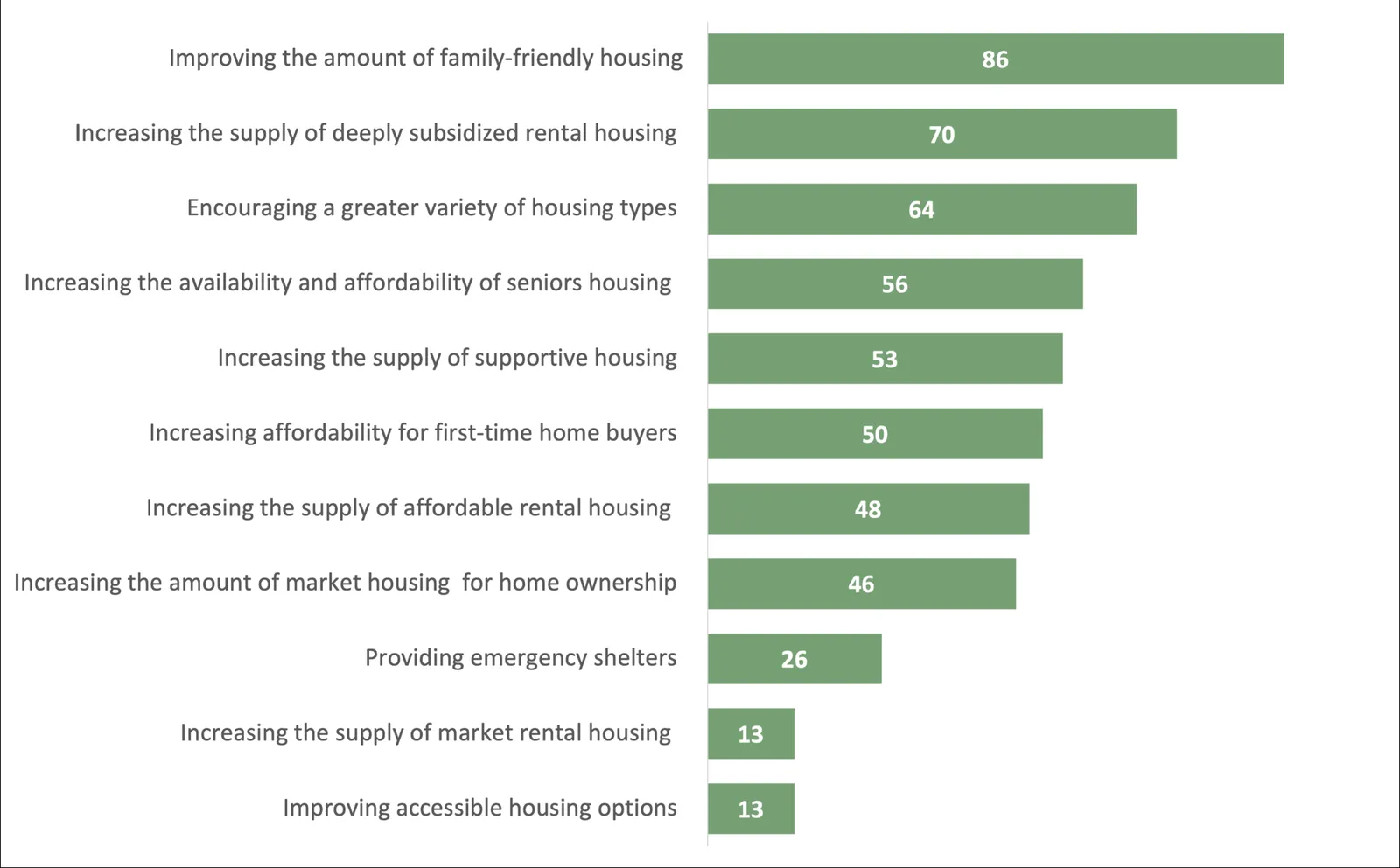
Top Priorities for Housing in Langford Q3. Which of the following are your top priorities for housing in Langford? (Select up to three)
The top three most frequently selected housing priorities included: Improving the amount of family-friendly housing (86), increasing the supply of deeply subsidized rental housing (70), and encouraging a greater variety of housing types (64).
Somewhat less frequently selected priorities included: increasing the availability and affordability of seniors housing (56), increasing the supply of supportive housing (53), increasing affordability for first-time home buyers (50), increasing the supply of affordable rental housing (48), and increasing the amount of market housing for home ownership (46).
Housing priorities selected the least often included: Providing emergency shelters (26), increasing the supply of market rental housing (13), and improving accessible housing options (13).
Langford Housing Strategy, IZ and ACC Bylaw Update: Engagement Summary Report 12 Page 251 of 304
Page 252
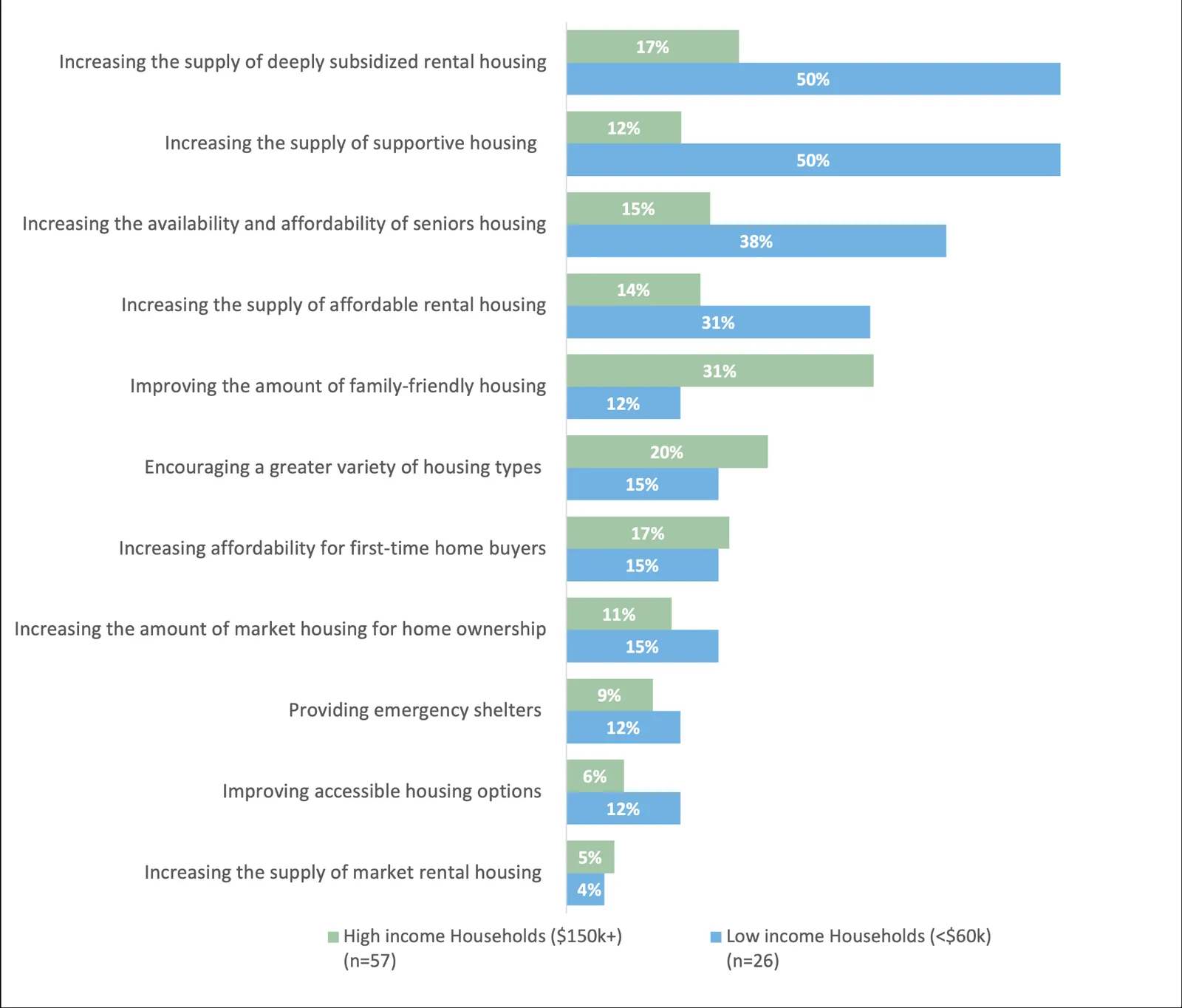
Housing Priorities and Household Income This chart shows housing priorities among those who reported a higher household income versus a lower household income. Households of over $150k can generally be considered higher income, and households of less than $60k may struggle more with affordability.
Comparing housing priorities between these two income groups reveals differing priorities: Respondents who reported a higher household income ($150k+) were more likely to list family-friendly housing and a greater variety of housing types as their top priorities. Respondents who reported a lower household income (<$60k) were significantly more likely to list increasing the supply of supportive housing, increasing the availability and affordability of seniors housing, increasing the supply of deeply subsidized rental housing, and increasing the supply of affordable rental housing as their top priorities.
Langford Housing Strategy, IZ and ACC Bylaw Update: Engagement Summary Report 13 Page 252 of 304
Page 253
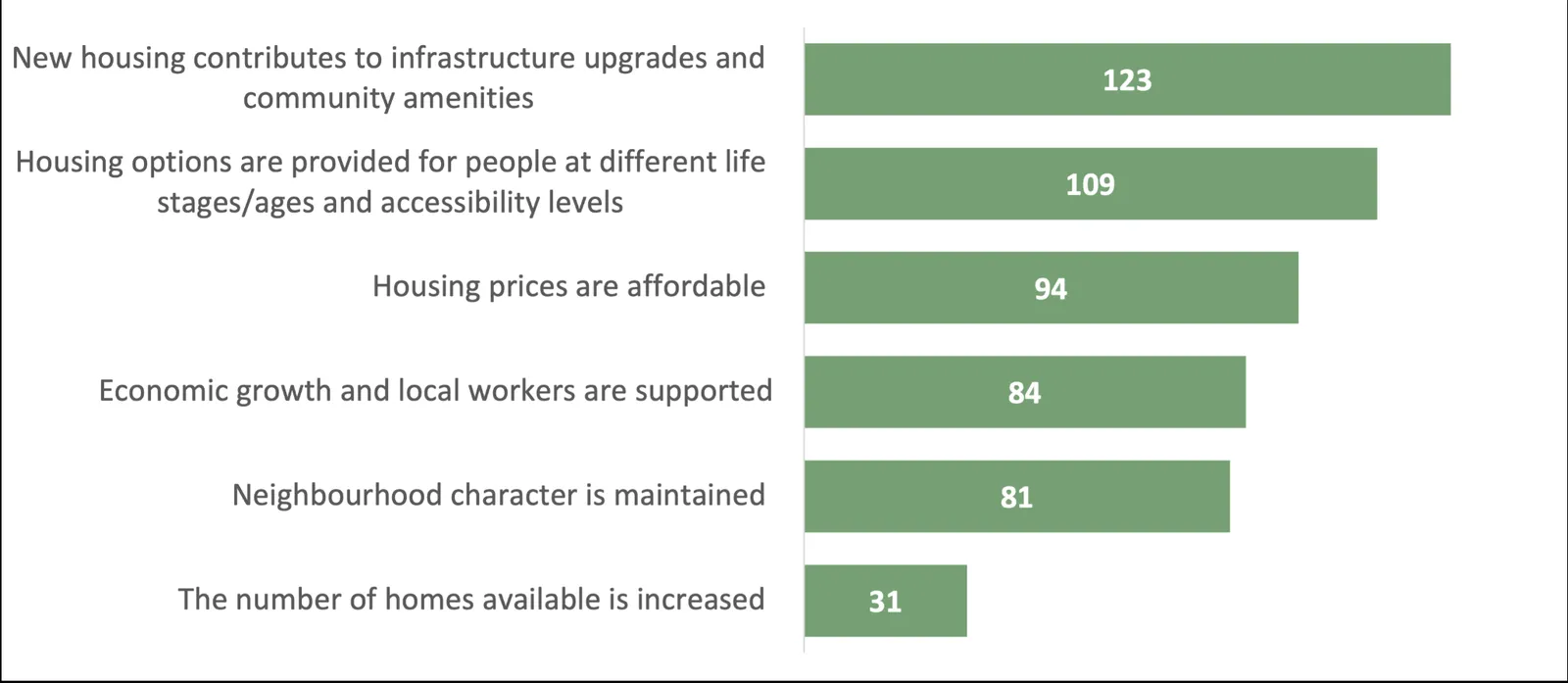
Community Outcomes Q4. As Langford’s population grows and new housing is built, which community outcomes are most important to you? (Select up to three)
The highest number of respondents (123) said their most important community outcome is that new housing contributes to infrastructure upgrades and community amenities.
Respondents also frequently reported (109) that having housing options provided for people at different life stages/ages and accessibility levels is an important community outcome, and that housing prices are affordable (94).
Supporting economic growth and local workers (84) and maintaining neighbourhood character (81) were selected somewhat frequently as respondents' most important community outcomes.
Increasing the number of available homes was selected significantly less frequently (31) than other options.
Langford Housing Strategy, IZ and ACC Bylaw Update: Engagement Summary Report 14 Page 253 of 304
Page 254
Additional Thoughts About Housing in Langford
Q5. Please tell us anything else you’d like to share about housing in Langford. Theme Sub-Theme Frequency Description Housing Form Less Apartments 8 Respondents feel that there are too many condominiums and apartments, and desire more diversity in housing options (townhomes and single-detached homes). Single-Detached Homes 6 Respondents would like to see more small, single-storey detached homes for seniors wanting to downsize. Co-Op Housing 6 Respondents want to see more housing co-ops, noting the community benefits of co-operative housing and its general shortage in Langford. Townhomes 5 Respondents are interested in seeing more townhomes that are well-built, have outdoor yards, and are family-friendly. Family-Friendly 4 Respondents feel that there are not enough affordable, spacious, and family-friendly housing options that have 3 or more bedrooms. Housing Quality 3 Respondents note the tendency to emphasize the quantity of homes and point out that quality housing that is aesthetically pleasing, incorporates nature, and meets people's needs is equally as important. Community Development Rate of Change 14 Respondents express concern about how fast new development is being built. Concerns are based on construction-based disruption and that new housing development is outpacing infrastructure upgrades. Overcrowding, lack of medical services, and lack of green space are primary concerns.
Langford Housing Strategy, IZ and ACC Bylaw Update: Engagement Summary Report 15 Page 254 of 304
Page 255
Theme Sub-Theme Frequency Description Community Development Neighbourhood Character 13 Respondents note the importance of maintaining neighbourhood character while new housing is built. This includes limiting tall apartment buildings in quiet residential areas, and creating housing that suits its neighbourhood, including mixed-use developments, incorporating nature, and finding the balance between affordability and “nice neighbourhoods”. Complete Communities 8 Respondents note that more emphasis is needed on creating complete communities rather than only developing new housing. This includes incorporating schools, shops, emergency services, parks, walkable/bikeable routes, mixed-use developments, restaurants, cafes, post offices, medical centres, and recreation facilities. Transportation Infrastructure Roads 10 Respondents express concern that current road infrastructure cannot support new housing and will lead to traffic and overcrowding. Parking 4 Respondents note the importance of maintaining street parking availability by having adequate parking, such as 2+ stalls per unit, in new housing developments. Municipal Process Taxes 8 7 respondents would not favour increasing municipal taxes to fund affordable housing. 1 respondent would like to see higher taxes in single-family, low-density neighbourhoods and lower taxes in higher-density buildings. Application Process 6 Respondents state that municipal policies should make it easier to build projects. Suggestions include streamlining and speeding up building permit/development permit and rezoning approval timelines, reducing delays, and having predictable processes.
Langford Housing Strategy, IZ and ACC Bylaw Update: Engagement Summary Report 16 Page 255 of 304
Page 256
Theme Sub-Theme Frequency Description Municipal Process ACCs/DCCs 3 2 respondents note a desire for developers to fund infrastructure upgrades and affordable housing. 1 respondent notes that developers should not be overburdened with ACCs and DCCs. Parks and Environmental Protection Greenspace 9 Respondents state the importance of balancing new development with adequate greenspace in the form of parks, community gardens, trails, dog parks, and wildlife. Protection of Trees 6 Respondents note the protection of trees and wooded areas needs to be a priority throughout new development. Social Supports Affordable Housing 21 Respondents state that more affordable housing is needed in Langford. Expanding the affordable housing program, affordable housing for families and seniors, and developing larger units with storage and parking are noted as top priorities. Respondents also note that affordability is relative, and that 30% of income does not always equate to affordability. Addressing Homelessness 6 Respondents state that more long-term, deeply subsidized, and supportive housing is needed in Langford. Suggestion to have ‘nobody is homeless’ as a housing priority. Against Supportive Housing 3 Respondents express concern about supportive housing due to perception that it attracts crime and drug use. Accessibility 2 Respondents state that more accessible and affordable housing options are needed for those with disabilities. Other 4 Other responses included comments on: keeping the vacancy rate above 5%, having smoking areas in multi-unit complexes, being against rezoning existing older
Langford Housing Strategy, IZ and ACC Bylaw Update: Engagement Summary Report 17 Page 256 of 304
Page 257
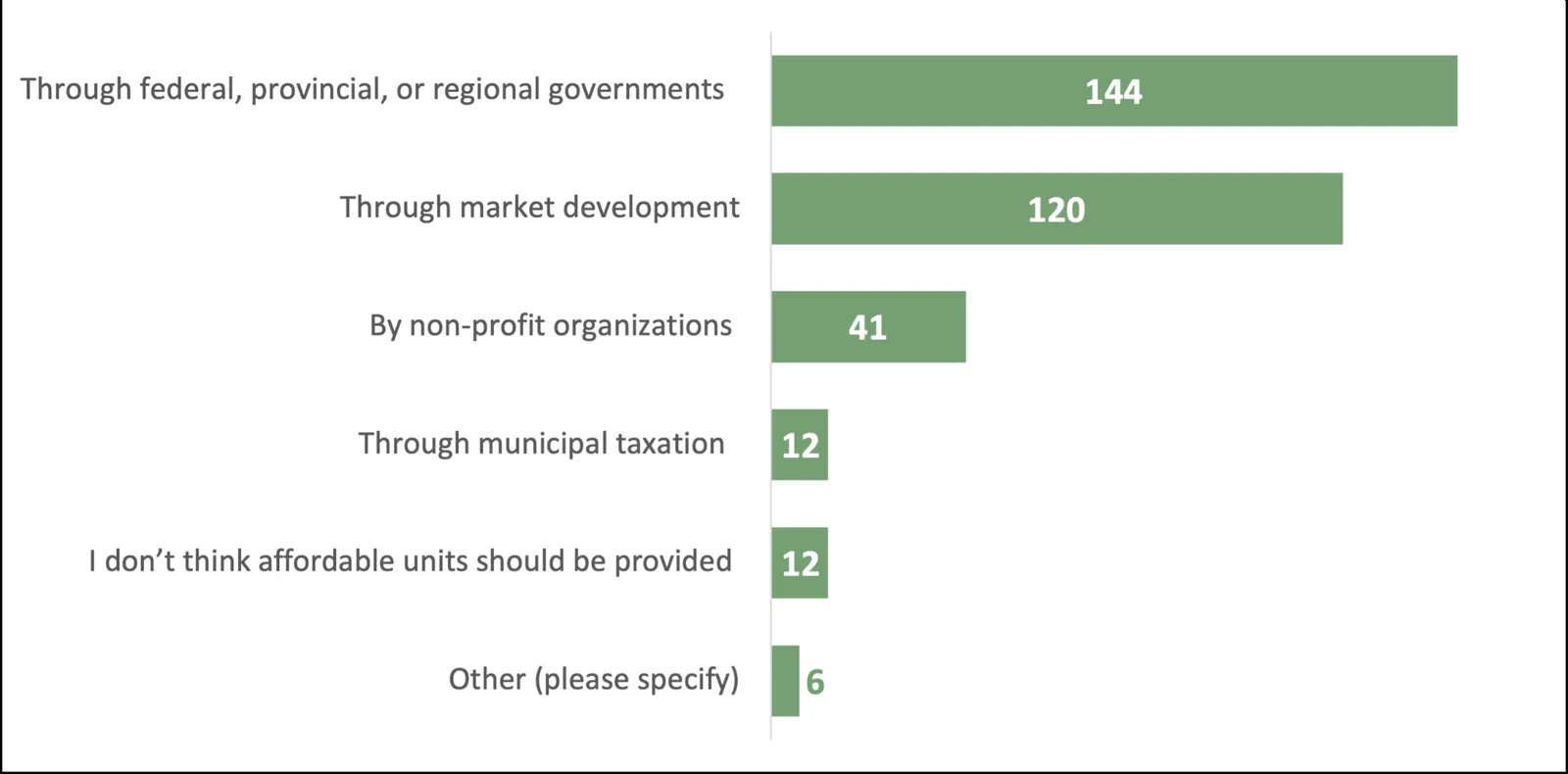
neighbourhoods, ensuring that properties are maintained and cleanliness standards are upheld. Funding Below-Market Affordable Housing Q6. How should below-market affordable housing be funded? (Select up to two)
The highest number of respondents (144) believe that below-market affordable housing should be funded through federal, provincial, or regional governments and through market development (120). A moderate number of respondents (41) think that affordable housing should be funded by non-profit organizations. The least number of respondents think that affordable housing should be delivered through municipal taxation (12) and do not think that affordable units should be provided (12). Other responses (6), which allowed for comments from respondents, included questions about land economics and housing affordability, concerns about tax dollars funding affordable housing, and a suggestion to build manufactured homes.
Langford Housing Strategy, IZ and ACC Bylaw Update: Engagement Summary Report 18 Page 257 of 304
Page 258
Other Suggestions Related to Funding Below-Market Affordable Housing in Langford
Q7. Do you have any other suggestions for how below-market affordable housing should be funded? Theme Sub-Theme Frequency Description Municipal Taxes 15 Respondents are somewhat divided on using municipal taxes to fund affordable housing. 9 respondents would favour higher property taxes to fund affordable housing. 6 respondents think that high taxes for higher tax brackets and implementing extremely high tax rates on unoccupied property could help fund affordable housing. Policy Change 13 Respondents state that municipal policy change could help fund affordable housing. Examples of suggested policy changes include: taxation control, reallocation of amenity and reserve funds, incentives for homeowners to build secondary suites, a shallow capital subsidy, productive land use, using funds from tourism, removing regulatory barriers for manufactured homes, and finding ways to reduce financial stress for Langford residents. Non-Profit Partnerships 6 Respondents note that affordable and accessible housing should be funded by the municipality in collaboration with non-profit developers and operators. Developers 13 Most respondents feel that all new developments should contribute to funding affordable housing. 1 respondent would like to see revenue from mixed-use developments fund affordable housing, and 2 respondents do not want developers to fund affordable housing.
Langford Housing Strategy, IZ and ACC Bylaw Update: Engagement Summary Report 19 Page 258 of 304
Page 259
Theme Sub-Theme Frequency Description Provincial & Federal 11 Respondents feel that federal and provincial governments should support and fund affordable housing development through grants, subsidies, loans, or using profits from government-owned businesses. Co-Op Housing 7 Respondents state that co-op housing programs should be encouraged, supported, and expanded by all levels of government. Against Affordable Housing 4 Respondents are generally against funding affordable housing development and the subsidization of affordable units. Collaboration Between Governments 3 Respondents state that affordable housing should be collaboratively funded by all levels of government. Other 4 Other responses included comments on: affordable units not being affordable enough, being against redevelopment of low-income housing, needing more information on different funding models.
Langford Housing Strategy, IZ and ACC Bylaw Update: Engagement Summary Report 20 Page 259 of 304
Page 260
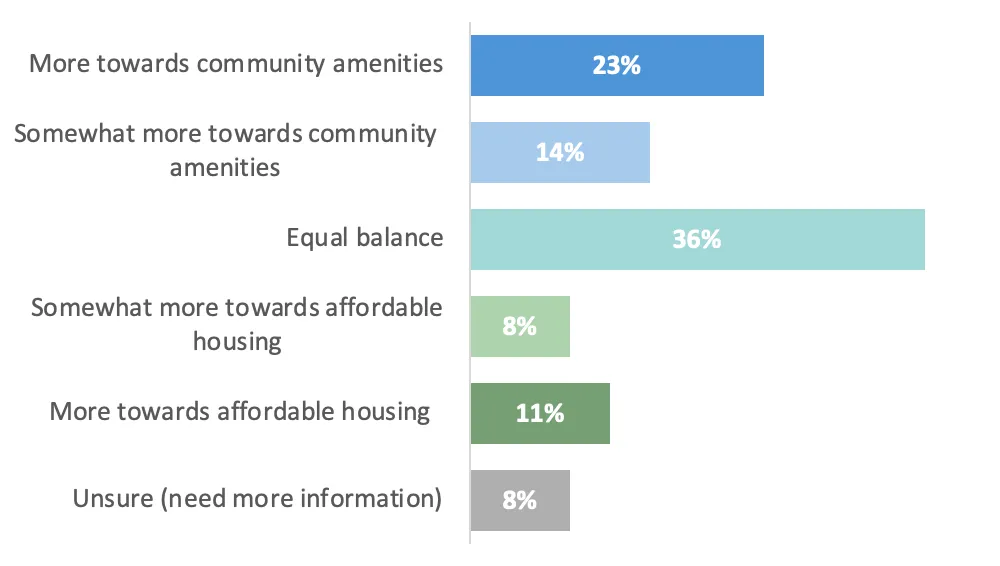
Balancing Affordable Housing and Community Amenities Q8. How do you think the City should balance contributions from new developments between building affordable housing and community amenities? (Select one)
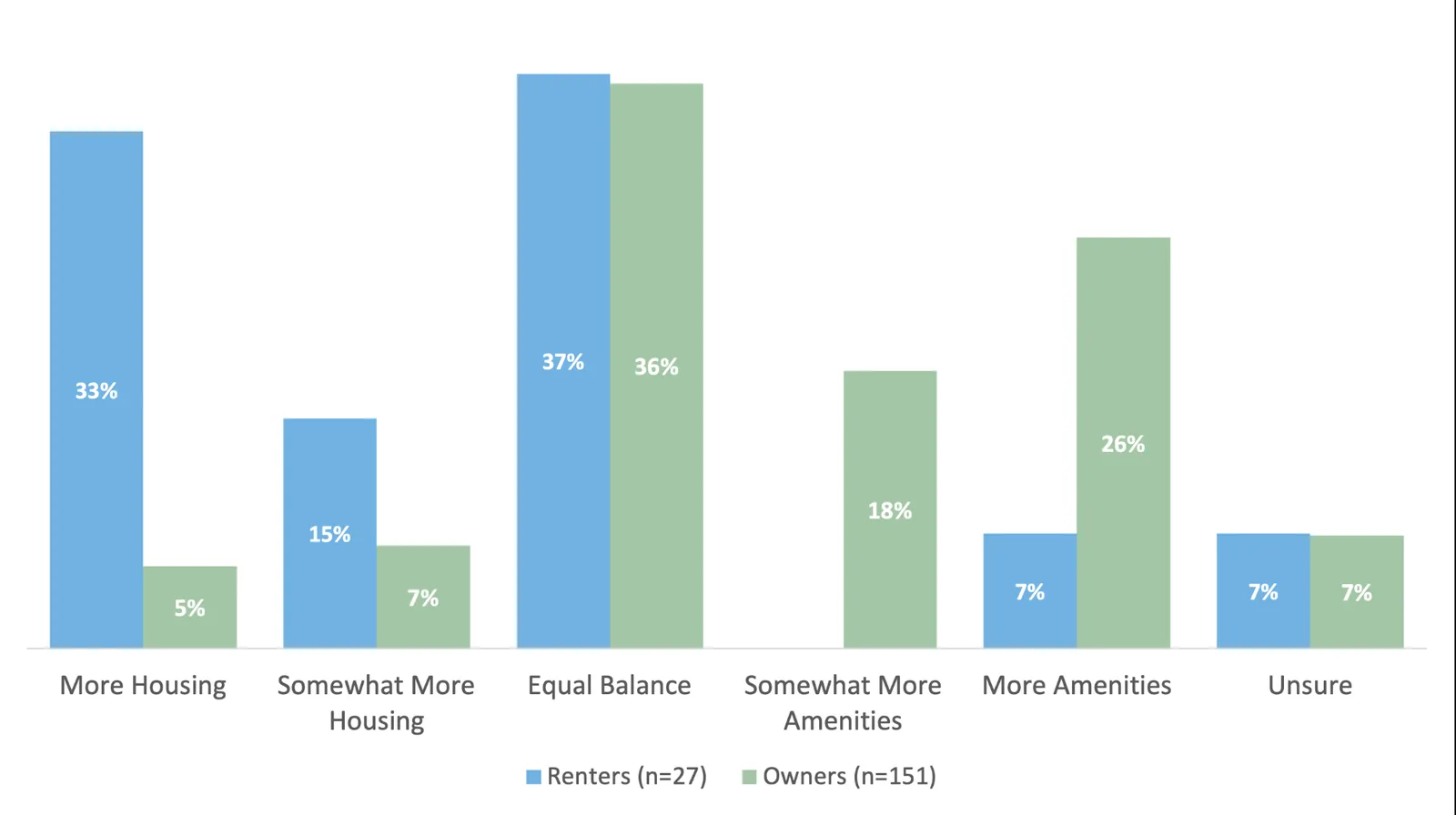
The highest percentage of respondents (37%) think that the City should focus more or somewhat more of the funding secured through development contributions towards community amenities than affordable housing. 36% also think that the City should equally balance contributions between building affordable housing and community amenities. A smaller percentage of respondents (19%) think that the City should focus more or somewhat more of the funding secured through development contributions towards affordable housing. 8% of respondents are unsure or need more information.
Langford Housing Strategy, IZ and ACC Bylaw Update: Engagement Summary Report 21 Page 260 of 304
Page 261
Balance of Amenities and Affordable Housing by Respondents Housing Tenure This chart shows preferences for how contributions from new developments are spent by those who reported being a renter versus an owner. Each column shows the percentage of respondents by housing tenure.
In general, respondents who are renters prefer using contributions towards affordable housing rather than towards amenities (33% and 15% of renters, versus 5% and 7% of owners). Respondents who own their home prefer using contributions towards amenities rather than affordable housing (26% and 18% of owners, versus 7% of renters). A nearly equal share of renters (37%) and owners (36%) think that contributions should be balanced between funding amenities and affordable housing.
Langford Housing Strategy, IZ and ACC Bylaw Update: Engagement Summary Report 22 Page 261 of 304
Page 262
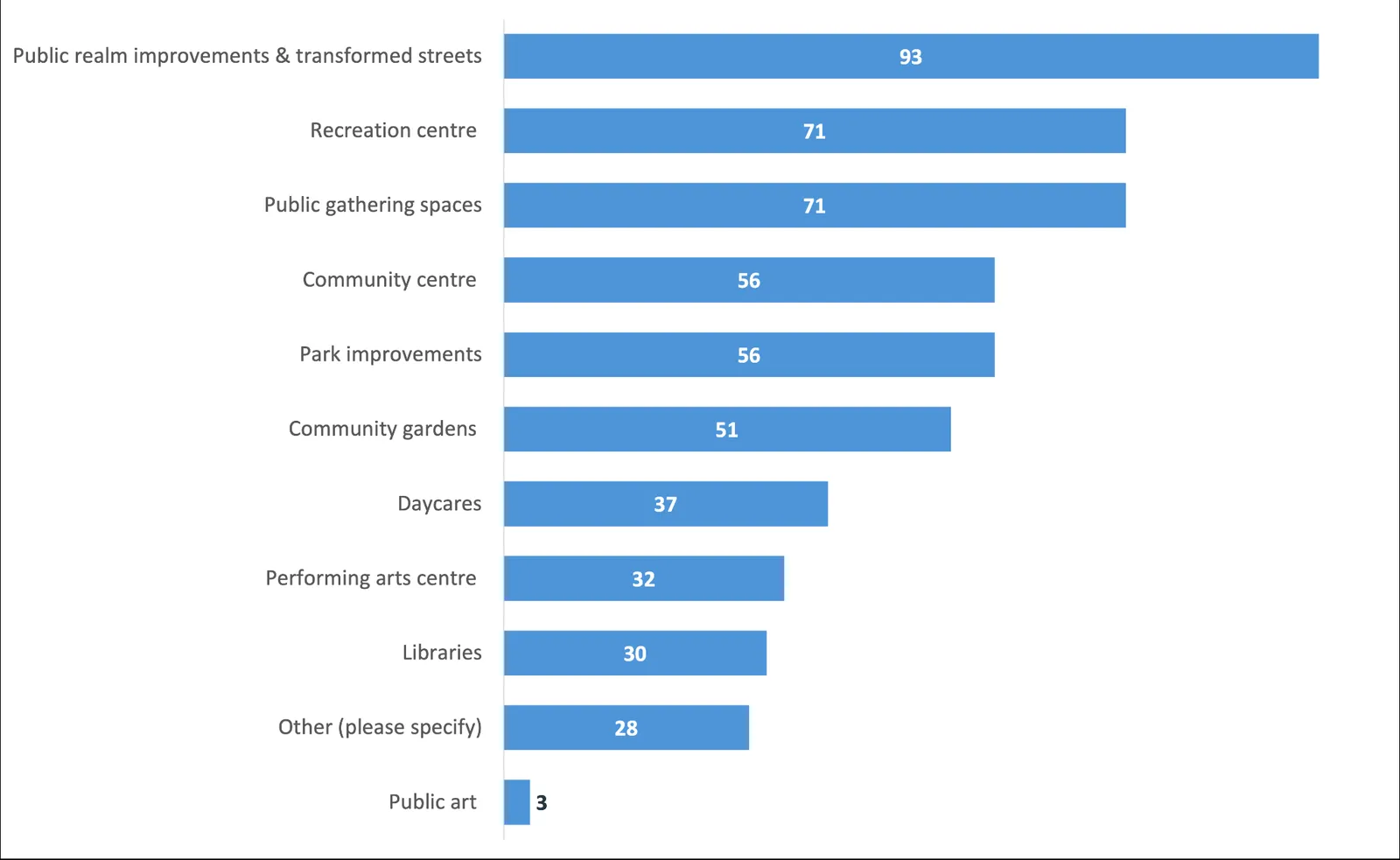
Top Priorities for Community Amenities in Langford Q9. Which of the following community amenities do you think should be a priority for Langford? (Select up to three)
The top three amenities that respondents think should be a priority for Langford include public realm improvements and transformed streets (93), and a recreation centre and public gathering spaces (71 for each). Amenities that were selected by respondents somewhat often include a community centre (56), park improvements (56), and community gardens (51). Amenities that were selected the least often by respondents include daycares (37), a performing arts centre (32), and libraries (30), and, the least frequently, public art (3). Where ‘Other’ was selected (28), respondents suggested the following amenities: maintaining public access to lakes and trails, increasing urban tree canopy, softball diamonds, active transportation infrastructure, a medical clinic, sports fields, a race track, waterslides, general greenspace, dog parks, road infrastructure, swimming pool, and a youth centre4. 4 Note that not all of these suggestions qualify for Amenity Cost Charge funding.
Langford Housing Strategy, IZ and ACC Bylaw Update: Engagement Summary Report 23 Page 262 of 304
Page 263
Other Suggested Community Facilities or Amenities
Q10. Do you have any other suggestions for types of community facilities or amenities or how they should be funded in Langford? Theme Frequency Description Community Gathering Spaces 12 Respondents suggest having more community gathering spaces such as community centres, makers spaces, libraries, and spaces that are able to be rented out. Sport Centres, Arenas, & Courts 12 Respondents suggest having more sports-oriented amenities such as aquatic facilities, recreation centres, community wellness parks with outdoor workout equipment, a sports arena, a covered lacrosse box, an ice rink, football and soccer fields, and a softball centre. Parks, Trails, Gardens 11 Respondents suggest having more amenities that contribute to the City’s green space, such as parks, walking trails, community gardens, dog parks, picnic areas, playgrounds, and conservation areas. Taxes 10 Respondents are concerned that improving or developing new amenities will increase taxes. Suggested alternatives to funding amenities with tax dollars include having fund-raising events, taxing developers, and slowing population growth. Active Transport 5 Respondents suggest having more active transportation options to reduce car dependency, such as bike paths, improved sidewalks and street lighting, and car-free streets.
Langford Housing Strategy, IZ and ACC Bylaw Update: Engagement Summary Report 24 Page 263 of 304
Page 264
Theme Frequency Description No new amenities 5 Respondents state that there are enough amenities in Langford, that no more are needed, and that the focus should be on maintaining existing amenity spaces. Healthcare 4 Respondents would like to see more healthcare facilities such as hospitals and medical centres. Arts & Culture 4 Respondents would like to see a dedicated performing arts centre for concerts and public art that is incorporated into public spaces. Funding 3 Respondents share suggestions for funding amenities, such as having developers fund amenities and funding amenities through the City budget. Other 6 Other responses included comments on: roads and transportation, the struggle to engage with amenities with high cost of living expenses, government-owned grocery stores, needing more information, City needing a better understanding of needs, having facilities and amenities be accessible from various areas of Langford.
Langford Housing Strategy, IZ and ACC Bylaw Update: Engagement Summary Report 25 Page 264 of 304
Page 265
External Interest-Holder Workshops Two virtual workshops were held, one with local developers and builders, and another with non-profit developers, operators, and advocacy groups. Each workshop focused on the Housing Strategy as well as the Inclusionary Zoning and Amenity Cost Charge Bylaws, with prompting questions on each of the topics questions (Appendix A). The Housing Strategy and the IZ and ACC Bylaws were discussed in separate breakout sessions attended by all participants. Breakout groups were led by a facilitator and followed a “Now, Wow, How” structure to map out current challenges and successes and brainstorm what future success could look like. A summary of what we heard in each workshop is described below. Developers & Builders: Current Challenges & Successes
1. Feasibility Challenges ○ Participants noted general feasibility challenges for the development of all housing types due to high construction and land costs. Participants also noted that feasibility becomes more challenging when building high-density development closer to the City’s core centre, and that Langford’s seismic hazard risk also leads to higher due diligence costs.
2. Changing Regulations ○ Participants noted that a changing and increasing amount of regulations and a lack of coordination between levels of government leads to greater complications for developers, which ultimately leads to higher costs.
3. High Expectations for Developers to Provide Multiple Community Benefits ○ Participants noted high expectations for developers to provide multiple community benefits, such as amenities and affordable housing, and that development is often treated as a “catch-all”. They noted that this is an additional challenge in an already challenging housing market.
4. Strong City Collaboration with Development Community ○ Participants expressed appreciation for the City’s strong partnerships, collaboration, and communication with the development community.
Langford Housing Strategy, IZ and ACC Bylaw Update: Engagement Summary Report 26 Page 265 of 304
Page 266
"Langford is definitely one of the better places to do business because they have the knowledge ... having the ability to speak to the chief building inspector, chief planner, CAO … that's gold."
5. Diverse Property Types and Attainable Housing Policy ○ Participants stated that Langford is doing well at meeting the general needs of the community, remarking on Langford’s diverse property types, long history of attainable housing policy, and creating amenities for families. Participants also expressed the benefit of adding more missing-middle housing to the community, particularly SSMUH homes for families that are either growing or downsizing. Developers & Builders: Future Success
1. Clarity, Consistency, & Simplicity ○ Participants expressed the importance of having clear, streamlined, and simple policies as well as having a consistent and reliable interpretation of bylaws amongst City staff.. Participants noted that more prescriptive requirements are beneficial because they help to remove unknowns and make requirements more quantified, allowing developers to reduce risk and have more financial certainty. Participants also expressed the benefit of leaning on current policies rather than creating new ones to reduce complication, and the importance of increasing cohesion with senior levels of government.
"If I had a dream, it would be one year from buying a property to building it... if you de-risk the processes and reduce the amount of burden carried by development, you can take smaller margins because you know you can crank-out product."
2. More Development-Friendly Incentives and Tools ○ Participants noted the benefits of moving to an incentive-based system with tools like tax breaks to accommodate the inclusion of affordable units. Participants expressed that developer-friendly policies result in more housing of all types.
3. Greater Flexibility in Requirements ○ Participants noted the benefit of having greater flexibility within City regulations and requirements, leading to the subsequent ability to pivot, change, and amend regulations to keep development moving and avoid stagnation. Examples of
Langford Housing Strategy, IZ and ACC Bylaw Update: Engagement Summary Report 27 Page 266 of 304
Page 267
areas needing more flexibility included: minimum frontage requirements, landscaping requirements, parking, and 5-10% inclusion of below-market housing. Non-Profit Developers, Operators, & Advocacy Groups: Current Challenges & Successes
1. Vulnerable Populations ○ Participants noted that more low- and lower-income housing is needed. There is a high percentage of families and single parents who are in need of affordable housing, and 10% of these single parents are fleeing violence. It was also noted that 17% of those who have been approved for housing loans in Langford are seniors. "[Langford has a]...high number of families—a higher percentage than the larger region—and a large percentage of those are single parents... that comes back to childcare obviously being an important piece."
2. Cost of Construction and Funding Programs ○ Participants noted that the high cost of construction and land as well as the reduction in Provincial and Federal affordable housing funding programs makes it challenging to build affordable homes.
3. Affordable Home Ownership Program and New Housing ○ Participants noted the success of Langford’s Attainable Home Ownership program and that Langford has been generally successful at delivering new housing.
4.Operational Complications ○ Participants noted the operating cost of affordable units that are scattered across different buildings (with less than five units per building) is often too high to justify, and the preference is to own or manage at least 20 or more housing units in one building. While participants prefer having larger blocks of units in a single building, they also noted that a housing-first scattered-site model can make use of any affordable units across a range of buildings.
Langford Housing Strategy, IZ and ACC Bylaw Update: Engagement Summary Report 28 Page 267 of 304
Page 268
5.Income Testing Challenges ○ Participants noted concerns with the rigidity of income testing within certain housing agreements. They noted that if a tenant’s income rises slightly above the threshold, strict agreements might require eviction. Participants stated that income testing should account for modest income fluctuations due to factors such as gig economy work.
"We had some... funders say if a tenant is over a dollar over that income limit after say one year, they get evicted. Our response was: we’re in the business of housing people, not in making people homeless... there has to be some leeway."
6.Unit Size Mismatch ○ Participants note that current housing agreements often result in 1 or 2-bedroom affordable units because they are easier for developers to deliver. Participants stated the community’s deep need for 3 and 4-bedroom units to support Langford’s family-oriented demographic.
Non-Profit Developers, Operators, & Advocacy Groups: Future Success
1. Municipal Land Allocation & Strategic Acquisition ○ Participants noted that allocating municipal land to non-profits can help with affordability challenges by lowering or omitting the cost of land. Participants also noted that strategic acquisition of existing properties could increase affordable rental units, and that there may be opportunities to buy relatively new rental buildings or buildings that require retrofitting.
2. Partnerships with Non-Profits for Management, Ownership or Administration of Affordable Units ○ Participants mentioned opportunities for strategic municipal partnerships with non-profits to administer, manage or track affordable units and programs, and that non-profits who have experience with many different types of housing agreements would be beneficial. Non-profit organizations are also available to purchase affordable ownership units and re-selling units in accordance with their
Langford Housing Strategy, IZ and ACC Bylaw Update: Engagement Summary Report 29 Page 268 of 304
Page 269
specific mandates.
3. Access to Services and Transportation ○ Participants noted the importance of creating communities by building affordable housing that’s close to existing services. They expressed that transportation, walkability, affordable home ownership, and accessible childcare go hand-in-hand.
"The focus is often on providing the 'unit' of housing rather than 'home' – rather than creating a home in Langford for them, and that involves their community, their building, where they live."
4. Per-Door Unit Funding for Non-Profit Affordable Housing Projects ○ Participants noted that having a formalized program for per-door unit funding for non-profit affordable housing projects would help create simplicity and clarity.
5. Accurate Homeless Counts ○ Participants expressed the importance of accurate point-in-time homeless counts so that existing needs can be accurately addressed.
6. Duration of Affordability in Housing Agreements ○ Participants expressed concern that current housing agreements are not long enough, and advocated for affordability “in perpetuity” to prevent units from reverting back to market rates after a few decades. On the other hand, requiring affordability in perpetuity can also impact the ability of organizations to leverage their assets towards future projects.
7. Affordability Calculations ○ Participants stated that units at 10% below-market are not affordable enough for low-income households. They note the importance of recognizing low- and very low-income households in Langford, especially those headed by single parents.
8. Volume of Units vs. Deeply Subsidized Units ○ Participants highlighted the necessity of increasing the supply of all below market housing types, while balancing overall unit delivery with the creation of deeply affordable housing.
Langford Housing Strategy, IZ and ACC Bylaw Update: Engagement Summary Report 30 Page 269 of 304
Page 270
9. Deepening Affordability Over Time ○ Participants expressed that market-rate housing built by non-profits for feasibility reasons becomes more affordable over time. As inflation drives up market rents, the rent of non-profit-owned units stays the same.
"A lot of our housing is coming of age... those all built from say the 60s to the 90s are all coming to … either end of life or in need of major repair. And that is the stuff that is our most affordable housing right now."
Langford Housing Strategy, IZ and ACC Bylaw Update: Engagement Summary Report 31 Page 270 of 304
Page 271
Appendix A Interest-Holder Workshop Breakout Room Questions
THEME 1 –DEVELOPING A HOUSING STRATEGY FOR LANGFORD Now ● What housing needs are being met and not being met? ● What general barriers do you face in housing delivery and/or operation? ● What is the City doing well, and where could the City better support the delivery of all types of housing (are there challenges within existing City policies, bylaws, processes)? ● What programs and funding sources are helping you to create housing today? Wow ● What are your hopes for the future of housing and housing delivery and operation in Langford? ● What specific housing objectives or goals would support these outcomes? How ● How do we get from Now to Wow? ● What strategies or policies within the City’s area of influence could support this? ● What additional strategies or policies outside of the City’s influence could support this?
THEME 2 – INCLUSIONARY ZONING AND AMENITY COST CHARGE BYLAWS Now ● How do Langford’s policies for securing affordable housing affect the delivery of housing and your organization today? ● How do Langford’s policies for securing community amenities affect your organization today? ● What successes and challenges do you experience with these policies and processes? Wow ● What are your hopes for the new bylaws? ● What groups would be best served by the IZ bylaw? ○ Asked only to non-profit groups: Should more units be secured or should fewer more deeply subsidized units be secured? ○ Asked only to non-profit groups: Is there a minimum number of units that can be efficiently managed?
Langford Housing Strategy, IZ and ACC Bylaw Update: Engagement Summary Report 32 Page 271 of 304
Page 272
● What amenities should be prioritized to support community growth? (list amenities) How ● How do we get from Now to Wow? ● Are there specific elements of the current policy approach that should change as the new bylaws are drafted?
Langford Housing Strategy, IZ and ACC Bylaw Update: Engagement Summary Report 33 Page 272 of 304