DocumentsStaff ReportJun 5, 2023Pages 78–87
Construction Nuisance Dust Control Bylaw Review
Staff report reviewing the Construction Nuisance Dust Control Bylaw and proposing updates to address construction-related dust management and enforcement.
Key facts
- Agenda item: 10.3 (Construction Nuisance Dust Control Bylaw Review) starting page 78
- Scope: review of existing dust control rules and proposed bylaw updates
- Objective: improve construction dust mitigation, enforcement and clarity of requirements
Construction Nuisance Dust Control Bylaw Review
t 250.478.7882
e administration@langford.ca
2nd Floor, 877 Goldstream Avenue
Langford, BC V9B 2X8
DATE: Monday, June 5, 2023
DEPARTMENT: Engineering
SUBJECT: Construction Nuisance Dust Control Bylaw Review

Background
The purpose of this report is to provide Council with options for a Dust Bylaw, in response to direction from Council to Staff at the December 5th, 2022 Council Meeting.
Staff began with reviewing the drafted Bylaw No. 1666 “A Bylaw to Regulate the Emission of Dust” (attached for information) that was brought forward to the Protective Services Committee in 2016 and was subsequently withdrawn from the Council Meeting agenda and referred to the WSDA to work with Staff on a dust management strategy. Staff compared this draft bylaw to other adopted Dust Control Bylaws from neighbouring communities and found them to be very similar.
Staff then attempted to determine the effectiveness of the enacted Dust Control Bylaws in those municipalities and found overall that stand-alone Dust Control Bylaws are relatively difficult to enforce and easily disputed in Court. The source and intensity of fugitive dusts in many cases can be inconsistent or will change rapidly with wind/weather conditions and depending on the individual person, complaints and public expectations can be very subjective in nature. True measurable intensities are difficult to establish and impede documentation of sufficient reliable conclusive evidence to support the penalty beyond a reasonable doubt (Provincial Court test for a successful Conviction of Guilt).
Next, Staff reviewed the Subdivision and Development Servicing Bylaw No. 1000 and the Soil Deposit and Removal Bylaw No. 1800 for current dust control requirements. In Bylaw 1000, under Schedule 2, General Requirements Section 2.5, a mitigation plan may be required at the request of the City Engineer (see excerpt below).
2.5 Mitigation Planning (Bylaw No. 1000 excerpts)
2.5.1 The City Engineer may request that the owner of lands for which an application to subdivide or develop has been submitted be required to prepare and submit a mitigation plan at the owner’s expense in accordance with sections 2.5.2 through 2.5.6 as they may apply to the lands. The mitigation plan is required where there are reasonable grounds to anticipate discharge of contaminants, pollutants, silts, airborne particulates (dust) or toxic material to natural watercourses, municipal ditches and sewage systems, public or private lands, waters or the atmosphere.
2.5.2 The plan shall include a statement of the expected nature, amount and concentration of contaminants, pollutants silts, airborne particulates (dust) and toxic materials from the land which are expected to be discharged to adjoining lands, water, natural watercourses, utility systems or the atmosphere during the course of subdivision, construction and development of the land.
2.5.3 The mitigation plan shall state the pertinent environmental standards that will govern the proposed discharge of contaminants, pollutants silts, airborne particulates (dust) or toxic materials to the air, soil or water during the course of subdivision, construction and development of the land.
2.5.4 The mitigation plan which requires works and services or facilities to control pollution or discharge during subdivision and development of the lands will include detailed plans and specifications of the works and services or facilities sealed by a Professional Engineer. Where a mitigation plan requires these works and services or facilities, the owner of the lands or their designated representative shall submit a letter of supervision that is an undertaking to inspect the construction, operation and decommissioning of the pollution control works and services and facilities.
2.5.5 Where applicable, the mitigation plan shall be referred to the Ministry authority having jurisdiction including Provincial and Regional agencies, where a discharge is anticipated to a municipal utility system or to the atmosphere.
Soil Deposit and Removal Bylaw No. 1800 (excerpt)
- PERMITS
a. An application for a soil permit shall be submitted to the City Engineer and shall be accompanied by:
i. A permit fee in the amount calculated in accordance with Schedule A;
ii. The appropriate highway damage deposit in accordance with Schedule A if an equal or greater highway damage deposit has not been paid in conjunction with a building permit or subdivision application;
iii. The civic address and legal description of the property;
iv. The start date and expected duration of the soil removal or deposit activities;
v. The location of all watercourses, waterworks, wells, ditches, drains, sewers, septic fields, catchbasins, culverts, manholes, rights-of-way, legal and geodetic survey monuments and markers, public utilities and public works on or within 30 m of the boundaries of the land, and the measures proposed to protect them;
vi. The proposed routes to be taken by vehicles transporting soil to or from the land;
vii. Copies of all certificates, permits and approvals as may be required by the Ministry of Water, Land and Air Protection under the Water Act or the Environmental Management Act, or by any other authority having jurisdiction over the proposed deposit or removal of soil, including completed site profile forms, with the required information about the past and present uses of the site, if the land has been used for industrial or commercial activities;
viii. The origin or destination of the soil;
b. With the exception of Single Family Dwellings with less than 300m3 of soil, the following additional items are required:
i. A certification by a Professional Engineer to the satisfaction of the City Engineer, as to the quantities of soil to be removed or deposited and the methodology of the proposed soil removal or deposition;
ii. A contour plan or plans prepared under the direction of the Professional Engineer in sufficient detail to show the present state of the land, the extent of soil removal or deposition contemplated, and the proposed surface and topography of the land after the soil removal or deposition has been completed.
iii. Certification by a British Columbia Land Surveyor, if in the opinion of the City Engineer, the extent of works require accurate topographic information, or to establish property lines;
iv. A storm water management plan in accordance with Bylaw No. 1000, which shall include erosion and silt control measures; and
v. A dust control plan.
Additionally, the City includes the following statement in every soil permit approval letter:
“Dust control is the responsibility of the contractor/applicant/owner performing the work and is to be managed daily. All measures must be taken to limit airborne particulate.”
Staff confirmed that Erosion and Sediment Control Plan (ESCP) submittals are being received and address dust control. However, this is usually subsidiary to the Environmental Protection Plan (EPP) which is Provincially mandated, and the mitigation measures are more related to environmental dust contamination with the level of mitigation being relative to the environmental sensitivity of the area. Environmental dust contamination is less of a concern in a fully urban area and falls more in the category of a nuisance, hence why additional urban specific measures should be considered.
Finally, Staff compared the penalty clauses in the Subdivision and Development Servicing Bylaw No. 1000 and the Soil Deposit and Removal Bylaw No. 1800 to the ones proposed in the draft Dust Bylaw No. 1666. All three had similar maximum fine amounts of $10,000; however, the draft Bylaw No. 1666 had several additional standard clauses that would make it more enforceable by our bylaw officers.
Bylaw No. 1000 penalty clause (only applicable to Schedule 3 Earthworks):
3.2.8. Every person who fails to comply with any of the requirements of this section is liable to a fine and penalty of not more than $10,000 for each offence and each day that an offence continues shall constitute a separate offence.
Bylaw No. 1800 penalty clause:
- PENALTY
Any person who violates any provision of this bylaw or fails to comply with any permit issued under this bylaw commits an offense punishable on summary conviction and shall be liable to a fine not exceeding $10,000
Draft Bylaw No. 1666 penalty clauses:
- Enforcement - Penalties
4.1. Any person who contravenes this Bylaw commits an offence and upon summary conviction shall be liable to a fine not exceeding $10,000.00
4.2. Each day that a contravention of this Bylaw continues shall constitute a separate offence.
4.3. This Bylaw may be enforced by means of a ticket in accordance with the Community Charter, SBC 2003 c 26 and in the form prescribed in the Community Charter Bylaw Enforcement Ticket Regulation.
4.4. Employees of the city appointed by council for the enforcement of city bylaws or members of the RCMP are designated as Bylaw Enforcement Officers for the purpose of enforcing this Bylaw.
4.5. The words or expression shown in Column 1 of Schedule “A” which forms part of this Bylaw designate the offence committed under the Bylaw section number appearing in Column 2 opposite the words or expression.
4.6. The dollar amounts shown in column 3 of Schedule “A” establish the fines for the corresponding offences shown in Column 1.
SCHEDULE "A"
Dust Control Bylaw No. 1666, 2016
| Offence | Section | Fine |
|---|---|---|
| Fail to prevent emission of dust | 2 | $1,000 |
Commentary
Construction dust (and noise) nuisance complaints are primarily generated from the highest dust (and noise) producing operations including but not limited to demolition, land clearing, logging, piling, excavation, rock blasting, breaking, crushing, and hauling. Therefore, notifying all rezoning applicants and other permit applicants consistently early in the process of the City’s expectations and obtaining a conforming plan from the applicant as a commitment they can be held to is key. This can be done in the form of a Construction Impact Management Strategy, as recommended by the Consultants for the Strategic Planning Initiatives and Official Community Plan Refresh.
This is both a proactive and educational approach, to have the developer/contractor plan for dust mitigation measures and other City expectations in their methodology prior to construction, such as Construction Parking and Delivery Management. Having the applicant’s plan and policy commitment attached to their permit and/or statement of conditions is much more effective than a minor financial penalty. There are many excellent Good Neighbour Development Policy examples currently in place in other BC municipalities which Langford Staff (with input from our Consultants and Industry Partners) could use as a starting point to begin drafting guidelines for Langford’s Construction Impact Management Strategy, with direction from Council.
Staff Recommendations (verbatim)
Staff do not recommend adoption of a stand-alone Dust Control Bylaw due to the prototypical ineffectiveness and criticism that would follow; however, if Council would still wish to proceed with this bylaw, Staff would recommend refining the wording to be more specific to construction/production dust as a recurring nuisance to adjacent residential properties (possibly within a certain radius), where it was determined that the contractor/producer was negligent in taking “reasonable precautions” (or industry standard best management practices) to prevent the dust from becoming airborne. This would focus staff time on the most problematic sites.
Staff do recommend, in accordance with the Early Guidance for Development approach for “Less Impactful, More Livable Construction”, some minor modifications to Bylaws No. 1000 & 1800 (with the omnibus amendments to go to committee) could make the current dust control plan requirements more widely applicable and enforceable, while we build the more progressive Construction Impact Management Strategy. This way, in the meantime, if we receive multiple dust nuisance or contamination complaints that are verified and documented, and the contractors/developers are not responding to staff requests for mitigation or remediation, then the City could revoke their permit, fine them, issue a stop work order, and/or notify the Ministry of Environment, as deemed necessary and reasonable.
Financial Implications
The recommended Bylaw amendments and policy changes would also apply to City capital projects, roads and/or facility construction sites. The additional measures/requirements would have to be budgeted into all projects, although most City projects already account for what is being proposed as mandatory. There is a possibility of additional Bylaw Enforcement Officer(s) being required to notify and/or enforce. Other additional standard staff time and consultant fees will be required to produce the Construction Impact Management Strategy.
Legal Implications
Under Section 8 and Section 64 of the Community Charter, Council has authority to adopt Bylaws to regulate, prohibit and impose requirements with respect to nuisances, including dusts.
Options
Option 1
THAT Council direct Staff to draft guidelines for review by the Sustainable Development Advisory Committee that will form, in whole or in part, the Construction Impact Management Strategy;
AND
THAT Council direct Staff to broaden the existing dust control plan requirements and incorporate the standard additional penalty clauses (from the draft Bylaw No. 1666) into Bylaw No. 1000 and/or 1800 with the omnibus amendments for review by the Sustainable Development Advisory Committee.
OR Option 2
THAT Council receive this report for information.
SUBMITTED BY: Katelyn Balzer, P.Eng., Director of Engineering and Public Works
Concurrence:
Lorne Fletcher, Manager Community Safety and Municipal Enforcement
Concurrence:
Donna Petrie, Senior Manager of Business Development and Events
Concurrence:
Yari Nielsen, Director of Parks, Recreation and Facilities
Concurrence:
Matthew Baldwin, MCIP, RPP, Director of Planning and Subdivision
Concurrence:
Katelyn Balzer, P.Eng., Director of Engineering and Public Works
Concurrence:
Michael Dillabaugh, CPA, CA, Director of Finance
Concurrence:
Marie Watmough, Deputy Director of Corporate Services
Concurrence: Braden Hutchins, Director of Corporate Services
Concurrence:
Darren Kiedyk, Chief Administrative Officer
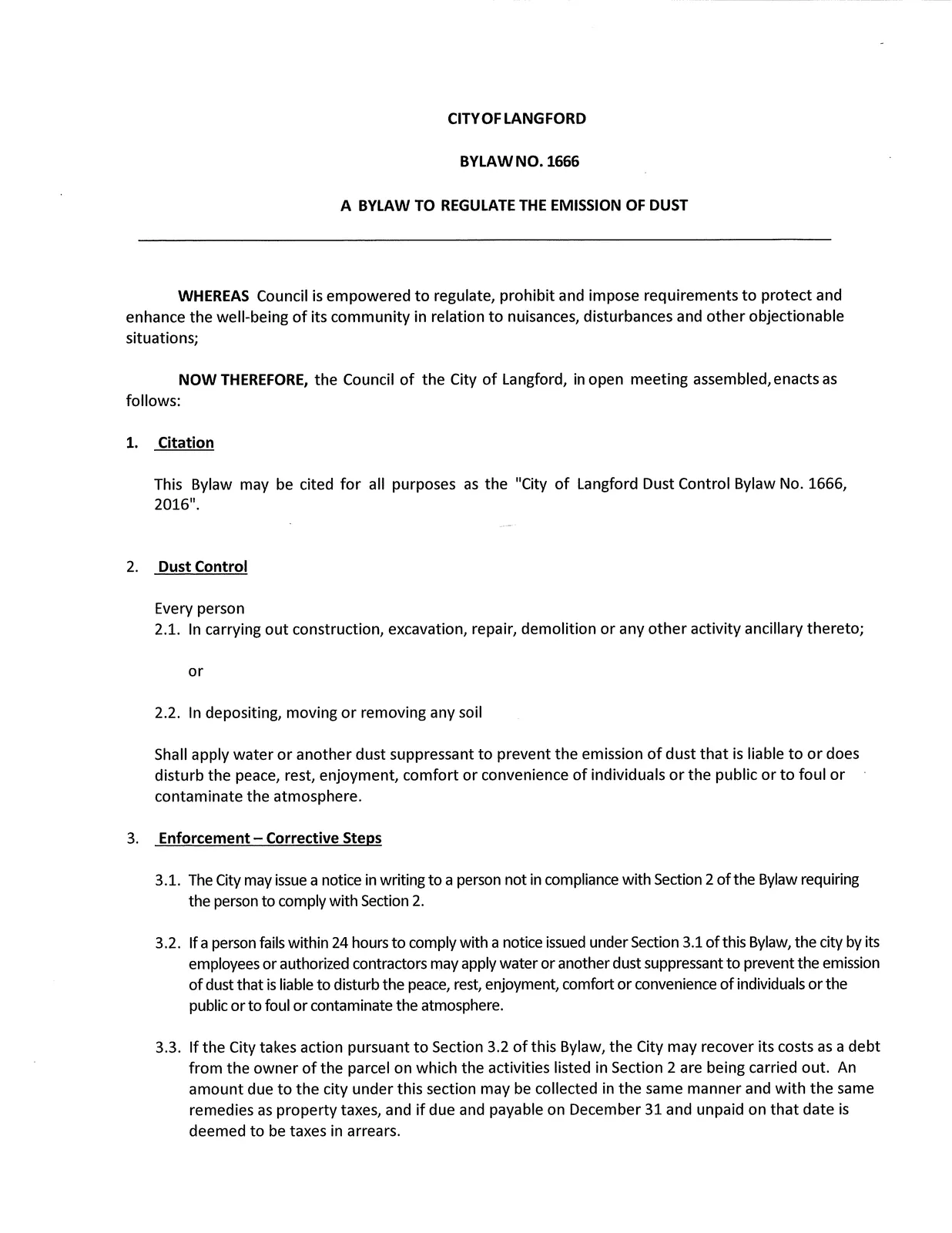
City of Langford — Bylaw No. 1666
A BYLAW TO REGULATE THE EMISSION OF DUST
WHEREAS Council is empowered to regulate, prohibit and impose requirements to protect and enhance the well-being of its community in relation to nuisances, disturbances and other objectionable situations;
NOW THEREFORE, the Council of the City of Langford, in open meeting assembled, enacts as follows:
1. Citation
This Bylaw may be cited for all purposes as the "City of Langford Dust Control Bylaw No. 1666, 2016".
2. Dust Control
Every person
2.1. In carrying out construction, excavation, repair, demolition or any other activity ancillary thereto; or
2.2. In depositing, moving or removing any soil
Shall apply water or another dust suppressant to prevent the emission of dust that is liable to or does disturb the peace, rest, enjoyment, comfort or convenience of individuals or the public or to foul or contaminate the atmosphere.
3. Enforcement — Corrective Steps
3.1. The City may issue a notice in writing to a person not in compliance with Section 2 of the Bylaw requiring the person to comply with Section 2.
3.2. If a person fails within 24 hours to comply with a notice issued under Section 3.1 of this Bylaw, the city by its employees or authorized contractors may apply water or another dust suppressant to prevent the emission of dust that is liable to disturb the peace, rest, enjoyment, comfort or convenience of individuals or the public or to foul or contaminate the atmosphere.
3.3. If the City takes action pursuant to Section 3.2 of this Bylaw, the City may recover its costs as a debt from the owner of the parcel on which the activities listed in Section 2 are being carried out. An amount due to the city under this section may be collected in the same manner and with the same remedies as property taxes, and if due and payable on December 31 and unpaid on that date is deemed to be taxes in arrears.
READ A FIRST TIME this 5th day of December 2016.
READ A SECOND TIME this 5th day of December, 2016.
READ A THIRD TIME this 5th day of November, 2016.
ADOPTED this 19th day of December, 2016.
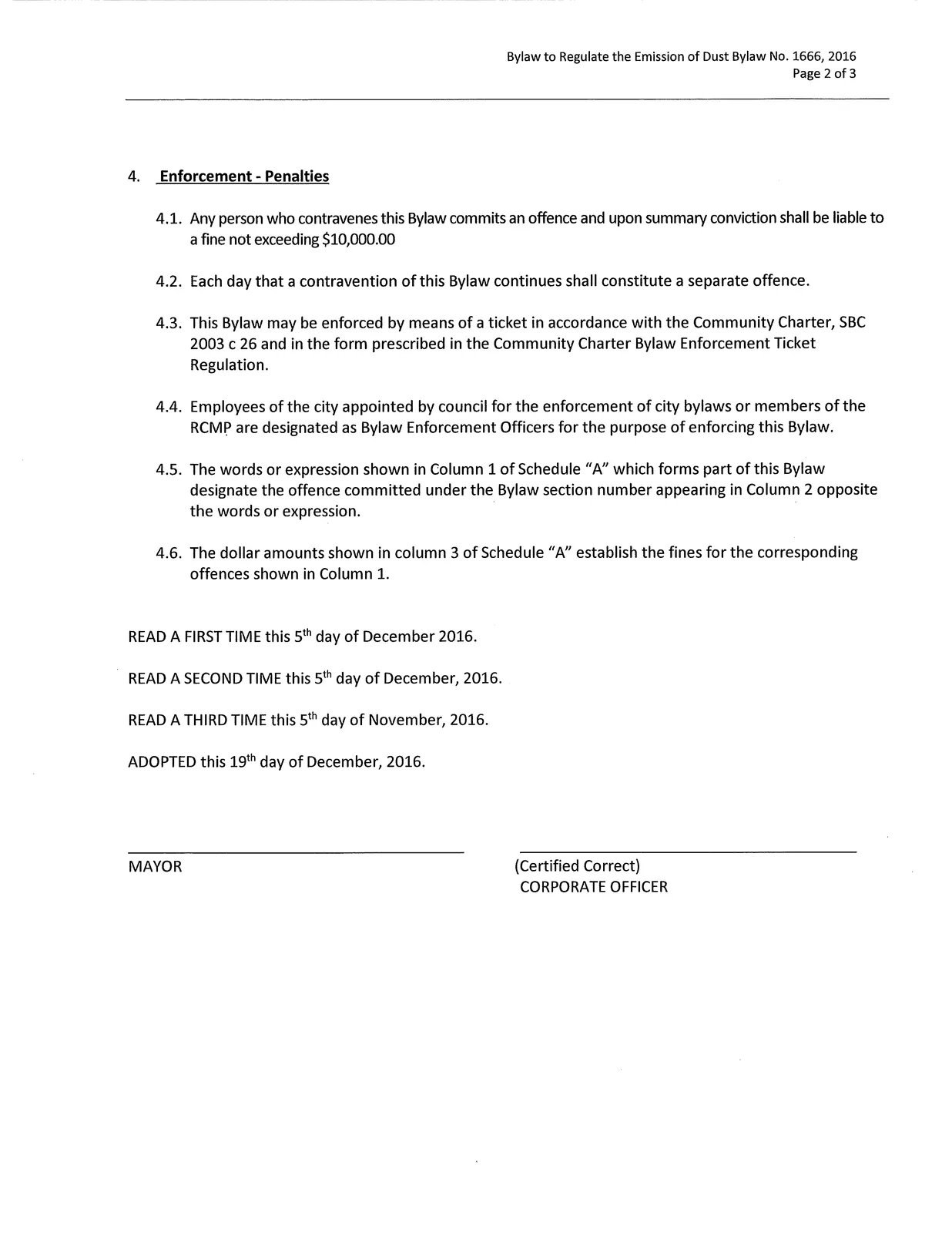
4. Enforcement - Penalties (Bylaw No. 1666 text)
4.1. Any person who contravenes this Bylaw commits an offence and upon summary conviction shall be liable to a fine not exceeding $10,000.00
4.2. Each day that a contravention of this Bylaw continues shall constitute a separate offence.
4.3. This Bylaw may be enforced by means of a ticket in accordance with the Community Charter, SBC 2003 c 26 and in the form prescribed in the Community Charter Bylaw Enforcement Ticket Regulation.
4.4. Employees of the city appointed by council for the enforcement of city bylaws or members of the RCMP are designated as Bylaw Enforcement Officers for the purpose of enforcing this Bylaw.
4.5. The words or expression shown in Column 1 of Schedule "A" which forms part of this Bylaw designate the offence committed under the Bylaw section number appearing in Column 2 opposite the words or expression.
4.6. The dollar amounts shown in column 3 of Schedule "A" establish the fines for the corresponding offences shown in Column 1.
Schedule "A" — Dust Control Bylaw No. 1666, 2016
| Offence | Section | Fine |
|---|---|---|
| Fail to prevent emission of dust | 2 | $1,000 |