DocumentsStaff ReportMar 7, 2023Pages 218–233
Report: Low-Carbon Concrete Policy
Council report concerning adoption/implementation of the Low-Carbon Concrete Policy, detailing policy requirements, implications and recommended actions.
Key facts
- Agenda item 9.1 (starts page 218)
- Policy referenced: POL-0167-PLAN (Low-Carbon Concrete Policy)
- May include requirement for post-industrial CO2 mineralized concrete or EPD verification
Report: Low-Carbon Concrete Policy
Staff Report to Council
DATE: Monday, March 6, 2023
DEPARTMENT: Planning
SUBJECT: POL-0167-PLAN Amendment
PURPOSE:
The purpose of this report is to seek Council approval for revisions to the City of Langford’s existing “Carbon Mineralization Policy” and renaming it the “Low-Carbon Concrete Policy”. The suggested amendments to this policy are based on feedback provided by industry representatives in consultation with City planning staff, professional engineering consultants, regional concrete/cement suppliers, and regional industry experts.
BACKGROUND:
At the meeting of November 17, 2021, the City of Langford adopted Policy POL-0167-PLAN, the Carbon Mineralization Policy. The existing policy was intended to do two things: 1) require construction projects to use carbon mineralization in concrete (as a condition of rezoning), and 2) reward suppliers with the lowest greenhouse gas (GHG) emissions with contracts. In this way, the Carbon Mineralization Policy would ensure a low-carbon concrete footprint in new projects while nudging the regional industry toward adopting carbon capture and storage technologies to remain competitive.
Carbon mineralization technologies are critical for the existing Carbon Mineralization Policy. In this process, carbon (from industrial emitters) is captured and injected into concrete during the manufacturing process. Once injected, the carbon dioxide (CO2) chemically converts into a mineral and becomes permanently embedded in the concrete.
Metrics of this policy are based on setting GHG emission thresholds, verified through Product-Specific Type 3 Environmental Product Declarations, and regulating reductions from existing regional baseline emissions. Results are reported as Global Warming Potential (GWP). Using GWP allows us to compare the global warming impacts of different gases associated with the lifecycle of a project.
The Carbon Mineralization Policy applies to all City-led capital improvement projects/municipal buildings and private construction projects (subject to rezoning) over 50 m3, where use of such concrete does not significantly increase costs or delay the project.
COMMENTARY
Issues with the Existing Policy
The current Carbon Mineralization Policy went into effect on June 1, 2022. Soon after, City staff were notified by several local ready-mix concrete suppliers that the existing policy was placing many suppliers at an unfair disadvantage by mandating a single technology (carbon mineralization). The supplier issue is the result of a lack of local competition to provide this specific technology: there are not yet enough companies who have adapted to meet this growing demand. As a result, new contracts were being awarded to the only local supplier who met the criteria for carbon mineralization (an effective monopoly). The change left all other suppliers, including those that are in active pursuit of other low-carbon and emissions technologies, unable to compete for most new contracts.
In response to these concerns, City staff formed a working group representing Langford planning staff, external professional engineering consultants, regional concrete/cement suppliers, and regional industry experts. The objective of the working group was to evaluate industry concerns and find a way forward that better included more local contractors, while still meeting the City’s climate action goals.
The working group developed a series of recommendations for amending the existing Carbon Mineralization Policy. These are outlined below, following a brief background on embodied carbon in concrete and tracking embodied carbon emissions.
Background on Embodied Carbon in Concrete
Construction materials, mainly concrete, are the single largest source of CO2 emissions in a city’s supply chain. It has been estimated that the concrete building industry is responsible for up to 8% of the world’s CO2 emissions largely due to the production of cement, the critical ingredient that gives concrete its strength.
Embodied carbon in concrete is reported and measured as “global warming potential” (GWP). This factor results from the production of cement, extraction of raw materials (aggregates, water, chemicals), manufacturing (energy used to store, move, and create the concrete), and transportation (all materials and fuels to transport ingredients). Global warming potential is expressed as kg-CO2eq (GHGs) per 1 m3 of concrete.
To date, the local construction industry has largely focused on reducing the operational CO2 emissions from lighting, heating, cooling, hot water, etc. However, embodied carbon, also known as upfront emissions, is now seen as a critical piece to achieving Langford’s community-wide GHG reduction targets.
Tracking Embodied Emissions: Environmental Product Declarations (EPDs)
To track and report on embodied emissions, all applicable projects require a Product Specific Type III - EPD to be provided to the City. An EPD is a standardized, third-party verified life-cycle assessment report that describes the environmental performance of a product.
EPDs report on emissions generated across the various stages of a product’s life cycle, often referred to as a product’s “embodied carbon” or “embodied emissions”. This quantifies the overall emissions footprint of a product from materials extraction to construction of the building.
For comparison, an EPD works much like the nutritional label on a grocery item that shows the nutritional contents inside – but in this instance, for embodied carbon. EPDs accompany existing submittals for building permit applications or site servicing drawings.
Working Group Suggested Policy Amendments
The proposed amendments to the Carbon Mineralization Policy are the outcome of extensive working group-based City consultation with local industry representatives, including consulting engineers and local ready-mix concrete suppliers.
The suggested changes propose amended policy requirements for industry to be rolled out in two phases.
Phase A: Concrete for a project shall be produced with average weighted embodied carbon emissions less than the referenced industry baseline (as reported by Concrete BC, 2022).
One benefit of this approach is that some concrete mixes within a project can go over the GHG emission threshold, provided the weighted average of embodied emissions is less than the baseline. It is intended that the City will adjust this weighted average target downwards each year, in consultation with industry, to ease the transition and leave time for industry to adapt.
Phase B: Concrete for a project shall be produced with embodied carbon emissions less than benchmark emissions set by the City.
The shortfall of Phase A is that the onus of GHG reduction is placed solely on ready-mix suppliers. The philosophy of Phase B will engage other construction process members, including contractors and designers (Architects and Engineers) to contribute to the City’s carbon reduction goals. This engagement will be accomplished by encouraging designers to evaluate designs against the associated GHG emissions in pursuit of more environmentally friendly solutions that do not compromise performance or strength requirements. Contractors will be encouraged to adapt these new concrete mix designs (with inherent alterations to physical properties) by reviewing and updating their construction practices and methodologies.
Proposed Council Considerations / Policy Amendments
Considering the above, Council may wish to consider the following amendments as part of the new policy:
a) Remove reference to carbon mineralization requirements.
b) Change the name of the policy from Carbon Mineralization Policy to Low-Carbon Concrete Policy.
c) Introduction of the Low-Carbon Concrete Policy is phased in as follows:
- Phase A to be implemented by June 1, 2023
- Phase B to be implemented following several years of data collection in consultation with industry.
d) Phase A requires that ready-mix concrete to meet or exceed weighted average GWP targets based on Concrete BC baseline (average) mix data.
- In subsequent years, (2024, 2025…) the City will update GWP targets in the form of a percentage reduction below the Concrete BC baseline.
- Potential reduction targets will be confirmed on an annual basis in full consultation with industry.
- Future reduction target projections are provided to allow ready-mix suppliers to make necessary adjustments for the following years.
e) Phase B requires that GWP solution opportunities are more widely distributed.
- Move the GWP onus away from ready-mix suppliers only and share opportunity with designers and contractors.
- AGWP for concrete projects will be set based on structure type, so that designers will have the ability to modify mix requirements to reduce GWP contributions.
f) The Low-Carbon Concrete Policy contains schedules A – E.
- This allows staff to adjust sections of the policy, so they are designed to change over time. For example, the GHG reduction targets for the future will depend on program monitoring and industry consultation. The schedules are intended to be updated and implemented as more data becomes available.
g) Schedule E stipulates that violation penalties are subject to change.
- The intent is not to punish or restrict development, but to nudge industry to oblige the policy to the extent possible.
h) Align the City of Langford’s Master Municipal Construction Documents (MMCD) Supplementary Specifications with this Low-Carbon Concrete Policy.
- The current policy may be at odds with the Master Municipal Construction Documents (MMCD) in terms of minimum cement content for sidewalks.
- Engineering and planning can work together to revise the City’s MMCD Supplementary Specifications to align with the policy as more data becomes available, to eliminate any potential contractual conflicts while maintaining concrete performance and strength requirements.
FINANCIAL IMPLICATIONS:
The proposed amendments and policy are not expected to result in any known additional direct costs to the City or development community. However, in cases where there are unforeseen circumstances and a developer is unable to meet the GHG thresholds, a minor financial penalty will be assigned or mix designs may need to be modified.
The penalty is intended as a deterrent from industry just ignoring the policy outright. Staff are in consultation with industry representatives on a final formula for this financial deterrent and will provide a reasonable number in the future if and once staff have reviewed the efficacy of the proposed policy changes. The penalty is currently proposed to be $0.25 per kg of CO2 in excess of the baseline limit for Phase A or B. The City will also complete random audits to review project GHG reporting. If, during an audit, it is determined that the GHG quantities have been misstated and the GHG threshold limit has been exceeded, it is recommended that the penalty be $0.50 per kg of CO2 in excess of the baseline limit.
A financial section has been added as a schedule to the proposed policy so that staff are able to make changes as more information becomes available.
In the case this policy results in financial implications for industry beyond what is considered reasonable by industry and Council, staff will revise the equation. Again, the policy is meant to encourage responsible development and not deter new housing or infrastructure.
LEGAL IMPLICATIONS:
The City faces no limitations when requiring a developer to comply with the policy as a condition of rezoning. Such commitments are secured via Section 219 covenant under the Land Title Act. For City projects the City has sole discretion over the specifications relating to GHG reduction targets as defined in the Policy.
OPTIONS:
Option 1
THAT Council
Approve the revised Low-Carbon Concrete Policy (POL-0167-PLAN), as drafted.
OR Option 2
THAT Council
Do nothing at this time with respect to the Low-Carbon Concrete Policy (POL-0167-PLAN).
SUBMITTED BY: David Sametz, MCIP, RPP, Long Range Planner II
Concurrence:
Leah Stohmann, Deputy Director of Planning and Subdivision
Concurrence:
Donna Petrie, Senior Manager of Business Development and Events
Concurrence: Yari Nielsen, Director of Parks, Recreation and Facilities
Concurrence:
Matthew Baldwin, MCIP, RPP, Director of Planning and Subdivision
Concurrence:
Katelyn Balzer, P.Eng., Director of Engineering and Public Works
Concurrence:
Michael Dillabaugh, CPA, CA, Director of Finance
Concurrence:
Marie Watmough, Deputy Director of Corporate Services
Concurrence: Braden Hutchins, Director of Corporate Services
Concurrence:
Darren Kiedyk, Chief Administrative Officer
Attachment: POL-0167-PLAN Amendment
Attachment: POL-0167-PLAN Amendment (Policy)
Policy Name: Low-Carbon Concrete Policy
☐ New ☒ Amendment
DEPARTMENT: Planning
SP Governance/Corporate Policy and Planning/Policies and Procedures
POLICY NO: POL-0167-PLAN
1. Policy
This policy describes the City of Langford (the City) “Low-Carbon Concrete Strategy” which shall commence on June 1st, 2023. This applies to all ready-mix concrete supplied for municipal buildings and infrastructure as well as private construction projects over 50 m3 (and subject to rezoning). Reporting of concrete Global Warming Potential (GWP) values shall be verified by a third party, mix design specific, Type 3 Environmental Product Declaration (EPD). This policy applies to permanent works only that form the structure (including footings, walls, slabs, beams, columns, sidewalks, curbs, etc.)
The Low-Carbon Concrete Strategy includes two phases:
Phase A – GWP Limits Based on Industry Averages
Commencement Date: June 1st, 2023
Conclusion Date: To Be Determined (TBD)
- The weighted Average Global Warming Potential (AGWP) for each project shall be less than or equal to the Baseline AGWP as determined by the following:
Project AGWP = ( Σ [ GWP_i × V_i ] ) / ( Σ V_i )
= (GWP_Mix1 × Volume_Mix1) + (GWP_Mix2 × Volume_Mix2) + ⋯
Total Concrete Volume of the Project
GWP_i = The global warming potential of mix design i [kgCO2eq./m3]
V_i = The total volume of mix design i [m3]
Baseline AGWP = ( Σ [ BGWP_i × V_i ] ) / ( Σ V_i )
= (BGWP_Mix1 × Volume_Mix1) + (BGWP_Mix2 × Volume_Mix2) + ⋯
Total Concrete Volume of the Project
BGWP_i = Baseline global warming potential of mix design i. That is, the AGWP of a baseline concrete mix as detailed in the Concrete BC Member Industry Wide EPD for Ready Mix Concrete dated July 27th 2022, and available here:
https://pcr-epd.s3.us-east-2.amazonaws.com/810.CRMCA_EPD_BC.pdf
[kgCO2eq./m3]
V_i = The volume of mix design i [m3]
Baseline mix designs shall be selected based on physical parameters of the concrete such as exposure classification, compressive strength, air entrainment, etc.
At the discretion of the City, and in consultation with industry, the maximum GWP threshold specified in (1) above shall be adjusted downward each year, in terms of percentage reduction, to meaningfully contribute to the City’s overall carbon reduction goals.
a) Anticipated GWP reduction targets have been provided in Schedule A.
Phase B – GWP Limits Based on Structure Type
Commencement Date: TBD
Conclusion Date: TBD
The shortfall of Phase A is that the onus of AGWP reduction is placed solely on ready-mix suppliers. The philosophy of Phase B will engage other construction process members, including contractors and designers (Architects and Engineers) to contribute to the City’s carbon reduction goals.
- AGWP of concrete supplied on a project shall be calculated the same as in Phase A and shall be less than or equal to AGWP limits based on structure type.
Project AGWP = ( Σ [ GWP_i × V_i ] ) / ( Σ V_i )
= (GWP_Mix1 × Volume_Mix1) + (GWP_Mix2 × Volume_Mix2) + ⋯
Total Concrete Volume of the Project
GWP_i = The global warming potential of mix design i [kgCO2eq./m3]
V_i = The total volume of mix design i [m3]
- AGWP limits based on structure type are provided in Schedule B.
- At the discretion of the City, and in consultation with industry, the maximum weighted average AGWP limits specified in Schedule B shall be adjusted downward each year to meaningfully contribute to the City’s overall carbon reduction goals.
- For projects with multiple structure types, AGWP reporting can be split between structure types for the volume of concrete associated with each portion of the overall structure. For example, an apartment building with underground parking may submit AGWP values for the volume of concrete associated with the parking structure separate from the volume of concrete associated with the apartment building.
2. Responsibilities
The City of Langford shall:
- Share information with concrete suppliers so they are aware of the City’s expectations in terms of product certification and emissions reductions in a timely manner.
- Convene annually with industry representatives to review the AGWPs with the intent of progressively lowering the thresholds over time to meaningfully contribute to the City’s overall carbon reduction goals.
- Report to Council on implementation progress, financial implications, supplier compliance, complaints, supplier feedback, and other stakeholder input on an annual basis.
- Ensure information resources relevant to project requirements, including the Embodied Carbon Project Reporting Template and this policy are incorporated as appendices in RFPs for design and construction services.
Concrete Suppliers shall:
- Provide accurate, third party verified EPDs for concrete mixes.
- Participate in discussions to determine future AGWP targets.
- Endeavour to optimise concrete mix designs to achieve these GWP reduction goals by implementing efficiencies in the manufacturing process and adopting new lower GWP promoting materials and technologies.
- Not substitute mix designs without submission of an updated EPD.
- Communicate concrete mix design performance changes (rheology, set time, etc.) to users (contractors, finishers, etc.). Assist these users to better understand reduced carbon concrete characteristics as so methodologies and schedules may be altered accordingly.
Developers (permit applicants) shall:
- Be aware of the AGWP limits on concrete mixes (Phase A) and projects (Phase B).
- For Phase B, work with designers and contractors to meet the AGWP limits prescribed in Schedule B.
- Submit to the City the required GWP information.
Design professionals (Architects, Engineers) shall:
- Be aware of GWP contributions of concrete mix designs and work with developers (permit applicants) to optimize designs to reduce the carbon footprint of their project.
- Assist developers (permit applicants) with reporting of ‘GWP Estimates’ and ‘GWP Summary’.
3. Reporting
- All EPDs must follow the accounting standards defined by the international standards ISO 14025 and ISO 21930.
- Contractors for eligible projects that sub-contract services from concrete providers shall require sub-contract bids to adhere to the same rules and standards.
- Two digital spreadsheets are available to assist permit applicants with reporting of GWP information, including:
a) ‘Project Concrete GWP Estimate’, and
b) ‘Project Concrete GWP Summary’
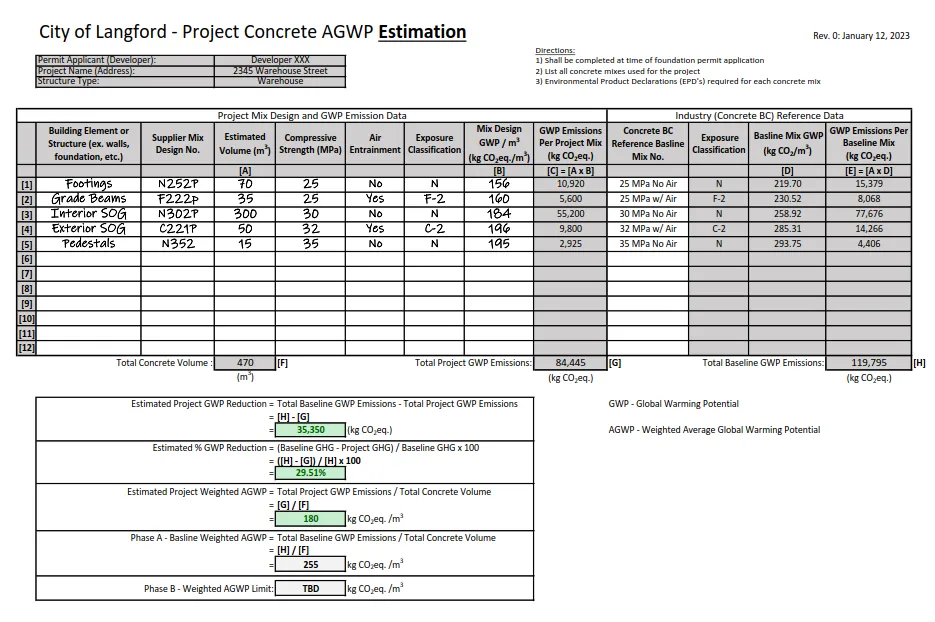
The digital spreadsheets are effectively the same; the only difference is the ‘Estimate’ is completed at the start of the project and the ‘Summary’ is completed at project completion with actual concrete volumes. An example of a completed spreadsheet is provided in Schedule C for reference.
Phase A - GWP Limits Based on Industry Averages
- For projects subject to this policy, the following reporting is required:
a) A ‘Project Concrete GWP Estimate’ indicating the following items prior to Foundation Permit:
i) Structure type,
ii) Proposed concrete mix codes (and properties),
iii) EPD’s for each proposed mix,
iv) Estimated concrete volumes,
v) Overall estimated weighted AGWP for the project.
b) A ‘Project Concrete GWP Summary’ indicating the following items prior to Occupancy Permit:
i) Actual concrete mix designs,
ii) EPD’s for each actual mix,
iii) Actual concrete volumes,
iv) Overall weighted AGWP for the project.
Phase B - GWP Limits Based on Structure Type
- For projects subject to this policy, the following reporting is required:
c) A ‘Project Concrete GWP Estimate’ indicating the following items prior to Foundation Permit:
i) Structure type,
ii) Proposed concrete mix codes (and properties),
iii) EPD’s for each proposed mix,
iv) Estimated concrete volumes,
v) Overall estimated weighted AGWP for the project,
vi) Confirmation the AGWP is less than the limit listed in Schedule B.
d) A ‘Project Concrete GWP Summary’ indicating the following items prior to Occupancy Permit:
i) Actual concrete mix designs,
ii) EPD’s for each actual mix,
iii) Actual concrete volumes,
iv) Overall weighted AGWP for the project,
vii) Confirmation the AGWP is less than the limit listed in Schedule B.
4. Exemptions
Special circumstances for a project may require that a mix (or mixes) be omitted from the AGWP calculation and submission. Therefore, permit applicants may submit requests for mix exemption from the requirements of Phase A or Phase B of this policy. At the discretion of the City, exemption may be provided if it can be demonstrated that no reasonable alternative exists. The following information must be submitted:
- Structure type
- Proposed concrete mix design(s)
- Mix(es) proposed to be excluded (with EPDs)
- Estimated concrete volume of the mix(es) to be excluded.
- Estimated overall project concrete volume.
- Estimated weighted AGWP with mix(es) included.
- Estimated weighted AGWP with mix(es) excluded.
- Written justification for why the mix or mixes cannot meet the policy requirement.
It is noted that exemption may only be provided for individual mix(es). An exemption to the weighted average GWP limits for a project will not be granted. Guidelines for the review and evaluation of exemption requests have been provided in Schedule D.
5. GHG Emission Reduction Policy Evaluation
The greenhouse gas emissions reduction of a project is equal to its carbon dioxide equivalent baseline emissions minus its carbon dioxide equivalent project emissions.
%GWP Reduction = ((Baseline AGWP − Project AGWP) / Baseline AGWP) × 100
6. Penalties
- A permit will not be granted if the Estimated AGWP is above the Baseline AGWP for the project.
- Upon completion of the project, if the AGWP as determined by the ‘Project Concrete GWP Summary’ exceeds the limit described in this policy, the permit applicant shall be fined for every kg of CO2 in violation of this policy. The fine will be determined as:
Fine ($) = [Project AGWP − Baseline AGWP] × Total Project Concrete Volume × Penalty X
Penalty A = Per kilogram monetary fine for policy violation [$ / kgCO2eq.]
- Randomly selected projects will be audited by the City. If discrepancy is found in the reported values from the randomly selected projects (for example, with the concrete volumes or the reported EPD data) the fine for the culpable party will be determined as:
Fine ($) = [Project AGWP − Baseline AGWP] × Total Project Concrete Volume × Penalty Y
Penalty B = Audit discovered per kilogram monetary fine for policy violation [$ / kgCO2eq.]
- Values of ‘Penalty A’ and ‘Penalty B’ have been provided in Schedule E.
Adopted by Council
Meeting Date:
CERTIFIED CORRECT
Administrator Date:
Schedules
Schedule A – Phase A, Anticipated Concrete AGWP Reduction Targets
Table 1 – Phase A Anticipated GWP Reduction Targets
| Dates | GWP Target Compared to Baseline AGWP |
|---|---|
| June 1, 2023 – June 1, 2024 | 0% below Baseline AGWP |
| June 1, 2024 – June 1, 2025 | 7%* below Baseline AGWP |
| June 1, 2025 – June 1, 2026 | 15%* below Baseline AGWP |
| 2026, 2027, … | TBD* |
*AGWP adjustments will be reviewed on an annual basis and determined in consultation with industry.
Schedule B – Phase B, AGWP limits based on structure type
Table 2 – Phase B Weighted Average GWP Limits
| Structure Type | AGWP Limit [kgCO2eq./m3] |
|---|---|
| Residential | |
| Single-Family | TBD* |
| Multi-Family | TBD* |
| Apartment/ Condominiums | TBD* |
| Commercial | |
| Warehouse | TBD* |
| Service Station | TBD* |
| Office Building | TBD* |
| Recreational | TBD* |
| Hotel | TBD* |
| Restaurant | TBD* |
| Institutional and Government | |
| Roadworks (Sidewalks, Curbs, etc.) | TBD* |
| Laboratory | TBD* |
| School | TBD* |
| Hospital | TBD* |
| Industrial | |
| Factory | TBD* |
| Transportation | TBD* |
| Parking Garage | TBD* |
*AGWP adjustments will be reviewed on an annual basis and determined in consultation with industry.
Schedule C – Example Reporting Template

Schedule D – Exemption Guidelines
For a mix to be considered for exemption, at least one of the following shall apply:
The design requires concrete performance outside the parameters of the baseline mixes and therefore a reference is not available for comparison.
- Example: If the design requires the use of a 70 MPa concrete mix, this would be eligible for exemption as a baseline comparison is not available for 70 MPa concrete.
Unique and unsurmountable schedule restrictions require the use of a high early strength gain concrete mix.
- In the exemption request, the applicant must supply detail of the circumstance surrounding the unique schedule restrictions.
The design requires the use of a specialized placement technique such as Self-Consolidating Concrete (SCC) or shotcrete.
- The specialized placement technique shall be prescribed in the design by the professional of record to achieve project performance.
- Specialized placement techniques employed by the contractor to contribute to ease of placement will not be considered applicable for exemption.
- This criteria for exemption shall apply to Phase A, only.
Schedule E – Policy Violation Penalty Values
| Penalty | Value |
|---|---|
| Penalty X | 0.25 [$ / kgCO2eq.] |
| Penalty Y | 0.50 [$ / kgCO2eq.] |
Note: Penalty amounts are subject to change at the discretion of the City.
Document Images
(1)