Public hearing package and associated materials for Bylaw No. 2054 to amend Zoning Bylaw No. 300 to add electric vehicle charging infrastructure requirements for new apartment buildings.
Requires EV-ready conduits and energized outlets for all multi-family residential parking spaces (excluding visitor stalls)
Includes Section 4.01.08 requirements, Section 219 covenant registration and compliance certificate prior to occupancy
Council first read: 2 May 2022 (read first time date recorded in bylaw text)
Public Hearing — Bylaw No. 2054 (EV Charging Stations)
Public Hearing
Date: Monday, 6 June 2022
File No.: Z21-0018
Purpose: To amend the City of Langford Zoning Bylaw No. 300 by amending the text of Part 4 – Parking Regulations by adding requirements for electric vehicle charging infrastructure in new apartment buildings.
A BYLAW TO AMEND BYLAW NO. 300, “LANGFORD ZONING BYLAW, 1999"
The Council of the City of Langford, in open meeting assembled, hereby enacts as follows:
A. Langford Zoning Bylaw No. 300, 1999 is amended as follows:
By adding the following text as Section 4.01.08:
“4.01.08 Electric Vehicle Infrastructure Requirements
(1) For new buildings containing apartment units, all parking spaces, excluding visitor parking spaces, shall include conduits capable of providing wiring for Level 2 Electric Vehicle charging in the future and:
(a) all conduits must be connected to electrical rooms; (b) where an Electric Vehicle Management System (“EVMS”) is provided all communications equipment, control systems, and other devices required to operate the EVMS shall be installed; and (c) all conduits shall be labelled for the use of electric vehicle charging.
(2) The following are required at the time of building permit application and prior to issuance of a building permit for a building subject to the requirements of this section 4.01.08:
(a) a site plan that shows the location, number and specifications of all energized parking spaces, conduits and electrical connections and, if required, the communications equipment, control systems and other devices required to operate the EVMS; (b) a memo from an electrical engineer that verifies that the load capacity of the building can provide Level 2 Electric Vehicle charging to all residential parking spaces; (c) where an EVMS is required, an electrical engineer shall verify that Level 2 charging can achieve at least 12kWh per vehicle over an eight-hour period when all vehicles are charging simultaneously; and (d) registration against title to the land of a covenant in favour of the City under section 219 of the Land Title Act requiring the owner to (i) construct the electric vehicle charging system in accordance with the plan under (a); (ii) repair and maintain and otherwise keep the electrical vehicle charging system in operation; and (iii) precluding the owner or any strata corporation from doing anything that would prevent the installation of electric vehicle charging equipment within the conduits and at each parking space and the connection of such charging equipment to the electrical system.
(3) Before issuance of an occupancy permit, the owner shall provide to the City a compliance form certified by a registered professional or qualified electrician, confirming that the future energized spaces, and equipment meet the requirements of this zoning bylaw.
(4) Where load sharing is implemented, the maximum number of parking spaces connected to the same circuit in the building, for various circuit ratings, is as shown in Table 1 below:
New MURB Developments EV Ready Level 2
Performance Requirements for Langford
Table 1: Circuit breaker amperage and maximum number of EV ready parking spaces energized
Circuit Breaker Amperage
Maximum Number of EV Ready Parking Spaces Energized
20
1
30
2
40
4
50
5
60
6
70
7
80
8
90
10
100
11
125
14
150
17
”
B. This Bylaw may be cited for all purposes as “Langford Zoning Bylaw, Amendment No. 665, (Omnibus No. 58 – Electric Vehicle Charging Stations), Bylaw No. 2054, 2022".
READ A FIRST TIME this 2nd day of May, 2022 PUBLIC HEARING held this day of , 2022. READ A SECOND TIME this day of , 2022. READ A THIRD TIME this day of , 2022. ADOPTED this day of , 2022.
Meeting Date and Time: 6 June 2022, 5:30 pm Meeting Place: City Hall Council Chambers, Third Floor, 877 Goldstream Avenue
Teleconference # 1-855-703-8985 (Canada Toll Free) OR 1-778-907-2071 (long distance charges may apply) Meeting ID #886 4630 6785 – Zoom.us or Zoom app on your mobile device
Council will not answer questions about the proposal or proposed bylaw except to provide clarification. The purpose of the Public Hearing is for Council to hear the views and opinions of those members of the public who wish to make comments. Please have all your questions answered in advance of the Public Hearing by contacting the Planning Department at planning@langford.ca or (250) 478.7882.
Correspondence may be submitted by emailing planning@langford.ca or by writing to Langford City Hall, 2nd Floor, 877 Goldstream Avenue, Langford, BC, V9B 2X8.
Marie Watmough Acting Director of Corporate Services
Page 5–32
Langford Station Cultural District ribbon cutting photo
(Associated caption in original: "A May 20 ribbon cutting at the Langford Station Cultural District. (Jake Romphf/News Staff)")
Page 5–32
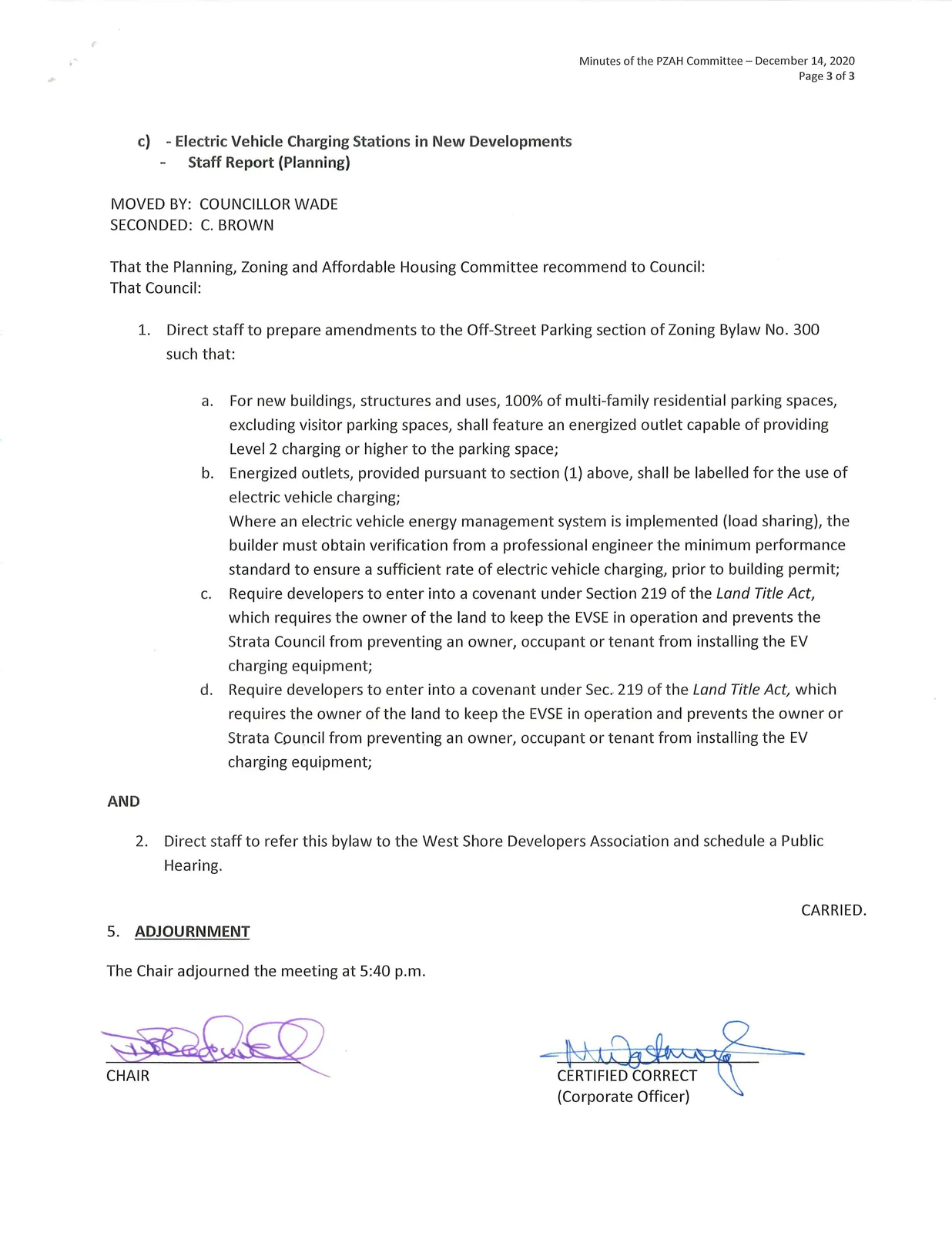
Excerpts from Minutes and Motions
Planning, Zoning and Affordable Housing Committee — December 14, 2020
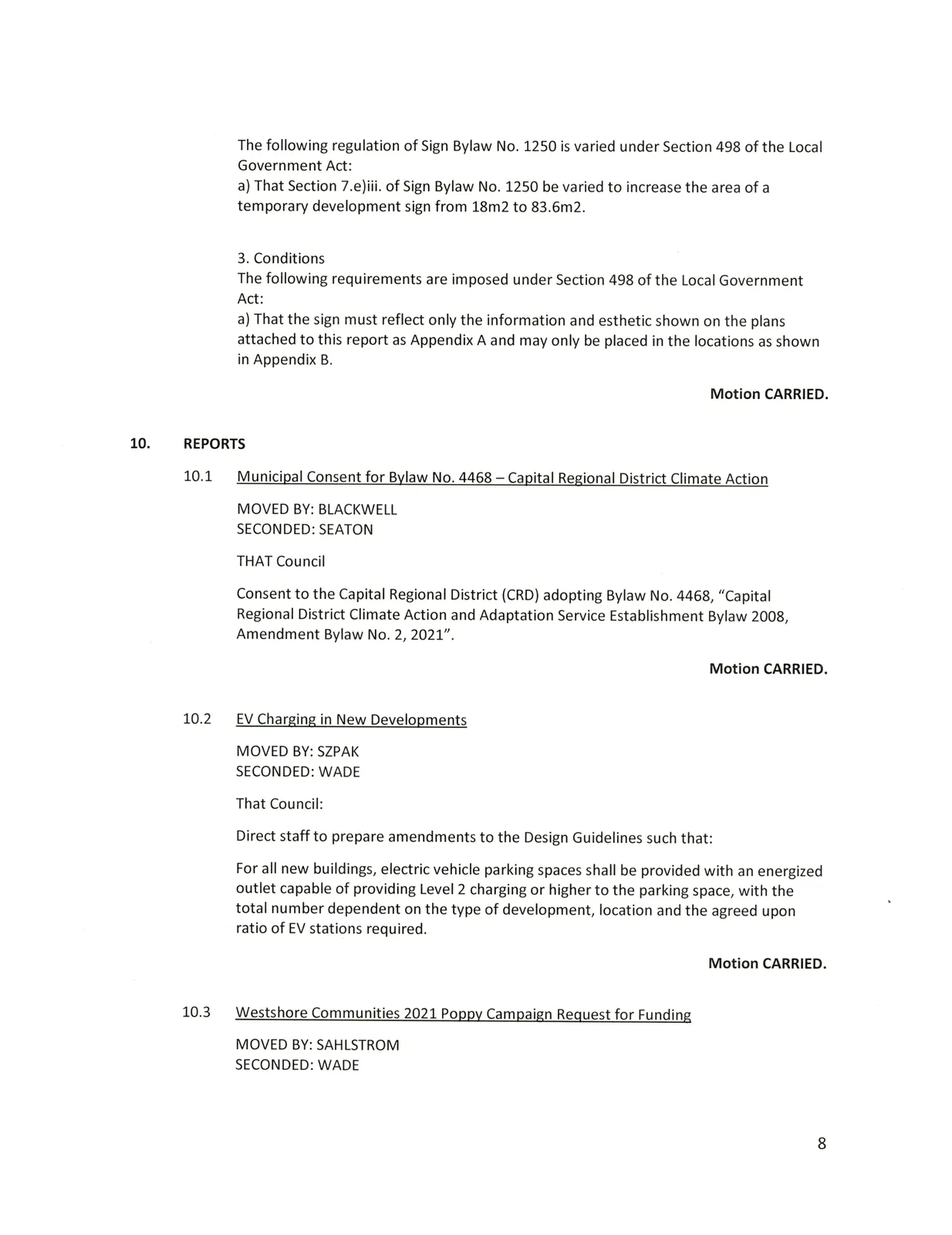
c) - Electric Vehicle Charging Stations in New Developments - Staff Report (Planning)
MOVED BY: COUNCILLOR WADE SECONDED: C. BROWN
That the Planning, Zoning and Affordable Housing Committee recommend to Council:
That Council:
Direct staff to prepare amendments to the Off-Street Parking section of Zoning Bylaw No. 300 such that:
a. For new buildings, structures and uses, 100% of multi-family residential parking spaces, excluding visitor parking spaces, shall feature an energized outlet capable of providing Level 2 charging or higher to the parking space; b. Energized outlets, provided pursuant to section (1) above, shall be labelled for the use of electric vehicle charging; Where an electric vehicle energy management system is implemented (load sharing), the builder must obtain verification from a professional engineer the minimum performance standard to ensure a sufficient rate of electric vehicle charging, prior to building permit; c. Require developers to enter into a covenant under Section 219 of the Land Title Act, which requires the owner of the land to keep the EVSE in operation and prevents the Strata Council from preventing an owner, occupant or tenant from installing the EV charging equipment; d. Require developers to enter into a covenant under Sec. 219 of the Land Title Act, which requires the owner of the land to keep the EVSE in operation and prevents the owner or Strata Council from preventing an owner, occupant or tenant from installing the EV charging equipment; AND
Direct staff to refer this bylaw to the West Shore Developers Association and schedule a Public Hearing.
CARRIED.
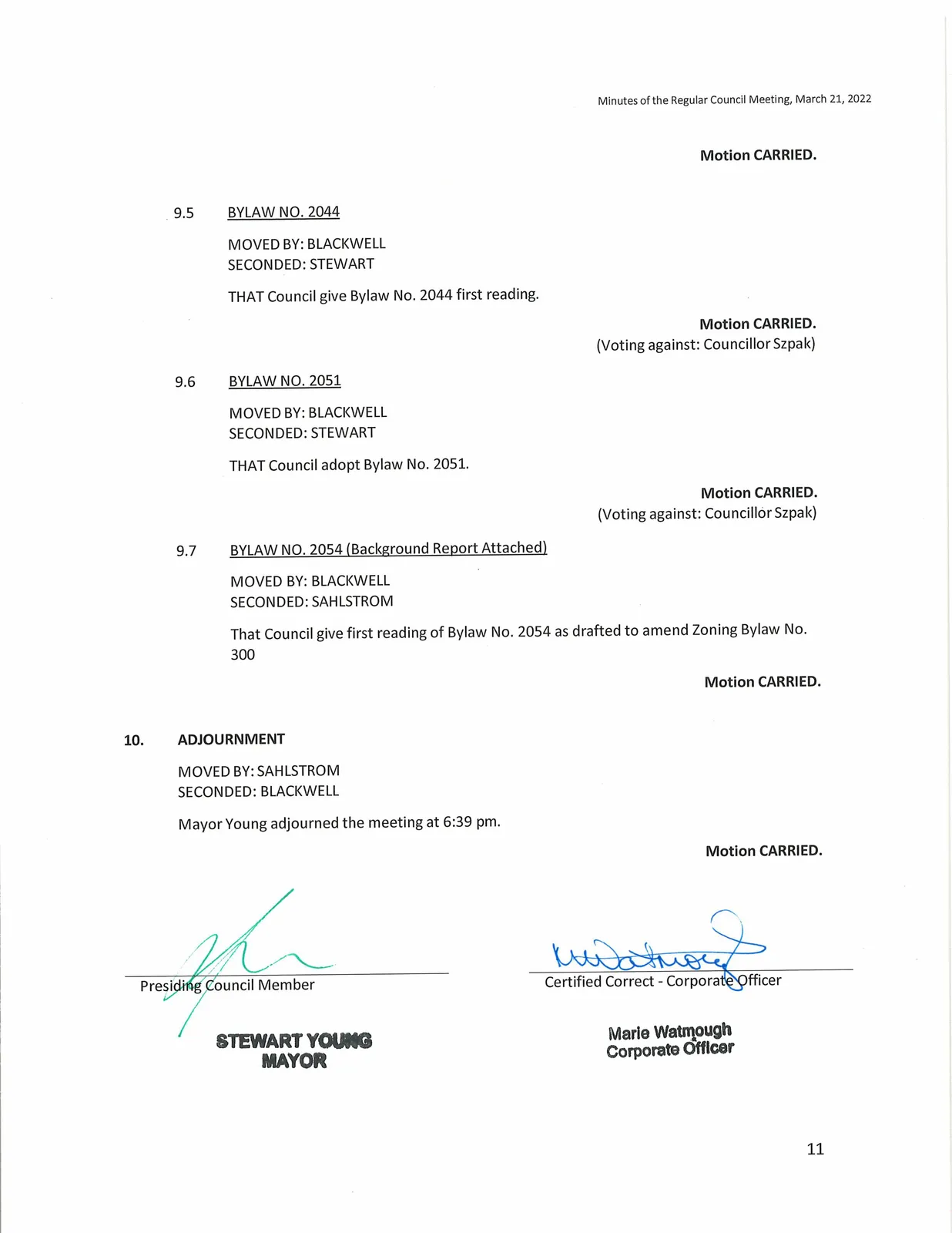
Regular Council Meeting — March 21, 2022 (selected)
MOVED BY: BLACKWELL SECONDED: SAHLSTROM
That Council give first reading of Bylaw No. 2054 as drafted to amend Zoning Bylaw No. 300
Motion CARRIED.
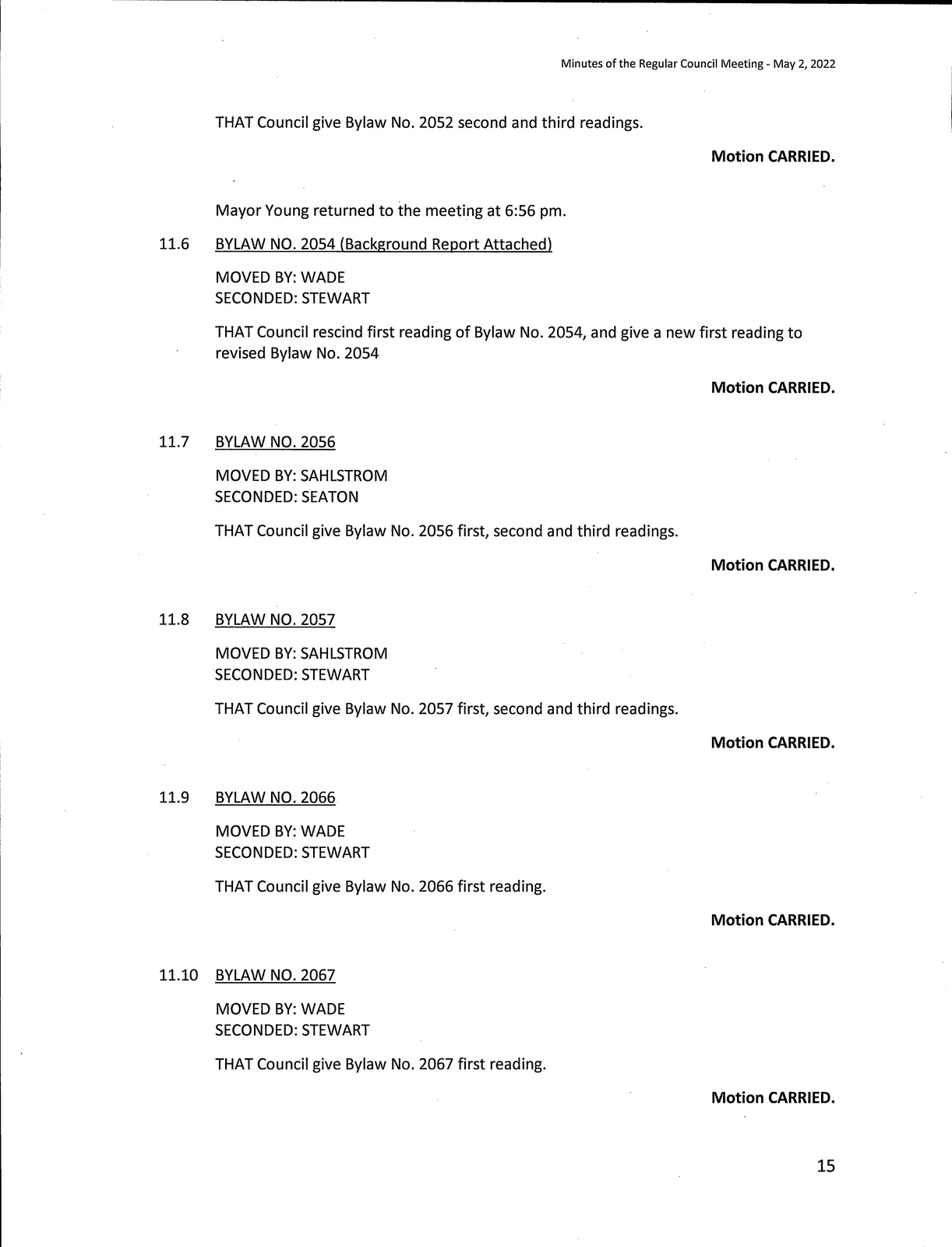
Regular Council Meeting — May 1, 2022 (selected)
MOVED BY: WADE SECONDED: STEWART
THAT Council rescind first reading of Bylaw No. 2054, and give a new first reading to revised Bylaw No. 2054
Breaking Wind teammates on stationary bikes fundraising photo
(Associated caption in original: "Breaking Wind teammates Cynthia Smith, Graham Hales, and Gerald Leahy spin on stationary bikes outside West Shore Parks and Recreation Saturday May 28, 2022 as part of a fundraiser in support of Victoria Hospice. (Justin Samanski-Langille/News Staff)")
Page 5–32
Staff Report: Electric Vehicle Charging Stations in New Developments (Planning)
Date: December 14, 2020
SUMMARY
The CleanBC economic agenda and recently passed Zero-Emission Vehicles Act in 2019 are part of a provincial legislative and regulatory framework addressing the growing electric vehicle market, forecast to comprise 100% of new vehicle sales in B.C. by 2040 (see more below). To meet the corresponding rise in charging requirements, the City of Langford may wish to develop a mechanism for implementing electric vehicle (EV) charging stations in new multi-family developments. Providing the infrastructure at the time of construction of the building is the most cost-effective way to make at home charging available in multi-family developments. The following report outlines best practices and options available for the inclusion of charging station needs in the City.
BACKGROUND
The B.C. Provincial Government adopted Bill 28 – 2019: Zero-Emission Vehicles Act as part of the CleanBC economic agenda, which requires automakers and suppliers to meet escalating annual percentages of new light-duty electric vehicle sales and leases, reaching: 10% by 2025, 30% by 2030, and 100% by 2040.
EV market share in B.C. has grown significantly; many local governments are developing policies, bylaws and guidelines to facilitate EV charging equipment in new developments.
Previously, many local governments used design guidelines or stand-alone policies, but zoning bylaws are now recognized as the most efficient form of implementation.
Key concepts
EV Energy Management Systems (load sharing / power sharing / smart charging) permit multiple vehicles to charge without exceeding circuit capacity and reduce required electrical infrastructure.
"EVSE-ready" (energized) means infrastructure required for EV charging is provided, excluding chargers; outlet boxes or receptacles are wired and dedicated for EV charging.
Infrastructure Costs in New Developments (borne by developer)
Costs depend on building power requirements and parking configuration.
A building using load sharing (e.g. 6:1) may estimate costs between $272 and $470 per stall if implemented at construction (source cited).
Assumes approximate parking stall cost ~$20,000/stall; EVSE-ready adds approximately 1.3% - 2.3% of parking stall cost.
Charging Station Costs (borne by future homeowner)
Four types commonly used: Level 1, Level 2 (dedicated), Level 2 (load sharing), Level 3 (DC Fast Charging).
Level 2 EVSE with Load Sharing is the most common for multi-family developments.
Installation costs per stall (typically paid by future homeowner) assuming 100% stalls EVSE-ready (with load sharing):
Retrofit cost (not EVSE-ready) estimated at $6,800 per single EV charger vs. $307-$760 per stall when EVSE-ready and load sharing is used.
Incentives
BC Hydro, Province and FortisBC offer rebates for purchase and installation of EV chargers.
Successful applicants to multi-unit residential/workplace charging rebate reimbursed 50% of cost of eligible new Level 2 charging stations up to $2,000 per station, or energized 208V/240V outlets up to $1,000 per outlet; applicants can apply up to $14,000 in rebates per application.
Suggested Options for Implementation
Update the Zoning Bylaw/Parking Schedule to require EVSE-ready infrastructure in new multi-family buildings.
Alternatively, adopt a stand-alone policy/design guidelines, but zoning bylaw approach is preferred for simplicity and broad application.
Municipal Precedents
Other municipalities have adopted EVSE requirements (examples cited in report include): District of Saanich, District of Squamish, Port Moody, City of Duncan, City of Port Coquitlam, City of Burnaby, City of Vancouver, City of Nelson, City of New Westminster, City of North Vancouver, District of North Vancouver, City of Richmond, District of West Vancouver, City of Coquitlam, City of Victoria.
(See report for references and supporting studies.)
LEGAL
The Local Government Act allows bylaws to establish design standards for parking spaces, enabling EV charging requirements.
Local governments cannot regulate how strata councils/building owners ultimately manage EV charging infrastructure; to help ensure continued operation, Langford could require a covenant under Section 219 of the Land Title Act obligating owners to keep EV infrastructure in operation and preventing strata actions that would prevent EV installations.
CONCLUSION / Options (as presented in report)
That the Planning and Zoning Committee recommend that Council:
Direct staff to prepare amendments to the Off-Street Parking section of Zoning Bylaw No. 300 such that:
a. For new buildings, structures and uses, 100% of multi-family residential parking spaces, excluding visitor parking spaces, shall feature an energized outlet capable of providing Level 2 charging or higher to the parking space;
b. Energized outlets, provided pursuant to section (1) above, shall be labelled for the use of electric vehicle charging;
c. Where an electric vehicle energy management system is implemented (load sharing), the builder must obtain verification from a professional engineer the minimum performance standard to ensure a sufficient rate of electric vehicle charging, prior to building permit;
d. Require developers to enter into a covenant under Section 219 of the Land Title Act, which requires the owner of the land to keep the EVSE in operation and prevents the Strata Council from preventing an owner, occupant or tenant from installing the EV charging equipment.
OR
Direct staff to prepare amendments to the Design Guidelines such that:
a. For all new buildings, structures, electric vehicle parking spaces shall be provided with an energized outlet capable of providing Level 2 charging or higher to the parking space, with the total number dependent on the type of development, location and the expected EV stations required.
AND
Direct staff to refer this bylaw to the West Shore Developers Association and schedule a Public Hearing.
OR
Take no action at time with respect to amending the zoning regulations and design guidelines for the implementation of EV charging infrastructure.
Submitted by: David Sametz, Land Development Planner – Approved
Concurrences: Matthew Baldwin, MCIP, RPP, Director of Planning - Approved Marie Watmough, Manager of Legislative Services - Approved Chris Aubrey, Fire Chief - Approved Lorne Fletcher, Manager of Community Safety and Municipal Enforcement - Approved Cory Manton, Manager of Parks and Recreation - Approved Michelle Mahovlich, P.Eng, P.Geo, Director of Engineering - Approved Leah Stohmann, MCIP, RPP, Deputy Director of Planning - Approved Michael Dillabaugh, CPA, CA, Director of Finance - Approved Braden Hutchins, Director of Corporate Services - Approved Darren Kiedyk, Chief Administrative Officer - Approved
Staff Report to Council: Electric Vehicle Charging in New Developments
Date: Monday, December 6, 2021 Department: Planning
SUMMARY
Province passed the Zero-Emission Vehicles Act (Bill 28 – 2019). Forecast: 100% new vehicle sales in B.C. by 2040.
Providing EV infrastructure at time of construction is cost-effective.
Report revises prior 2020 PZAH report to reflect updated rebates, construction costs, and corrected labour cost reporting.
COMMENTARY
Shift toward requiring 100% of parking stalls in new multi-family developments to be EVSE-ready (excluding visitor parking).
EVSE-ready includes metering, transformers, electrical panel with breakers, outlet boxes, raceways.
EV Energy Management Systems (load sharing) reduce capital costs and required electrical supply.
FINANCIAL / AFFORDABILITY FOR RESIDENTS
Providing EVSE-ready at time of construction is most cost-effective and protects affordability; retrofit costs may be prohibitive and complex legally.
Cost often recaptured in unit sale, enabling financing via mortgage versus upfront retrofit cost.
EVSE-READY CONSTRUCTION COSTS (borne by developer)
Based on interviews and updated costing: full installation costs (wiring, conduit, labour) excluding EVSE/charger are in the range of $3,000 per stall when installed at time of construction.
Retrofit estimated at ~ $6,800 per stall.
AVAILABLE REBATES
Current provincial rebate options (summary):
EV Ready plan rebate: up to $3,000 for creation of an EV Ready plan;
EV Ready infrastructure rebate: up to $600 per parking space to install electrical infrastructure to implement EV Ready plan, to a maximum of $80,000;
EV charger rebate: up to $1,400 per charger to purchase and install Level 2 networked EV chargers, to a maximum of $14,000.
(See BC EV Rebate Program Website for details.)
SUGGESTED OPTIONS FOR IMPLEMENTATION
Update Zoning Bylaw/Parking Schedule to require EVSE-ready infrastructure (preferred).
Stand-alone policies/design guidelines: allow case-by-case evaluation but not recommended as primary means.
MUNICIPAL PRECEDENTS
Other municipalities have EVSE-ready requirements (list included in report).
ENGAGEMENT
Consulted with West Shore Developers Association, construction managers, electrical engineers, municipal planners, strata representatives, BC Hydro and CRD workshops.
Vancouver Island Strata Owners Association recommended installing all infrastructure at time of construction to avoid legal/strata complications.
IMPLEMENTATION
City already requires a Section 219 covenant at rezoning requiring all parking stalls to be energized and capable of Level 2 charging in the future.
If Council supports policy, update zoning bylaw so Development Permit and Building Permit plans indicate energized outlet at applicable stalls, verified by qualified electrical engineer.
LEGAL
Local Government Act allows design standards for parking spaces. Strata Act complicates allocation and management; Section 219 covenant recommended to bind future strata corporation to keep EV infrastructure operative.
CONCLUSION / OPTIONS (verbatim from report)
Option 1
That Council:
Direct staff to prepare a bylaw to amend the Off-Street Parking section of Zoning Bylaw No. 300 such that:
a. For new buildings, structures and uses, 100% of multi-family residential parking spaces, excluding visitor parking spaces, shall feature an energized outlet capable of providing Level 2 charging or higher;
b. Energized outlets, provided pursuant to section (1) above, shall be labelled for the use of electric vehicle charging;
c. Where an electric vehicle energy management system is implemented (load sharing), the builder must obtain verification from a professional engineer of the minimum performance standard to ensure a sufficient rate of electric vehicle charging, prior to building permit issuance;
d. Require developers to enter into a covenant under Section 219 of the Land Title Act, which requires the owner of the land to keep the EV system in operation and prevents the Strata Council from preventing an owner, occupant or tenant from installing the EV charging equipment.
OR Option 2
That Council:
Direct staff to prepare amendments to the Design Guidelines such that:
a. For all new buildings, electric vehicle parking spaces shall be provided with an energized outlet capable of providing Level 2 charging or higher to the parking space, with the total number dependent on the type of development, location and the agreed upon ratio of EV stations required.
OR Option 3
That Council:
Take no action at time with respect to amending the zoning regulations and design guidelines for the implementation of EV charging infrastructure.
SUBMITTED BY: David Sametz, MCIP, RPP, Planner II, Long Range Planning
Concurrences (verbatim list from report): Leah Stohmann, MCIP, RPP Deputy Director of Planning and Subdivision Matthew Baldwin, MCIP, RPP, Director of Planning and Subdivision Michelle Mahovlich, P.Eng, P.Geo, Director of Engineering and Public Works Michael Dillabaugh, CPA, CA, Director of Finance Marie Watmough, Acting Director of Corporate Services Darren Kiedyk, Chief Administrative Officer
Staff Report to Council: Bylaw 2054 - EV Charging in New Developments
Date: Monday, March 21, 2022 Department: Planning
BACKGROUND (verbatim highlights)
On December 6, 2021, Council passed resolution directing staff to prepare a bylaw amending the Design Guidelines such that: a. For all new multi-family buildings, electric vehicle parking spaces shall be provided with an energized outlet capable of providing Level 2 charging or higher to the parking space, with the total number dependent on the type of development, location and the agreed upon ratio of EV stations required.
City’s legal team advised stand-alone policy/design guideline approach likely unenforceable; best implementation is amendment to Zoning Bylaw 300 under section 525 (Off-Street Parking and Loading Space Requirements) of the Local Government Act.
The conditions presented within proposed Bylaw No. 2054 are based on best practices for future proofing developments for EV charging and are consistent with other municipalities.
OPTIONS (verbatim)
Option 1
That Council:
Provide First Reading of Bylaw 2054 as drafted to amend Zoning Bylaw No. 300
Option 2
THAT Council
Take no action at time with respect to amending Zoning Bylaw 300.
SUBMITTED BY: David Sametz, MCIP, RPP, Long Range Planner II
Concurrences (verbatim list): Leah Stohmann, MCIP, RPP, Deputy Director of Planning and Subdivision Donna Petrie, Manager of Business Development and Events Matthew Baldwin, MCIP, RPP, Director of Planning and Subdivision Michelle Mahovlich, P.Eng, P.Geo, Director of Engineering and Public Works Michael Dillabaugh, CPA, CA, Director of Finance Marie Watmough, Acting Director of Corporate Services Darren Kiedyk, Chief Administrative Officer
Staff Report to Council: Bylaw No. 2054 — Amendment
Date: Monday, May 2, 2022 Department: Planning Application No.: Bylaw No. 2054 – Amendment Subject: Electric Vehicle Charging in New Developments
BACKGROUND (verbatim highlights)
At its regular Council meeting of March 21, 2022, Council gave First Reading to Bylaw No. 2054, requiring all new multi-family buildings to provide energized outlets capable of providing Level 2 electric vehicle (“EV”) charging to all multi-family residential parking spaces (excluding visitor parking).
Following First Reading, several members of the development community expressed concern over the potential for theft of the electrical wire prior to the need for the EV charger/energized outlet.
To address these concerns and ensure equitable access for future homeowners, staff reviewed conditions for only partially installing EV infrastructure at time of development, such that all networking and communication systems, transformers, sub-panels, metering, and conduit are installed by the developer, but the wire is installed by the future homeowner on an as needed basis.
According to the City’s legal team, this readiness option may necessitate the need for registration of a section 219 covenant prior to issuance of a building permit preventing a future strata council from blocking the installation of charging infrastructure at a later date. This has been incorporated into revised Bylaw No. 2054.
FINANCIAL IMPLICATIONS
There are no financial implications to the proposed amendment other than staff time required for securing the covenants.
LEGAL IMPLICATIONS
There are no legal implications for the proposed amendment.
OPTIONS (verbatim)
Option 1
THAT Council
Rescind First Reading of Bylaw No. 2054, and give a new First Reading to revised Bylaw No. 2054
OR Option 2
THAT Council
Do not rescind First Reading of Bylaw No. 2054 and direct staff to proceed with Second and Third Readings following additional discussions with the development community
SUBMITTED BY: David Sametz, MCIP, RPP, Long Range Planner II
Concurrences (verbatim list): Leah Stohmann, MCIP, RPP, Deputy Director of Planning and Subdivision Donna Petrie, Manager of Business Development and Events Will Ying-udomrat, Manager of Legislative Services Matthew Baldwin, MCIP, RPP, Director of Planning and Subdivision Michelle Mahovlich, P.Eng, P.Geo, Director of Engineering and Public Works Michael Dillabaugh, CPA, CA, Director of Finance Marie Watmough, Acting Director of Corporate Services Darren Kiedyk, Chief Administrative Officer