DocumentsAppendixJan 24, 2017Pages 9–78
Regional Growth Strategy (Schedule "A" to Bylaw No. 4017)
The full Capital Regional District Regional Growth Strategy (Schedule A), containing vision, objectives, policies, maps, targets and implementation measures to guide regional growth to 2038.
Key facts
- Contains Vision, Objectives, Maps, Policies and Implementation Measures for the CRD to 2038
- Targets include: accommodate minimum 95% of new dwelling units within Growth Policy Area; reduce community GHG emissions 33% (from 2007) by 2020 and 61% by 2038
- Includes Map 3 Growth Management Concept Plan, Map 4 Renewable Resource Lands Detail, and Map 5 Municipal Boundary Adjustment Detail (reference to ~380 acres in Metchosin/Langford area)
- Addresses policies on water service extensions, infrastructure, housing affordability, transportation, food/agriculture and ecosystem protection
Regional Growth Strategy (Schedule "A" to Bylaw No. 4017)
Page 9
The Capital Regional District Regional Growth Strategy (Schedule "A" to Bylaw No. 4017) Prepared by Regional and Strategic Planning Capital Regional District Page 9 of 84 Page 9 of 84
Page 10
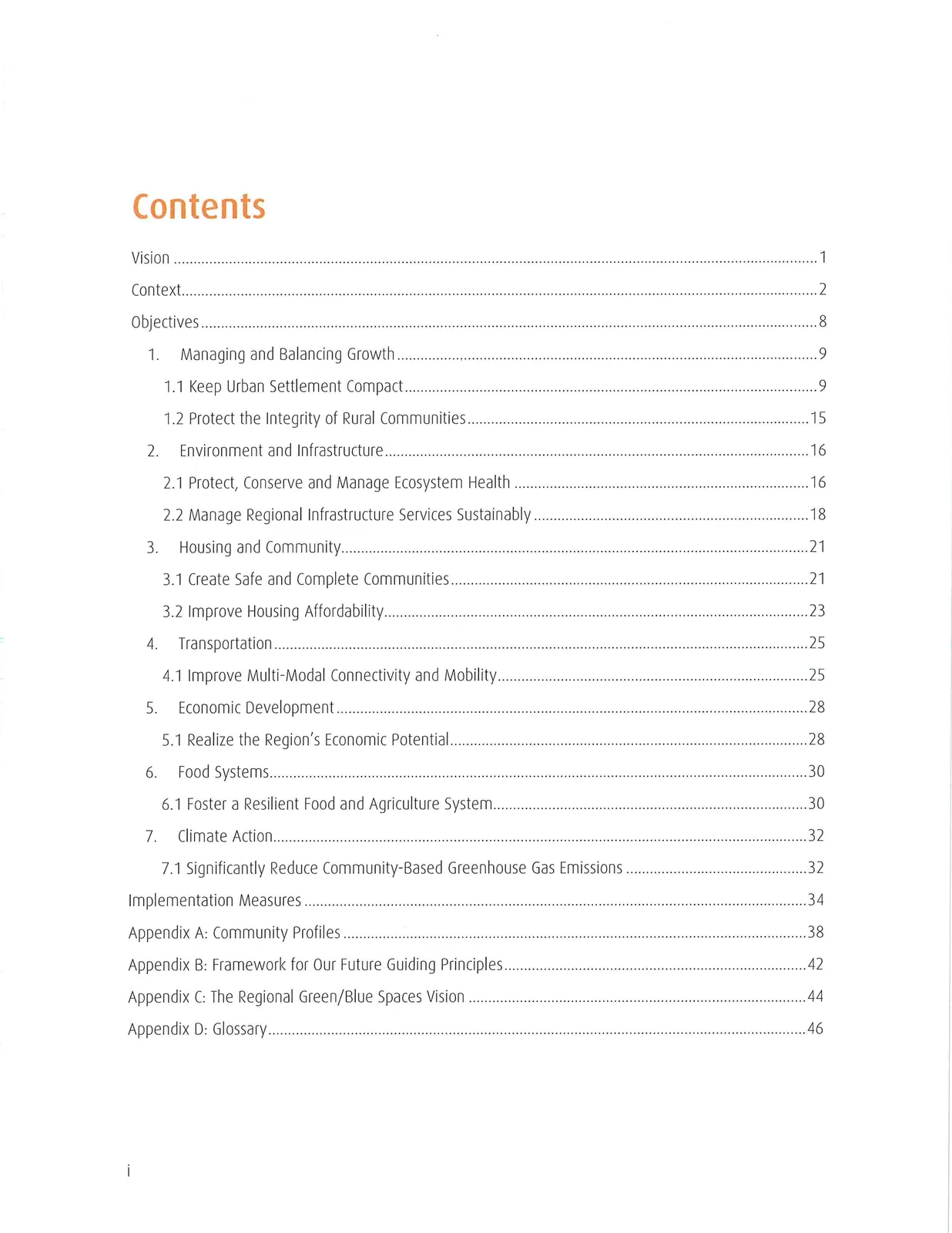
Contents Vision .1 Context..................................................................................................................................................................2 Objectives.............................................................................................................................................................8 1. Managing and Balancing Growth...........................................................................................................9 1.1 Keep Urban Settlement Compact.........................................................................................................9 1.2 Protect the Integrity of Rural Communities.......................................................................................15 2. Environment and Infrastructure............................................................................................................16 2.1 Protect, Conserve and Manage Ecosystem Health ...........................................................................16 2.2 Manage Regional Infrastructure Services Sustainably ...................................................................... 1 8 3. Housing and Community.......................................................................................................................21 3.1 Create Safe and Complete Communities...........................................................................................21 3.2 Improve Housing Affordability ............................................................................................................ 23 4. Transportation........................................................................................................................................25 4.1 Improve Multi-Modal Connectivity and Mobility ..................................... .......................................... 25 5. Economic Development........................................................................................................................28 5.1 Realize the Region's Economic Potential...........................................................................................28 6. Food Systems.........................................................................................................................................30 6.1 Foster a Resilient Food and Agriculture System ................................................................................ .30 7. Climate Action........................................................................................................................................32 7.1 Significantly Reduce Community-Based Greenhouse Gas Emissions..............................................32 Implementation Measures................................................................................................................................34 Appendix A: Community Profiles......................................................................................................................38 Appendix B: Framework for Our Future Guiding Principles.............................................................................42 Appendix C: The Regional Green/Blue Spaces Vision......................................................................................44 Appendix 0: Glossary.........................................................................................................................................46 Page 10 of 84 Page 10 of 84
Page 11
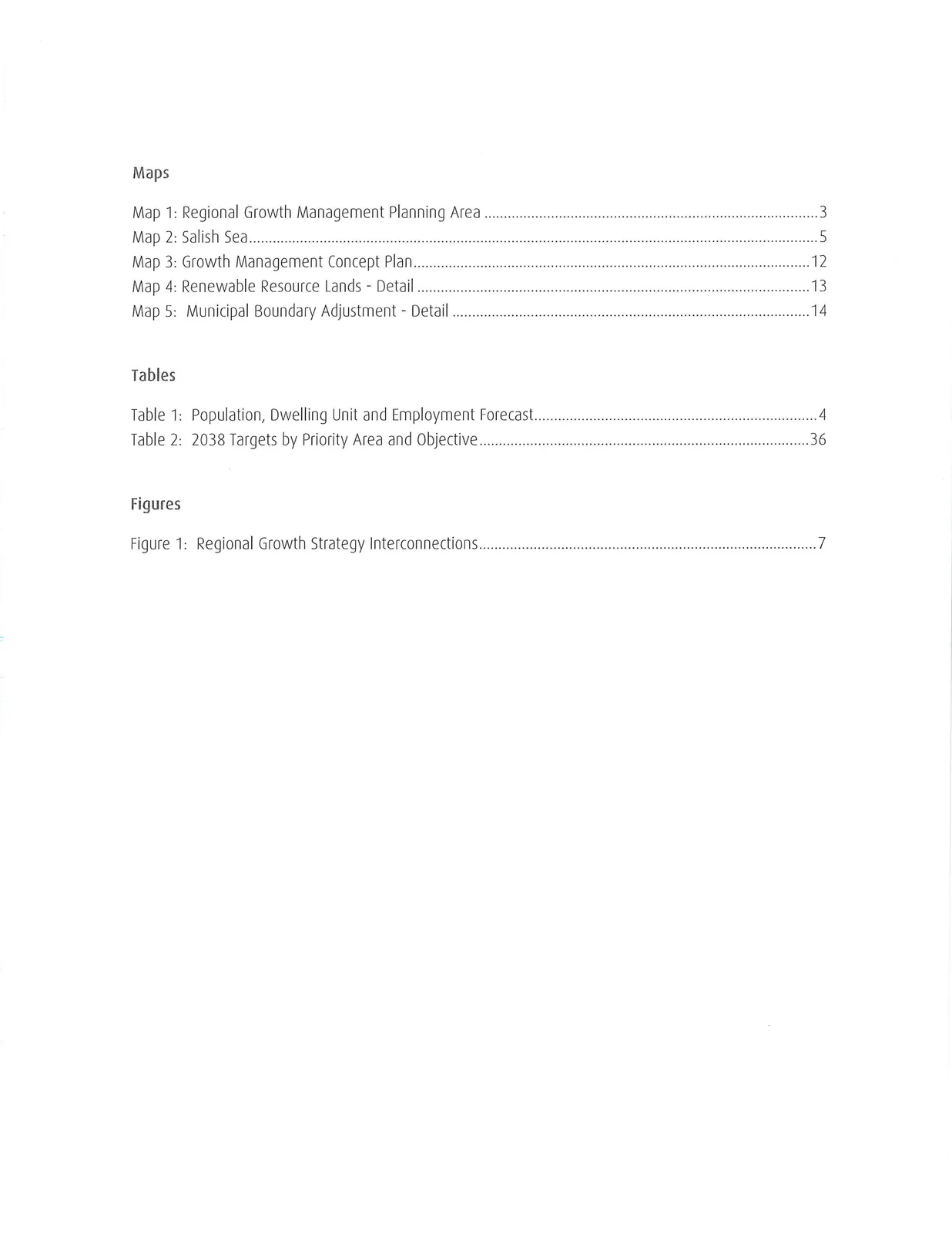
Maps Map 1: Regional Growth Management Planning Area Map2: Salish Sea........................................................... Map 3: Growth Management Concept Plan................. Map 4: Renewable Resource Lands - Detail................ Map 5: Municipal Boundary Adjustment - Detail ....... 3 5 12 13 14 Tables Table 1: Population, Dwelling Unit and Employment Forecast................ .4 Table 2: 2038 Targets by Priority Area and Objective.............................. 36 Figures Figure 1: Regional Growth Strategy Interconnections......................................................................................7 Page 11 of 84 Page 11 of 84
Page 12
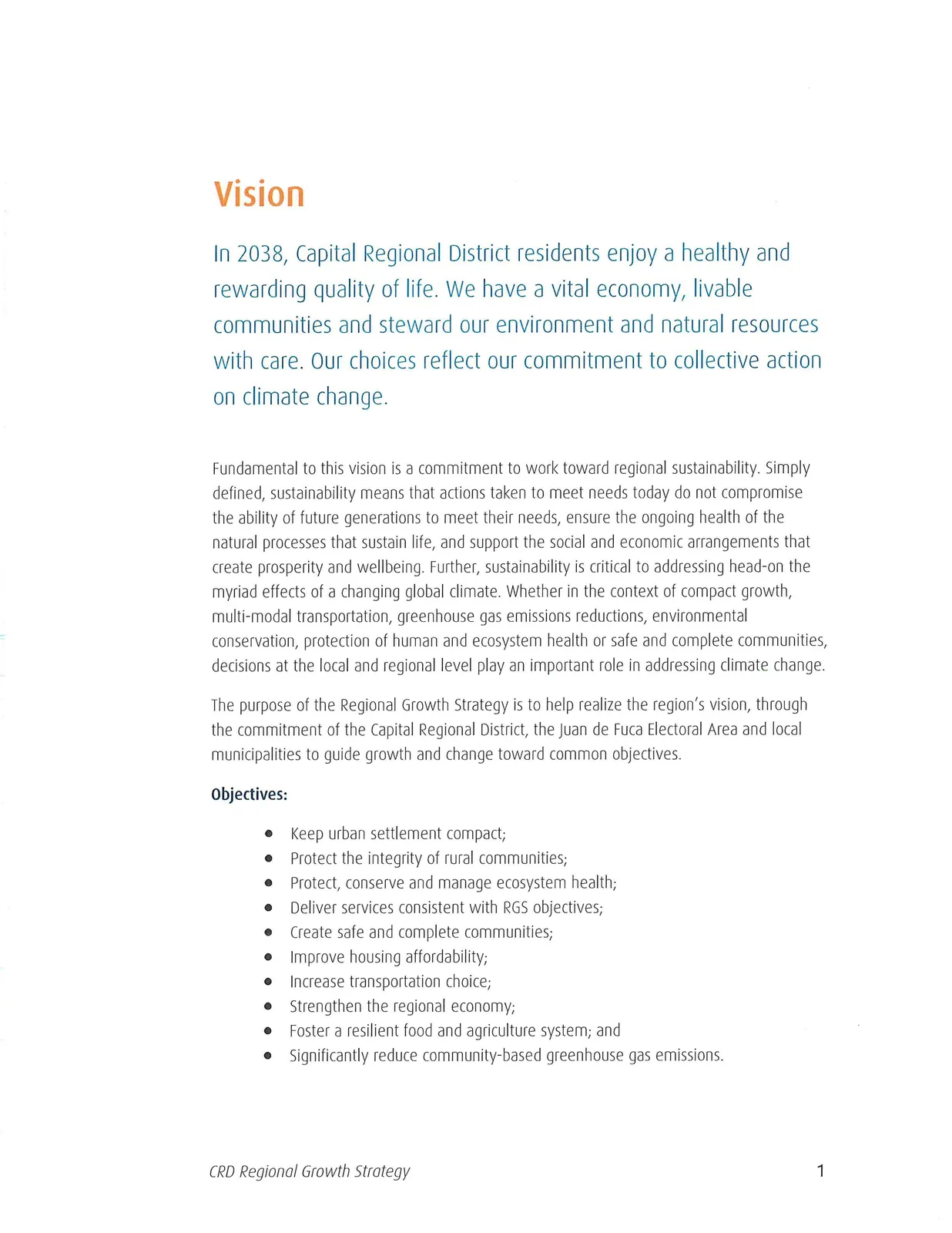
In 2038, Capital Regional District residents enjoy a healthy and rewarding quality of life. We have a vital economy, livable communities and steward our environment and natural resources with care. Our choices reflect our commitment to collective action on climate change. Fundamental to this vision is a commitment to work toward regional sustainability. Simply defined, sustainability means that actions taken to meet needs today do not compromise the ability of future generations to meet their needs, ensure the ongoing health of the natural processes that sustain life, and support the social and economic arrangements that create prosperity and wellbeing. Further, sustainability is critical to addressing head-on the myriad effects of a changing global climate. Whether in the context of compact growth, multi-modal transportation, greenhouse gas emissions reductions, environmental conservation, protection of human and ecosystem health or safe and complete communities, decisions at the local and regional level play an important role in addressing climate change. The purpose of the Regional Growth Strategy is to help realize the region's vision, through the commitment of the Capital Regional District, the Juan de Fuca Electoral Area and local municipalities to guide growth and change toward common objectives. Objectives: • Keep urban settlement compact; • Protect the integrity of rural communities; • Protect, conserve and manage ecosystem health; • Deliver services consistent with RGS objectives; • Create safe and complete communities; • Improve housing affordability; • Increase transportation choice; • Strengthen the regional economy; • Foster a resilient food and agriculture system; and • Significantly reduce community-based greenhouse gas emissions. (RD Regional Growth Strategy 1 Page 12 of 84 Page 12 of 84
Page 13
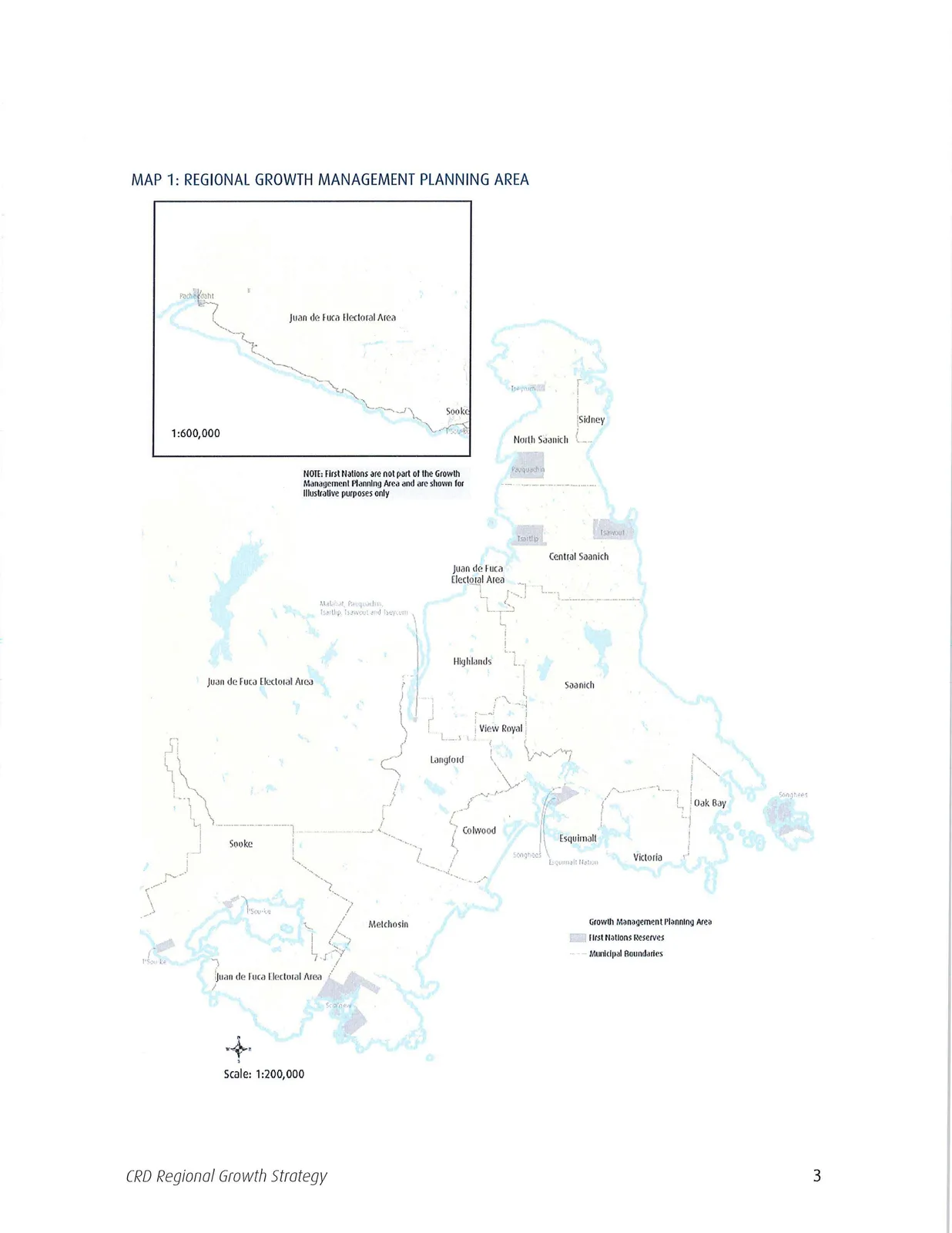
'.uitAt A regional growth strategy is a framework, developed by municipalities and the regional district in partnership, for identifying social, economic and environmental objectives. Its purpose, under Part 13 of the Local Government Act, is to "... promote human settlement that is socially, economically, and environmentally healthy and that makes efficient use of public facilities and services, land and other resources." A regional growth strategy expresses how communities will work together to enhance regional quality of life and social well- being. As of 2008, regional growth strategies must also include policies, actions and targets for the reduction of greenhouse gas emissions. The Capital Regional District adopted a Regional Growth Strategy bylaw in 2003. In 2011, the Capital Regional District Board in partnership with local municipalities initiated the required five year review of the Regional Growth Strategy (2003). The 2016 update to the Regional Growth Strategy follows considerable public and intergovernmental discussion and consultation. Map 1 shows the Regional Growth Management Planning Area. At the present time, the Capital Region's ten First Nations are not partners in the regional growth strategy, nor does it apply to the Salt Spring Island and the Southern Gulf Islands Electoral Areas, which fall under the planning jurisdiction of the Islands Trust (see Map 1). Citizens, local governments, First Nations, school district boards, stakeholders, and provincial and federal agencies have been involved in the Strategy's update through a regional sustainability planning process. This process determined that many of the policies of the Regional Growth Strategy (2003) are achieving desired objectives, notably, increasing compact and complete communities, acquiring green space, and substantially completing the regional trail network. Further, key complementary planning documents identified as actions to implement the Regional Growth Strategy (2003) are complete, including: • 2007 Regional Housing Affordability Strategy; and • Regional Transportation Strategy (completed as the 2014 Regional Transportation Plan and the 2011 Pedestrian and Cycling Master Plan). Input and feedback have affirmed the desire for a strong growth management framework rooted in the 2003 Regional Growth Strategy objectives and emphasized the importance of mitigating and adapting to the effects of climate change. Updates integrate recommendations from completed planning documents and address the requirements for policies, actions and targets for greenhouse gas reductions. 2 (RD ReD/Dna! Growth Strategy Page 13 of 84 Page 13 of 84
Page 14
MAP 1: REGIONAL GROWTH MANAGEMENT PLANNING AREA Juan tie I rica Ti cheat Area Soctkr 1:600,000 NOTE First Nations are not part of the Growth lhrnigninenh I1inhritiuj Area dish sre stiswii for Illustrative purposes only Sidney h'lcrihhu Saarrichi Central Saanich Juan de F tuna Electoral Area
Highlands Juan do Inca [leclotal Area . Soanch View Royal Lorrytord I / Oak Bay
-...................-. -- Coiwood SnoRe .-.- Enqriiririhi 4. Victoria i' Metctrnsin Growth Management Nanning Area Out Notions Reserves Mtuirkipsl t5o1111drrmes Juan do I inca I Iechnnral Area Scale: 1:200,000 (RD Regional Growth Strategy 3 Page 14 of 84 Page 14 of 84
Page 15
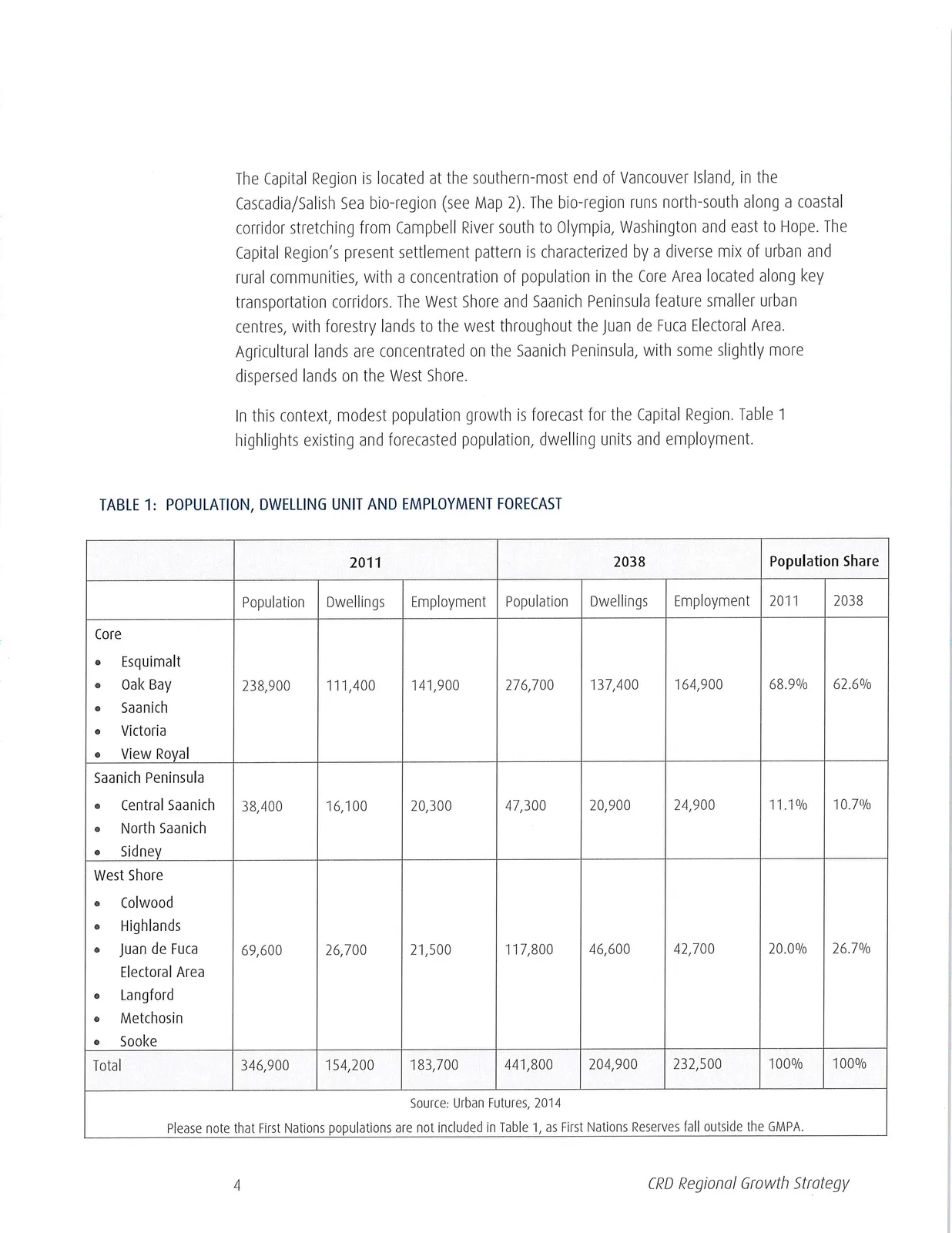
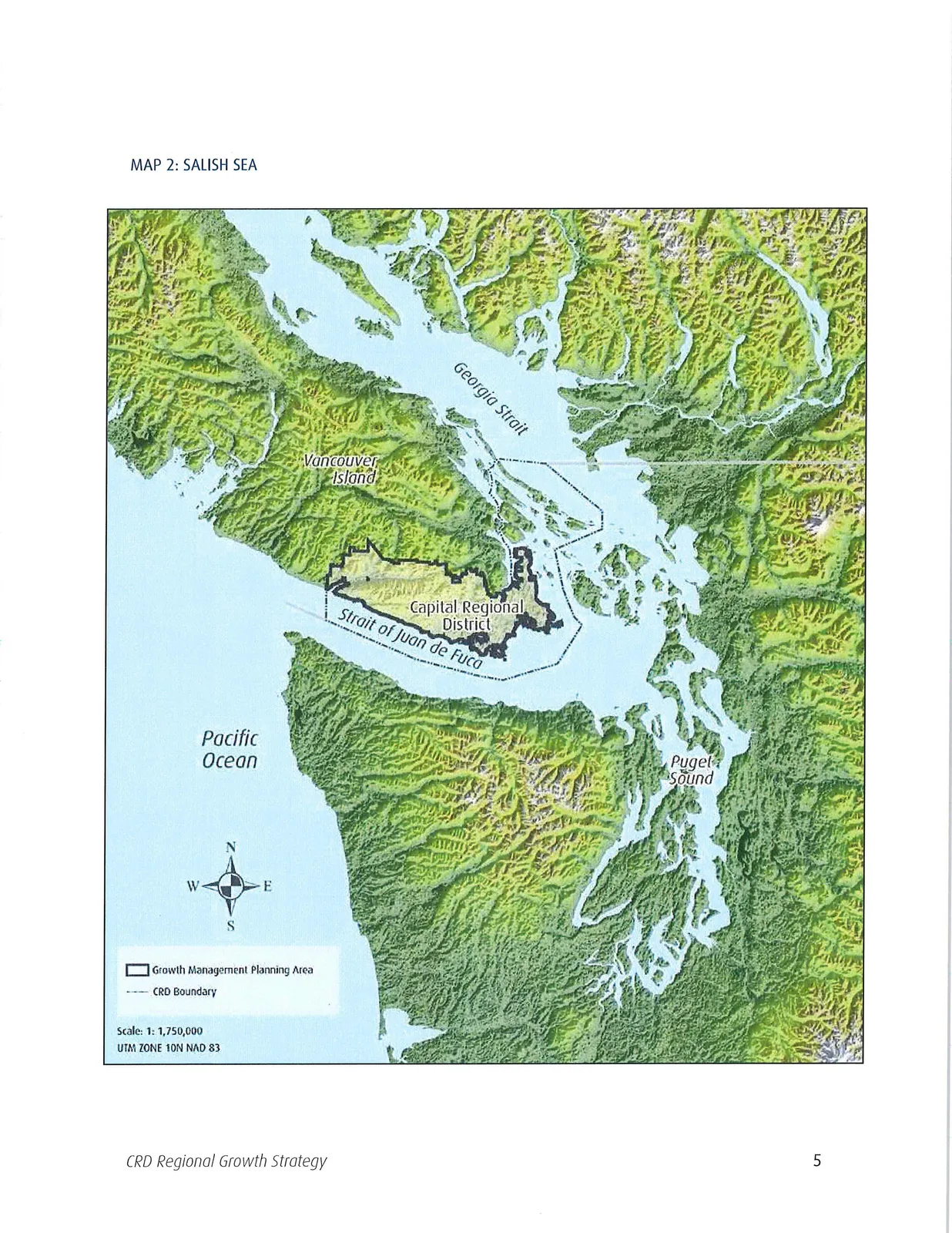
The Capital Region is located at the southern-most end of Vancouver Island, in the Cascadia/Salish Sea bio-region (see Map 2). The bio-region runs north-south along a coastal corridor stretching from Campbell River south to Olympia, Washington and east to Hope. The Capital Region's present settlement pattern is characterized by a diverse mix of urban and rural communities, with a concentration of population in the Core Area located along key transportation corridors. The West Shore and Saanich Peninsula feature smaller urban centres, with forestry lands to the west throughout the Juan de Fuca Electoral Area. Agricultural lands are concentrated on the Saanich Peninsula, with some slightly more dispersed lands on the West Shore. In this context, modest population growth is forecast for the Capital Region. Table 1 highlights existing and forecasted population, dwelling units and employment. TABLE 1: POPULATION, DWELLING UNIT AND EMPLOYMENT FORECAST 2011 2038 Population Share Population Dwellings Employment Population Dwellings Employment 2011 2038 Core • Esquimalt • Oak Bay 238,900 111,400 141,900 276,700 137,400 164,900 68.9% 62.6% • Saanich • Victoria • View Royal
Saanich Peninsula • Central Saanich 38,400 16,100 20,300 47,300 20,900 24,900 11.1°/a 10.7% • North Saanich • Sidney
West Shore • Colwood • Highlands • Juan de Fuca 69,600 26,700 21,500 117,800 46,600 42,700 20.0 0/a 26.7% Electoral Area • Langford • Metchosin • Sooke
Total 346,900 154,200 183,700 441,800 204,900 232,500 100% 100% Source: Urban Futures, 2014 Please note that First Nations populations are not included in Table 1, as First Nations Reserves fall outside the GMPA. 4 CRD Peg/one! Growth Strotegy Page 15 of 84 Page 15 of 84
Page 16
MAP 2: SALISH SEA 5 ._ :: 7j1 v i*
• &-' , J' "
- A.-O -7 j -7f A Z -,'- , r r/, ' 1"lII((J1lVlI " l4'? d
— .1 fit 10 rf'Øir ,r / f(1fld4 f gtrY A /
p • t. a 4 J AW f ç JA fC IN J4 It Ce- I CE11'll ii 1' ea1111 ii ' r-
.-.-- jr-a. •: -F t.-'
-i
;I-,p. •;. ri CRD Regionol Growth Strotegy JCrowth management Planning Area CR0 Boundary Stale: 1: 1,75000 UtM ZONE ION NAO 83 Pacific Ocean W F District // :1 Ca
—
37 — IIPP jj It Ak
46 -, () L t LiJL
AfA 6 in i 6W V Of ti•: I fi Ai • fi
, 1
:'-; ': ,:';•'-TW Page 16 of 84 Page 16 of 84
Page 17
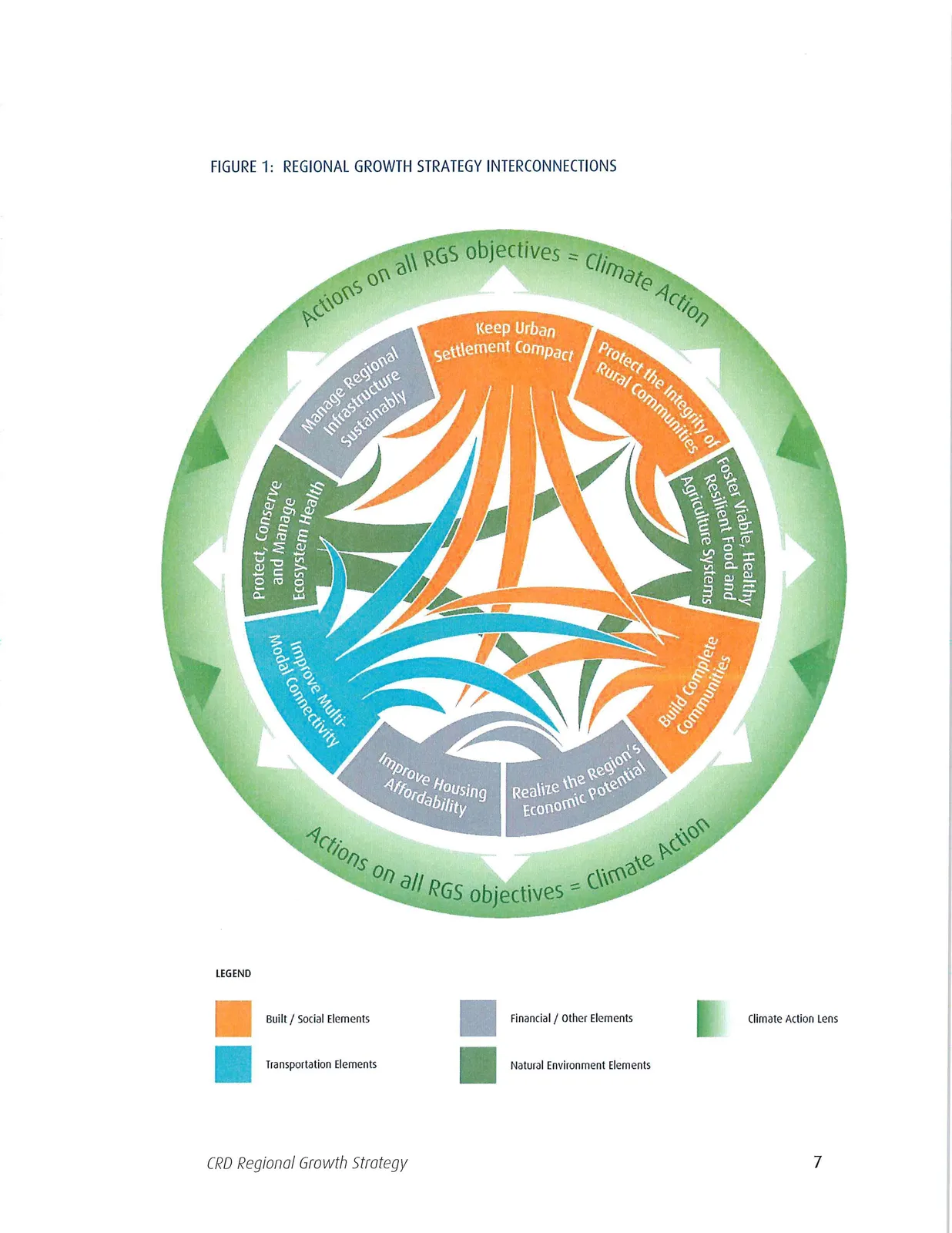
From a 2011 base of approximately 346,900, the region's population is forecast to increase by approximately 94,900 people to 441,800 in 2038, an approximate 1% average annual population increase. The slow aging of the region's population continues as a significant trend, with the proportion of residents 65 years and older expected to rise from 18% in 2011 to 26% by 2038. Further, although the workforce (ages 15 to 64) is projected to grow by 31,900, the proportion of workforce to total population is projected to decline from 690/0 to 61% by 2038. Serving the needs of an aging population in the context of a Proportionately smaller workforce will affect all aspects of the region's social, economic and physical development. It continues to be clear, however, that even modest population growth would undermine the regional vision if it were accommodated as it has been since the 1950s, through further urban expansion into farms, forests and countryside. Further, an expanded regional footprint would significantly contribute to increased greenhouse gas emissions. Achieving the regional vision requires a concerted effort to largely shift to policies that encourage investment and development in complete communities within the designated growth area. Paramount to success is coordinated and consistent decision-making that focuses on how people, land use, transportation, infrastructure and technology can mitigate and adapt to a changing climate. The Regional Growth Strategy supports the regional vision by making this policy shift, through objectives that aim to: keep urban settlement compact; protect the integrity of rura communities; protect, conserve and manage ecosystem health; deliver services consistent with RGS objectives; build safe and complete communities; improve housing affordability; increase transportation choice; strengthen the regional economy; and, foster a resilient food and agriculture system. Realising these objectives is critically important for successfully reducing greenhouse gas emissions. Figure 1 illustrates the interconnections among the Regional Growth Strategy objectives and between these objectives and climate change. The objectives are colour-coded to reflect how different elements of sustainability are represented in the Regional Growth Strategy and how together, these elements provide for a climate action lens. Keeping urban settlement compact and increasing transportation choice have a high degree of interdependence with other objectives. These strong links illustrate that achieving these two objectives will be particularly important for the realization of the regional vision. Further, the graphic illustrates that the Regional Growth Strategy objectives will support climate action and that taking action on climate change will, in turn, impact each objective. CRD Regional Growth Strategy Page 17 of 84 Page 17 of 84
Page 18
FIGURE 1: REGIONAL GROWTH STRATEGY INTERCONNECTIONS \ ?GS objectives
•p; POW 4. OOS all RGS objectives LEGEND Built/ Social Elements Financial / Other Elements k~ Climate Action Lens Transportation Elements Natural Environment Elements (RD Reg/ono! Growth Strategy 7 Page 18 of 84 Page 18 of 84
Page 19
Ohiectj VP S The Regional Growth Strategy includes integrated objectives, incorporating policies, targets, maps and guidelines that together express a program of joint action by the Capital Regiona District and local municipalities to achieve the regional vision. • Objectives define a desired future on matters of regional interest. • Policies are provided under the "policy" heading for each objective. The Capital Regional District will implement policies and undertake actions for regionally- delivered services and programs. Local municipalities will identify how their Official Community Plan aligns to each policy in a Regional Context Statement. • Maps showing the Growth Management Concept Plan (Map 3) and details of the Renewable Resource Lands (Map 4) provide spatial definition for policy. • Targets for each objective are provided in Table 2 at the end of the document. Targets are aspirational in nature. It is unlikely that they will be achieved by the CRD and municipalities alone. Achieving the targets will require concerted effort on the part of the CRD and municipalities as well as senior governments, local residents and businesses, utilities, community groups and others. • Actions for the Capital Regional District to implement the Regional Growth Strategy are provided in the Implementation Measures section. Subject to the Local 60v81/7rne/7tActand the articulation of policies in the Regional Growth Strategy document, the CRD and local municipalities recognize that the Regional Growth Strategy is intended as a planning policy document to serve as a guide for future decision making. 8 (RD Regionol Growth Strotegy Page 19 of 84 Page 19 of 84
Page 20
1.1 Keep Urban Settlement Compact A designated Growth Policy Area aims to keep urban areas compact and to keep growth largely contained within its boundaries. Fundamental to urban containmentgrowth management are four related approaches that aim to increase the capacity of urban areas, particularly in the Core Municipalities and the urban West Shore, to accommodate new growth.' Approaches I. Establish a strong mix of uses focused around Victoria's downtown core area as the primary regional employment, business and cultural centre; II. Focus employment and population growth primarily in complete communities, located in areas that meet criteria described in Objective 3.1, that will encourage the development of walkable, bikeable and transit—focused areas with a dense mix of housing, employment, services and public open space; II. Increase the proportion of apartments, row houses and other attached housing types within the Growth Policy Area, especially within complete communities; and, V. Locate a minimum of 95% of the region's new dwelling units to 2038 within the Growth Policy Area. The aim of keeping urban settlement compact is to concentrate growth within a firm Growth Policy Area Boundary that will over time result in the creation of centres and connecting corridors that can be effectively served by express-bus transit. This lays the foundation to achieve a longer term objective of connecting the downtown Victoria—Douglas Street— Uptown corridor with Coiwood and Langford by high— capacity public transit running in a dedicated right—of—way. To support quality of life and community character in rural areas, urban containment directs growth into complete communities to reduce development pressures in the Saanich Peninsula, rural West Shore, Sooke and the Juan de Fuca Electoral Area. Growth outside the growth boundary is to be kept to 5% or less of the regional total. 1 Table 1 provides a general forecast, for information only, of population, dwelling units and employment in 2038 by sub-region that could be expected under the Regional Growth strategy. CRD Reg/onol Growth Strotegy 9 Page 20 of 84 Page 20 of 84
Page 21
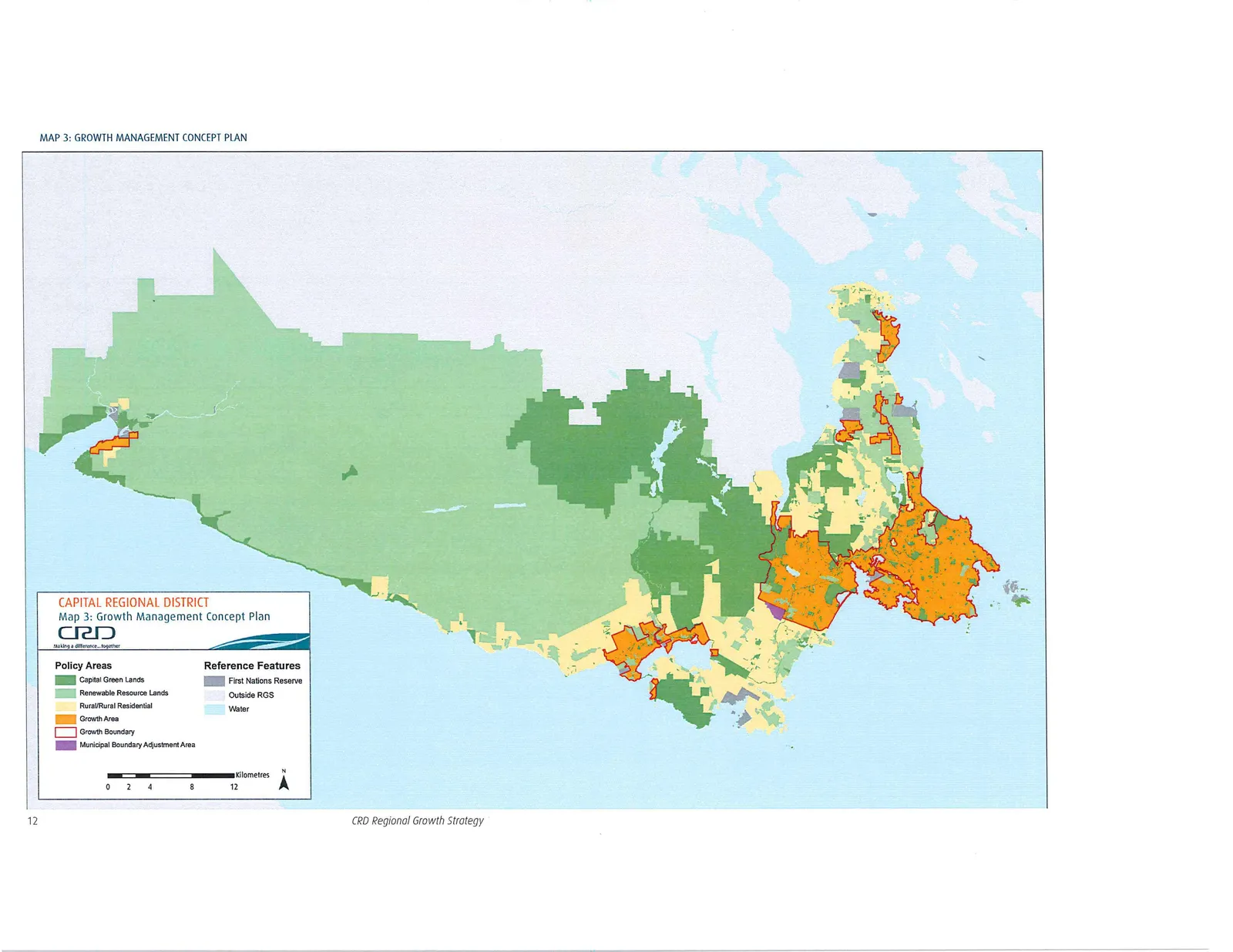
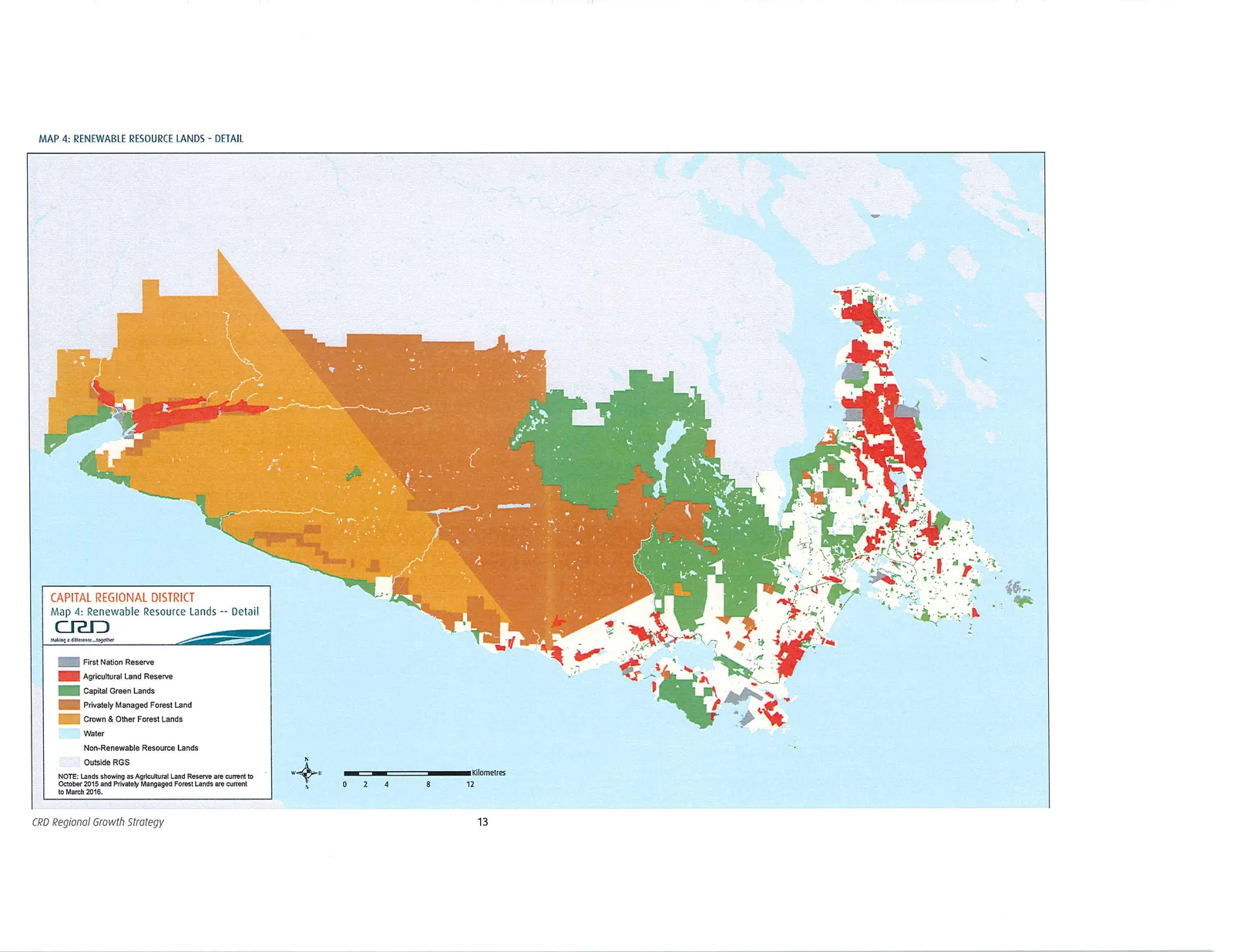
A Growth Management Concept Plan and four land use policy designations will help keep urban settlement compact. Map 3 sets out the Growth Management Concept Plan and Map 4 provides additional detail for the Renewable Resource Lands Policy Area. Land Use Designations Capital Green Lands Policy Area: Includes Ecological Reserves, Capital Regional District Water lands, and Parks. The Regional Growth Strategy sets out in policy 2.1(1) the continued long—term use of these lands for these purposes. Renewable Resource Lands Policy Area: Includes lands within the Agricultural Land Reserve (ALR), the Private Managed Forest Lands and Crown Forest Lands. The Regional Growth Strategy sets out in policy 5.1(4) the continued long—term use of these lands as renewable resource working landscapes. Growth Policy Area: Includes residential, general employment, commercial and industrial lands, as well as other associated land uses. The Growth Policy Area is intended to accommodate 95% of the region's new dwelling units, and is where major new transportation infrastructure investments will be directed. The Regional Growth Strategy restricts extension of urban—standard sanitary sewerage services beyond the Growth Policy Area Boundary as set out under policy 2.2(5). Within the Growth Policy Area, employment and population growth is to be directed to areas that meet criteria set out in Objective 3.1, for complete communities. Complete communities are intended to accommodate housing, jobs and services at densities that will support transit. Focusing growth in complete communities is central to reducing community-based greenhouse gas emissions, reducing development pressure on rural and resource lands and keeping infrastructure affordable. Where Capital Green Lands and Renewable Resource Lands Policy Areas overlap with the Growth Policy Area, the land use policy for the Capital Green Lands and Renewable Resource Lands Policy Areas shall take precedence. Liquid waste service may be provided to such lands within the Growth Policy Area provided it is for a purpose consistent with the land use designations for the Capital Green Lands and Renewable Resource Lands Policy Areas. Rural/Rural Residential Policy Area: Includes lands to be used for rural and rural residential purposes and the Victoria International Airport (with development potential as established through approved Memorandum of Understanding). The Regional Growth Strategy sets out in policy 1.1(1) and 1.2(1) that Rural/Rural Residential lands are not intended to become future urban areas requiring extensive services. Residential uses are of a form, density and character that support rural working landscapes. Commercial uses are local serving and such uses and other employment opportunities result in minimal impact to the surrounding community and to the environment. Low-impact tourism uses complement rural character. 10 (RD Regionol Growth Strotegy Page 21 of 84 Page 21 of 84
Page 22
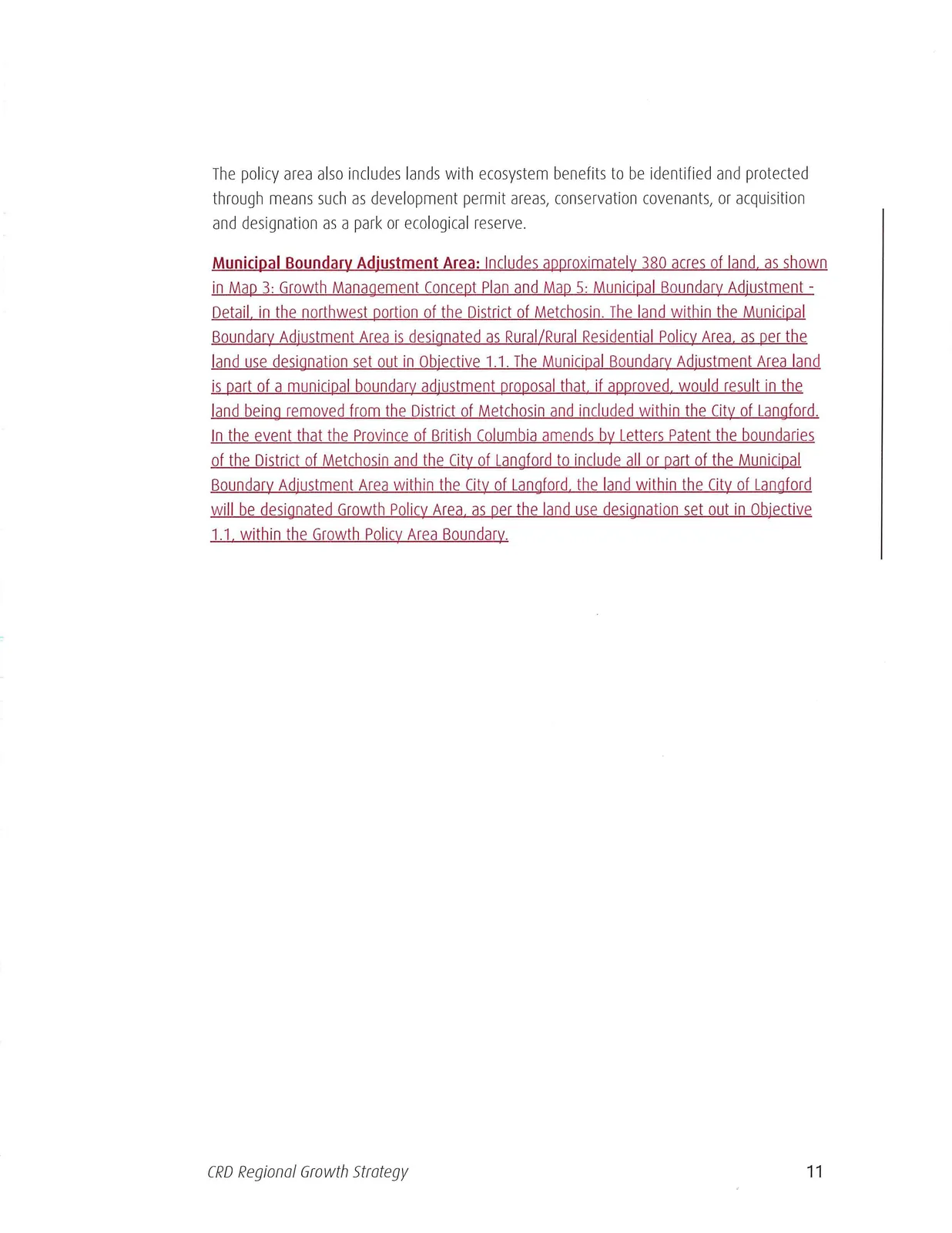
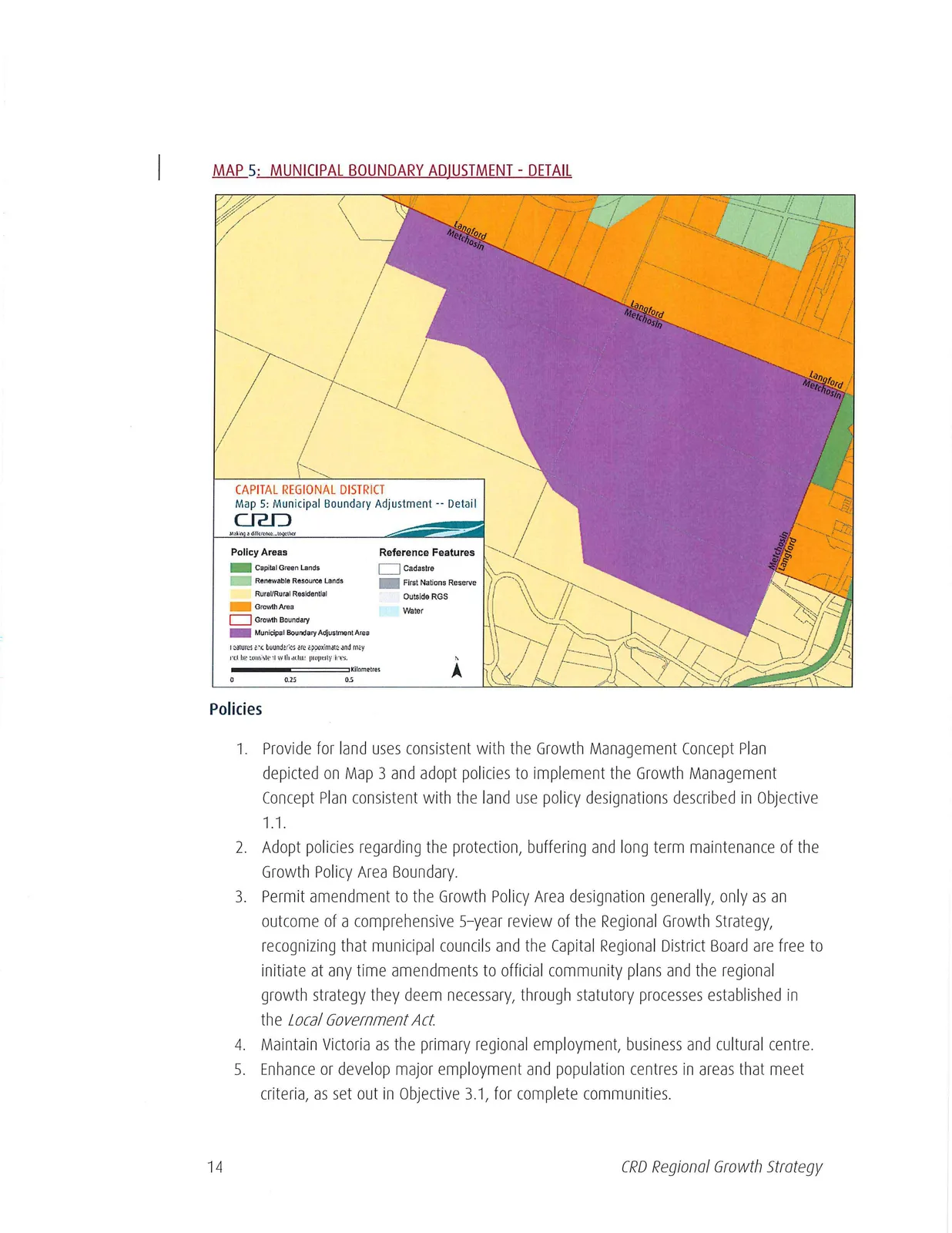
The policy area also includes lands with ecosystem benefits to be identified and protected through means such as development permit areas, conservation covenants, or acquisition and designation as a park or ecological reserve. Municipal Boundary Adjustment Area: Includes approximately 380 acres of land, as shown in Map 3: Growth Management Concept Plan and Map 5: Municipal Boundary Adjustment - Detail, in the northwest portion of the District of Metchosin. The land within the Municipal Boundary Adjustment Area is designated as Rural/Rural Residential Policy Area, as per the land use designation set out in Objective 1.1. The Municipal Boundary Adjustment Area land is part of a municipal boundary adjustment proposal that, if approved, would result in the land being removed from the District of Metchosin and included within the City of Langford. In the event that the Province of British Columbia amends by Letters Patent the boundaries of the District of Metchosin and the City of Langford to include all or part of the Municipal Boundary Adjustment Area within the City of Langford, the land within the City of Langford will be designated Growth Policy Area, as per the land use designation set out in Objective 1.1, within the Growth Policy Area Boundary. CRD Regional Growth Strategy 11 Page 22 of 84 Page 22 of 84
Page 23
MAP 3: GROWTH MANAGEMENT CONCEPT PlAN 1 CAPITAL REGIONAL DISTRICT Map 3: Growth Management Concept Plan CS2JJ _ ON, .159n5c Policy Areas Reference Features Capital Green Lands
First Nations Reserve Renewable Resource Lands Outside RGS Rural/Rural Residential Water Growth Area [] Growth Boundary Municipal Boundary Adjustment Area 12 Kilometres 0 2 4 8 12 A (RD Regional Growth Strategy Page 23 of 84 Page 23 of 84
Page 24
MAP 4: RENEWABLE RESOURCE LANDS - DETAIL . I A i~ L + b .' .-..I Kilometres 0 2 4 8 12 (RD Reg/onol Growth Strotegy 13 Page 24 of 84 Page 24 of 84
Page 25
MAP 5: MUNICIPAL BOUNDARY ADJUSTMENT - DETAIL
// /• ,/ /' /' /" /-•'-:L /1 "-°A'
/ II ,/ CAPITAL REGIONAL DISTRICT Map 5: Municipal Boundary Adjustment -- Detail CRJD _ 50/ dlk5i.,t/,doi / Policy Areas ET'T1 Capital Green Lands Renewable Resource Lends Rural/Rural Residential Growth Area [J Growth Boundary Municipal Boundary AuslmentArea ralurri c LuUndlrCS /10 drisrinimair and moy roil'. ii,' ii w lii Kilnmetre 0 0.25 03 Policies
- Provide for land uses Consistent with the Growth Management Concept Plan depicted on Map 3 and adopt policies to implement the Growth Management Concept Plan consistent with the land use policy designations described in Objective 1.1
- Adopt policies regarding the protection, buffering and long term maintenance of the Growth Policy Area Boundary.
- Permit amendment to the Growth Policy Area designation generally, only as an outcome of a comprehensive 5—year review of the Regional Growth Strategy, recognizing that municipal councils and the Capital Regional District Board are free to initiate at any time amendments to official community plans and the regional growth strategy they deem necessary, through statutory processes established in the Local Government Act.
- Maintain Victoria as the primary regional employment, business and cultural centre.
- Enhance or develop major employment and population centres in areas that meet criteria, as set out in Objective 3.1, for complete communities. 14 (RD Regionol Growth Strotegy Reference Features Cadastre First Nations Reserve Outside RGS Water A -0 /1 / ,1
411 J11
;i
Page 25 of 84
Page 25 of 84
Page 26
1.2 Protect the Integrity of Rural Communities Keeping urban settlement compact will help protect the character and quality of rural communities, ensure that they remain strongly rooted in the agricultural and resource land base, and allow the rural countryside and natural landscape to remain a durable fact of life in the Capital Region. The protection of rural communities starts with clearly defining and distinguishing between urban and rural areas. The Regional Growth Strategy does this by designating for long term protection as Capital Green Lands and Renewable Resource Lands those natural assets including parks, ecological reserves, forests, farmland and watersheds that make up the region's green infrastructure and contribute to the regional economy. The designation of a Growth Policy Area reinforces the protection of Capital Green Lands, Renewable Resource Lands and Rural/Rural Residential Policy Areas and has the further benefit of supporting the long—term effort to keep urban settlement compact. Rural and rural—residential communities offer a choice of rural lifestyles and outdoor recreation opportunities that complement the surrounding working landscapes and preserve ecological diversity. New development in the Rural/Rural Residential Policy Area is not intended to exceed 5% of the region's new dwelling units. Policy 1.1 protects rural communities by requiring that local municipalities and the Juan de Fuca Electoral Area provide for land uses consistent with the Growth Management Concept Plan and adopt policies that would prevent lands designated as Rural/Rural Residential from becoming future urban areas. Strengthening the character and quality of rural communities can be achieved by planning for development in accordance with the principles set out below. Principles Maintain working landscapes including agriculture, forestry and outdoor recreation activities that contribute to the region's economy; II. Avoid the creation of future urban areas through development patterns that complement rural form, density and character; Ill. Minimize impacts to the natural environment and surrounding working landscapes; and IV. Accommodate a slow to moderate rate of growth, contributing to no more than 5% of the region's new residential units. Policies Plan for development in the Rural/Rural Residential Policy Area depicted on Map 3 in a manner that is consistent with the principles set out in Objective 1.2. CRD Regionol Growth Strategy 15 Page 26 of 84 Page 26 of 84
Page 27
2.1 Protect, Conserve and Manage Ecosystem Health The Capital Region has a rich inheritance of natural lands and waters of great beauty and biophysical diversity. Residents of the Capital Region enjoy a healthy environment where environmental quality is improved and the inheritance of renewable and non-renewable natural resources is carefully stewarded. Many of the region's terrestrial, fresh water and marine environments - its green and blue spaces - are of provincial, national and international significance.' The system of green and blue spaces that make up the region's natural environment spans a diverse range of ecosystems and land uses and requires integrated, collaborative and co-operative management of land and water resources. The Regional Growth Strategy aims to protect the landscape character, ecological heritage and biodiversity of the Capital Region by protecting, conserving and managing lands according to the principles set out below. Principles I. Waste discharges of all types should not exceed the assimilative capacity of the natural environment (including land, air and water); II. Depletion rates for natural resources should not exceed the regenerative capacity of the ecosystems that produce them; Ill. Consumption of scarce renewable and non—renewable resources should be minimized through conservation, efficiency and application of technology and reduce, reuse and recycle practices; IV. Benefits derived from healthy ecosystems should be recognized and integrated into land use management and service delivery decisions; and, V. Decision—making should give first priority to options that maintain ecosystem and population health and support the ongoing ability of natural systems to sustain life. Parkland acquisition protects lands for conservation and recreation by establishing a connected system of natural areas. Central to this system is the protection of a sea to sea green/blue belt running from Saanich Inlet south to Juan de Fuca Strait, and the development of an integrated system of parks and trails linking urban areas to rural green space areas. By applying these principles, it will be possible to improve human health, 2 The Regional Green/Blue spaces Strategy was a foundational document for the development of the 2003 Regional Growth Strategy. The strategy has been superseded by subsequent planning initiatives such as the Regional Parks strategic Plan, the Integrated Watershed Management Program Plan, the Regional Parks Land Acquisition strategy and park management plans for the Sooke Hills Wilderness and Sea to Sea Regional Parks. 16 CRD Regional Growth Strategy Page 27 of 84 Page 27 of 84
Page 28
[educe negative impacts on the natural environment and mitigate and adapt to the impacts of climate change. Policies
- Ensure the long—term protection of Capital Green Lands depicted on Map 3. This could include policies for buffering and land use transition between Capital Green Lands and adjacent settled areas (i.e., lands within the Rural/Rural Residential Land Use Policy Area as well as the Growth Policy Area), as well as policies aimed at enhancing, restoring or naturalizing Capital Green Lands.
- Prioritize community and regional park land acquisition, public and private land stewardship programs and regional trail network construction that contributes to completion of the sea to sea green/blue belt running from Saanich Inlet south to Juan de Fuca Strait.
- Identify, protect, enhance and restore healthy ecosystems using tools that may consist of policies, regulations, development permit area guidelines, incentives, initiatives and education and outreach delivered at the local level consistent with the principles set out in Objective 2.1.
- Protect the ecological integrity of watersheds and marine areas through collaborative initiatives consistent with the principles set out in Objective 2.1.
- Manage surface water, drainage and groundwater in non—catchment watersheds throughout the region using an integrated watershed planning approach consistent with the principles set out in Objective 2.1.
- Plan for the long term strategic resource needs in the Capital Region - including food (paying specific attention to local food production), energy, water, and aggregate materials consistent with the principles set out in Objectives 2.1 and 7.1. Plans will consider long term demand, security of supply and potential impacts of factors such as long term climate change, fossil fuel depletion and water reclamation where feasible, and make policy and program recommendations to ensure that future needs are successfully anticipated and met. CRD Regional Growth Strategy 17 Page 28 of 84 Page 28 of 84
Page 29
2.2 Manage Regional Infrastructure Services Sustainably Regional servicing infrastructure includes drinking water, liquid and solid waste. These services must be efficiently and cost-effectively managed for the long-term in order to accommodate the anticipated population increase. The Sooke reservoir, managed and operated by the CRD, is the drinking water supply for the Capital Region. The CRD provides treated bulk water to multiple distribution systems around the region. The distribution systems differ by municipality and require ongoing cooperation for the planning and management of the service. Private wells and community water systems supply water to many residents in rural areas. The Hartland Landfill provides solid waste disposal services for the Capital Region. The CRD sees waste as a commodity and seeks the highest and best use for these resources by applying the 5R hierarchy of Reduce, Reuse, Recycle, Resource Recovery and Residual Management. This includes a focus towards zero waste in our landfill, recycling programs, organics diversion, landfill gas capture and emerging opportunities. The Saanich Peninsula Wastewater Treatment Plant provides secondary wastewater treatment to residents in the Saanich Peninsula. At the time of writing the Regional Growth Strategy, a planning process is underway to identify wastewater management strategies for the Core Area. Private septic fields treat liquid waste for residents in rural areas. Infrastructure services may be impacted not only by an increased demand for the service as the population grows, but also by the form, pattern and location of new development. Servicing new development with limited or low density, which adds fewer new users per unit length of water or sewer pipe than the system average, would generally be more expensive than in denser areas. The costs of operating and maintaining this infrastructure over its lifecycle require consideration beyond the one-time capital investment. Keeping urban settlement compact will help create the densities needed to create efficient servicing infrastructure. It is also necessary to acknowledge and plan for the effects of a changing climate on regional infrastructure. Managing regional infrastructure services according to the principles below and as outlined in Objective 2.1 will help minimize social, environmental and financial costs of providing regional infrastructure. Principles Promote settlement patterns that are cost-effective and efficient to service; Minimize negative financial impacts to those currently serviced (impacts to consider system life cycle costs); and 18 CRD Reg/onol Growth Strotegy Page 29 of 84 Page 29 of 84
Page 30
Ill. Avoid negatively impacting the long-term availability of the service for existing development and planned growth within the growth boundary, recognizing the impacts of climate change. Policies
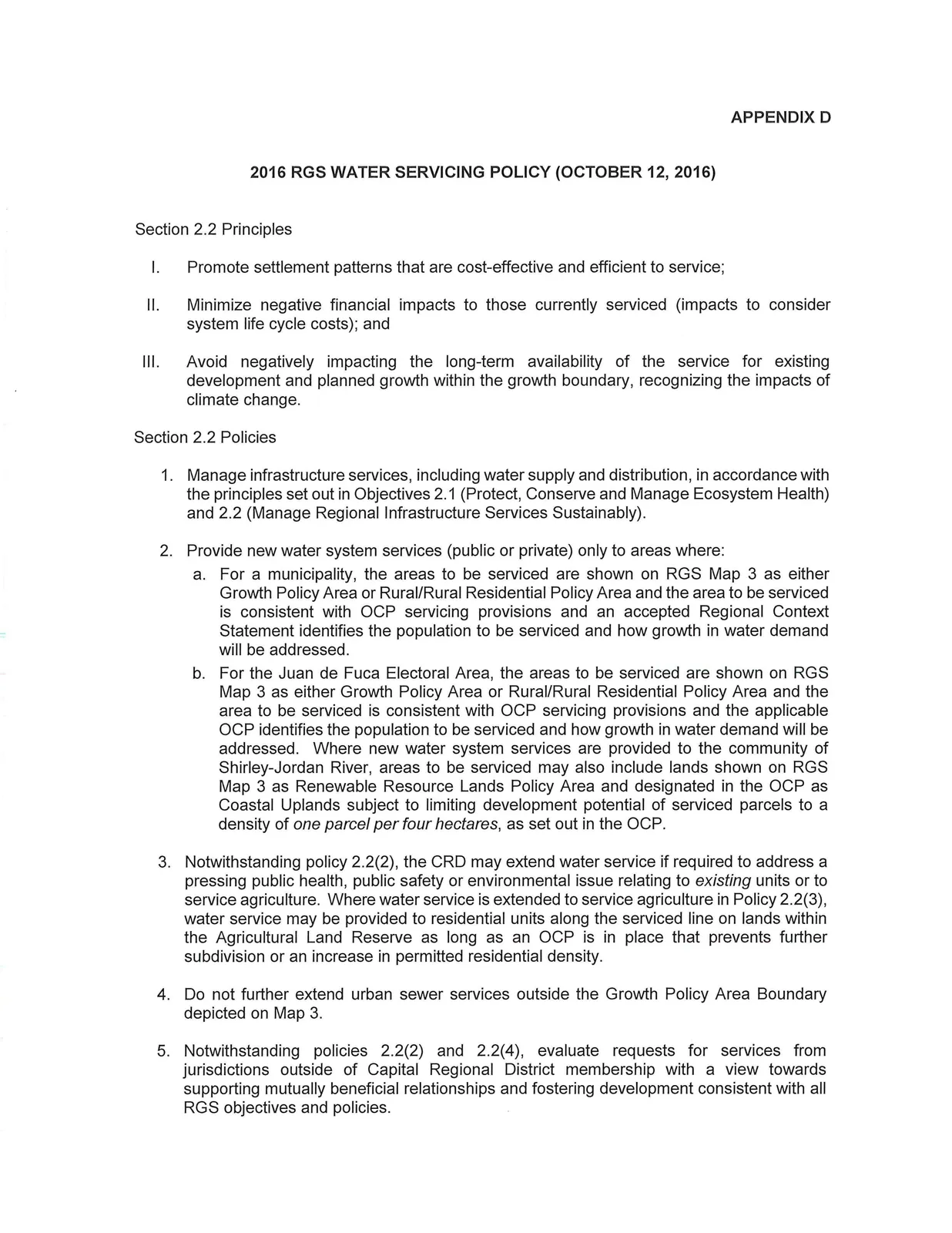
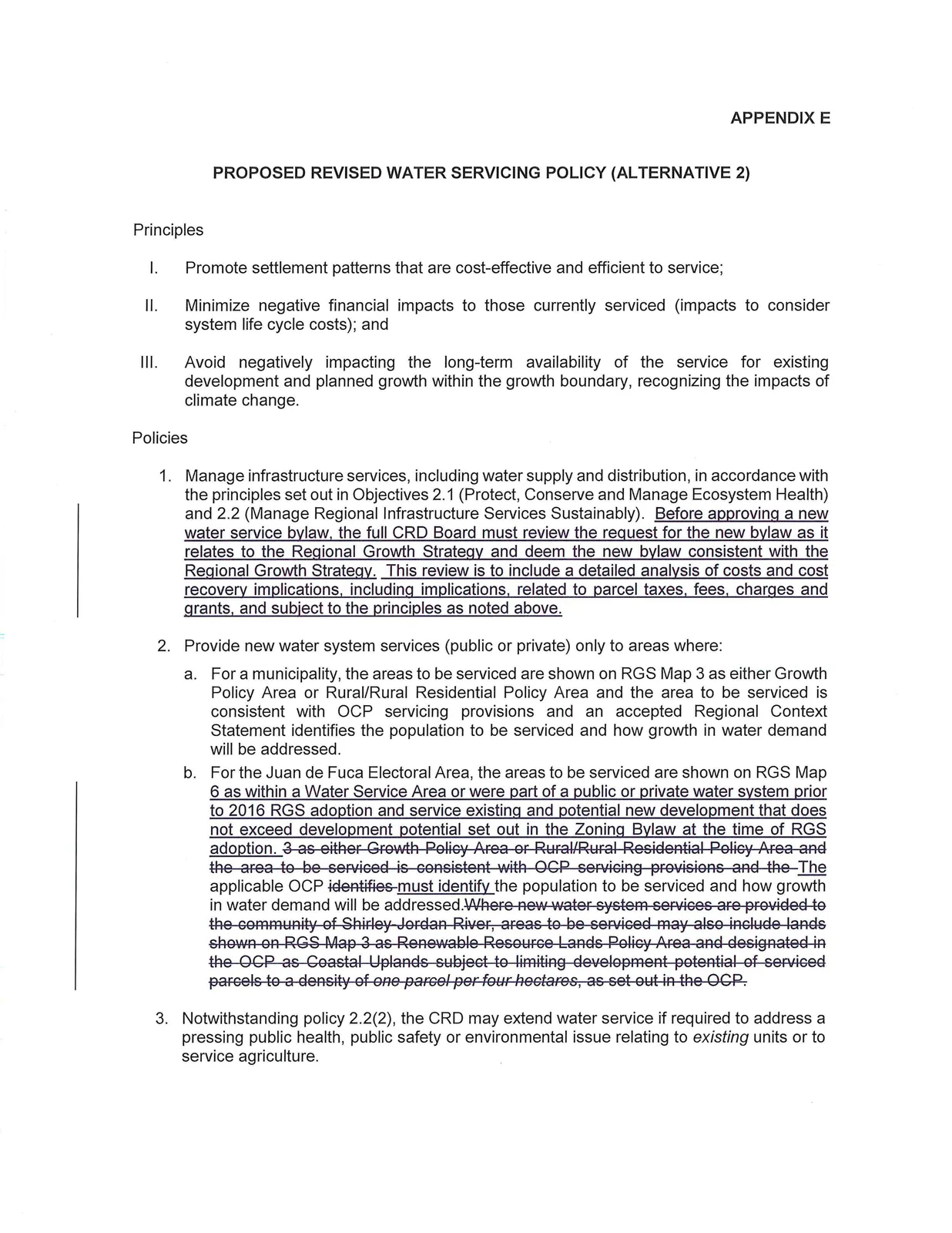
- Manage infrastructure services, including water supply and distribution, in accordance with the principles set out in Objectives 2.1 (Protect, Conserve and Manage Ecosystem Health) and 2.2 (Manage Regional Infrastructure Services Sustainably).
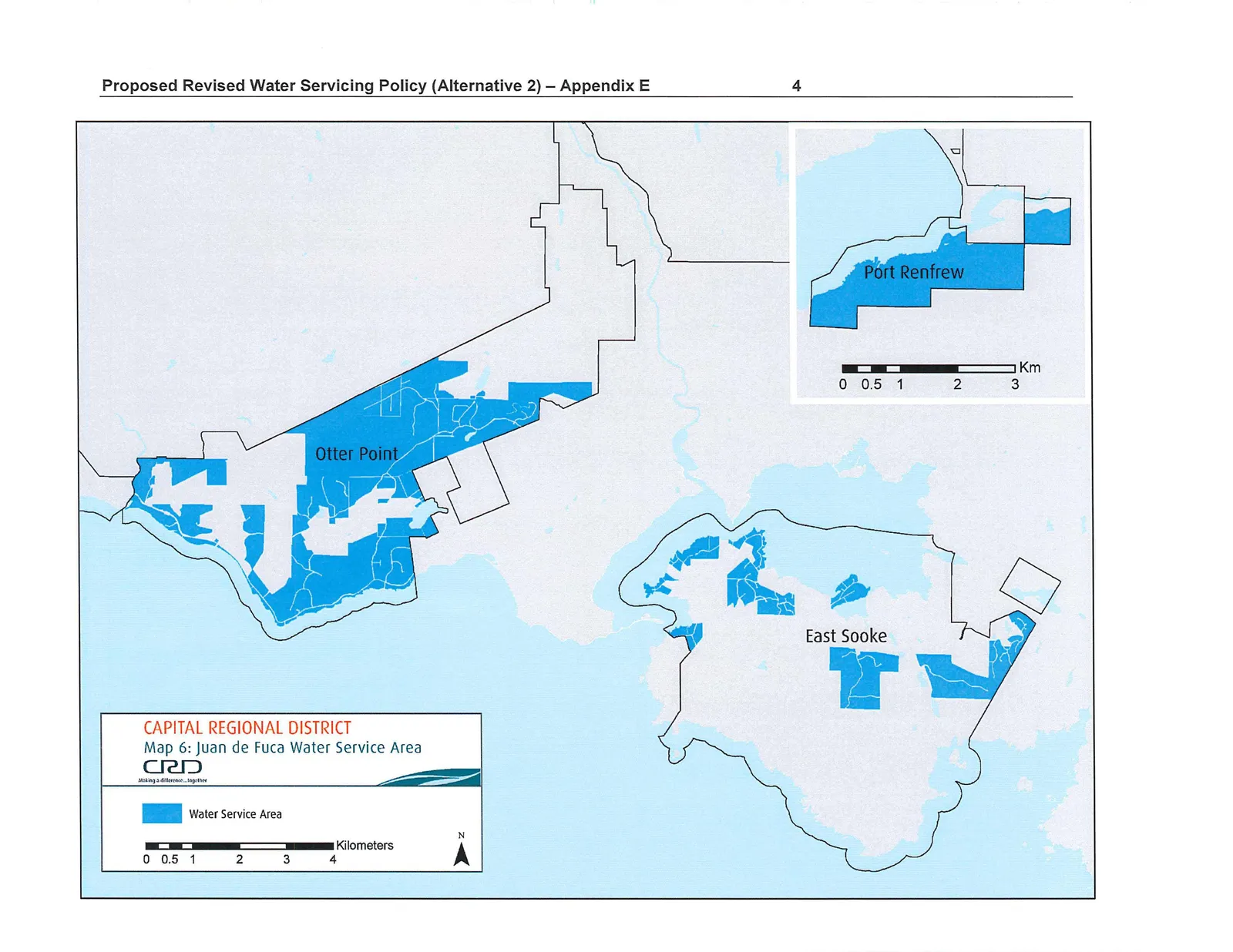
- Provide new water system services (public or private) only to areas where: a. For a municipality, the areas to be serviced are shown on RGS Map 3 as either Growth Policy Area or Rural/Rural Residential Policy Area and the area to be serviced is consistent with OCP servicing provisions and an accepted Regional Context Statement identifies the population to be serviced and how growth in water demand will be addressed.Before approving a new water service bylaw, the full CRD Board must review the request for the new bylaw as it relates to the Regional Growth Strategy and deem the new bylaw consistent with the Regional Growth Strategy. This review is to include a detailed analysis of costs and cost recovery implications, including implications, related to parcel taxes, fees, charges and grants, and subject to the principles as noted above. b. For the Juan de Fuca Electoral Area, the areas to be serviced are shown on RGS Map 3 as either Growth Policy Area or Rural/Rural Residential Policy Area and the area to be serviced is consistent with OCP servicing provisions and the applicable OCP identifies the population to be serviced and how growth in water demand will be addressed. Where new water system services are provided to the community of Shirley-jordan River, areas to be serviced may also include lands shown on RGS Map 3 as Renewable Resource Lands Policy Area and designated in the OCP as Coastal Uplands subject to limiting development potential of serviced parcels to a density of oneparce/perfourhectares, as set out in the OCP.
- Notwithstanding policy 2.2(2), the CRD may extend water service if required to address a pressing public health, public safety or environmental issue relating to ex/t/ng units or to service agriculture.
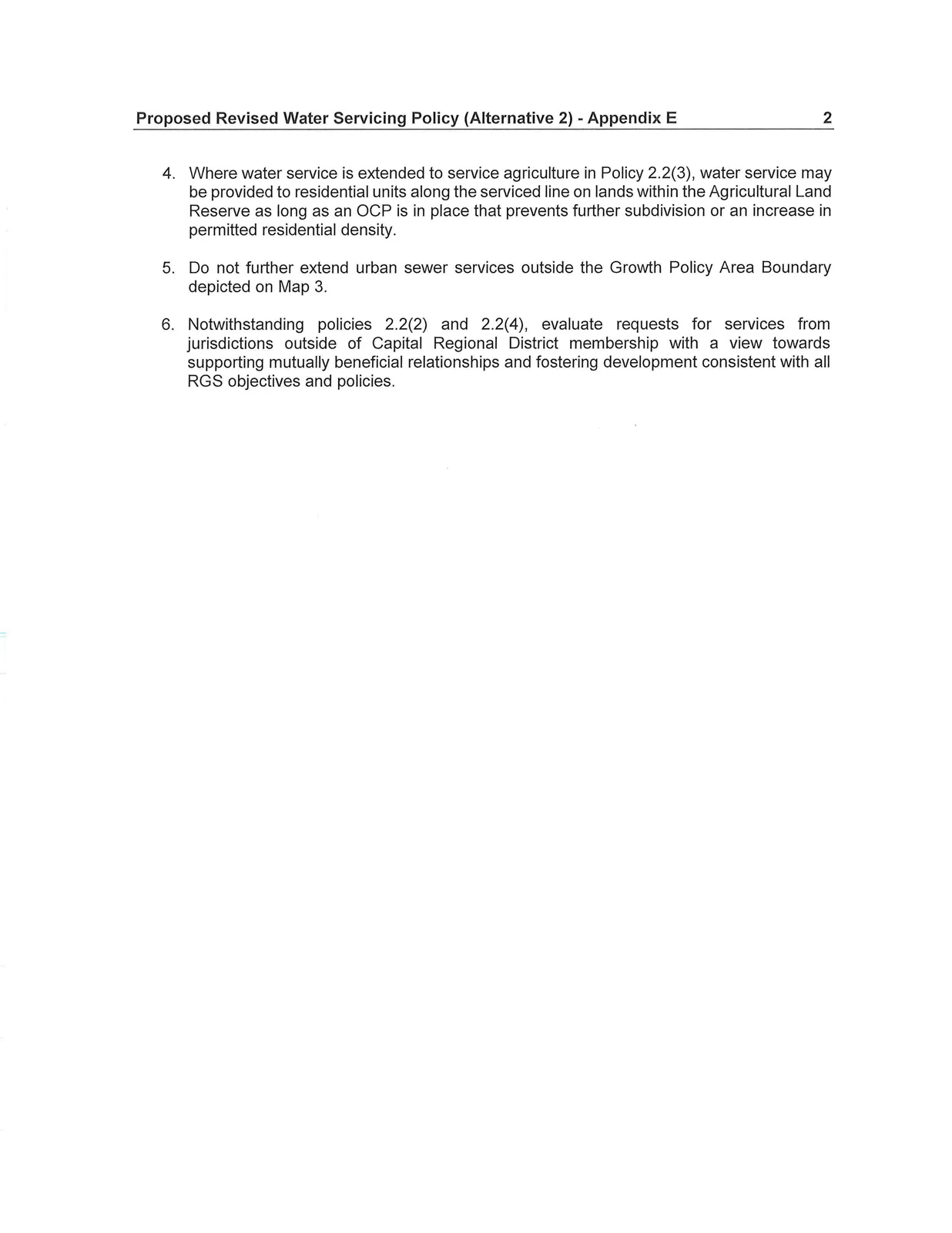
- Where water service is extended to service agriculture in Policy 2.2(3), water service may be provided to residential units along the serviced line on lands within the Agricultural Land Reserve as long as an OCP is in place that prevents further subdivision or an increase in permitted residential density. (RD Regional Growth Strategy 19 Page 30 of 84 Page 30 of 84
Page 31
- Do not further extend urban sewer services outside the Growth Policy Area Boundary depicted on Map 3
- Notwithstanding policies 2.2(2) and 2.2(4), evaluate requests for services from jurisdictions outside of Capital Regional District membership with a view towards supporting mutually beneficial relationships and fostering development consistent with all RGS objectives and policies. 20 (RD Reg/onol Growth Strotegy Page 31 of 84 Page 31 of 84
Page 32
3.1 Create Safe and Complete Communities The Regional Growth Strategy supports the development of complete communities within the Growth Policy Area that enable residents to undertake a wider range of daily activities closer to home. It does this by supporting the development of communities that offer a variety of housing types and tenures in proximity to places of work, schools, shopping, recreation, parks and green space. Complete communities provide a better balance and distribution of jobs and housing, a wider choice of affordable housing types, a better distribution of public services and more opportunity to walk, cycle, and use public transit conveniently. Complete communities, are safe, socially diverse, openly accessible, livable and attract economic investment, thereby enhancing social sustainability and health and well-being. The characteristics of a complete community are highly dependent on context. In some locations, the addition of employment opportunities or commercial services may be required while in others it may be the provision of a greater mix of housing types. In still others, the development of a park, footpaths or cycling facilities may help create a complete community. The criteria for a complete community within the Growth Policy Area are listed below. Outside the Growth Policy Area, the notion of what makes a community complete may be yet different and the criteria set out for complete communities does not apply to the Rural/Rural Residential Policy Area. Complete Communities Criteria I. Multiple modes can be used to move to, from and within the community; II. Places of work, shopping, learning, recreation and parks and green space can be easily accessed by a ten minute walk or a fifteen minute bike ride; Ill. A range of housing types and tenures across the housing spectrum is available for people through all stages of their lives; and IV. The community is demographically diverse, with a mix of people of all ages, incomes and abilities. Lands vulnerable to natural hazards risks may be located throughout the Growth Management Planning Area. Risks may limit or eliminate development. CRD Re!onaI Growth Strotegy 21 Page 32 of 84 Page 32 of 84
Page 33
Policies
- Identify locations within the Growth Policy Area that support the wellbeing of residents, consistent with the Complete Communities Criteria outlined in Objective 3.1, and adopt policies to direct growth to these locations.
- Create complete communities consistent with the criteria in Objective 3.1 by adopting policies, developing regulations or pursuing strategies focusing on matters such as densification, mix of uses, diverse housing types and tenures and multi- modal transportation.
- Avoid locating new development in the Growth Management Planning Area in areas with high seismic hazard associated with ground-motion amplification, liquification, slope instability or in areas prone to flooding, or incorporate appropriate engineering and planning measures to mitigate risk. Design, manage and construct climate change-adaptive and risk-adaptive infrastructure and utilities in the Growth Management Planning Area. 22 CRD Regionol Growth Strotegy Page 33 of 84 Page 33 of 84
Page 34
3.2 Improve Housing Affordability Maintaining a broad range of affordable housing types and forms is necessary for individual quality of life, community health, and economic competitiveness. Central to affordability is the provision of housing along a broad spectrum that acknowledges different market and non-market tenures, ranging from shelters to social housing, assisted and market rental to home ownership. Urban containmentGrowth management may have mixed results for housing affordability. In urban areas, increased residential densities and an expanded stock of attached housing may enhance affordability by expanding choice and by reducing the need to rely on travel by car to reach services. In rural areas, mobile homes, secondary suites and detached accessory suites may provide more affordable housing. Urban containmentGrowth management measures could have the effect of limiting the supply of new lands for the urban housing market, thereby putting upward pressure on housing prices, particularly for single detached homes. The provision of affordable housing to accommodate the anticipated population increase is the responsibility of many stakeholders including the Capital Regional District, local and senior levels of government, industry and the not-for-profit sector. The Capital Region Housing Corporation will continue to provide affordable housing to meet the needs associated with anticipated population growth, recognizing that implementation relies on funding and partnerships with other stakeholders. In addition to the provision of affordable housing, the Regional Housing Affordability Strategy has been developed to support all residents of the Capital Region - especially low and moderate-income households, the elderly, youth, those with special health and other needs, and the homeless
- to have reasonable choice of housing by type, tenure, price and location. Five approaches to housing affordability underlie the Regional Housing Affordability Strategy. CRD Regionol Growth Strotegy 23 Page 34 of 84 Page 34 of 84
Page 35
Approaches to Housing Affordability I. Work across the housing spectrum when identifying the current and anticipated future issues concerning market and non-market housing affordability for no, low and middle income and special needs households; II. Analyze the extent of present issues and forecast future problems; III. Focus on developing practical policies, and gaining commitments to action to address identified needs and problems in the short, medium and long term across the Capital Region; IV. Involve the broader community in the development of the strategy and its recommended solutions; and, V. Act as a catalyst for activities to improve housing affordability in the Capital Region. Policies
- Provide for an adequate, accessible and diverse supply of affordable housing across the housing spectrum. 24 CRD Regionol Growth Strotegy Page 35 of 84 Page 35 of 84
Page 36
4.1 Increase Transportation Choi ceimprove Multi-Modal Connectivity and Mobility The Regional Growth Strategy supports the development of a balanced and sustainable transportation system providing residents with reasonable and affordable transportation choices that enhance overall regional quality of life. Increasing congestion and travel delays and desires for a more effective, connected, sustainable and multi-modal transportation system are of central concern to regional residents. The majority of transportation movements in the region cross municipal boundaries. Although some transportation issues can be addressed at the local level, resolution of most transportation challenges will require collaborative, multi-Jurisdictional, region-wide action. To improve multi-modal connectivity and mobil ityachieve this objective, the Regional Growth Strategy relies on two related initiatives. First, the coordination of land use and transportation so that the majority of regional residents do not have to rely solely on travel by automobile to meet their daily needs. The Regional Growth Strategy's aim to keep urban settlement compact and build complete communities (Objectives 1.1 and 3.1) will tend to increase average urban densities and put people and their activities (homes, jobs, services) closer together. Creating communities where housing is close to activities will enhance opportunities for using walking, cycling, and public transit to meet daily needs. Secondly, transportation choice will be enhanced with the planning, development and implementation of -th.Regional Multi-Modal Network identified in the Regional Transportation Plan. The Regional Transportation Plan provides actions and outcomes to develop an effective inter-municipal arterial road network that provides travel choices and supports smart growth and livable, complete communities. Achieving Implementing the Regional Multi-Modal Network is the responsibility of many actors, including the Capital Regional District, local and senior levels of government and BC Transit. Seven principles guide the Regional Transportation Plan and support the multi-modal and integrated connected approach to transportation across the region. Principles I. Take a coordinated and engaged approach to transportation and land use planning; II. Prioritize strategic investments that serve regional mobility needs; Ill. Reduce greenhouse gas emissions and prepare for climate change; IV. Integrate transportation and land use planning; V. Capitalize on the potential for alternatives to driving alone; VI. Enhance the role for public transit; and (RD Regional Growth Strategy 25 Page 36 of 84 Page 36 of 84
Page 37
VII. Maximize efficiency of existing transportation corridors for multiple modes. 26 (RD Regional Growth Strategy Page 37 of 84 Page 37 of 84
Page 38
Policies
- Implement the Regional Transportation Plan in accordance with the principles outlined in Objective 41.
- Locate growth and major trip-generating uses where such can be efficiently serviced by transit and active transportation.
- Prioritize transit and active modes in community planning and in the design and implementation of infrastructure, facilities and programs. CRD Regional Growth Strategy 27 Page 38 of 84 Page 38 of 84
Page 39
5.1 strengthen the Regional EconomyRealize the Region's Economic Potential For residents of the Capital Region, economic prosperity is a foundation of high regional quality of life. Economic sustainability means the production and distribution of wealth to meet present and future generations' needs for goods and services in ways that ensure the long—term promotion of a satisfying and high quality of life for all residents. A sustainable economy is one that exhibits diverse and viable economic opportunities and is resilient and responsive to changing circumstances. Further characteristics of a sustainable economy are the involvement of a broad range of parties and interests in economic decision—making and contribution to the achievement of environmental and social sustainability. The Capital Region already has a highly diversified economy. Current strengths include the internationally significant tourism industry, agri-tourism, colleges and universities, provincial capital services and functions, major national defense headquarters and facilities, a growing high technology sector, health services, small business, environmental consulting, retirement services, the film industry and a natural environment and livable communities that attract others to live here. These advantages notwithstanding, significant regional growth management and quality of life considerations remain un-addressed. Economic Development Considerations Finding ways to achieve a minimum jobs/population ratio of: i. 0.60 in the Core Area ii. 0.53 in the Saanich Peninsula in. 0.36 in the West Shore; H. Finding ways to work collaboratively on regional economic development considerations, including cooperation with First Nations; III. Finding ways to expand and diversify the economy of formerly resource—dependent communities in Sooke and the Juan de Fuca Electoral Area, such as through low- impact recreation and tourism; IV. Finding ways to ensure the long term, affordable supply of strategic economic resources such as water, aggregate and energy; V. Finding ways to increase economic activity in forestry and agriculture including high— value and specialized agriculture and value-added forestry; VI. Finding ways to address the shortage of designated space—extensive industrial/business land in the region in locations consistent with overall goals CR0 Regionol Growth Strategy Page 39 of 84 Page 39 of 84
Page 40
regarding community completeness, transportation balance, and a network of major centres within an urban containment boundary; VII. Finding ways to enhance established employment centres; VIII. Finding ways to integrate high—value, clean industry and business in complete communities; X. Finding ways to attract, develop and maintain a highly skilled workforce; and, X. Finding ways to reduce poverty in the Capital Region. Policies
- Collaboratively build on the region's economic, environmental and quality of life advantages to position the region as a highly desirable location for investing in existing and new businesses, working to address the economic development considerations identified in Objective 5.1.
- Provide for land development patterns that maintain an adequate supply of employment land, industrial land, transportation infrastructure and services to support a diverse regional economy.
- Prioritize the attraction of new businesses and investment that will support climate action.
- Ensure the long—term protection of Renewable Resource Lands depicted on Maps 3 and 4. This could include policies aimed for buffering and land use transition between Renewable Resource Lands and settled areas (i.e., lands within the Rural/Rural Residential Land Use Policy Area as well as the Growth Policy Area), and policies that support farming within the Agricultural Land Reserve, and forestry, silviculture, forestry-related industrial uses and low-impact tourism within the Private Managed Forest Land and Crown and other forest lands. CRD Regionol Growth Strotegy 29 Page 40 of 84 Page 40 of 84
Page 41
6.1 Foster a Resilient Food and Agriculture System Food and agriculture are part of a food system which includes planting, irrigation, harvesting, processing, distribution, preparation and marketing and consumption, in addition to food waste management and soil betterments. A viable and resilient local food and agriculture system is important to the Capital Regional District's health, sustainability, security and visual/cultural identity. Changes in climate, energy costs and water availability will impact agricultural production and will draw greater attention to regional food system resiliency. The widespread impact of food and agriculture and the nature of the challenges likely to be faced in coming years make food and agriculture a matter of regional interest. Challenges include loss of farmland, lack of farm profitability and financial sustainability, increasing average age of farmers, increasing food prices, limited (72 hour) supply of fresh food in an emergency, food wastage, need to revitalize indigenous food systems, lack of knowledge of how to grow and prepare healthy food, increasing rates of food insecure people and increasing rates of diet-related chronic disease. Regional alignment will strengthen the food and agricultural sector. The Regional Food and Agriculture Strategy recommends actions to create a viable, healthy and resilient food system. Regional Growth Strategy policies are intended to work in tandem with the Regional Food and Agriculture Strategy to guide future decisions. Achieving a healthy, viable and resilient local food and agriculture system will require adherence to the following related principles: Principles I. Support First Nations food interests and rights; II. Protect and enhance the region's food and farmlands; III. Avoid urban/agricultural land use conflict; mitigate where avoidance is not possible; IV. Enhance access to nutritious, safe and culturally-appropriate food; V. Expand food system economic opportunities; VI. Encourage food system education and agri-tourism; and VII. Foster resiliency in the face of an unpredictable climate, increased pest resistance, and declining, increasingly expensive water and energy supplies. 30 (RD Regionol Growth Strotegy Page 41 of 84 Page 41 of 84
Page 42
Policies
- Implement initiatives in accordance with the principles outlined in Objective 6.1.
- Enable food production, processing and distribution that will foster a place-based food economy that increases access to local, nutritious, safe and culturally appropriate food.
- Support food waste management that is environmentally sustainable, benefits the regional economy and improves residents' connections to rural and agricultural landscapes. CR0 Regional Growth Strategy 31 Page 42 of 84 Page 42 of 84
Page 43
7.1 Significantly Reduce Community-Based Greenhouse Gas Emissions The Regional Growth Strategy supports the reduction of community-based greenhouse gas emissions to address the effects of a changing climate. In the Capital Region, community greenhouse gas emissions come from the transportation system, the heating, cooling and energizing of buildings, waste, energy production, the production of goods and agriculture. The Capital Regional District and local governments have long-standing commitments to make decisions, target investments and build capacity for reducing the use of fossil fuels and expanding the clean energy economy. Further, the Regional Growth Strategy's aim to keep urban settlement compact, protect, conserve and manage ecosystem health, build safe and complete communities, increase transportation choice, strengthen the regional economy and foster a resilient regional food and agriculture system will support the low-carbon built form that is the foundation for reducing energy demand. Reducing community greenhouse gas emissions requires action on many fronts and is the responsibility of many actors including the Capital Regional District, local and senior levels of government, industry, institutions, businesses and residents. It requires coordinated, consistently applied action focusing on people, land use, transportation, infrastructure and technology. Achieving community greenhouse gas reduction targets means following four related principles. Principles I. Create a low-carbon built form to reduce energy demand; II. Increase energy efficiency and recovery from retrofits and new development; Ill. Promote energy efficiency and the use of renewable, clean energy to reduce reliance on fossil fuels; and IV. Protect the carbon sequestration value of natural systems, including forested lands and wetlands. Source: community Energy and Emissions Inventory (CEEI). Province of BC. 32 CRD Regional Growth Strategy Page 43 of 84 Page 43 of 84
Page 44
Policies
- Prioritize investment that will provide for a low-carbon built form that supports efficient energy use, the provision of clean and renewable district energy, active transportation modes, transit service, and low/zero emissions vehicles.
- Design, manage, fund and operate programs, services and infrastructure to reduce greenhouse gas emissions in keeping with the principles outlined in Objective 7.1.
- Strategically acquire protected areas that contribute to climate change mitigation. (RD Regional Growth Strategy 33 Page 44 of 84 Page 44 of 84
Page 45
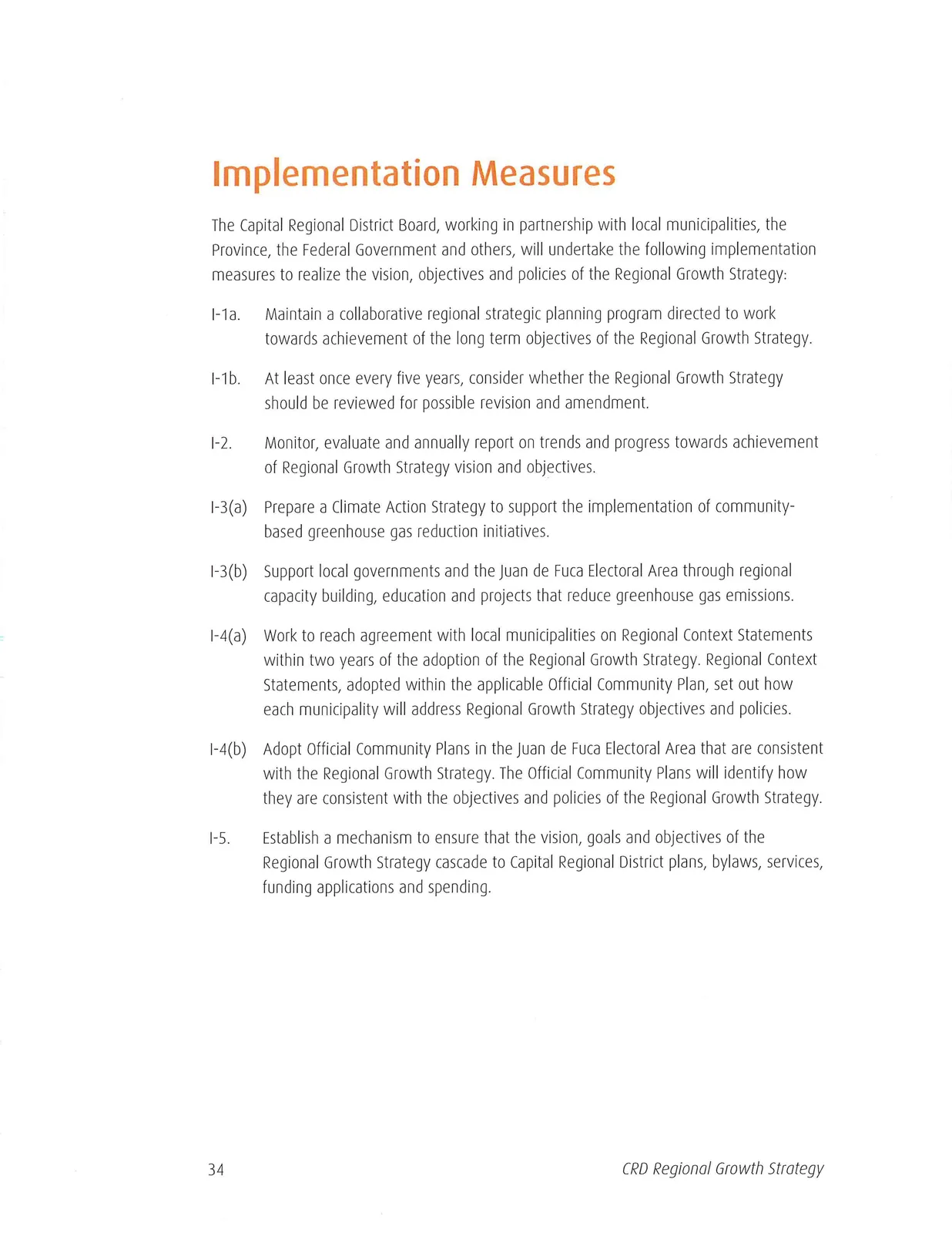
Implementation Measures The Capital Regional District Board, working in partnership with local municipalities, the Province, the Federal Government and others, will undertake the following implementation measures to realize the vision, objectives and policies of the Regional Growth Strategy: 1-1 a. Maintain a collaborative regional strategic planning program directed to work towards achievement of the long term objectives of the Regional Growth Strategy. 1-1 b. At least once every five years, consider whether the Regional Growth Strategy should be reviewed for possible revision and amendment. 1-2. Monitor, evaluate and annually report on trends and progress towards achievement of Regional Growth Strategy vision and objectives. 1-3(a) Prepare a Climate Action Strategy to support the implementation of community- based greenhouse gas reduction initiatives. 1-3(b) Support local governments and the Juan de Fuca Electoral Area through regional capacity building, education and projects that reduce greenhouse gas emissions. -4(a) Work to reach agreement with local municipalities on Regional Context Statements within two years of the adoption of the Regional Growth Strategy. Regional Context Statements, adopted within the applicable Official Community Plan, set out how each municipality will address Regional Growth Strategy objectives and policies. 1-4(b) Adopt Official Community Plans in the Juan de Fuca Electoral Area that are consistent with the Regional Growth Strategy. The Official Community Plans will identify how they are consistent with the objectives and policies of the Regional Growth Strategy. -5. Establish a mechanism to ensure that the vision, goals and objectives of the Regional Growth Strategy cascade to Capital Regional District plans, bylaws, services, funding applications and spending. 34 (RD Reg/onol Growth Strotegy Page 45 of 84 Page 45 of 84
Page 46
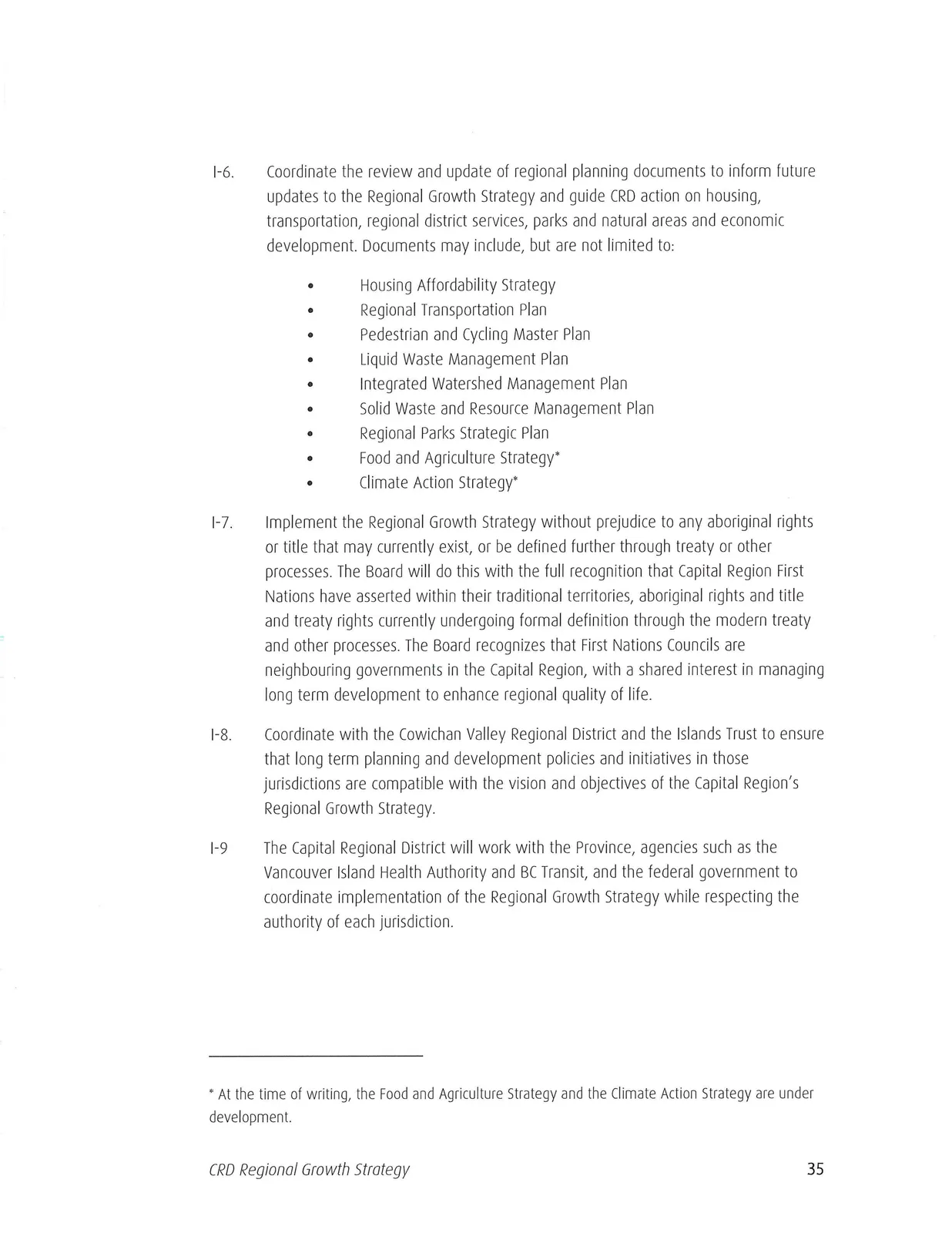
1-6. Coordinate the review and update of regional planning documents to inform future updates to the Regional Growth Strategy and guide CRD action on housing, transportation, regional district services, parks and natural areas and economic development. Documents may include, but are not limited to: • Housing Affordability Strategy • Regional Transportation Plan • Pedestrian and Cycling Master Plan • Liquid Waste Management Plan • Integrated Watershed Management Plan • Solid Waste and Resource Management Plan • Regional Parks Strategic Plan • Food and Agriculture Strategy* • Climate Action Strategy* -7. Implement the Regional Growth Strategy without prejudice to any aboriginal rights or title that may currently exist, or be defined further through treaty or other processes. The Board will do this with the full recognition that Capital Region First Nations have asserted within their traditional territories, aboriginal rights and title and treaty rights currently undergoing formal definition through the modern treaty and other processes. The Board recognizes that First Nations Councils are neighbouring governments in the Capital Region, with a shared interest in managing long term development to enhance regional quality of life. 1-8. Coordinate with the Cowichan Valley Regional District and the Islands Trust to ensure that long term planning and development policies and initiatives in those jurisdictions are compatible with the vision and objectives of the Capital Region's Regional Growth Strategy. 1-9 The Capital Regional District will work with the Province, agencies such as the Vancouver Island Health Authority and BC Transit, and the federal government to coordinate implementation of the Regional Growth Strategy while respecting the authority of each jurisdiction.
- At the time of writing, the Food and Agriculture Strategy and the Climate Action Strategy are under development. (RD Regionol Growth Strote7y 35 Page 46 of 84 Page 46 of 84
Page 47
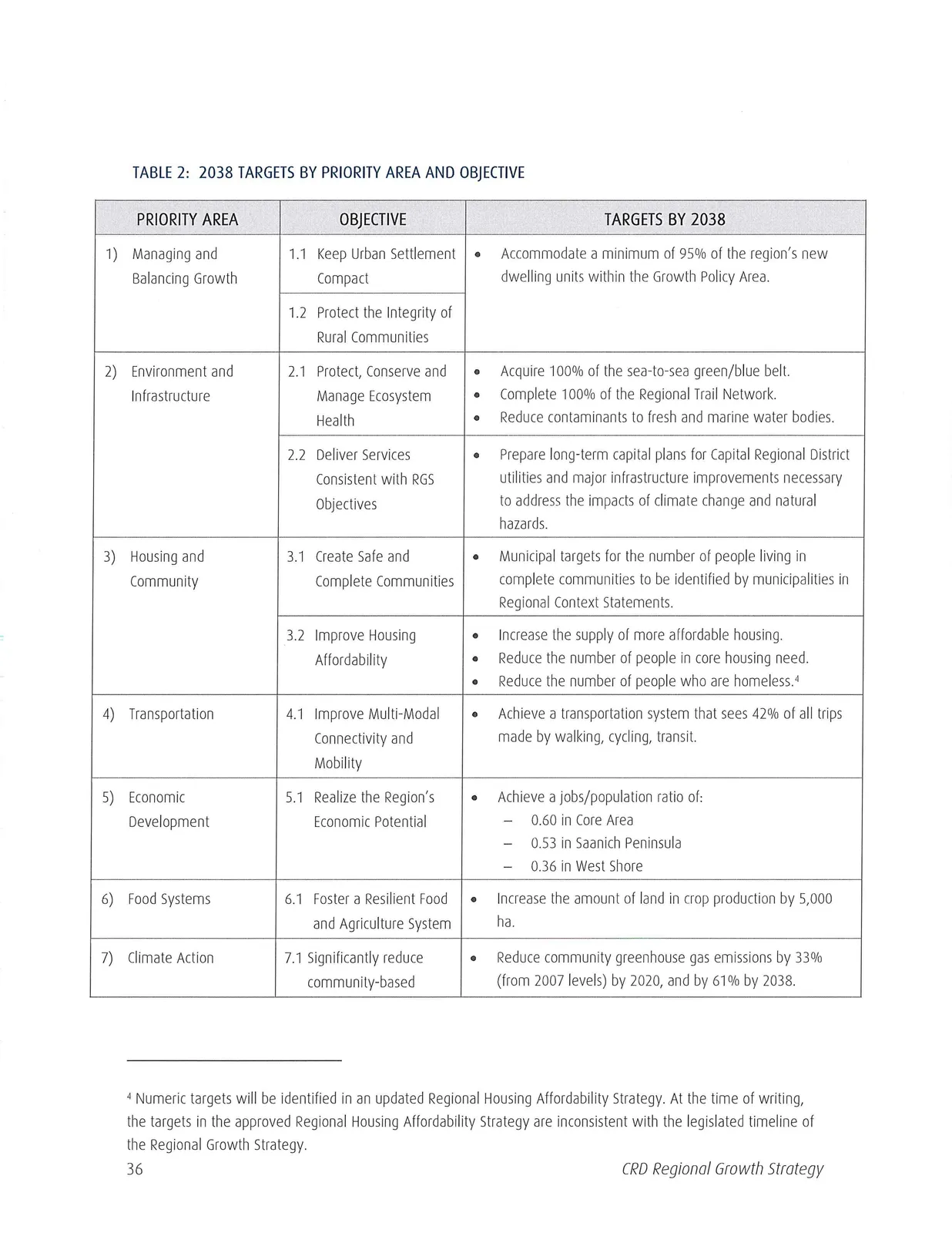
TABLE 2: 2038 TARGETS BY PRIORITY AREA AND OBJECTIVE PRIORITY AREA OBJECTIVE TARGETS BY 2038
- Managing and 1.1 Keep Urban Settlement • Accommodate a minimum of 95% of the region's new Balancing Growth Compact
dwelling units within the Growth Policy Area. 1.2 Protect the Integrity of Rural Communities 2) Environment and 2.1 Protect, Conserve and • Acquire 100% of the sea-to-sea green/blue belt. Infrastructure Manage Ecosystem • Complete 100% of the Regional Trail Network. Health • Reduce contaminants to fresh and marine water bodies. 2.2 Deliver Services • Prepare long-term capital plans for Capital Regional District Consistent with RGS utilities and major infrastructure improvements necessary Objectives to address the impacts of climate change and natural hazards. 3) Housing and 3.1 Create Safe and • Municipal targets for the number of people living in Community Complete Communities complete communities to be identified by municipalities in Regional Context Statements. 3.2 Improve Housing • Increase the supply of more affordable housing. Affordability • Reduce the number of people in core housing need. Reduce the number of people who are homeless.' 4) Transportation 4.1 Improve Multi-Modal • Achieve a transportation system that sees 42°Io of all trips Connectivity and made by walking, cycling, transit. Mobility
- Economic 5.1 Realize the Region's • Achieve a jobs/population ratio of: Development Economic Potential
- 0.60 in Core Area
- 0.53 in Saanich Peninsula
- 0.36 in West Shore
- Food Systems 6.1 Foster a Resilient Food • Increase the amount of land in crop production by 5,000 and Agriculture System ha.
- Climate Action 7.1 Significantly reduce • Reduce community greenhouse gas emissions by 33% community-based (from 2007 levels) by 2020, and by 61°/o by 2038. Numeric targets will be identified in an updated Regional Housing Affordability Strategy. At the time of writing, the targets in the approved Regional Housing Affordability Strategy are inconsistent with the legislated timeline of the Regional Growth Strategy. 36 CR0 Regional Growth Strategy Page 47 of 84 Page 47 of 84
Page 48
PRIORITY AREA OBJECTIVE TARGETS BY 2038 greenhouse gas emissions CR0 Regiono! Growth Strotegy 37 Page 48 of 84 Page 48 of 84
Page 49
Appendix A: Community Profiles Spanning coastal, forest and agricultural landscapes, communities in the capital region range from seaside towns to rural farms, to suburban and downtown neighbourhoods. This diversity is our strength. Residents can access a variety of lifestyles thanks to the commitments of municipalities and the Juan de Fuca Electoral Area to protect and perpetuate our natural environments and to foster shared regional amenities and resources. This is made possible by our communities working together as a region, creating a whole that is greater than the sum of its parts. The Regional Growth Strategy champions a collaborative approach to realizing our vision and objectives. It supports decision-making that takes a regional perspective while valuing the community characteristics of the 13 local municipalities and the Juan de Fuca Electoral Area. Community profiles/vision statements are described below Central Saanich The community of Central Saanich, including the Tsartlip and Tsawout First Nations, spans the centre of the Peninsula. The municipality includes the greatest concentration of agricultural production in the region, along with light industrial land, residential areas with rural and suburban character, and compact village centres. In order to maintain rural character and protect the function of natural ecosystems, slow and managed growth is accepted within defined urban settlement areas and outside of rural and agricultural lands. The intensification of high quality knowledge-based and light industrial business and industrial growth is encouraged in the Keating Industrial area. Coiwood Colwood will become a more urban community while retaining its exceptional heritage resources and natural areas. Colwood Corners is transformed into an attractive, welcoming town centre. Royal Bay, Olympic View and Colwood Corners have expanded as complete communities. Hatley Park Estate is the home of Royal Roads University and features extensive public open space. Esquimalt Esquimalt exhibits a more sustainable model of urban development where the quality of the natural and built environment passed on to the next generation is healthier than at present. The Wardroom/Hospital DND site has clusters of low and medium density multiple family housing surrounded by green space. Macaulay Point/Work Point is a complete community 38 CRD Regionol Growth Strategy Page 49 of 84 Page 49 of 84
Page 50
that is pedestrian oriented, socially diverse, with a mix of uses and services and park space, treed areas, and continuous waterfront access. Through infrastructure investment and redevelopment. Esguimalt Road will transition into a vibrant, urban environment. It is Esquimalt's intention to strengthen its commercial/retail sector to service the expanding needs of the community and to market our central location to businesses and high-tech industries. The Esquimalt graving dockand CFB/BFC Esguimalt -j,an important contributor to the regional economy. Highlands The Highlands will continue to preserve large areas of natural green space protecting elements of the regional ecosystem and providing outdoor recreational opportunities for CRD residents and visitors. Lands retained in a natural state preserve diversity of plant and animal life. Development remains primarily residential on rural acreages or large lots, with no role as an area for urban development. Juan de Fuca Electoral Area The Juan de Fuca Electoral Area comprises approximately 151,189 hectares or about 61°/a of the CRD land area. It contains significant provincial, regional and locally controlled parks and trail systems, ecological reserves and the CRD Water Supply area. The Rural Resource Lands comprise approximately 132,000 ha or 83% of land in the Juan de Fuca Electoral Area and is primarily Crown Forest or Private Managed Forest Land. These lands are preserved for renewable resource working landscapes, and provide for natural green space and outdoor recreational and eco-tourism opportunities for residents and visitors to the Capital Region. Port Renfrew, a tourism and forestry based community provides for small-lot tourism- oriented urban development. Five small community areas, Fast Sooke, Otter Point, Malahat, Shirley/Jordan River and Willis Point maintain the rural character while providing rural residential choices. Langford The City of Langford has a cohesive town centre with pedestrian areas, commercial districts, and convenient vehicle access, providing a central community focus and an enhanced regional role. An open space system made up of treed areas, lakes and streams links and defines neighbourhoods. Metchosin Metchosin is a community of rural character with a choice of rural lifestyles. The vibrant and locally-supported agricultural industry continues to thrive and diversify with a range of products and organic crops. Our natural areas, shorelines, sensitive ecosystems and CRD Regional Growth Strategy 39 Page 50 of 84 Page 50 of 84
Page 51
biodiversity are valued, preserved and protected. There is an expanded system of local and regional parks and natural open spaces linked with multi-use trails, along with improved access to shoreline areas, allowing increased recreational opportunities and fostering active healthy lifestyles. Metchosin village continues to be the community hub and primary commercial centre for local businesses and retailers, with some limited room for expansion. Metchosin's rural character is an integral component of, and valued contributor to the broader complete regional community. North Saanich Situated in the northerly tip of the Saanich Peninsula approximately 27 kilometres north of downtown Victoria, the District of North Saanich is a collection of coastal focused neighbourhoods which surround agricultural lands. The community's long term development plans are based on the desire of residents to retain rural character and safeguard environmental qualities. The District's policies reflect a strong commitment to preserve the agricultural land base and agricultural activities in the municipality. Oak Bay Oak Bay continues to be a green, landscaped, quiet residential community with a mix of housing types and neighbourhood commercial centres with a special emphasis on heritage preservation. Oak Bay village is a strong shopping area and the historical, cultural, community and business core of the municipality. Public access to waterfront amenities including clean safe beaches is maximized. Saanich Environmental integrity is paramount to ensuring social wellbeing and economic vibrancy. Saanich remains a series of community focused neighbourhoods, within an urban containment boundary that clearly separates the urban area from the rural portion of the municipality. This growth framework is based on principles of sustainability and livability. Rural Saanich forms part of the peninsula farm lands. Population increases are managed within the context of the local area planning process, where land use, density and development policies direct growth to "Centres" and "Villages" to build complete communities that encourage diversity of lifestyle, housing, economic and cultural opportunities. Sidney Sidney remains the commercial centre for the north Peninsula and the economic competitiveness of Sidney is maintained and enhanced. Commercial/industrial lands are 40 CR0 Regionol Growth Strotegy Page 51 of 84 Page 51 of 84
Page 52
available and there are growing knowledge-based industries. Orientation between the town and the ocean is strong, including enhanced ocean-side amenities. Sooke Sooke, located on the Sooke Harbour and Basin, will become a complete, vibrant community with a mix of businesses, affordable housing, services and public open spaces. The highest population densities and commercial growth occur in the Town Centre, serving the growing population base and the surrounding coastal communities. Residential growth will continue within the designated Community Growth Area. Large parcel sizes will maintain the rural ambiance, and limit the development outside the town's core. Victoria Victoria is an urban sustainability leader inspiring innovation, pride and progress towards greater ecological integrity, livability, economic vitality, and community resiliency confronting the changes facing society and the planet today and for generations to come, while building on Victoria's strengths as a harbour-centred, historic, capital city that provides exceptional quality of life through a beautiful natural setting, walkable neighbourhoods of unique character, and a thriving Downtown that is the heart of the region. View Royal View Royal will have a series of economic centres providing expanded retail, professional financial and convenience services. Single family detached housing will remain the predominant housing form with some provision made for other types of housing. A network of foot and cycle paths will provide neighbourhoods with access to shopping, recreation and natural open space. Natural amenities associated with shorelines, streams, estuaries, hillsides and forested areas will be protected. (RD Regionol Growth Strotegy 41 Page 52 of 84 Page 52 of 84
Page 53
Appendix B: Framework for Our Future Guiding Principles On July 15, 1998 the Capital Regional District Board resolved to adopt the Framework for Our Future Agreement to guide the development of a regional growth strategy for the Capital Region. The Framework Agreement provided general guiding principles for the preparation of the Regional Growth Strategy. Over 15 years later, in 2016, this framework endures as the foundation of the Regional Growth Strategy.
- The Capital Region's Growth Management Strategy is based on four fundamental pri nciples: Sustainability: actions to meet our needs today do not compromise the ability of future generations to meet their needs, and ensure the ongoing healthy functioning of the natural systems that sustain life. Appropriateness: actions are appropriate to the aspirations and local conditions of the Capital Region, and do not simply reflect the uncritical application of ideas developed for other places and situations. Continuity: the strategy will build on work that has already been undertaken by the Capital Regional District and its member municipalities, and will consider the thoughts and ideas contributed by individual residents and community associations. Cooperation, Collaboration and Coordination: the Capital Regional District, local municipalities, provincial ministries and agencies, and regional residents will work together to develop and implement the strategy. First Nations, the Islands Trust, and the Cowichan Valley Regional District are neighbouring governments and will be invited to participate.
In addition, the development and evaluation of alternative solutions will pay due regard to the following 14 provincial goals set out in the Locol Government Act: a. Avoid urban sprawl; b. Minimize automobile use and encourage walking, cycling and efficient public transit; c. Move goods and people efficiently, making effective use of transportation and utility corridors; d. Protect environmentally sensitive areas; e. Maintain a secure and productive resource base, including the agricultural land reserve; 42 (RD Regionol Growth Strotegy Page 53 of 84 Page 53 of 84
Page 54
Encourage economic development that supports the unique character of communities; g. Reduce and prevent air, land and water pollution; h. Ensure adequate, affordable and appropriate housing; i. Ensure adequate inventories of suitable land and resources for future settlement; j. Protect the quality and quantity of ground and surface water; k. Minimize the risks to settlement associated with natural hazards; I. Preserve, create and link urban and rural open space including parks and recreation areas; m. Plan for energy supply and promote efficient use, conservation and alternative sources of energy; and, n. Ensure good stewardship of land, sites and structures with cultural heritage value. CRD Regionol Growth Strotegy 43 Page 54 of 84 Page 54 of 84
Page 55
Appek C: The Regional Green/Blue Spaces Vision The Green/Blue Spaces Strategy set out a comprehensive, long—term strategy for maintaining, conserving, rehabilitating and restoring green/blue spaces on public and private lands in the region, including areas with ecological, aesthetic, renewable resource, outdoor recreation and greenways values. The Board adopted the Green/Blue Spaces vision on November 26, 1997 as a guide for the preparation of the 2003 Regional Growth Strategy. This vision - Our Essential Nature - formed part of the Framework for Our Future Agreement adopted by the Board on July 15, 1998 to guide the development of the Regional Growth Strategy. The Regional Green/Blue Spaces Strategy has been superseded by subsequent planning initiatives such as the Regional Parks Strategic Plan, the Integrated Watershed Management Program Plan, the Regional Parks Land Acquisition Strategy and park management plans for the Sooke Hills Wilderness and Sea to Sea Regional Parks. There ore times when we just wont to room the Gowl/ond Range and listen to the sound of air stirred up by eagles 11 wings. Or stroll the Swon Luke boardwalk and watch a family of proud ducklings parade post our feet. Then there ore days when splashing about with our children in the cool, clean waters of Thetis Luke is the only thing worth doing. Or maybe it's kicking up the worm, soft sand of Willows Beach. Perhaps it's walking along the Colquitz Creek that makes our world come olive. Or taking a second, reflective look at a rare old Douglas-fir on the grounds of Royal Roads. Whether it is the pastoral splendour of the Soonich Peninsula Farmlands,, or the stork and wild beauty of the Juan de Fuca coastline, our ability to appreciate nature begins with whatever captivates our senses. It then expands to values we feel deeply but rarely capture in words. All of us who live in the Capitol Regional District cherish the natural environment that is so essential to our quality of life, and we ore determined that it never be compromised. So although we already enjoy a diverse network of protected areas that stretches from the southern Gulf Islands to Port Renfrew, we cannot be complacent. As the region's population continues to grow, we must ensure 44 CR0 Regional Growth Strategy Page 55 of 84 Page 55 of 84
Page 56
that the stewardship of the natural environment remains integral to all forms of urban, suburban and rural development. But we don't protect nature just so we can hike, re/ox and contemplate. We must also safeguard endangered species and sensitive ecosystems such as Garry Oak meadows and stands of o/d growth Douglas-fir. And we need to give Pacific salmon a fighting chance to return to urban streams. To that end we envision the development of a regional green/blue space system that will protect and maintain the full range and diversity of the natural environment that surrounds us, including significant green spaces, the marine environment, wetlands, fish and wildlife habitat, and unique ecosystems. We ore also committed to protecting and maintaining the lust remnants of ecosystems that flourished here before the time of Captain Cook, and to restore natural systems we have altered. This is neither a park plan nor a policy document, but a vision of cooperative stewardship that integrates the contributions of citizens, landowners, businesses, communities, and all levels of government. It is a vision of sustaining the essential nature of our region, of continually creating and protecting a livable and healthy community - and passing on that legacy to future generations. The objectives of the Regional Green/Blue Spaces Strategy were to: • Conserve rare, threatened or endangered ecosystems and species in the Capital Regional District; • Maintain biological diversity by protecting and enhancing a variety of habitats; • Conserve ecologically valuable areas in large, diverse, contiguous units and connect them with gleenways; • Maintain the character and diversity of green/blue spaces in the Capital Regional District; • Enhance and restore areas that could have green/blue space values; • Develop a comprehensive set of priorities for the conservation of green/blue spaces in the Capital Regional District; • Educate people about the value of protecting green/blue spaces in the Capital Regional District; and, • Foster partnerships for the conservation and stewardship of green/blue spaces. cRD Reg/onol Growth Strotegy 45 Page 56 of 84 Page 56 of 84
Page 57
A P~'_j 6ill iil Glossary Attached housing Any form of housing where more than two individual dwellings are structurally attached including townhouses, apartments regardless of tenure, stacked townhouses and the like. Climate Change A change of climate which is attributed directly or indirectly to human activity.' Complete Community Multiple—use urban community that contains within its boundaries the full range of facilities and activities necessary to meet typical household needs for employment, shopping, personal services, recreation, housing, education and other goods and services. Complete communities typically are defined by what they are not, that is, single-use residential areas that serve a largely dormitory function to a larger centre, with few local opportunities to meet the broad range of household needs described. Core Municipalities The Capital Region sub—region that includes the municipalities of Victoria, Esquimalt, Oak Bay, Saanich and View Royal. Density A measure of the intensity of occupancy and use of the land, generally described in terms of persons per hectare, or dwelling units per hectare, or a ratio of the built floor area of a structure to the area of the lot it occupies. Framework For Our Future Agreement An agreement approved by the Capital Regional District Board on July 15, 1998 that set out the scope, overall vision, priority areas and guiding principles for the preparation of the Regional Growth Strategy. Greenhouse Gas (GHG) Gases in the earth's atmosphere that absorb and re-emit infrared radiation. These gases occur through both natural and human-influenced processes. GHG emitted through human activities include carbon dioxide (CO2), nitrous oxide (N20), methane (CH4), hydrofluorocarbons (HFCs), perfluorocarbons (PFCs), and sulphur hexafluoride (SF6). Growth management Implementation of government regulations that control the type, location, quality, scale, rate, sequence or timing of development. More generally, the whole range of policies designed to control, guide or mitigate the effects of growth. By attempting to guide growth rather than react to its effects, communities engaged in growth management assume a proactive stance in ensuring that the very qualities that attract growth are not destroyed for existing residents and future generations. Based on the united Nations Framework convention on climate change definition. 46 (RD Regionol Growth Strategy Page 57 of 84 Page 57 of 84
Page 58
Healthy ecosystems Terrestrial, riparian and shoreline areas with high ecological value that support habitat and biodiversity, support rare, threatened or endangered plant and animal species and contribute to the continued functioning of natural processes such as groundwater infiltration, water purification, air filtration, carbon sequestration and soil nutrient management. Healthy ecosystems could be on developed, partly developed or undeveloped public and private spaces. Housing affordability Generally describes a condition in which housing costs consume no more than 300/a of gross household income (unless by choice); including taxes and insurance (for owners) and utilities (for owners and renters). Applies to both market and non-market (subsidized) dwellings. Infrastructure The physical capital and associated services considered basic and necessary to the functioning of the built environment. These include such things as: sanitary sewers, treatment plants, and water pipelines and distribution/collection systems; roads, signals, sidewalks and other components of the transportation system including transit vehicles, ferries and airports; solid waste management facilities including transfer stations and landfills; and, energy supply and distribution systems including hydroelectric and natural gas transmission and distribution systems. More generally, infrastructure can refer to other tangible public and private assets necessary to support the development of a modern urban settlement, such as hospitals, schools and recreation facilities. In some cases, preserved green space and natural areas including forests, wetlands, and stream corridors have been described as a "green infrastructure", essential to the vitality of healthy human communities. Metropolitan Victoria or Victoria Metropolitan Area (VMA) That portion of the Capital Region from, Otter Point in the west to Swartz Bay in the north, defined by Statistics Canada as the Victoria Census Metropolitan Area. Mixed—use Land use regulations that permit a variety of different uses and activities either on one legal parcel or within one defined land use zone. The classic example of a mixed use district is a historical downtown core that contains a wide range of residential, business, service, institutional, cultural, recreational and industrial uses within a relatively small area; in many cases, a wide range of different uses within individual buildings or on single sites. Official Community Plan (OCP) Under Section 471 of the Local Government Act, a general statement of the broad objectives and policies of the local government respecting the form and character of existing and proposed land use and servicing requirements in the area covered by the plan. Peninsula The sub—region of the Capital Regional District including the municipalities of Central Saanich, Sidney, and North Saanich. CRD Regional Growth Strategy 47 Page 58 of 84 Page 58 of 84
Page 59
Regional Context Statement Under Section 446 of the Locol Government Act, a statement, accepted by the regional district board, included in a municipal official community plan within two years of the adoption of the Regional Growth Strategy, that explains the relationship between the official community plan and the Regional Growth Strategy. Regional Growth Strategy (RGS) Under Part 13 of the Locol Government Act, a regional agreement (including a vision, goals, policies and actions) that commits affected municipalities and regional districts to a course of action to meet common social, economic and environmental objectives. It is initiated and adopted by a regional district and referred to all affected local governments for acceptance. Regional Multi-Modal Network The interconnected transportation corridors defined in the Regional Transportation Plan. The multi-modal network provides for connectivity across modes (walking, cycling, transit and driving) and describes the backbone of the region's transportation system. The corridors that comprise the network are prioritized based on expected demand for two or more transportation modes. Sea to Sea Green/Blue Belt A band of watersheds running between Saanich Inlet and Sooke Basin that includes major parks and Capital Regional District Water lands. Target A desired level of performance set for a specific situation in a plan or program. The time horizon for all targets is 2038. Growth Policy Area Boundary The area contained within a regulatory boundary (an urban containment boundary) marking the limit between a defined urban growth and servicing area and other areas such as rural and resource areas, where urban growth is discouraged. Walkable In urban design, a community is walkable when it is scaled, dimensioned and provided with facilities and a mix of uses and activities that make walking an easy, convenient way to get around. A general rule of thumb is that most people will not walk much more than 10 to 15 minutes to shop or reach services such as libraries and schools. To meet this standard, a walkable community would have a shopping and service centre no more than 400-600 metres from most residences, with a sidewalk and street environment scaled to be interesting and inviting to people on foot. West Shore The sub-region of the Capital Regional District that includes the municipalities of Colwood, Langford, Metchosin, Highlands, Sooke, and the Juan de Fuca Electoral Area. 48 CR0 Regional Growth Strategy Page 59 of 84 Page 59 of 84
Page 60
APPENDIX C WATER SERVICING POLICY SUMMARY INTRODUCTION Seven water servicing policies, including the policy proposed in response to comments received during the public hearing, will have been considered by the Capital Regional District (CRD) Board as part of updating the 2003 Regional Growth Strategy (RGS). An additional six policies have been considered at a staff level by the Development Planning Advisory Committee (DPAC). The policy proposed in response to the public hearing draws on elements from several of these policies to provide for a comprehensive policy approach to water servicing in urban and rural areas. The policy considers costs, growth management and potential impacts to the water service and water service users. WATER SERVICE POLICIES CONSIDERED BY THE CRD BOARD The following summarizes water servicing policies considered by the Board as part of updating the 2003 RGS.
- 2003 RGS - Restrict water services to within the RUCSPA Agree not to further extend urban sewer and water services, or increase servicing capacity to encourage growth beyond designated official community plan limits at the date of adoption of the Regional Growth Strategy bylaw, outside the Regional Urban Containment and Servicing Policy Area (RUCSPA) generally described on Map 3, except to address pressing public health and environmental issues, to provide fire suppression or to service agriculture. Where expansion or increased capacity of existing sewer and water services is proposed beyond the RUCSPA, member municipalities agree to comply with the requirements of a Master Implementation Agreement prepared as required under Implementation measure 2, and to include guidelines for service expansion and extension in the Regional Context Statements, required by Implementation measure 4.
- May 2007 Interim RGS Update Draft - Restrict Water Service to OCP-Defined Community Settlement Areas Agree not to further extend water services, or increase water servicing capacity to encourage growth beyond designated official community plan limits at the date of the adoption of the RGS bylaw, to areas outside of the Regional Urban Containment and Servicing Policy Area (RUCSPA) unless contained within an approved community settlement area in an Official Community Plan (OCP) and accompanied by a Multi-Party Servicing Agreement approved by the Regional Board. Municipalities and Electoral Areas must document, within approved OCPs, the justification for service extensions, the anticipated development patterns and densities, and maps showing the extent of the community settlement areas to be serviced. Page 60 of 84 Page 60 of 84
Page 61
Water Servicing Policy Summary - Appendix C 2 3. October 2014 RSS Draft - Restrict Water Service to RGS-Defined Rural Settlement Areas Restrict extensions of regional water systems beyond municipal boundaries except for the following Rural Settlement Areas in the JdF EA:
- East Sooke
- Otter Point
- Port Renfrew to service existing and new development that does not increase the subdivision and development potential set out in the OCP at the time of adoption of the RSS. Exceptions to this action may be allowed to address a pressing public health, public safety environmental issue, for existing development or to serve agricultural activities.
- March 2016 RGS Draft - Silent on Water Service As directed by the Board on October 23, 2015, the RGS was drafted to remove water servicing as a growth management tool.
- July 2016 RGS Draft - Criteria-Based Water Servicing Policy Principles I. Promote settlement patterns that are cost-effective and efficient to service; II. Minimize negative financial impacts to those currently serviced (impacts to consider system life cycle costs); and Ill. Avoid negatively impacting the long-term availability of the service for existing development and planned growth within the growth boundary, recognizing the impacts of climate change. Policies
- Manage infrastructure services, including water supply and distribution, in accordance with the principles set out in Objectives 2.1 (Protect, Conserve and Manage Ecosystem Health) and 2.2 (Manage Regional Infrastructure Services Sustainably).
- Provide new water system services (public or private) only to areas where: a. For a municipality, the areas to be serviced are shown on RGS Map 3 as either Growth Policy Area or Rural/Rural Residential Policy Area and the area to be serviced is consistent with OCP servicing provisions and an accepted Regional Context Statement identifies the population to be serviced and how growth in water demand will be addressed. b. For the Juan de Fuca Electoral Area, the areas to be serviced are shown on RGS Map 3 as either Growth Policy Area or Rural/Rural Residential Policy Area and the area to be serviced is consistent with OCP servicing provisions and the applicable OCP identifies the population to be serviced and how growth in water demand will be addressed. Page 61 of 84 Page 61 of 84
Page 62
Water Servicing Policy Summary - Appendix C 3 3. Notwithstanding policy 2.2(2), the CRD may extend water service if required to address a pressing public health, public safety or environmental issue relating to existing units or to service agriculture. 4. Where water service is extended to service agriculture in Policy 2.2(3), water service may be provided to residential units along the serviced line on lands within the Agricultural Land Reserve as long as an OCP is in place that prevents further subdivision or an increase in permitted residential density. 5. Do not further extend urban sewer services outside the Growth Policy Area Boundary depicted on Map 3. 6. Notwithstanding policies 2.2(2) and 2.2(4), evaluate requests for services from jurisdictions outside of Capital Regional District membership with a view towards supporting mutually beneficial relationships and fostering development consistent with all RGS objectives and policies. 6. October 2016 RGS Draft- Refined Water Servicing Policy for Shirley-Jordan River Same as #5 - July 2016 RGS Draft with the following refinements: a) Change Map 3: Growth Management Concept Plan: Increase the extent of lands designated as Renewable Resource Lands in the community of Shirley-Jordan River. b) Add the following sentence to Policy 2.2.2(b): Where new water system services are provided to the community of Shirley-Jordan River, areas to be serviced may also include lands shown on RGS Map 3 as Renewable Resource Lands Policy Area and designated in the OCP as Coastal Uplands subject to limiting development potential of serviced parcels to a density of one parcel per four hectares, as set out in the OCP. 7. November 2016 RGS Draft (Alternative 2) - Criteria-Based Policy and Restrict Water Service to RGS-Defined Settlement Containment Areas Same as #6 - July 2016 RGS Draft with the following refinements: a) Expanded policy on infrastructure services (2.2.1) to clarify requirements for approving a new water service bylaw: Before approving a new water service bylaw, the full CRD Board must review the request for the new bylaw as it relates to the Regional Growth Strategy and deem the new bylaw consistent with the Regional Growth Strategy. This review is to include a detailed analysis of costs and cost recovery implications, including implications related to parcel taxes, fees, charges and grants. b) Revised policy for water extensions in the JdF [2.2.2(b)] to restrict water service to Settlement Containment Areas: Remove provision for the extension of water system services to Shirley-Jordan River. Page 62 of 84 Page 62 of 84
Page 63
Water Servicing Policy Summary - Appendix C 4 Add the following content: For the Juan de Fuca Electoral Area, the areas to be serviced are shown on RGS Map 6 as within a Settlement Containment Area to service existing and potential new development that does not exceed subdivision and development limits set out in the Zoning Bylaw at the time of RGS adoption. The applicable OCP must identify the population to be serviced and how growth in water demand will be addressed. c) Option to allow for the ability to provide for JdF water services beyond the Settlement Containment Areas without requiring an RGS amendment: Provision of water servicing to JdF communities not identified on Map 6 would be permitted providing that the full Board approves, by 2/3 majority, the servicing of such, subsequent to confirming that Policy 2.2.1 can be fulfilled and provided that the areas to be serviced are identified in the applicable OCP as a Settlement Containment Area and the lands in question are shown on RGS Map 3 as either Growth Policy Area or Rural/Rural Residential Policy Area. WATER SERVICE POLICY OPTONS CONSIDERED BY STAFF The following lists several other water service policy options considered by the Development Planning Advisory Committee (DPAC) to address water servicing concerns. 8. Prohibit Water Service to RGS-Defined Rural Settlement Areas Prohibit extensions of regional water systems beyond municipal boundaries except for the following Rural Settlement Areas in the JdF EA:
- East Sooke
- Otter Point
- Port Renfrew To service existing and new development that does not increase the subdivision and development potential set out in the OCP at the time of adoption of the RSS. Exceptions to this action may be allowed to address a pressing public health, public safety environmental issue (based on peer- reviewed science), for existing development or to serve non-urban agricultural activities.
- 5-Year Trial Period for Water Service Extensions Restrict extensions of regional water systems beyond municipal boundaries except for the following Rural Settlement Areas in the JdF EA:
- East Sooke *
- Otter Point *
- Port Renfrew *
- For a trial period of 5 years after adoption of the RSS Page 63 of 84 Page 63 of 84
Page 64
Water Servicing Policy Summary - Appendix C 5 To service existing and new development that does not increase the subdivision and development potential set out in the OCP at the time of adoption of the RSS. Exceptions to this action may be allowed to address a pressing public health, public safety environmental issue, for existing development or to serve agricultural activities. 10. Link Water Service Extensions to Creation of New Local Employment Restrict extensions of regional water systems beyond municipal boundaries except for the following Rural Settlement Areas in the JdF EA:
- East Sooke*
- Otter Point*
- Port Renfrew*
- And only if local employment opportunities are provided in balance To service existing and new development that does not increase the subdivision and development potential set out in the OCP at the time of adoption of the RSS. Exceptions to this action may be allowed to address a pressing public health, public safety environmental issue, for existing development or to serve agricultural activities.
- Include East Sooke, Otter Point and Port Renfrew in the Growth Policy Area Revise Map 3: Growth Management Concept Plan to show East Sooke, Otter Point and Port Renfrew within the Growth Policy Area, effectively designating these communities as urban areas.
- New Water Service Establishment Bylaw (All JDF Settled Areas) Approve a new water service establishment bylaw for areas outside the Growth Containment Area only where: i. the bylaw applies to lands within municipal boundaries; or ii. the bylaw pertains to the JdF EA except for lands encompassed in the Rural Resources Lands Official Community Plan, zoned Resource Lands, to allow for the potential to service existing and new development that does not exceed subdivision and development limits set out in the OCP at the time of adoption of the RSS; or iii. the bylaw is required to address a pressing: public health, public safety, or environmental issue relating to existing development; or iv. the bylaw is required to service agricultural activities. Further, it is proposed that this policy be accompanied by an implementation agreement or other appropriate approach that would require board approval of JdF OCP and zoning amendment consistent with the existing procedures bylaw for the JdF EA. The above policy wording would also be accompanied by replacement of RSS Maps 3 and 9 with mapping that designates lands within the Juan de Fuca as shown on the map in Attachment 10 of the Committee of the Whole (CoW) April 29 staff report. Page 64 of 84 Page 64 of 84
Page 65
Water Servicing Policy Summary - Appendix C 6 13. New Water Service Establishment Bylaw (East Sooke and Otter Point) Approve a new water service establishment bylaw for areas outside the Growth Containment Area only where: i. the bylaw applies to lands within municipal boundaries; or ii. the bylaw pertains to the East Sooke or Otter Point Rural Settlement Areas in JdF and will service existing and potential new development that does not exceed subdivision and development limits set out in the OCP at the time of adoption of the RSS; or iii. the bylaw is required to address a pressing: public health, public safety, or environmental issue relating to existing development; or iv. the bylaw is required to service agricultural activities. Further, it is proposed that this policy be accompanied by an implementation agreement or other appropriate approach that would require board approval of JdF OCP and zoning amendments consistent with the existing procedures bylaw for the JdF EA. The above policy wording would also be accompanied by replacement of RSS Maps 3 and 9 with mapping that designates lands within the Juan de Fuca as shown on the map in Attachment 10 of the CoW April 29 staff report. Page 65 of 84 Page 65 of 84
Page 66
APPENDIX D 2016 RGS WATER SERVICING POLICY (OCTOBER 12, 2016) Section 2.2 Principles Promote settlement patterns that are cost-effective and efficient to service; Minimize negative financial impacts to those currently serviced (impacts to consider system life cycle costs); and Ill. Avoid negatively impacting the long-term availability of the service for existing development and planned growth within the growth boundary, recognizing the impacts of climate change. Section 2.2 Policies
- Manage infrastructure services, including water supply and distribution, in accordance with the principles set out in Objectives 2.1 (Protect, Conserve and Manage Ecosystem Health) and 2.2 (Manage Regional Infrastructure Services Sustainably).
- Provide new water system services (public or private) only to areas where: a. For a municipality, the areas to be serviced are shown on RGS Map 3 as either Growth Policy Area or Rural/Rural Residential Policy Area and the area to be serviced is consistent with OCP servicing provisions and an accepted Regional Context Statement identifies the population to be serviced and how growth in water demand will be addressed. b. For the Juan de Fuca Electoral Area, the areas to be serviced are shown on RGS Map 3 as either Growth Policy Area or Rural/Rural Residential Policy Area and the area to be serviced is consistent with OCP servicing provisions and the applicable OCP identifies the population to be serviced and how growth in water demand will be addressed. Where new water system services are provided to the community of Shirley-Jordan River, areas to be serviced may also include lands shown on RGS Map 3 as Renewable Resource Lands Policy Area and designated in the OCP as Coastal Uplands subject to limiting development potential of serviced parcels to a density of one parcel per four hectares, as set out in the OCP.
- Notwithstanding policy 2.2(2), the CRD may extend water service if required to address a pressing public health, public safety or environmental issue relating to existing units or to service agriculture. Where water service is extended to service agriculture in Policy 2.2(3), water service may be provided to residential units along the serviced line on lands within the Agricultural Land Reserve as long as an OCP is in place that prevents further subdivision or an increase in permitted residential density.
- Do not further extend urban sewer services outside the Growth Policy Area Boundary depicted on Map 3.
- Notwithstanding policies 2.2(2) and 2.2(4), evaluate requests for services from jurisdictions outside of Capital Regional District membership with a view towards supporting mutually beneficial relationships and fostering development consistent with all RGS objectives and policies. Page 66 of 84 Page 66 of 84
Page 67
APPENDIX E PROPOSED REVISED WATER SERVICING POLICY (ALTERNATIVE 2) Principles I. Promote settlement patterns that are cost-effective and efficient to service; Minimize negative financial impacts to those currently serviced (impacts to consider system life cycle costs); and Ill. Avoid negatively impacting the long-term availability of the service for existing development and planned growth within the growth boundary, recognizing the impacts of climate change. Policies Manage infrastructure services, including water supply and distribution, in accordance with the principles set out in Objectives 2.1 (Protect, Conserve and Manage Ecosystem Health) and 2.2 (Manage Regional Infrastructure Services Sustainably). Before approving a new water service bylaw, the full CRD Board must review the request for the new bylaw as it relates to the Regional Growth Strategy and deem the new bylaw consistent with the Regional Growth Strategy. This review is to include a detailed analysis of costs and cost recovery implications, including implications, related to parcel taxes, fees, charges and grants, and subject to the principles as noted above. 2. Provide new water system services (public or private) only to areas where: a. For a municipality, the areas to be serviced are shown on RGS Map 3 as either Growth Policy Area or Rural/Rural Residential Policy Area and the area to be serviced is consistent with OCP servicing provisions and an accepted Regional Context Statement identifies the population to be serviced and how growth in water demand will be addressed. b. For the Juan de Fuca Electoral Area, the areas to be serviced are shown on RGS Map 6 as within a Water Service Area or were part of a public or private water system prior to 2016 RGS adoption and service existing and potential new development that does not exceed development potential set out in the Zoning Bylaw at the time of RGS adoption. 3 as either Growth Policy Area or Rural/Rural Residential Policy Area and the area to be serviced is consistent with OCP servicing provisions and the The applicable OCP identifies must identify the population to be serviced and how growth in water demand will be add ressed.Where new water system services are provided to the community of Shirley-Jordan River, areas to be serviced may also include lands shown on RGS Map 3 as Renewable Resource Lands Policy Area and designated in the OCP as Coastal Uplands subject to limiting development potential of serviced parcels to a density of one parcel per four hectares, as set out in the OCP. 3. Notwithstanding policy 2.2(2), the CRD may extend water service if required to address a pressing public health, public safety or environmental issue relating to existing units or to service agriculture. Page 67 of 84 Page 67 of 84
Page 68
Proposed Revised Water Servicing Policy (Alternative 2) - Appendix E 2 4. Where water service is extended to service agriculture in Policy 2.2(3), water service may be provided to residential units along the serviced line on lands within the Agricultural Land Reserve as long as an OCP is in place that prevents further subdivision or an increase in permitted residential density. 5. Do not further extend urban sewer services outside the Growth Policy Area Boundary depicted on Map 3. 6. Notwithstanding policies 2.2(2) and 2.2(4), evaluate requests for services from jurisdictions outside of Capital Regional District membership with a view towards supporting mutually beneficial relationships and fostering development consistent with all RGS objectives and policies. Page 68 of 84 Page 68 of 84
Page 69
Proposed Revised Water Servicing Policy (Alternative 2) - Appendix E Glossary Water Service Area Areas in the Juan de Fuca Electoral Area identified on RGS Map 6 as eligible for water systems services on the basis of being designated within a settlement containment area in the applicable Juan de Fuca Electoral Area Official Community Plan. Page 69 of 84 Page 69 of 84
Page 70
Proposed Revised Water Servicing Policy (Alternative 2) - Appendix E 4 Port Renfrew — — Km 0 0.5 1 2 3 Otter Point wig
East Sooke 7L CAPITAL R[GIONAL DISTRICT Map 6: Juan de Fuca Water Service Area CJ?JJ
Water Service Area N
Kilometers 0 0.5 1 2 3 4 Page 70 of 84 Page 70 of 84
Page 71
APPENDIX F LOCAL GOVERNMENT ACT PROVISIONS FOR ACCEPTANCE AND SETTLEMENT OF A REGIONAL GROWTH STRATEGY Facilitation of agreement during development of regional growth strategy 435 (1) The minister may appoint facilitators for the purposes of this Part, whose responsibilities are (a) to monitor and assist local governments in reaching agreement on the acceptance of regional growth strategies during their development by (i) facilitating negotiations between the local governments, (ii) facilitating the resolution of anticipated objections, (iii) assisting local governments in setting up and using non-binding resolution processes, and (iv) facilitating the involvement of the Provincial and federal governments and their agencies, first nations, boards of education, greater boards and improvement district boards, and (b) to assist local governments in entering into implementation agreements under section 451. (2) On being notified that a regional growth strategy has been initiated, the minister may designate a person appointed under subsection (1) as the facilitator responsible in relation to the regional growth strategy. (3) At any time until the end of the period for acceptance or refusal of the proposed regional growth strategy under section 436 (4) (b), the facilitator is to provide assistance referred to in subsection (1) (a) of this section if requested to do so (a) by the proposing board or an affected local government, or (b) by an electoral area director of the proposing board, if the request is supported by at least 2 other directors. (4) Once a facilitator becomes involved under subsection (3), the proposing board and affected local governments must provide information as requested by the facilitator and must otherwise cooperate with the facilitator in fulfilling his or her responsibilities. Page 71 of 84 Page 71 of 84
Page 72
Legislative Provisions for Acceptance and Settlement of a RGS - Appendix F 2 Acceptance by affected local governments 436 (1) Before it is adopted, a regional growth strategy must be accepted by the affected local governments or, failing acceptance, become binding on the affected local governments under section 440 (6) [settlement of regional growth strategy in acceptance not otherwise reached]. (2) Acceptance of a regional growth strategy by an affected local government must be done by resolution of the local government. (3) For the purposes of this section, before third reading of the bylaw to adopt a regional growth strategy, the board must submit the regional growth strategy to the following: (a) the council of each municipality all or part of which is covered by the regional growth strategy; (b) the board of directors of the South Coast British Columbia Transportation Authority if the regional growth strategy is for the Greater Vancouver Regional District; (c) the board of each regional district that is adjoining an area to which the regional growth strategy is to apply; (d) the facilitator or, if no facilitator for the regional growth strategy has been designated, the minister. (4) After receiving a proposed regional growth strategy under subsection (3), each affected local government must (a) review the regional growth strategy in the context of any official community plans and regional growth strategies for its jurisdiction, both those that are current and those that are in preparation, and in the context of any other matters that affect its jurisdiction, and (b) subject to an extension by the facilitator under section 438 (3), within 60 days of receipt either (i) accept the regional growth strategy, or (ii) respond, by resolution, to the proposing board indicating that the local government refuses to accept the regional growth strategy. Page 72 of 84 Page 72 of 84
Page 73
Legislative Provisions for Acceptance and Settlement of a RGS - Appendix F 3 (5) An acceptance under subsection (4) (b) becomes effective (a) when all affected local governments have accepted the regional growth strategy, or (b) at the end of the period for acceptance or refusal under that subsection if, at the end of that period, all affected local governments have not accepted the regional growth strategy. (6) If an affected local government fails to act under subsection (4) (b) within the period for acceptance or refusal, the local government is deemed to have accepted the regional growth strategy. (7) In the resolution under subsection (4) (b) (ii), the affected local government must indicate (a) each provision to which it objects, (b) the reasons for its objection, and (c) whether it is willing that a provision to which it objects be included in the regional growth strategy on the basis that the provision will not apply to its jurisdiction, as referred to in section 432 (2). (8) An affected local government is deemed to have accepted any provision of the regional growth strategy to which it does not indicate an objection under subsection (7). (9) All affected local governments are entitled to participate in any non-binding resolution processes used to resolve an objection or anticipated objection by an affected local government. (10) If an area in a regional district is incorporated as a new municipality and the regional district has adopted a regional growth strategy for all or part of the area of the new municipality, the regional growth strategy is binding on that new municipality. Resolution of anticipated objections 438 (1) Before the end of the 60 days referred to in section 436 (4) (b) [time for acceptance or refusal], the facilitator may require the proposing board and the affected local governments to identify any issues on which they anticipate that acceptance may not be reached. (2) If an issue is identified under subsection (1), Page 73 of 84 Page 73 of 84
Page 74
Legislative Provisions for Acceptance and Settlement of a RGS - Appendix F 4 (a) the facilitator may require the proposing board and the affected local governments to send representatives to a meeting convened by the facilitator for the purpose of clarifying the issues involved and encouraging their resolution, and (b) the proposing board and the affected local governments must provide information as requested by the facilitator and must otherwise cooperate with the facilitator in fulfilling his or her responsibilities. (3) For the purposes of this section, the facilitator may extend the period for acceptance or refusal under section 436 (4) (b) before or after the end of that period. Resolution of refusal to accept 439 (1) The proposing board must notify the minister in writing if an affected local government refuses to accept a proposed regional growth strategy. (2) After being notified under subsection (1), the minister must (a) require a non-binding resolution process to attempt to reach acceptance on the regional growth strategy, or (b) if satisfied that resolution using a non-binding resolution process under paragraph (a) is unlikely, direct that the regional growth strategy is to be settled under section 440. (3) If requiring a non-binding resolution process under subsection (2) (a), the minister (a) must, at the time of requiring the non-binding resolution process, specify a time period within which the parties must begin the resolution process, and (b) may, before or after the resolution process has begun, specify a time period within which the parties must conclude the resolution process. (4) The choice of non-binding resolution process under subsection (2) (a) is to be determined by agreement between the proposing board and the affected local government or governments that refused to accept the regional growth strategy but, if the minister considers that these parties will not be able to reach agreement, the minister must direct which process is to be used. (5) Any affected local government may participate in a non-binding resolution process under this section. (6) Unless otherwise agreed by these parties, the fees of any neutral person participating in the non-binding resolution process and the administrative costs of the process, other Page 74 of 84 Page 74 of 84
Page 75
Legislative Provisions for Acceptance and Settlement of a RGS - Appendix F 5 than the costs incurred by the parties participating in the process, are to be shared proportionally between the proposing board and the affected local governments that participate in the process on the basis of the converted value of land and improvements in their jurisdictions. (7) An affected local government is deemed to have accepted the provisions of the regional growth strategy that were not changed as a result of a resolution process under subsection (2) (a). (8) The following apply if changes to a regional growth strategy are proposed as a result of a resolution process under subsection (2) (a): (a) the regional growth strategy must be submitted again to the affected local governments for acceptance, subject to paragraph (b) of this subsection, in accordance with section 436; (b) an affected local government may not indicate an objection to a provision it is deemed to have accepted under section 436 (8) [no previous objection to provision] or subsection (7) of this section. (9) If acceptance is not reached within 60 days after a non-binding resolution process under this section is concluded, the regional growth strategy must be settled in accordance with section 440 unless the proposing board and the affected local governments can reach agreement on the provisions of the regional growth strategy before the settlement process is completed. Settlement of regional growth strategy if acceptance not otherwise reached 440 (1) If acceptance by affected local governments cannot otherwise be reached under this Part, the regional growth strategy is to be settled by one of the following: (a) peer panel settlement in accordance with section 441 (1); (b) final proposal arbitration in accordance with section 441 (2); (c) full arbitration in accordance with section 441 (3). (2) If more than one affected local government has refused to accept a regional growth strategy, whether the refusals are in relation to the same or different issues, the regional growth strategy is to be settled for all affected local governments in the same settlement proceedings. Page 75 of 84 Page 75 of 84
Page 76
Legislative Provisions for Acceptance and Settlement of a RGS - Appendix F 6 (3) The choice of process for settlement is to be determined by agreement between the proposing board and the affected local government or governments that refused to accept the regional growth strategy but, if the minister considers that these parties will not be able to reach agreement, the minister must direct which process is to be used. (4) Any affected local government may participate in a settlement process under section 441. (5) During the 60 days after the provisions of a regional growth strategy are settled under section 441, the proposing board and the affected local governments may agree on the acceptance of a regional growth strategy that differs from the one settled. (6) At the end of the period under subsection (5), unless agreement is reached as referred to in that subsection, the provisions of a regional growth strategy as settled under section 441 become binding on the proposing board and all affected local governments, whether or not they participated in the settlement process. Options for settlement process 441 (1) As one option, the provisions of a regional growth strategy may be settled by a peer panel as follows: (a) the panel is to be composed of 3 persons selected from the applicable list prepared under section 442 (1); (b) the selection of the panel is to be done by agreement between the proposing board and the affected local government or governments that refused to accept the regional growth strategy or, if the minister considers that these parties will not be able to reach agreement, by the minister; (c) subject to the regulations, the panel may conduct the proceedings in the manner it determines; (d) the panel must settle the disputed issues of the regional growth strategy and may make any changes to the provisions of the regional growth strategy that it considers necessary to resolve those issues; (e) the panel must give written reasons for its decision if this is requested by the proposing board or an affected local government before the panel retires to make its decision. (2) As a second option, the provisions of a regional growth strategy may be settled by final proposal arbitration by a single arbitrator as follows: Page 76 of 84 Page 76 of 84
Page 77
Legislative Provisions for Acceptance and Settlement of a RGS - Appendix F 7 (a) the arbitrator is to be selected from the applicable list prepared under section 442 (1); (b) the selection of the arbitrator is to be done by agreement between the proposing board and the affected local government or governments that refused to accept the regional growth strategy or, if the minister considers that these parties will not be able to reach agreement, by the minister; (c) subject to the regulations, the arbitrator must conduct the proceedings on the basis of a review of written documents and written submissions only, and must determine each disputed issue by selecting one of the final written proposals for resolving that issue submitted by one of the participating parties; (d) the provisions of the regional growth strategy will be as settled by the arbitrator after incorporation of the final proposals selected by the arbitrator under paragraph (c); (e) no written reasons are to be provided by the arbitrator. (3) As a third option, the provisions of a regional growth strategy may be settled by full arbitration by a single arbitrator as follows: (a) the arbitrator is to be selected from the applicable list prepared under section 442 (1); (b) the selection of the arbitrator is to be done by agreement between the proposing board and the affected local government or governments that refused to accept the regional growth strategy or, if the minister considers that these parties will not be able to reach agreement, by the minister; (c) subject to the regulations, the arbitrator may conduct the proceedings in the manner he or she determines; (d) the provisions of the regional growth strategy will be as settled by the arbitrator, who is not restricted in his or her decision to submissions made by the parties on the disputed issues; (e) the arbitrator must give written reasons for the decision. General provisions regarding settlement process 442 (1) Lists of persons who may act on a panel under section 441 (1), as an arbitrator under section 441 (2) or as an arbitrator under section 441 (3) are to be prepared by the Page 77 of 84 Page 77 of 84
Page 78
Legislative Provisions for Acceptance and Settlement of a RGS - Appendix F 8 minister in consultation with representatives of the Union of British Columbia Municipalities. (2) Persons who may be included on a list for a panel under section 441 (1) are persons who are or have been elected officials of a local government or who, in the opinion of the minister, have appropriate experience in relation to local government matters. (3) In the case of a specific regional growth strategy, a person may not be appointed to a panel or as an arbitrator if the person is, or was at any time since the regional growth strategy was initiated, an elected official of the proposing board or of an affected local government for the regional growth strategy. (4) Subject to a direction by the panel or arbitrator or to an agreement between the parties, the fees and reasonable and necessary expenses of the members of a peer panel or arbitrator and the administrative costs of the process, other than the costs incurred by the parties participating in the process, are to be shared proportionally between the proposing board and the affected local governments that participate in the process on the basis of the converted value of land and improvements in their jurisdictions. (5) The directors of the electoral areas to which the regional growth strategy is proposed to apply and the Provincial government may make representations in the settlement process, subject to any conditions set by the panel or arbitrator. (6) The time limit for bringing any judicial review of a decision of a panel or arbitrator under section 441 is the end of the period for agreement under section 440 (5) [60 days after provisions settled by panel or arbitrator]. (7) The minister may make regulations regarding settlement processes under section 441, which may be different for different settlement processes, including regulations (a) respecting matters that a panel or arbitrator may or must consider, (b) respecting the authority of a panel or arbitrator to settle a regional growth strategy, and (c) respecting the authority of a panel or arbitrator to require the cooperation of local governments in relation to the settlement processes. Page 78 of 84 Page 78 of 84