DocumentsCorrespondenceNov 7, 2016Pages 107–117
Correspondence: Capital Regional District (CRD) – Request to Establish a Regional Transportation Service
CRD correspondence requesting a motion of support from member municipalities to establish a regional transportation service.
Key facts
- Correspondence page: 107
- Subject: Request for Motion of Support to Establish a Regional Transportation Service
- Action requested: local government support for regional transit/transportation governance
Capital Regional District — Letter to Mayor Stewart Young and Langford Council
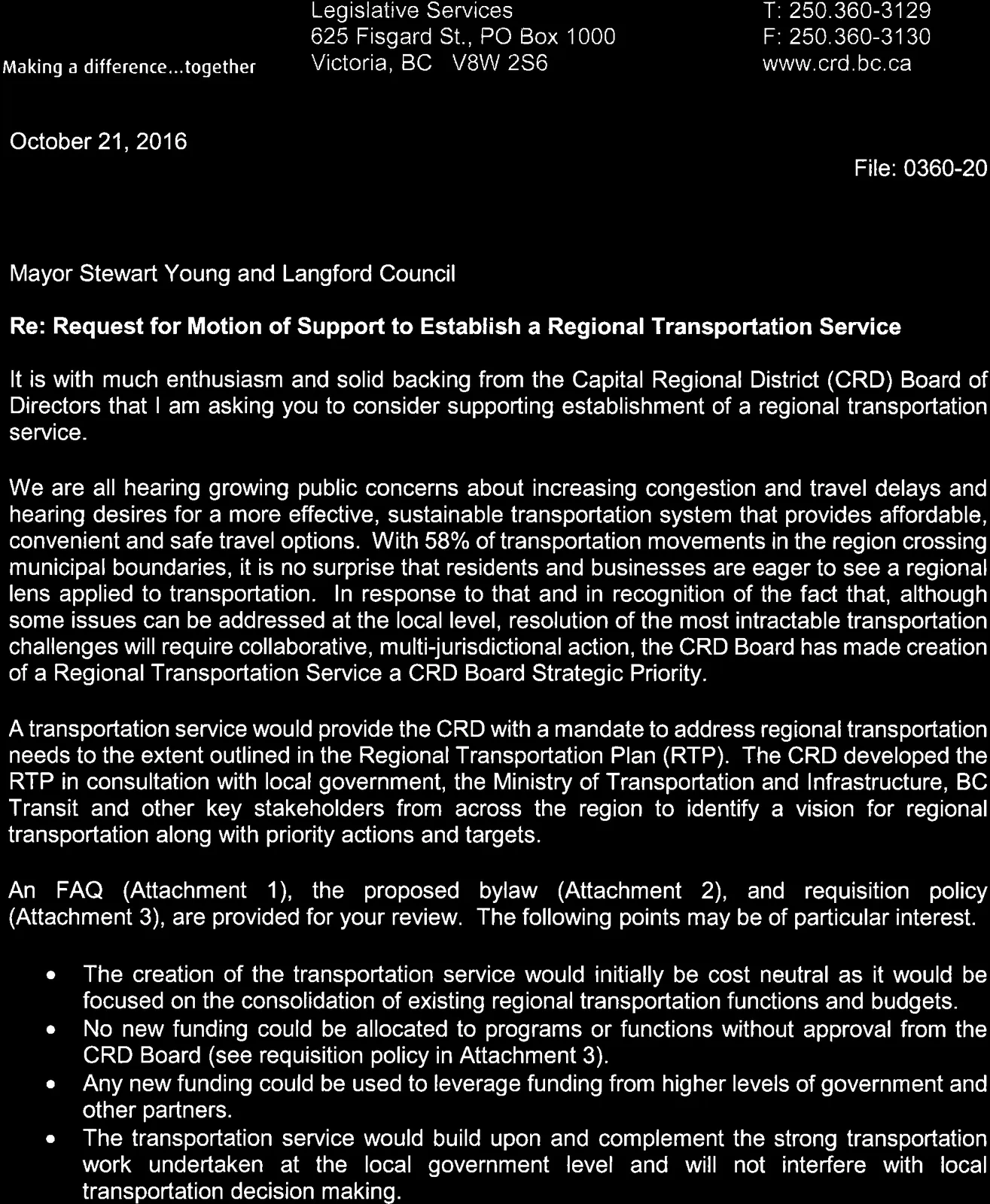
Legislative Services
625 Fisgard St., PO Box 1000
Victoria, BC V8W 2S6
T: 250.360-3129
F: 250.360-3130
www.crd.bc.ca
October 21, 2016
File: 0360-20
Mayor Stewart Young and Langford Council:
Re: Request for Motion of Support to Establish a Regional Transportation Service
It is with much enthusiasm and solid backing from the Capital Regional District (CRD) Board of Directors that I am asking you to consider supporting establishment of a regional transportation service.
We are all hearing growing public concerns about increasing congestion and travel delays and hearing desires for a more effective, sustainable transportation system that provides affordable, convenient and safe travel options. With 58% of transportation movements in the region crossing municipal boundaries, it is no surprise that residents and businesses are eager to see a regional lens applied to transportation. In response to that and in recognition of the fact that, although some issues can be addressed at the local level, resolution of the most intractable transportation challenges will require collaborative, multi-jurisdictional action, the CRD Board has made creation of a Regional Transportation Service a CRD Board Strategic Priority.
A transportation service would provide the CRD with a mandate to address regional transportation needs to the extent outlined in the Regional Transportation Plan (RTP). The CRD developed the RTP in consultation with local government, the Ministry of Transportation and Infrastructure, BC Transit and other key stakeholders from across the region to identify a vision for regional transportation along with priority actions and targets.
An FAQ (Attachment 1), the proposed bylaw (Attachment 2) and requisition policy (Attachment 3), are provided for your review. The following points may be of particular interest.
- The creation of the transportation service would initially be cost neutral as it would be focused on the consolidation of existing regional transportation functions and budgets.
- No new funding could be allocated to programs or functions without approval from the CRD Board (see requisition policy in Attachment 3).
- Any new funding could be used to leverage funding from higher levels of government and other partners.
- The transportation service would build upon and complement the strong transportation work undertaken at the local government level and will not interfere with local transportation decision making.
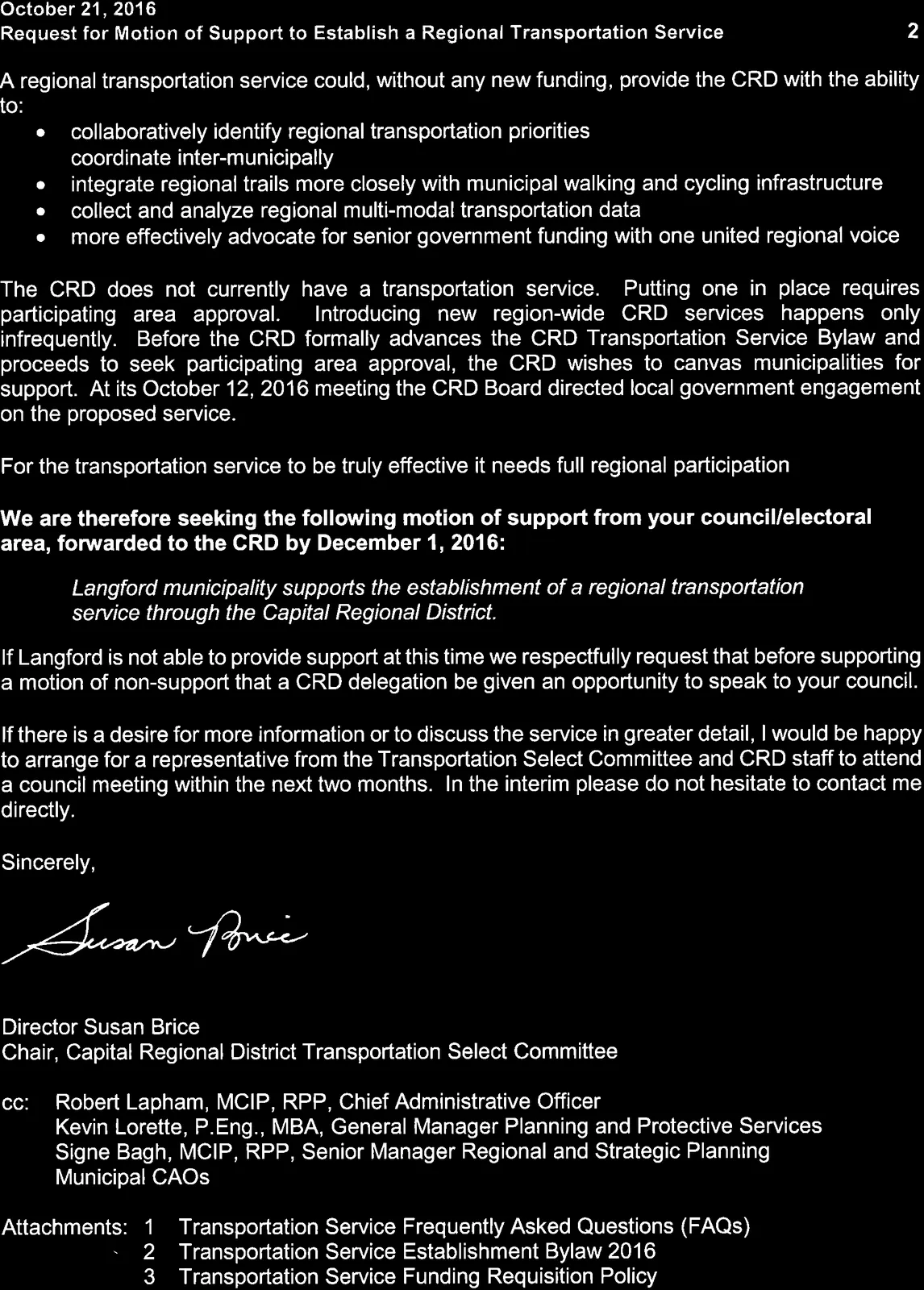
We are therefore seeking your support for a motion of support by your municipal council/electoral area, forwarded to the CRD by December 1, 2016. (See Attachment 1 for more detail.)
Sincerely,
[Signature]
Director Susan Brice
Chair, Capital Regional District Transportation Select Committee
cc: Robert Lapham, MCIP, RPP, Chief Administrative Officer
Kevin Lorette, P.Eng., MBA, General Manager Planning and Protective Services
Signe Bagh, MCIP, RPP, Senior Manager Regional and Strategic Planning
Municipal CAOs
Attachments:
- Transportation Service Frequently Asked Questions (FAQs)
- Transportation Service Establishment Bylaw 2016
- Transportation Service Funding Requisition Policy
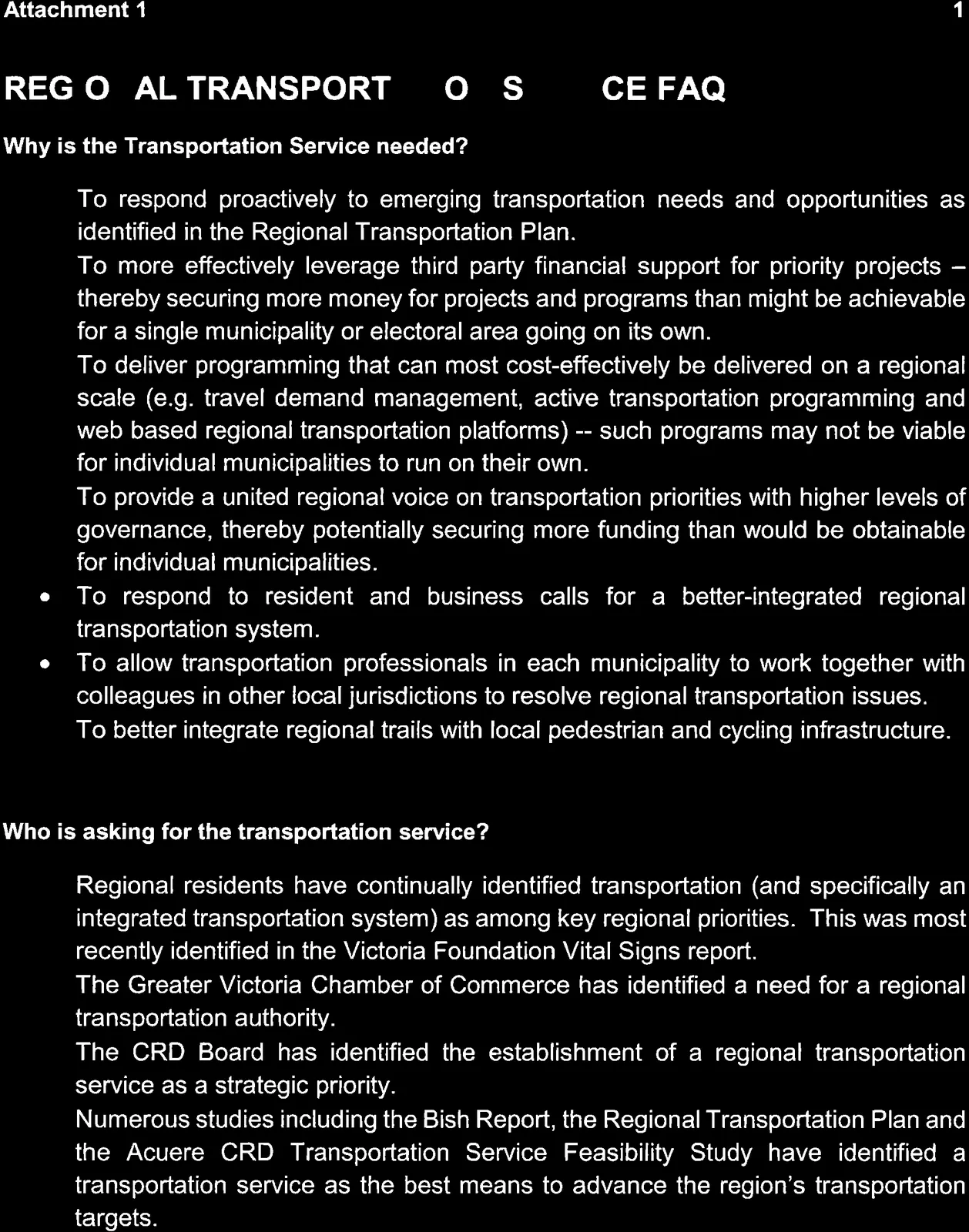
Attachment 1
REGIONAL TRANSPORTATION SERVICE FAQ
Why is the Transportation Service needed?
- To respond proactively to emerging transportation needs and opportunities as identified in the Regional Transportation Plan.
- To more effectively leverage third party financial support for priority projects – thereby securing more money for projects and programs than might be achievable for a single municipality or electoral area going on its own.
- To deliver programming that can most cost-effectively be delivered on a regional scale (e.g., travel demand management, active transportation programming and web based regional transportation platforms) -- such programs may not be viable for individual municipalities to run on their own.
- To provide a united regional voice on transportation priorities with higher levels of governance, thereby potentially securing more funding than would be obtainable for individual municipalities.
- To respond to resident and business calls for a better-integrated regional transportation system.
- To allow transportation professionals in each municipality to work together with colleagues in other local jurisdictions to resolve regional transportation issues.
- To better integrate regional trails with local pedestrian and cycling infrastructure.
Who is asking for the transportation service?
- Regional residents have continually identified transportation (and specifically an integrated transportation system) as among key regional priorities. This was most recently identified in the Victoria Foundation Vital Signs report.
- The Greater Victoria Chamber of Commerce has identified a need for a regional transportation authority.
- The CRD Board has identified the establishment of a regional transportation service as a strategic priority.
- Numerous studies including the Bish Report, the Regional Transportation Plan and the Acuere CRD Transportation Service Feasibility Study have identified a transportation service as the best means to advance the region’s transportation targets.
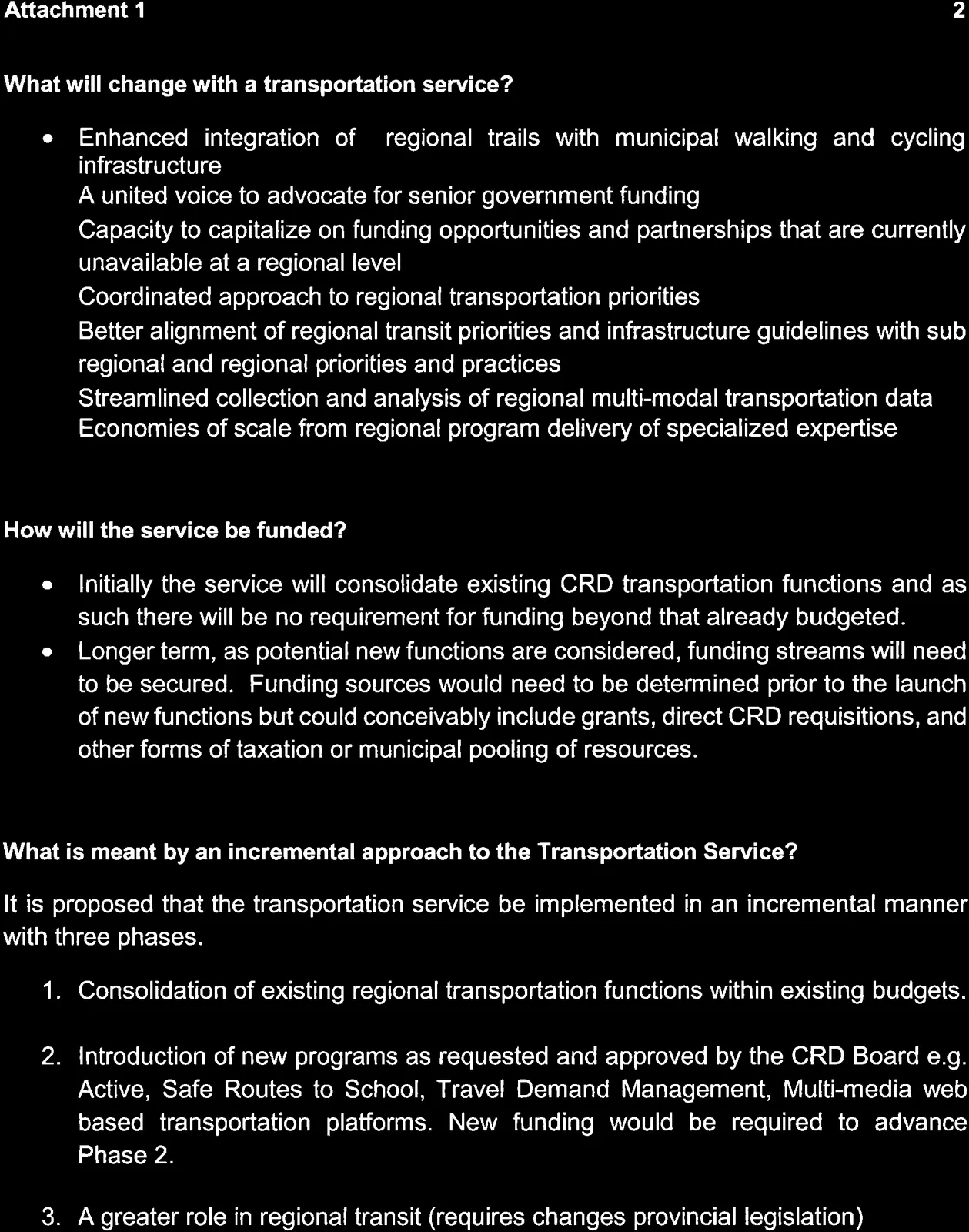
What will change with a transportation service?
- Enhanced integration of regional trails with municipal walking and cycling infrastructure
- A united voice to advocate for senior government funding
- Capacity to capitalize on funding opportunities and partnerships that are currently unavailable at a regional level
- Coordinated approach to regional transportation priorities
- Better alignment of regional transit priorities and infrastructure guidelines with sub regional and regional priorities and practices
- Streamlined collection and analysis of regional multi-modal transportation data
- Economies of scale from regional program delivery of specialized expertise
How will the service be funded?
- Initially the service will consolidate existing CRD transportation functions and as such there will be no requirement for funding beyond that already budgeted.
- Longer term, as potential new functions are considered, funding streams will need to be secured. Funding sources would need to be determined prior to the launch of new functions but could conceivably include grants, direct CRD requisitions, and other forms of taxation or municipal pooling of resources.
What is meant by an incremental approach to the Transportation Service?
It is proposed that the transportation service be implemented in an incremental manner with three phases.
Consolidation of existing regional transportation functions within existing budgets.
Introduction of new programs as requested and approved by the CRD Board e.g. Active, Safe Routes to School, Travel Demand Management, Multi-media web based transportation platforms. New funding would be required to advance Phase 2.
A greater role in regional transit (requires changes provincial legislation).
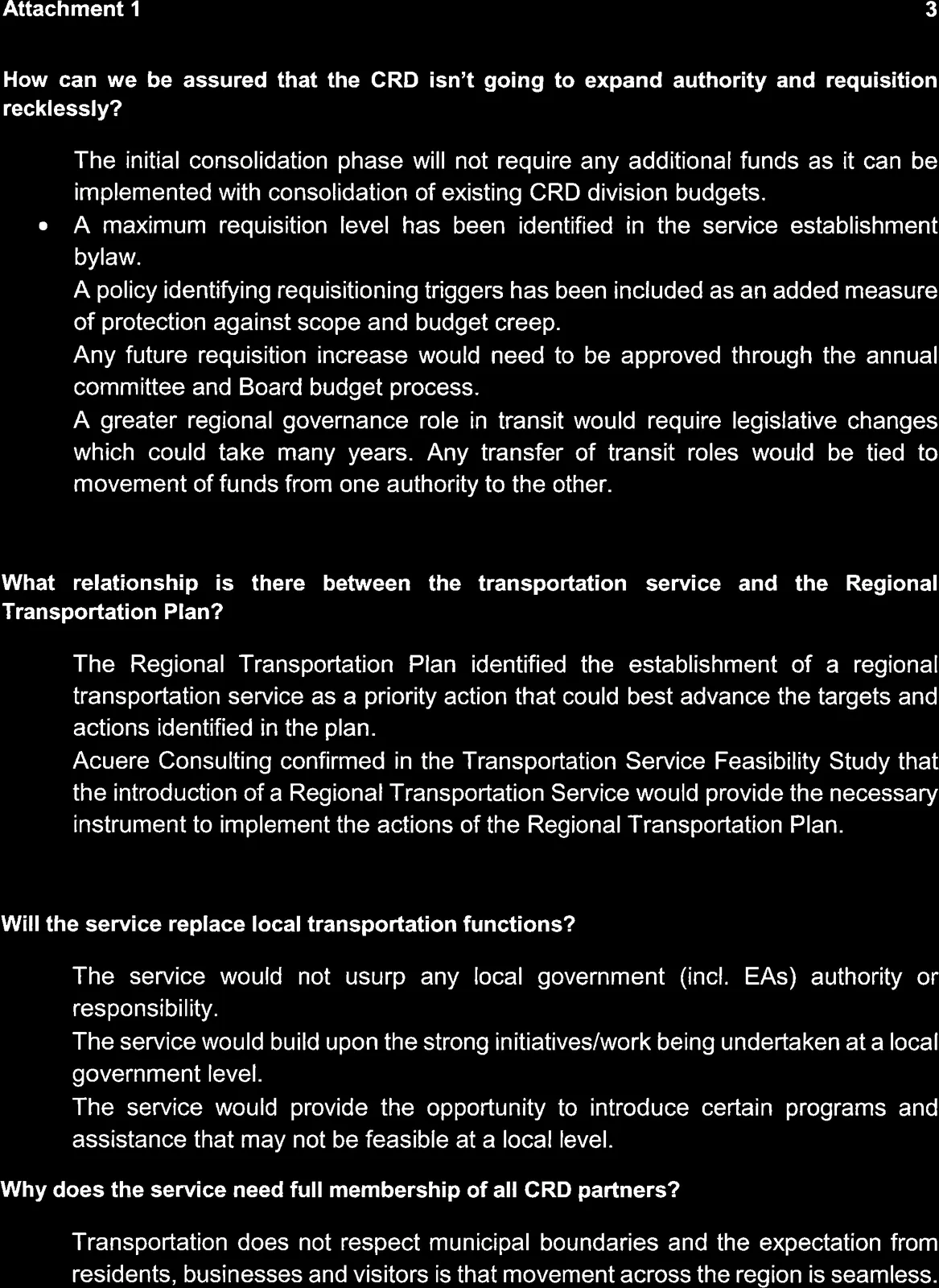
How can we be assured that the CRD isn't going to expand authority and requisition recklessly?
- The initial consolidation phase will not require any additional funds as it can be implemented with consolidation of existing CRD division budgets.
- A maximum requisition level has been identified in the service establishment bylaw.
- A policy identifying requisitioning triggers has been included as an added measure of protection against scope and budget creep.
- Any future requisition increase would need to be approved through the annual committee and Board budget process.
- A greater regional governance role in transit would require legislative changes which could take many years. Any transfer of transit roles would be tied to movement of funds from one authority to the other.
What relationship is there between the transportation service and the Regional Transportation Plan?
- The Regional Transportation Plan identified the establishment of a regional transportation service as a priority action that could best advance the targets and actions identified in the plan.
- Acuere Consulting confirmed in the Transportation Service Feasibility Study that the introduction of a Regional Transportation Service would provide the necessary instrument to implement the actions of the Regional Transportation Plan.
Will the service replace local transportation functions?
- The service would not usurp any local government (incl. EAs) authority or responsibility.
- The service would build upon the strong initiatives/work being undertaken at a local government level.
- The service would provide the opportunity to introduce certain programs and assistance that may not be feasible at a local level.
Why does the service need full membership of all CRD partners?
- Transportation does not respect municipal boundaries and the expectation from residents, businesses and visitors is that movement across the region is seamless.
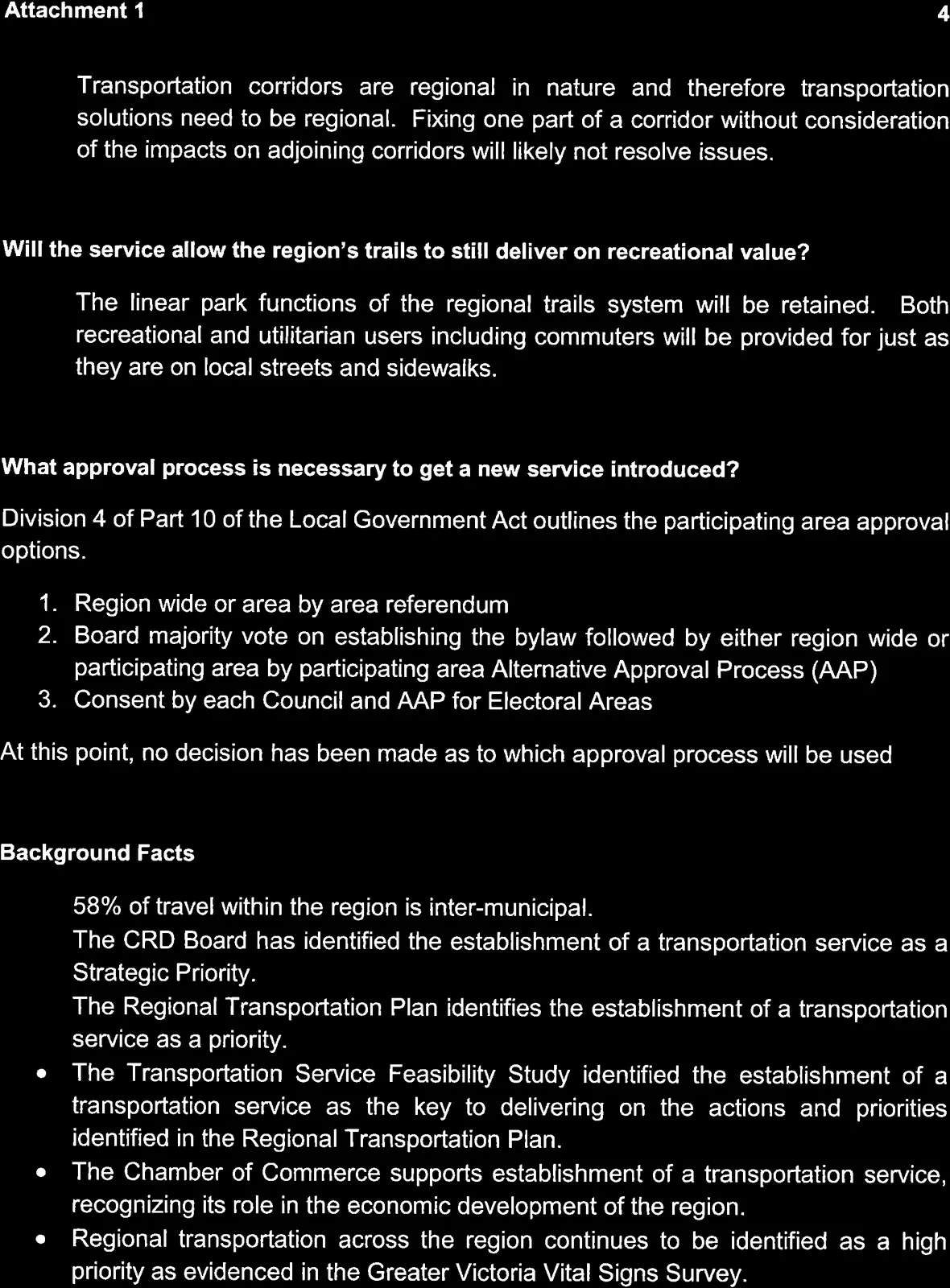
- Transportation corridors are regional in nature and therefore transportation solutions need to be regional. Fixing one part of a corridor without consideration of the impacts on adjoining corridors will likely not resolve issues.
Will the service allow the region's trails to still deliver on recreational value?
- The linear park functions of the regional trails system will be retained. Both recreational and utilitarian users including commuters will be provided for just as they are on local streets and sidewalks.
What approval process is necessary to get a new service introduced?
Division 4 of Part 10 of the Local Government Act outlines the participating area approval options.
- Region wide or area by area referendum
- Board majority vote on establishing the bylaw followed by either region wide or participating area by participating area Alternative Approval Process (AAP)
- Consent by each Council and AAP for Electoral Areas
At this point, no decision has been made as to which approval process will be used.
Background Facts
- 58% of travel within the region is inter-municipal.
- The CRD Board has identified the establishment of a transportation service as a Strategic Priority.
- The Regional Transportation Plan identifies the establishment of a transportation service as a priority.
- The Transportation Service Feasibility Study identified the establishment of a transportation service as the key to delivering on the actions and priorities identified in the Regional Transportation Plan.
- The Chamber of Commerce supports establishment of a transportation service, recognizing its role in the economic development of the region.
- Regional transportation across the region continues to be identified as a high priority as evidenced in the Greater Victoria Vital Signs Survey.
Attachment 2
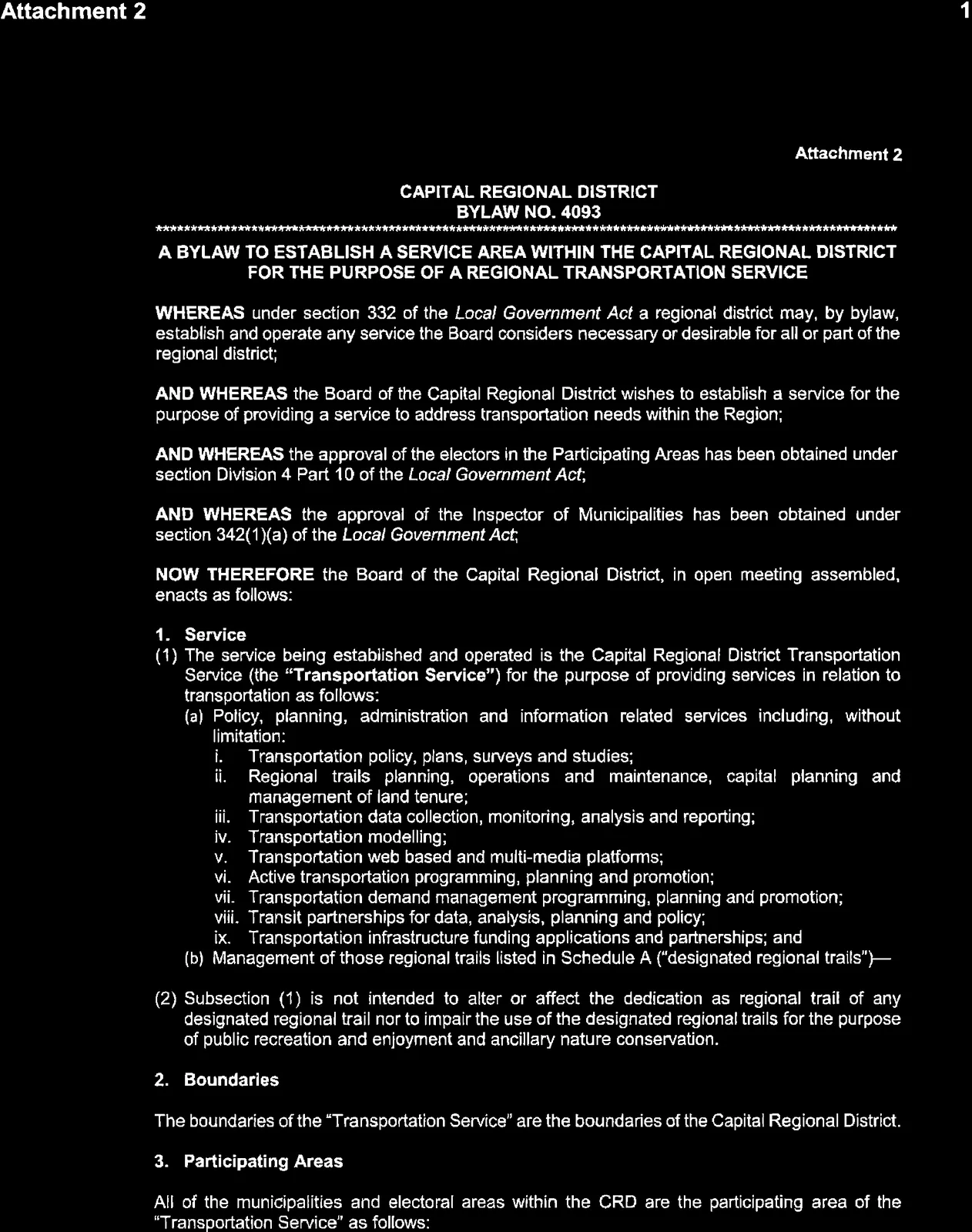
CAPITAL REGIONAL DISTRICT
BYLAW NO. 4093
A BYLAW TO ESTABLISH A SERVICE AREA WITHIN THE CAPITAL REGIONAL DISTRICT FOR THE PURPOSE OF A REGIONAL TRANSPORTATION SERVICE
WHEREAS under section 332 of the Local Government Act a regional district may, by bylaw, establish and operate any service the Board considers necessary or desirable for all or part of the regional district;
AND WHEREAS the Board of the Capital Regional District wishes to establish a service for the purpose of providing a service to address transportation needs within the Region;
AND WHEREAS the approval of the electors in the Participating Areas has been obtained under section Division 4 Part 10 of the Local Government Act;
AND WHEREAS the approval of the Inspector of Municipalities has been obtained under section 342(1)(a) of the Local Government Act;
NOW THEREFORE the Board of the Capital Regional District, in open meeting assembled, enacts as follows:
- Service
(1) The service being established and operated is the Capital Regional District Transportation Service (the "Transportation Service") for the purpose of providing services in relation to transportation as follows:
(a) Policy, planning, administration and information related services including, without limitation:
i. Transportation policy, plans, surveys and studies;
ii. Regional trails planning, operations and maintenance, capital planning and management of land tenure;
iii. Transportation data collection, monitoring, analysis and reporting;
iv. Transportation modelling;
v. Transportation web based and multi-media platforms;
vi. Active transportation programming, planning and promotion;
vii. Transportation demand management programming, planning and promotion;
viii. Transit partnerships for data, analysis, planning and policy;
ix. Transportation infrastructure funding applications and partnerships; and
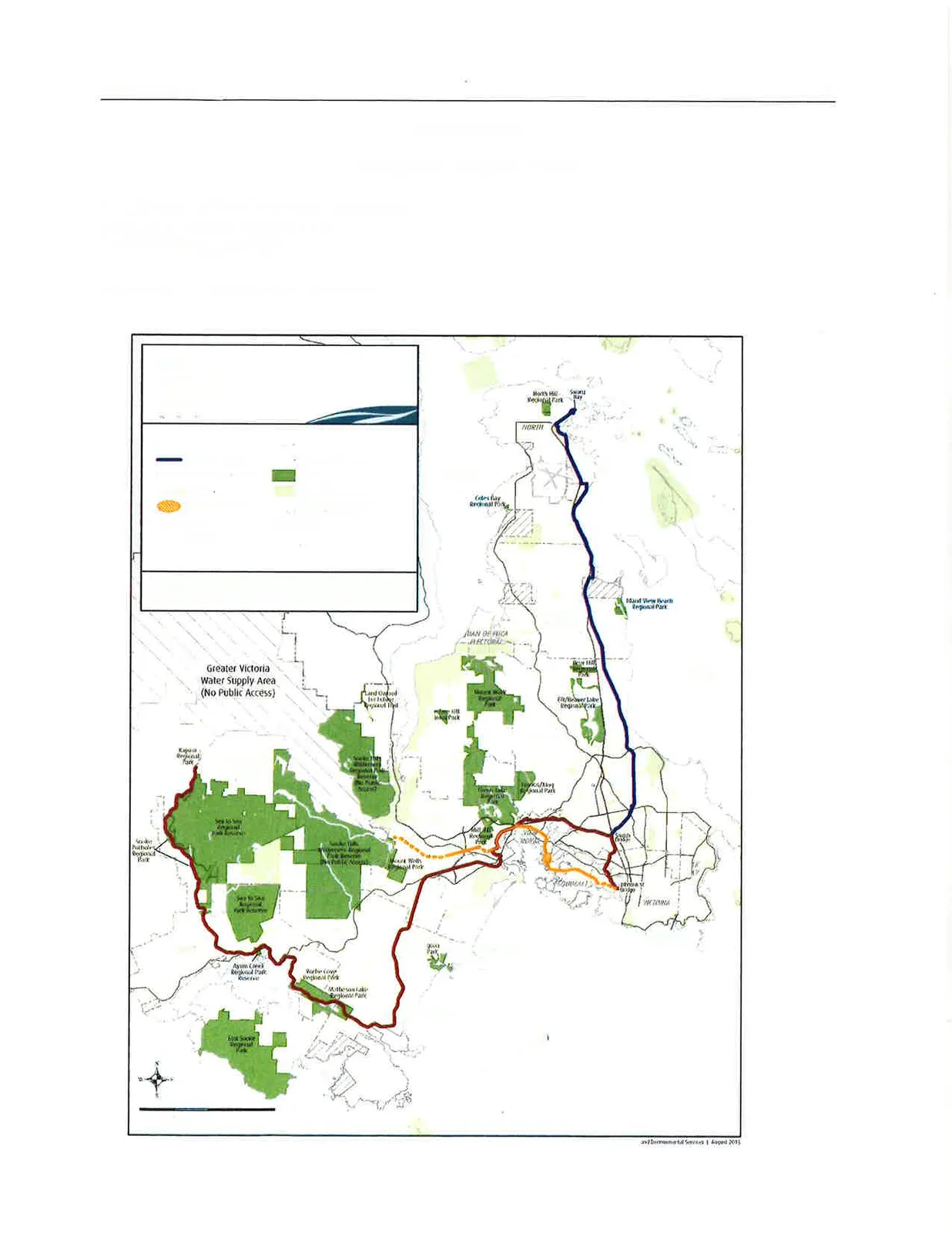
(b) Management of those regional trails listed in Schedule A ("designated regional trails")—
(2) Subsection (1) is not intended to alter or affect the dedication as regional trail of any designated regional trail nor to impair the use of the designated regional trails for the purpose of public recreation and enjoyment and ancillary nature conservation.
- Boundaries
The boundaries of the "Transportation Service" are the boundaries of the Capital Regional District.
- Participating Areas
All of the municipalities and electoral areas within the CRD are the participating area of the "Transportation Service" as follows:
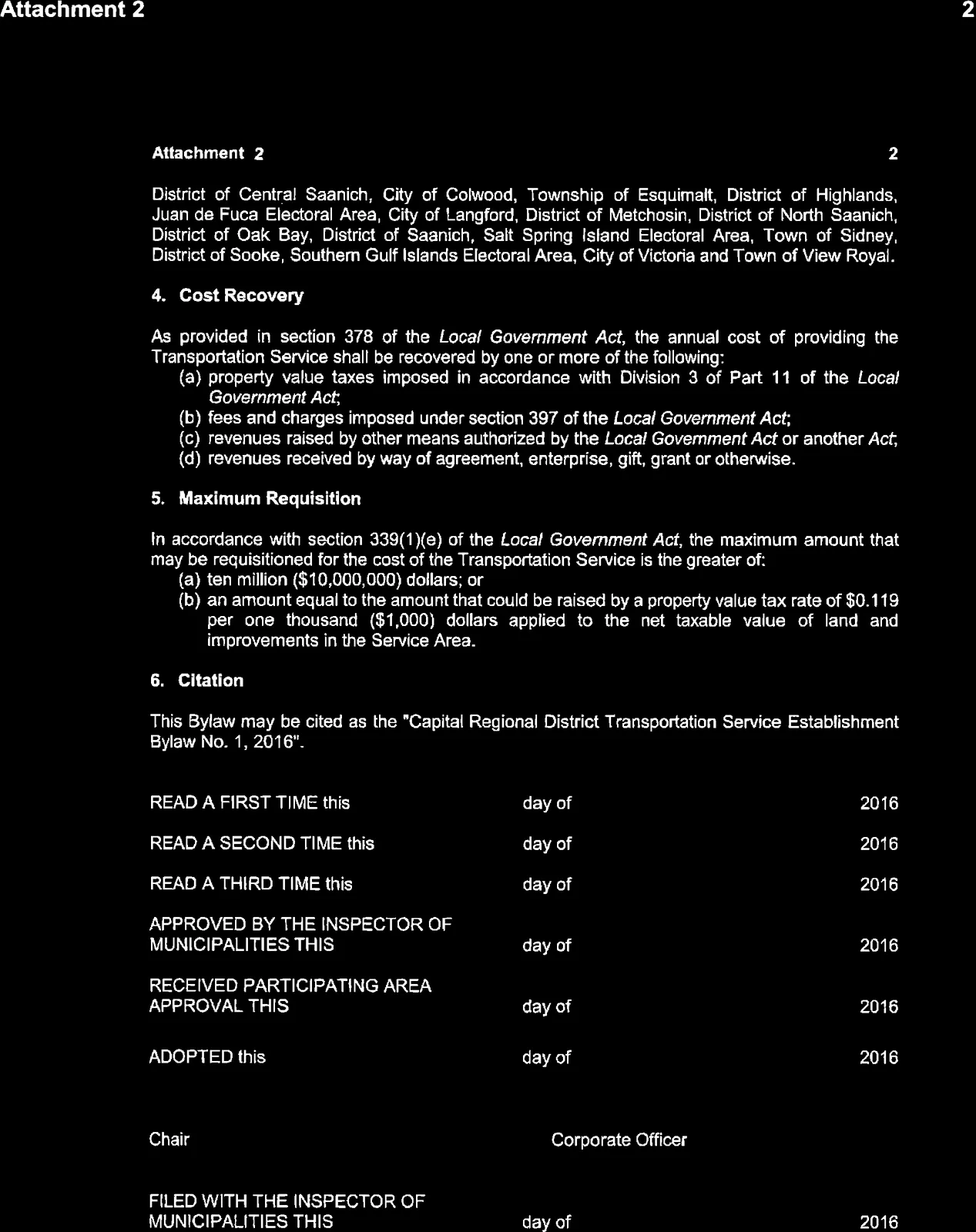
- District of Central Saanich
- City of Colwood
- Township of Esquimalt
- District of Highlands
- Juan de Fuca Electoral Area
- City of Langford
- District of Metchosin
- District of North Saanich
- District of Oak Bay
- District of Saanich
- Salt Spring Island Electoral Area
- Town of Sidney
- District of Sooke
- Southern Gulf Islands Electoral Area
- City of Victoria
- Town of View Royal
- Cost Recovery
As provided in section 378 of the Local Government Act, the annual cost of providing the Transportation Service shall be recovered by one or more of the following:
(a) property value taxes imposed in accordance with Division 3 of Part 11 of the Local Government Act;
(b) fees and charges imposed under section 397 of the Local Government Act;
(c) revenues raised by other means authorized by the Local Government Act or another Act;
(d) revenues received by way of agreement, enterprise, gift, grant or otherwise.
- Maximum Requisition
In accordance with section 339(1)(e) of the Local Government Act, the maximum amount that may be requisitioned for the cost of the Transportation Service is the greater of:
(a) ten million ($10,000,000) dollars; or
(b) an amount equal to the amount that could be raised by a property value tax rate of $0.119 per one thousand ($1,000) dollars applied to the net taxable value of land and improvements in the Service Area.
- Citation
This Bylaw may be cited as the "Capital Regional District Transportation Service Establishment Bylaw No. 1, 2016".
READ A FIRST TIME this ____ day of ______ 2016
READ A SECOND TIME this ____ day of ______ 2016
READ A THIRD TIME this ____ day of ______ 2016
APPROVED BY THE INSPECTOR OF MUNICIPALITIES THIS ____ day of ______ 2016
RECEIVED PARTICIPATING AREA APPROVAL THIS ____ day of ______ 2016
ADOPTED this ____ day of ______ 2016
Chair
Corporate Officer
FILED WITH THE INSPECTOR OF MUNICIPALITIES THIS ____ day of ______ 2016
Schedule "A"
Designated Regional Trails
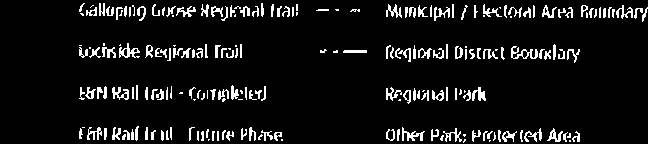
- E & N Rail Trail – Humpback Connector
- Galloping Goose Regional Trail
- Lochside Regional Trail
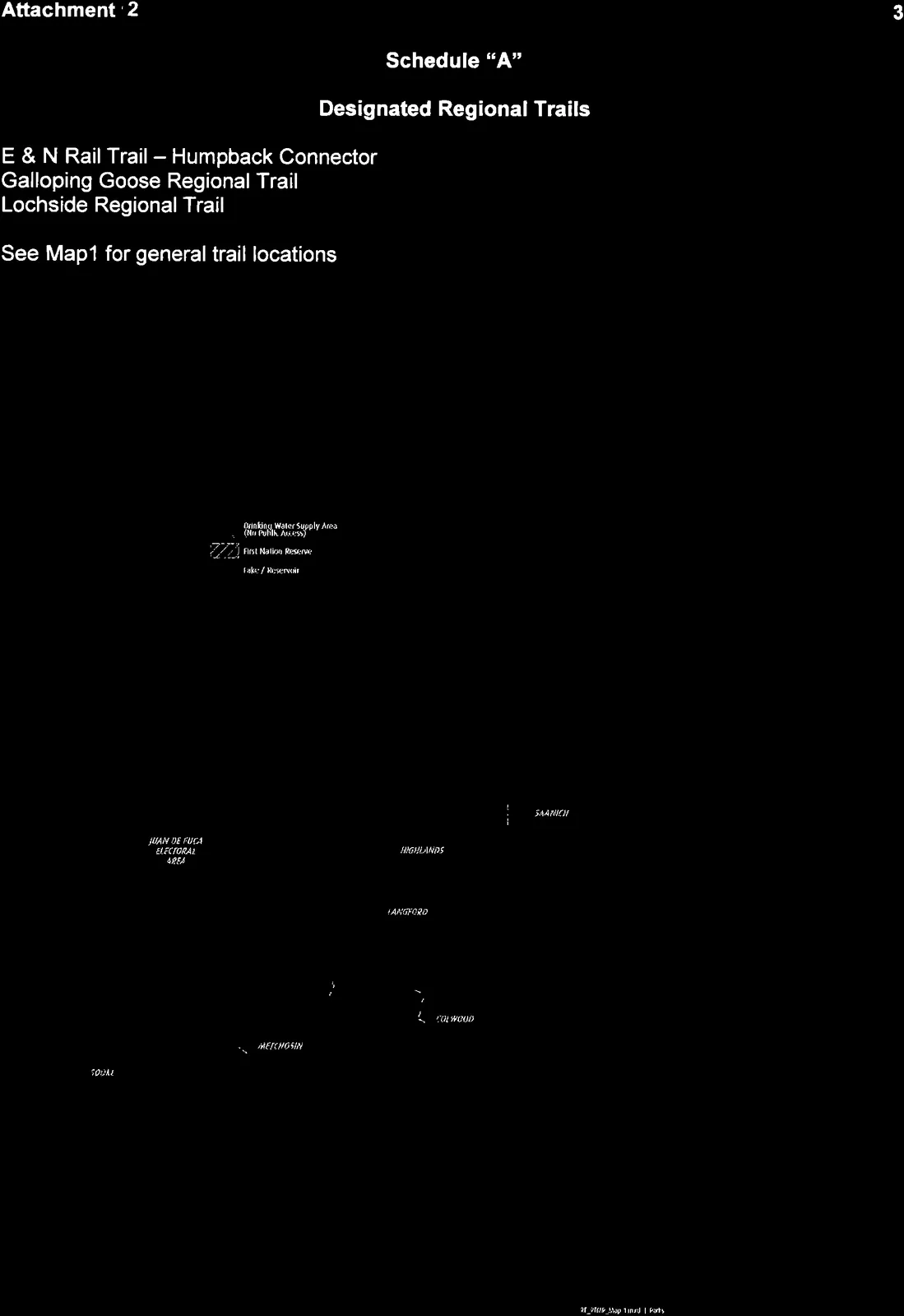
See Map1 for general trail locations

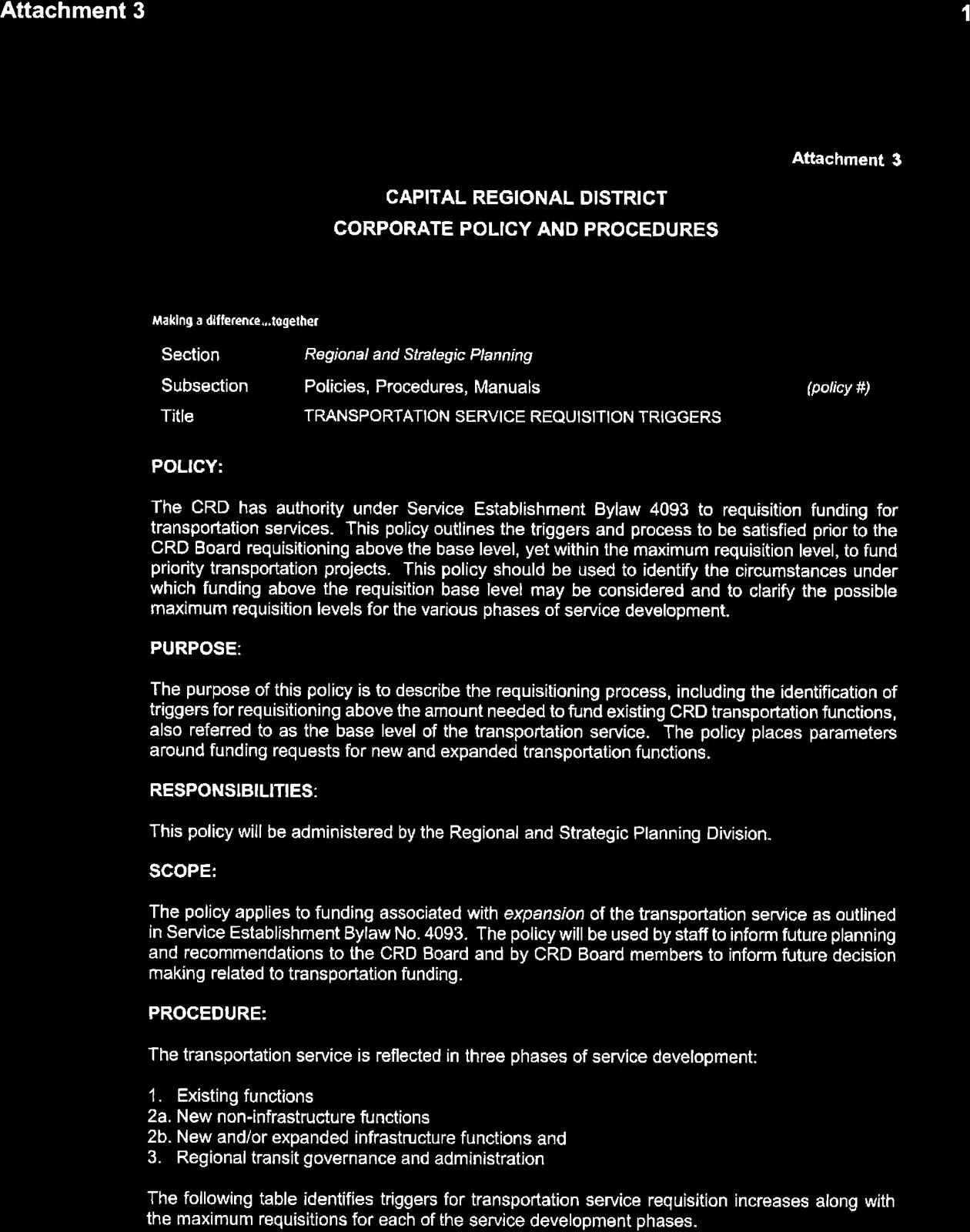
Attachment 3
CAPITAL REGIONAL DISTRICT
CORPORATE POLICY AND PROCEDURES
CRD logo (header)
Section: Regional and Strategic Planning
Subsection: Policies, Procedures, Manuals (policy #)
Title: TRANSPORTATION SERVICE REQUISITION TRIGGERS
POLICY:
The CRD has authority under Service Establishment Bylaw 4093 to requisition funding for transportation services. This policy outlines the triggers and process to be satisfied prior to the CRD Board requisitioning above the base level, yet within the maximum requisition level, to fund priority transportation projects. This policy should be used to identify the circumstances under which funding above the requisition base level may be considered and to clarify the possible maximum requisition levels for the various phases of service development.
PURPOSE:
The purpose of this policy is to describe the requisitioning process, including the identification of triggers for requisitioning above the amount needed to fund existing CRD transportation functions, also referred to as the base level of the transportation service. The policy places parameters around funding requests for new and expanded transportation functions.
RESPONSIBILITIES:
This policy will be administered by the Regional and Strategic Planning Division.
SCOPE:
The policy applies to funding associated with expansion of the transportation service as outlined in Service Establishment Bylaw No. 4093. The policy will be used by staff to inform future planning and recommendations to the CRD Board and by CRD Board members to inform future decision making related to transportation funding.
PROCEDURE:
The transportation service is reflected in three phases of service development:
- Existing functions
2a. New non-infrastructure functions
2b. New and/or expanded infrastructure functions and - Regional transit governance and administration
The following table identifies triggers for transportation service requisition increases along with the maximum requisitions for each of the service development phases.
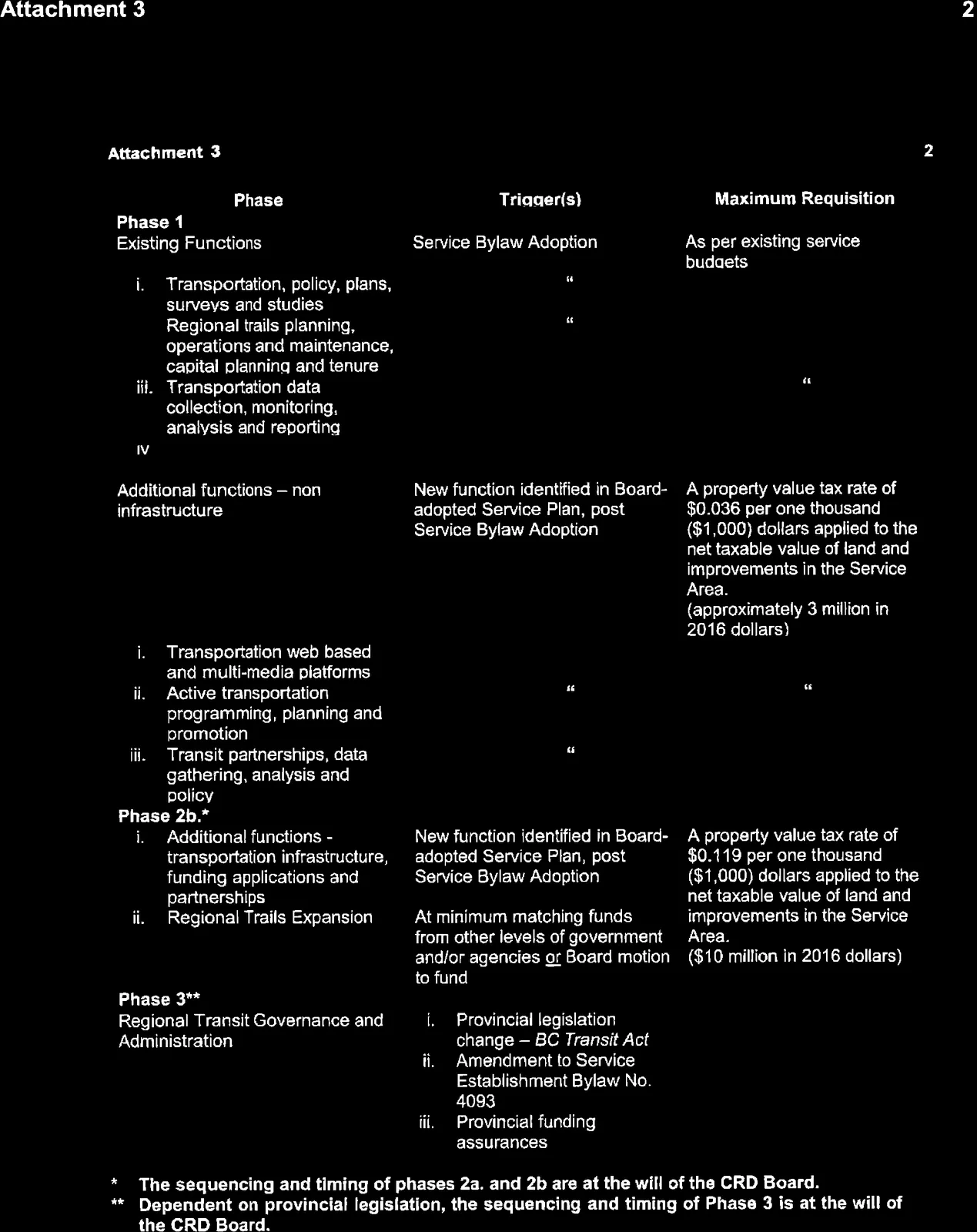
Transportation Service Requisition Triggers
| Phase | Trigger(s) | Maximum Requisition |
|---|---|---|
| Phase 1 Existing Functions |
Service Bylaw Adoption | As per existing service budgets |
| i. Transportation policy, plans, surveys and studies | ||
| ii. Regional trails planning, operations and maintenance, capital planning and tenure | ||
| iii. Transportation data collection, monitoring, analysis and reporting | ||
| iv. Transportation modelling | ||
| Phase 2a: Additional functions – non infrastructure |
New function identified in Board-adopted Service Plan, post Service Bylaw Adoption | A property value tax rate of $0.036 per one thousand ($1,000) dollars applied to the net taxable value of land and improvements in the Service Area. (approximately 3 million in 2016 dollars) |
| i. Transportation web based and multi-media platforms | ||
| ii. Active transportation programming, planning and promotion | ||
| iii. Transit partnerships, data gathering, analysis and policy | ||
| Phase 2b:* | New function identified in Board-adopted Service Plan, post Service Bylaw Adoption / At minimum matching funds from other levels of government and/or agencies or Board motion to fund | A property value tax rate of $0.119 per one thousand ($1,000) dollars applied to the net taxable value of land and improvements in the Service Area. ($10 million in 2016 dollars) |
| i. Additional functions - transportation infrastructure, funding applications and partnerships | ||
| ii. Regional Trails Expansion | ||
| Phase 3** Regional Transit Governance and Administration |
i. Provincial legislation change – BC Transit Act ii. Amendment to Service Establishment Bylaw No. 4093 iii. Provincial funding assurances |
* The sequencing and timing of phases 2a. and 2b are at the will of the CRD Board.
** Dependent on provincial legislation, the sequencing and timing of Phase 3 is at the will of the CRD Board.
Approval Date: ___________
Approved By: ___________
Document Images
(31)