DocumentsCorrespondenceNov 7, 2016Pages 90–103
Correspondence: Town of View Royal – Tri‑Partite Resolution to FCM Annual Conference
Letter from Town of View Royal submitting a tri‑partite resolution for consideration at the FCM Annual Conference and requesting Council support.
Key facts
- Correspondence start page: 90
- Subject: Submission of Tri‑Partite Resolution to the FCM Annual Conference
- Request: City endorsement/support of the proposed resolution
Correspondence: Town of View Royal – Tri‑Partite Resolution to FCM Annual Conference
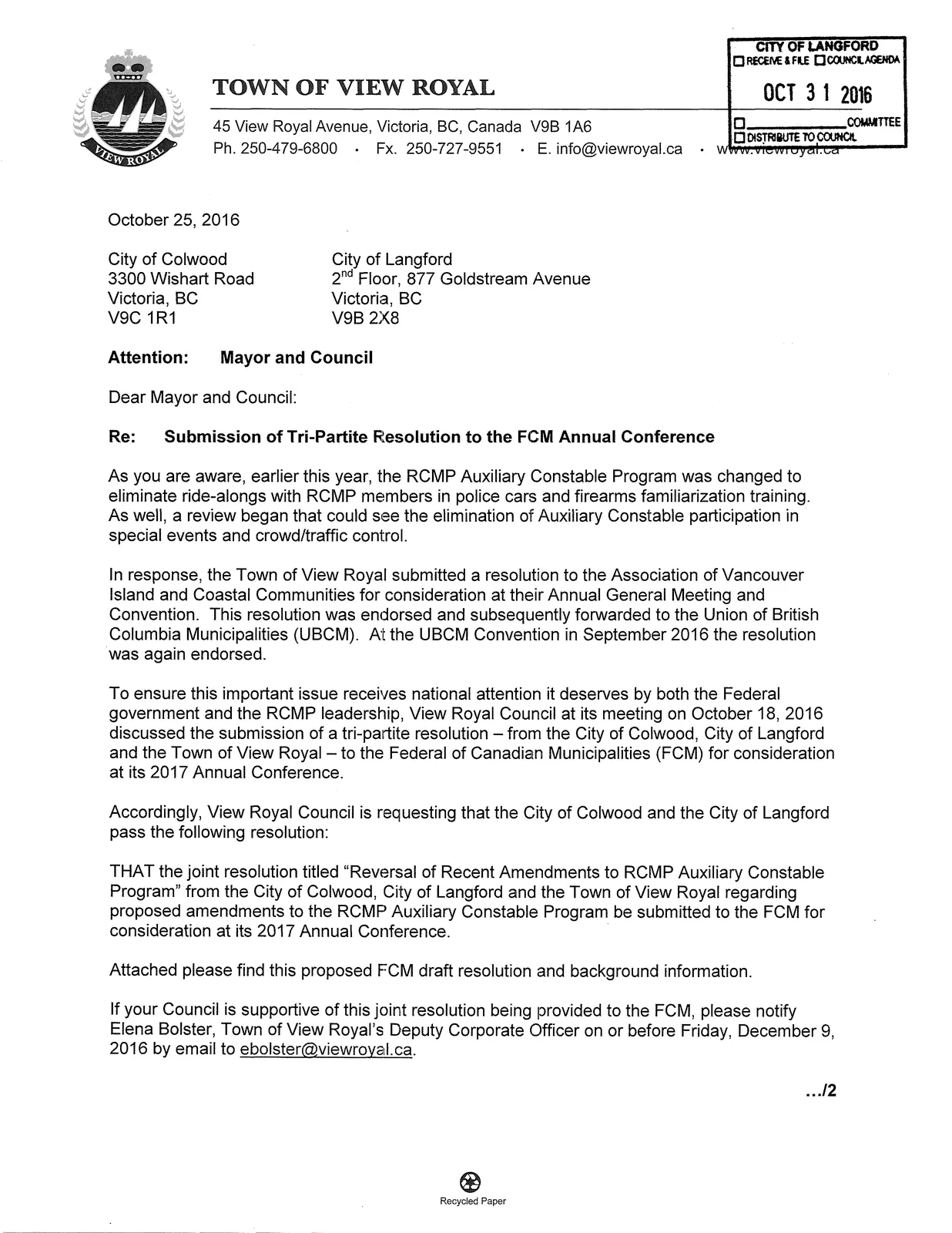
October 25, 2016
City of Colwood
3300 Wishart Road
Victoria, BC
V9C 1R1
City of Langford
2nd Floor, 877 Goldstream Avenue
Victoria, BC
V9B 2X8
Attention:
Mayor and Council
Dear Mayor and Council:
Re: Submission of Tri-Partite Resolution to the FCM Annual Conference
As you are aware, earlier this year, the RCMP Auxiliary Constable Program was changed to eliminate ride-alongs with RCMP members in police cars and firearms familiarization training. As well, a review began that could see the elimination of Auxiliary Constable participation in special events and crowd/traffic control.
In response, the Town of View Royal submitted a resolution to the Association of Vancouver Island and Coastal Communities for consideration at their Annual General Meeting and Convention. This resolution was endorsed and subsequently forwarded to the Union of British Columbia Municipalities (UBCM). At the UBCM Convention in September 2016 the resolution was again endorsed.
To ensure this important issue receives national attention it deserves by both the Federal government and the RCMP leadership, View Royal Council at its meeting on October 18, 2016 discussed the submission of a tri-partite resolution — from the City of Colwood, City of Langford and the Town of View Royal — to the Federal of Canadian Municipalities (FCM) for consideration at its 2017 Annual Conference.
Accordingly, View Royal Council is requesting that the City of Colwood and the City of Langford pass the following resolution:
THAT the joint resolution titled "Reversal of Recent Amendments to RCMP Auxiliary Constable Program" from the City of Colwood, City of Langford and the Town of View Royal regarding proposed amendments to the RCMP Auxiliary Constable Program be submitted to the FCM for consideration at its 2017 Annual Conference.
Attached please find this proposed FCM draft resolution and background information.
If your Council is supportive of this joint resolution being provided to the FCM, please notify Elena Bolster, Town of View Royal's Deputy Corporate Officer on or before Friday, December 9, 2016 by email to ebolsterviewroval.ca.
Yours truly,
David Screech
Mayor
Attachment
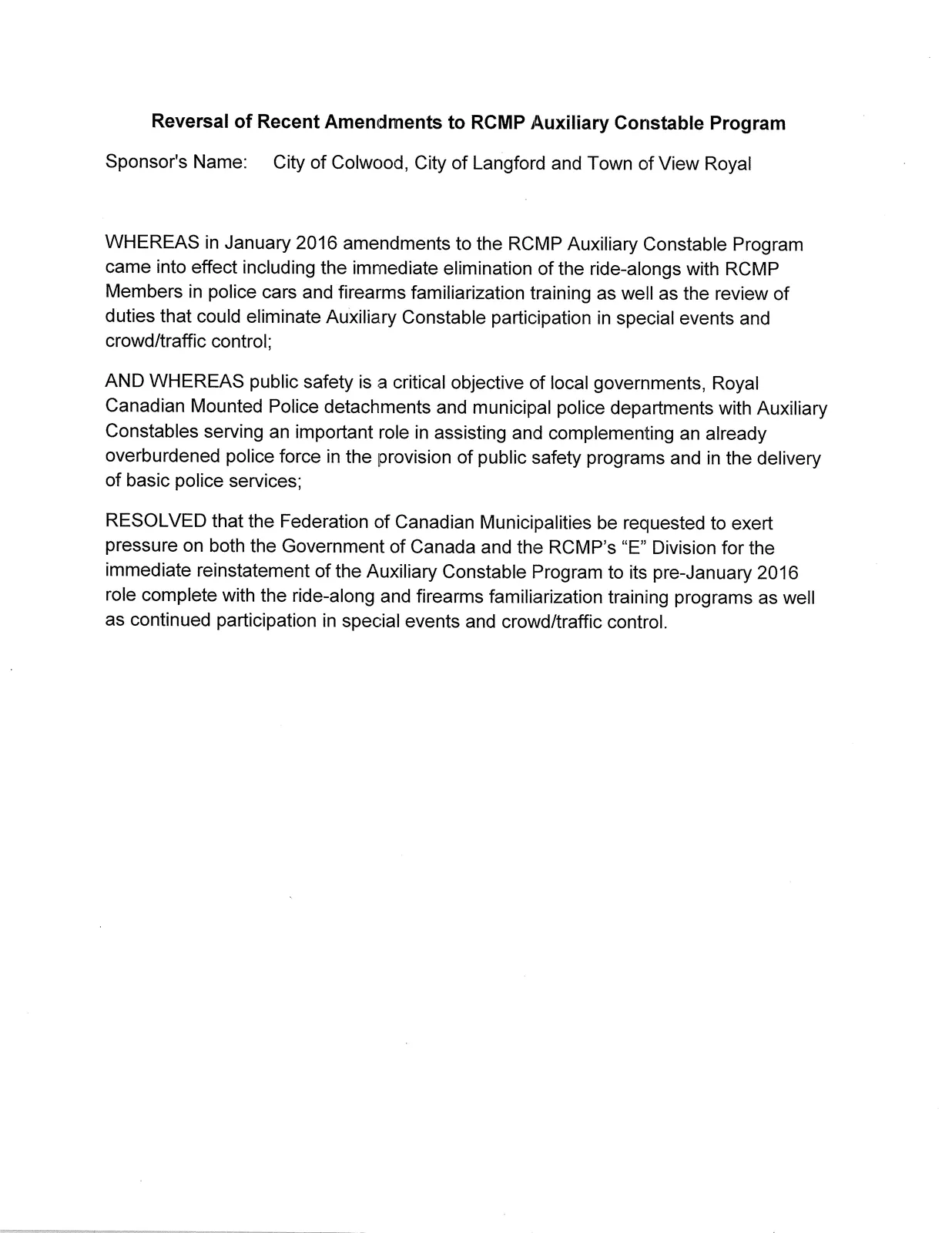
Reversal of Recent Amendments to RCMP Auxiliary Constable Program
Sponsor's Name: City of Colwood, City of Langford and Town of View Royal
WHEREAS in January 2016 amendments to the RCMP Auxiliary Constable Program came into effect including the immediate elimination of the ride-alongs with RCMP Members in police cars and firearms familiarization training as well as the review of duties that could eliminate Auxiliary Constable participation in special events and crowd/traffic control;
AND WHEREAS public safety is a critical objective of local governments, Royal Canadian Mounted Police detachments and municipal police departments with Auxiliary Constables serving an important role in assisting and complementing an already overburdened police force in the provision of public safety programs and in the delivery of basic police services;
RESOLVED that the Federation of Canadian Municipalities be requested to exert pressure on both the Government of Canada and the RCMP's "E" Division for the immediate reinstatement of the Auxiliary Constable Program to its pre-January 2016 role complete with the ride-along and firearms familiarization training programs as well as continued participation in special events and crowd/traffic control.
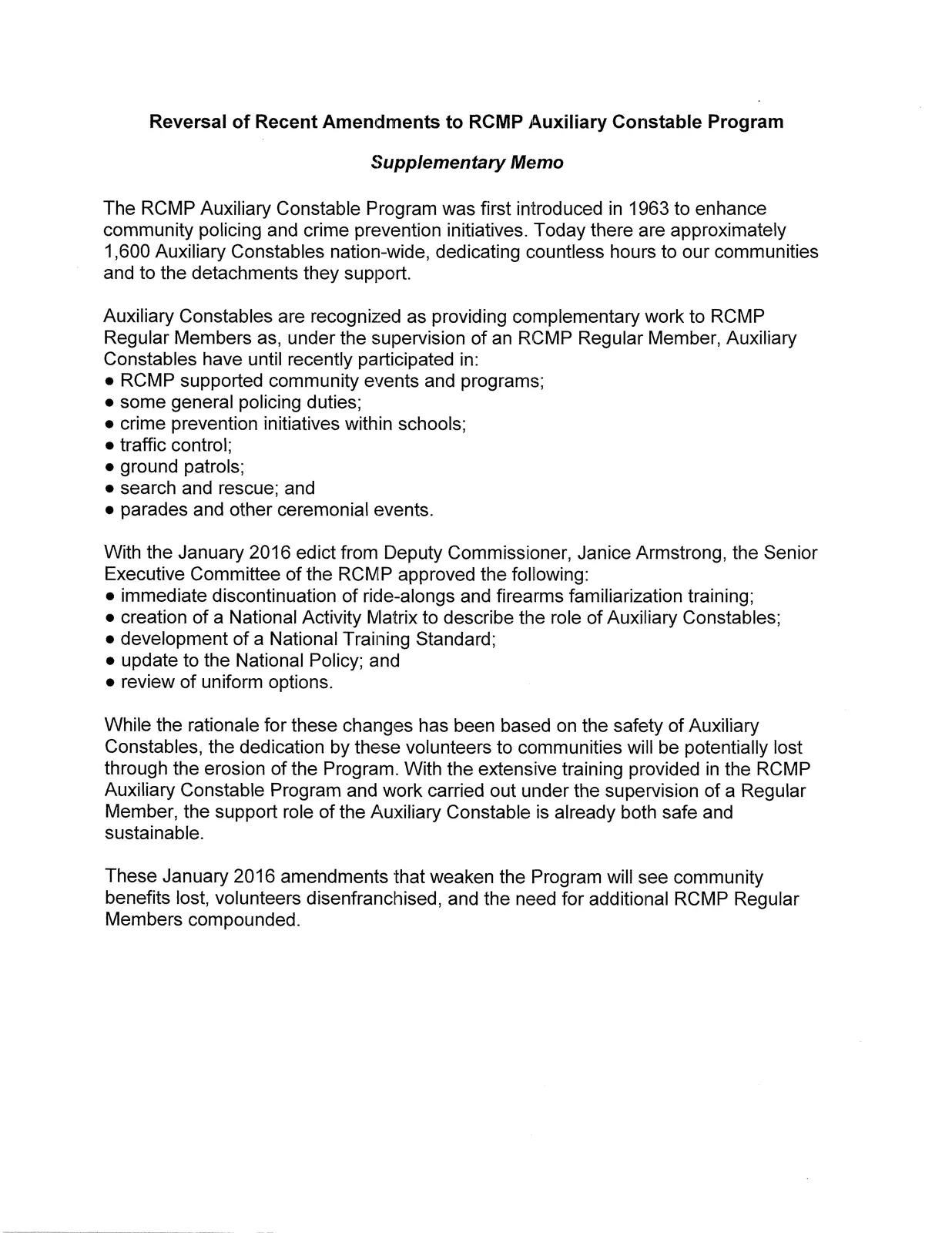
Supplementary Memo
The RCMP Auxiliary Constable Program was first introduced in 1963 to enhance community policing and crime prevention initiatives. Today there are approximately 1,600 Auxiliary Constables nation-wide, dedicating countless hours to our communities and to the detachments they support.
Auxiliary Constables are recognized as providing complementary work to RCMP Regular Members as, under the supervision of an RCMP Regular Member, Auxiliary Constables have until recently participated in:
- RCMP supported community events and programs;
- some general policing duties;
- crime prevention initiatives within schools;
- traffic control;
- ground patrols;
- search and rescue; and
- parades and other ceremonial events.
With the January 2016 edict from Deputy Commissioner, Janice Armstrong, the Senior Executive Committee of the RCMP approved the following:
- immediate discontinuation of ride-alongs and firearms familiarization training;
- creation of a National Activity Matrix to describe the role of Auxiliary Constables;
- development of a National Training Standard;
- update to the National Policy; and
- review of uniform options.
While the rationale for these changes has been based on the safety of Auxiliary Constables, the dedication by these volunteers to communities will be potentially lost through the erosion of the Program. With the extensive training provided in the RCMP Auxiliary Constable Program and work carried out under the supervision of a Regular Member, the support role of the Auxiliary Constable is already both safe and sustainable.
These January 2016 amendments that weaken the Program will see community benefits lost, volunteers disenfranchised, and the need for additional RCMP Regular Members compounded.
Comparing the Options — Renewing the Auxiliary Constable Program
Table of Contents
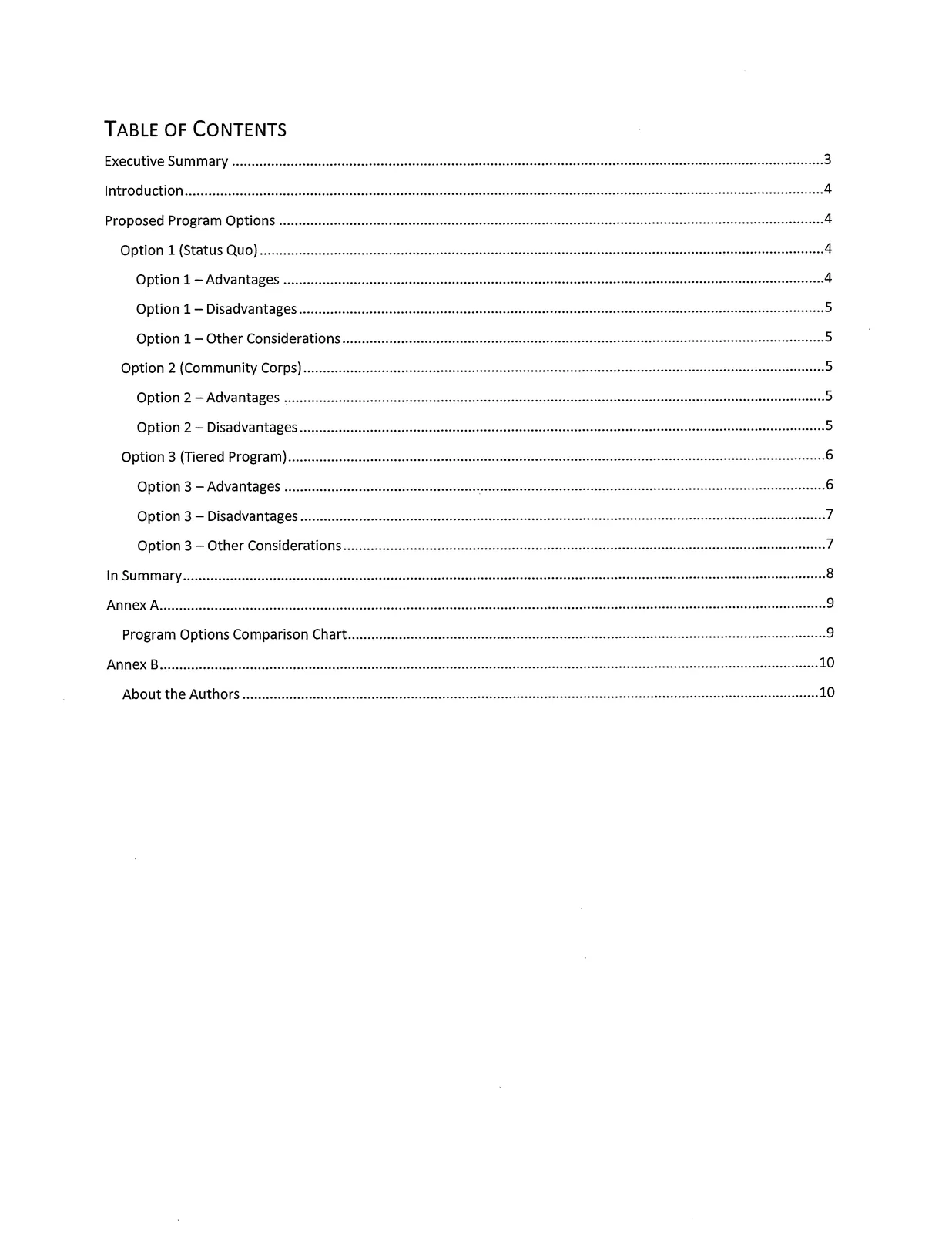
- Executive Summary .................................................. 3
- Introduction ...................................................... 4
- Proposed Program Options ......................................... 4
- Option 1 (Status Quo) ........................................ 4
- Option 1 — Advantages ...................................... 4
- Option 1 — Disadvantages .................................. 5
- Option 1 — Other Considerations ............................. 5
- Option 2 (Community Corps) ................................. 5
- Option 2 — Advantages ..................................... 5
- Option 2 — Disadvantages .................................. 5
- Option 3 (Tiered Program) .................................. 6
- Option 3 — Advantages ..................................... 6
- Option 3 — Disadvantages .................................. 7
- Option 3 — Other Considerations ............................. 7
- In Summary .................................................... 8
- Annex A ........................................................ 9
- Program Options Comparison Chart ............................ 9
- Annex B ........................................................ 10
- About the Authors ........................................... 10
Executive Summary
The purpose of this discussion paper is to provide local government decision makers with added insight into the Auxiliary Constable Program in BC at what might well be a pivotal point in its existence.
In January 2016, citing safety and liability concerns the RCMP unilaterally suspended General Duty / ride-along participation for their auxiliary constables across Canada. This action created a negative reaction across the country but especially in BC where, unlike the rest of the country, the RCMP is a partner with the province in the provincial Auxiliary /Reserve Constable Program. The RCMP then undertook a study of the Auxiliary Program with a view to revamp it. Their proposed options are presented here.
Unlike volunteer firefighter programs which regularly and widely publicise the value and function of their members' efforts, the Auxiliary Policing Program has largely existed as a quiet source of significant crime reduction and support to our regular force RCMP members in BC communities. It's the unobtrusive nature of policing which dictates this lack of open public discussion about this valuable program. While we haven't gone into close detail here it is our sincere hope that our nearly 50 years of combined study and input to the Auxiliary Constable Program, both provincially and federally, will provide an experience-based evaluation that you, our local government decision makers, can use to move this program in a direction that will serve your community best. At minimum, we believe the attached Annex A to this discussion paper will offer much needed "real life" clarification around how these different options presented by the RCMP (through the UBCM survey) will allow for a better informed decision on the part of our local Mayors and Councils.
Thank you in advance for considering the content.
Introduction
RCMP Auxiliary Constables are unarmed, uniformed volunteers whose primary purpose is to participate in community policing and crime prevention activities. In British Columbia, the Auxiliary Constable Program has been in existence for over 50 years and is governed by a Provincial Policy. There are currently about 700 active Auxiliary Constables located in 67 RCMP detachments throughout the Province, volunteering about 120,000 hours of service a year to their local communities.
One former RCMP Superintendent is quoted as saying the "Auxiliary Constable Program is incredibly important to the (his detachment's) city."
Because of the longevity and success of the Auxiliary Constable Program in BC, it is often easy to overlook one of the basic tenets behind its inception whereby the program originally fell under the Provincial Civil Defence Program. There have been many changes in the program since then including changes in the uniform to changes in the roles and responsibilities of our auxiliary constables, but it should be acknowledged our well trained Auxiliary Constables with Peace Officer status will become a critical component in the context of any emergent situation for a local government so long as we ensure these current standards are maintained.
Auxiliary Constables are appointed under the BC Police Act to assist the Provincial Police Force in the performance of its duties. The Province provides the funding to support local Auxiliary Constable Programs approved and established at Provincial RCMP detachments. Municipalities with populations greater than 5,000 are responsible for providing policing within their municipality, and are responsible for funding their local Auxiliary Constable Program, with the Ministry providing maintenance support. The Province also provides Auxiliary Constables with personal liability protection, WorkSafe BC coverage, death and dismemberment insurance coverage, a training curriculum, badges and ID.
Proposed Program Options
Based on input received during previous consultations, RCMP National Crime Prevention Services has developed several options regarding the future of the Auxiliary Constable Program. UBCM asks BC local governments to indicate their preferred option via survey prior to Tuesday, November 1, 2016. UBCM will then convey responses to the RCMP.
The RCMP is considering three options with regard to the Auxiliary Constable Program. These options are discussed below.
Option 1 (Status Quo)
Maintain the Auxiliary Constable Program in its current form (consistent with January 2016 changes), with no Auxiliary Constable participation in general duty patrols or ride-alongs, and no firearms familiarization training. Auxiliary Constables would remain appointed peace officers, wear a police-type uniform, and be issued intervention tools and soft body armour. A training standard and activity matrix would be subsequently developed to ensure minimum standards for Auxiliary Constables. At this time, the level of supervision (direct or indirect), nature of the activity matrix, and training requirements are unknown.
Option 1 — Advantages
It's difficult to come up with any distinct advantages to this first option since it has really yet to be developed. That said, the BC Auxiliaries have been operating under this form since ride-along restrictions were decreed so we do have some anecdotal evidence to base our analysis on. Based on our experience since ride-alongs were cancelled we can say that the only advantage to this option is that the RCMP has been able to reduce their liability for the A/Cst program.
Option 1 — Disadvantages
There are a number of disadvantages to this option, namely:
- If selected, implementation of the program under this option would be delayed because:
- The training standard for this option doesn't exist;
- The activity matrix for this option doesn't exist; and
- Supervision levels for this level have yet to be determined.
- A/Csts engaged under this option are limited in their utility to the local community.
- Their lack of exposure to police procedures and experience gained through working with their partners within the policing environment would reduce their ability to properly respond to emergency situations that might unexpectedly develop in a community (i.e. wildfire or earthquake evacuations, keeping the peace, etc.)
Option 1 — Other Considerations
While useful as a mid-way level in the progression from a Tier 1 to a Tier 3 A/Cst (see Option 3), because of the limited utility of auxiliaries working under this option, there are really no compelling reasons to recommend this option.
Option 2 (Community Corps)
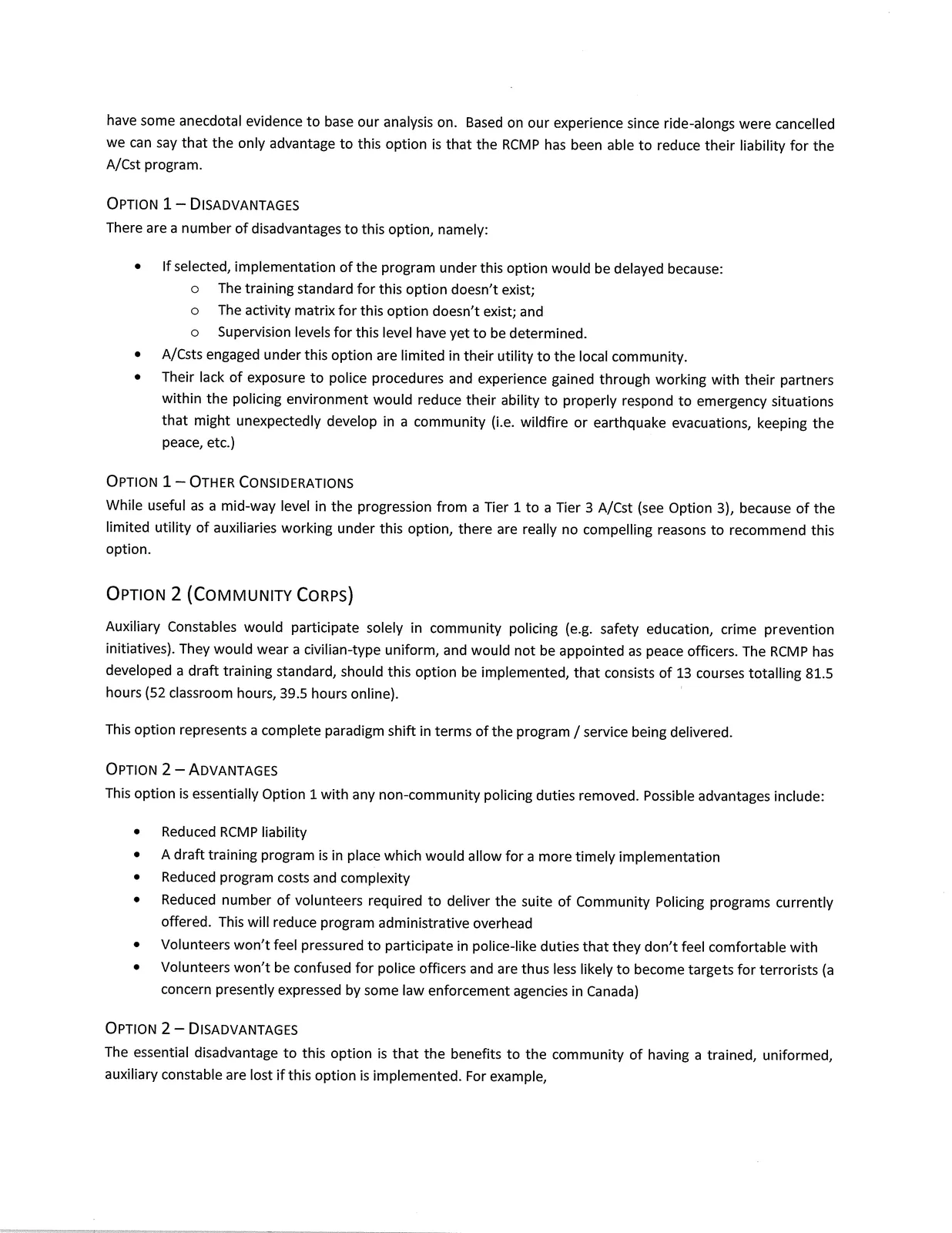
Auxiliary Constables would participate solely in community policing (e.g. safety education, crime prevention initiatives). They would wear a civilian-type uniform, and would not be appointed as peace officers. The RCMP has developed a draft training standard, should this option be implemented, that consists of 13 courses totalling 81.5 hours (52 classroom hours, 39.5 hours online).
This option represents a complete paradigm shift in terms of the program/service being delivered.
Option 2 — Advantages
This option is essentially Option 1 with any non-community policing duties removed. Possible advantages include:
- Reduced RCMP liability
- A draft training program is in place which would allow for a more timely implementation
- Reduced program costs and complexity
- Reduced number of volunteers required to deliver the suite of Community Policing programs currently offered. This will reduce program administrative overhead
- Volunteers won't feel pressured to participate in police-like duties that they don't feel comfortable with
- Volunteers won't be confused for police officers and are thus less likely to become targets for terrorists (a concern presently expressed by some law enforcement agencies in Canada)
Option 2 — Disadvantages
The essential disadvantage to this option is that the benefits to the community of having a trained, uniformed, auxiliary constable are lost if this option is implemented. For example:
- Community Corps volunteers would have minimal utility:
- They have no disaster response capability
- They can't support regular RCMP members at even low risk (i.e. directing traffic) activities
- They are unable to participate in situations where uniformed presence is required
- Built-in efficiencies are lost. For example, situations where the Auxiliary Constable can complete the onboard computer file synopsis while the "partners" move on to the next dispatched call for service
- Their lack of exposure to police procedures and experience within the policing environment would reduce their credibility and ability to respond to questions, etc. when presenting certain community programs (Block Watch or CPTED reviews, for example).
- Some of the community programs currently responsible for high tasking levels of our regular members actually require a uniformed facilitator. The DARE program is an example of this. Under current conditions A/Csts can, and do, teach DARE and are able to alleviate the workload of CPVS regular members somewhat. As Community Corps volunteers they wouldn't be able to do this.
- While perhaps useful in larger centres this option would likely be of little benefit to smaller communities who have a reduced need for the community programs. In a smaller community — under 5,000 population for example — how much need would there be for Block Watch presentations before the demand was satisfied? How many "Lock It or Lose It" sessions, etc.? Likely not very many, so while the Community Corps would have some value in the smaller centres these smaller communities are likely better serviced by an auxiliary serving under Option 1 or 3.
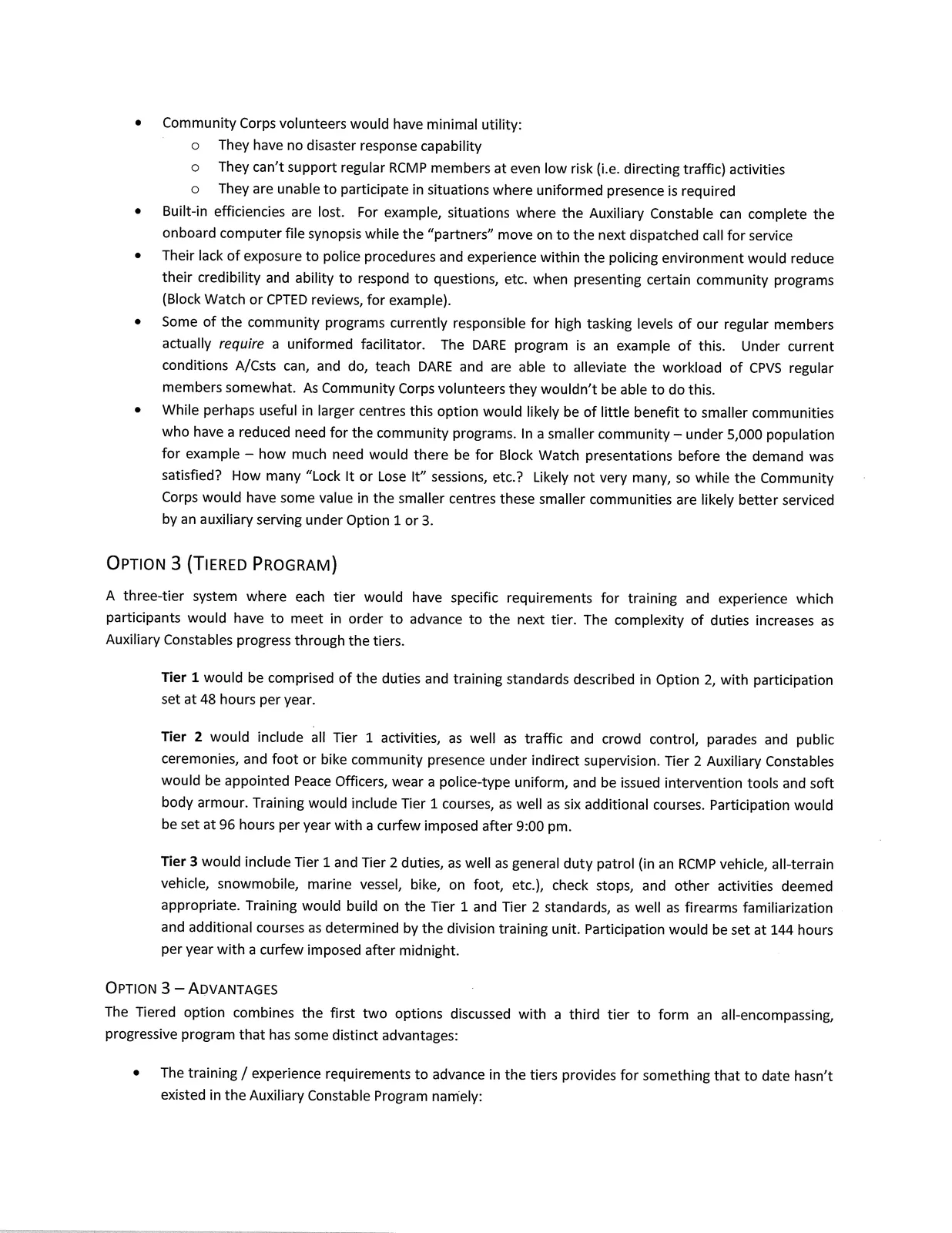
Option 3 (Tiered Program)
A three-tier system where each tier would have specific requirements for training and experience which participants would have to meet in order to advance to the next tier. The complexity of duties increases as Auxiliary Constables progress through the tiers.
- Tier 1 would be comprised of the duties and training standards described in Option 2, with participation set at 48 hours per year.
- Tier 2 would include all Tier 1 activities, as well as traffic and crowd control, parades and public ceremonies, and foot or bike community presence under indirect supervision. Tier 2 Auxiliary Constables would be appointed Peace Officers, wear a police-type uniform, and be issued intervention tools and soft body armour. Training would include Tier 1 courses, as well as six additional courses. Participation would be set at 96 hours per year with a curfew imposed after 9:00 pm.
- Tier 3 would include Tier 1 and Tier 2 duties, as well as general duty patrol (in an RCMP vehicle, all-terrain vehicle, snowmobile, marine vessel, bike, on foot, etc.), check stops, and other activities deemed appropriate. Training would build on the Tier 1 and Tier 2 standards, as well as firearms familiarization and additional courses as determined by the division training unit. Participation would be set at 144 hours per year with a curfew imposed after midnight.
Option 3 — Advantages
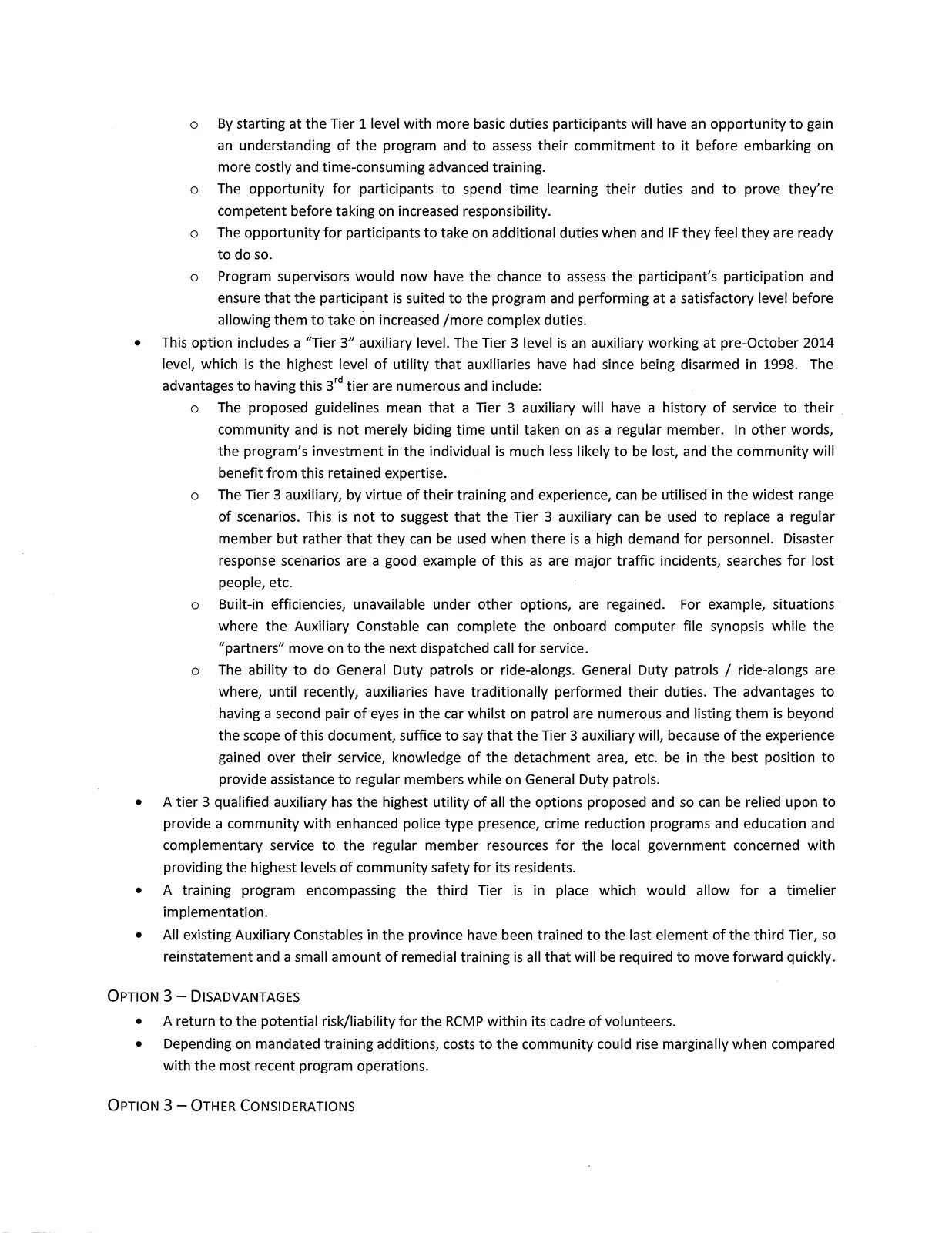
The Tiered option combines the first two options discussed with a third tier to form an all-encompassing, progressive program that has some distinct advantages:
- The training / experience requirements to advance in the tiers provides for something that to date hasn't existed in the Auxiliary Constable Program namely:
- By starting at the Tier 1 level with more basic duties participants will have an opportunity to gain an understanding of the program and to assess their commitment to it before embarking on more costly and time-consuming advanced training.
- The opportunity for participants to spend time learning their duties and to prove they're competent before taking on increased responsibility.
- The opportunity for participants to take on additional duties when and IF they feel they are ready to do so.
- Program supervisors would now have the chance to assess the participant's participation and ensure that the participant is suited to the program and performing at a satisfactory level before allowing them to take On increased /more complex duties.
- This option includes a "Tier 3" auxiliary level. The Tier 3 level is an auxiliary working at pre-October 2014 level, which is the highest level of utility that auxiliaries have had since being disarmed in 1998. The advantages to having this 3rd tier are numerous and include:
- The proposed guidelines mean that a Tier 3 auxiliary will have a history of service to their community and is not merely biding time until taken on as a regular member. In other words, the program's investment in the individual is much less likely to be lost, and the community will benefit from this retained expertise.
- The Tier 3 auxiliary, by virtue of their training and experience, can be utilised in the widest range of scenarios. This is not to suggest that the Tier 3 auxiliary can be used to replace a regular member but rather that they can be used when there is a high demand for personnel. Disaster response scenarios are a good example of this as are major traffic incidents, searches for lost people, etc.
- Built-in efficiencies, unavailable under other options, are regained. For example, situations where the Auxiliary Constable can complete the onboard computer file synopsis while the "partners" move on to the next dispatched call for service.
- The ability to do General Duty patrols or ride-alongs. General Duty patrols / ride-alongs are where, until recently, auxiliaries have traditionally performed their duties. The advantages to having a second pair of eyes in the car whilst on patrol are numerous and listing them is beyond the scope of this document, suffice to say that the Tier 3 auxiliary will, because of the experience gained over their service, knowledge of the detachment area, etc. be in the best position to provide assistance to regular members while on General Duty patrols.
- A tier 3 qualified auxiliary has the highest utility of all the options proposed and so can be relied upon to provide a community with enhanced police type presence, crime reduction programs and education and complementary service to the regular member resources for the local government concerned with providing the highest levels of community safety for its residents.
- A training program encompassing the third Tier is in place which would allow for a timelier implementation.
- All existing Auxiliary Constables in the province have been trained to the last element of the third Tier, so reinstatement and a small amount of remedial training is all that will be required to move forward quickly.
Option 3 — Disadvantages
- A return to the potential risk/liability for the RCMP within its cadre of volunteers.
- Depending on mandated training additions, costs to the community could rise marginally when compared with the most recent program operations.
Option 3 — Other Considerations
- Proposed curfew times will limit A/Cst utility, especially in serious / complex events like a severe storm, major fire or other such disaster.
In Summary
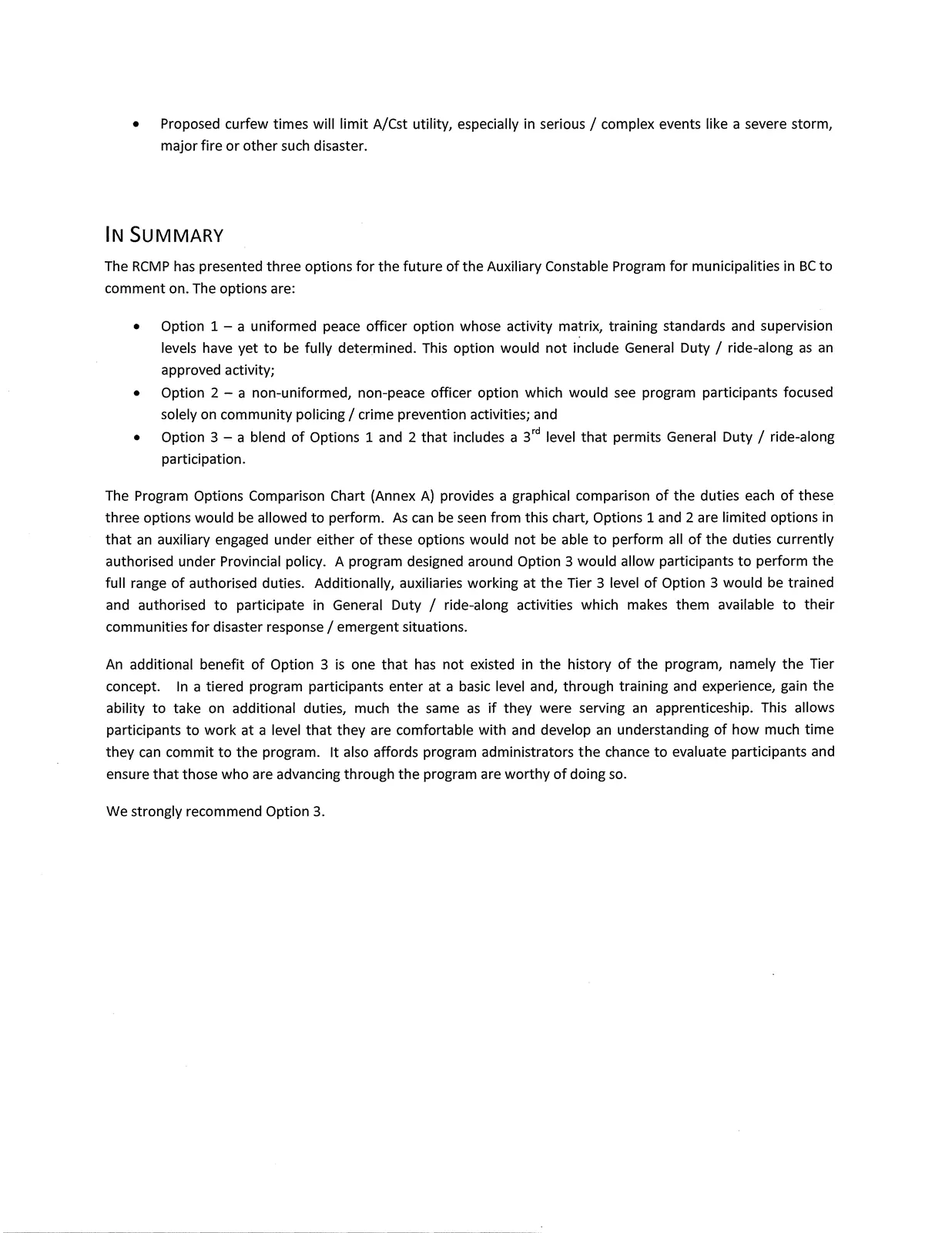
The RCMP has presented three options for the future of the Auxiliary Constable Program for municipalities in BC to comment on. The options are:
- Option 1 — a uniformed peace officer option whose activity matrix, training standards and supervision levels have yet to be fully determined. This option would not include General Duty / ride-along as an approved activity;
- Option 2 — a non-uniformed, non-peace officer option which would see program participants focused solely on community policing / crime prevention activities; and
- Option 3 — a blend of Options 1 and 2 that includes a 3rd level that permits General Duty / ride-along participation.
The Program Options Comparison Chart (Annex A) provides a graphical comparison of the duties each of these three options would be allowed to perform. As can be seen from this chart, Options 1 and 2 are limited options in that an auxiliary engaged under either of these options would not be able to perform all of the duties currently authorised under Provincial policy. A program designed around Option 3 would allow participants to perform the full range of authorised duties. Additionally, auxiliaries working at the Tier 3 level of Option 3 would be trained and authorised to participate in General Duty / ride-along activities which makes them available to their communities for disaster response / emergent situations.
An additional benefit of Option 3 is one that has not existed in the history of the program, namely the Tier concept. In a tiered program participants enter at a basic level and, through training and experience, gain the ability to take on additional duties, much the same as if they were serving an apprenticeship. This allows participants to work at a level that they are comfortable with and develop an understanding of how much time they can commit to the program. It also affords program administrators the chance to evaluate participants and ensure that those who are advancing through the program are worthy of doing so.
We strongly recommend Option 3.
Annex A — Program Options Comparison Chart
dated October 14, 2016
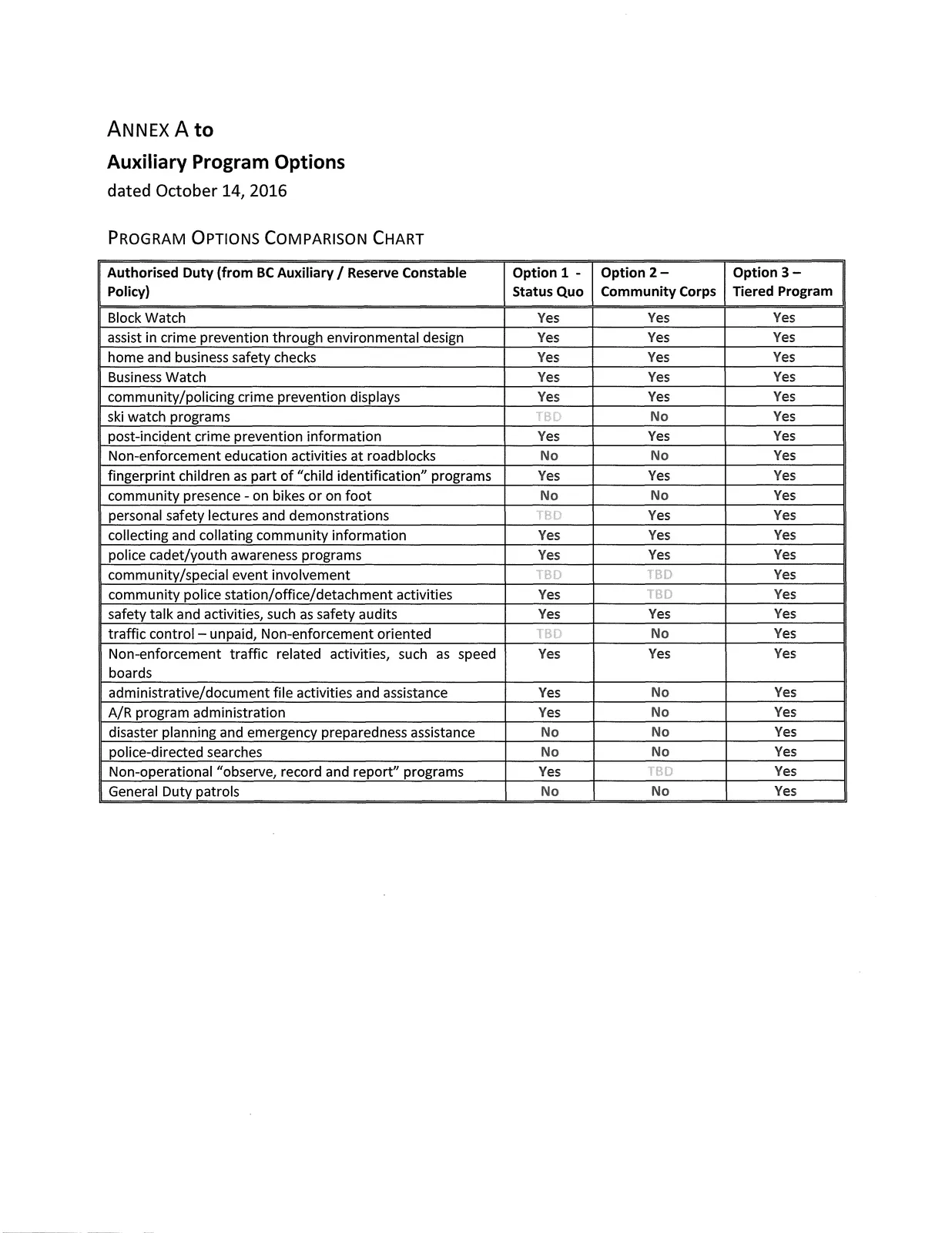
| Authorised Duty (from BC Auxiliary / Reserve Constable Policy) | Option 1 - Status Quo | Option 2 — Community Corps | Option 3 — Tiered Program |
|---|---|---|---|
| Block Watch | Yes | Yes | Yes |
| assist in crime prevention through environmental design | Yes | Yes | Yes |
| home and business safety checks | Yes | Yes | Yes |
| Business Watch | Yes | Yes | Yes |
| community/policing crime prevention displays | Yes | Yes | Yes |
| ski watch programs | No | Yes | |
| post-incident crime prevention information | Yes | Yes | Yes |
| Non-enforcement education activities at roadblocks | No | Yes | |
| fingerprint children as part of "child identification" programs | Yes | Yes | Yes |
| community presence - on bikes or on foot | No | Yes | |
| personal safety lectures and demonstrations | Yes | Yes | |
| collecting and collating community information | Yes | Yes | Yes |
| police cadet/youth awareness programs | Yes | Yes | Yes |
| community/special event involvement | Yes | ||
| community police station/office/detachment activities | Yes | Yes | |
| safety talk and activities, such as safety audits | Yes | Yes | Yes |
| traffic control — unpaid, Non-enforcement oriented | ,ki,n' | Yes | |
| Non-enforcement traffic related activities, such as speed boards | Yes | Yes | Yes |
| administrative/document file activities and assistance | Yes | Yes | |
| A/R program administration | Yes | Yes | |
| disaster planning and emergency preparedness assistance | No | Nc | Yes |
| police-directed searches | No | No | Yes |
| Non-operational "observe, record and report" programs | Yes | Yes | |
| General Duty patrols | No | Yes |
(Note: Table content preserved from source; some cells in original were blank or contained typographical artifacts and are presented here as in the source document.)
Annex B — About the Authors
dated October 14, 2016
Lorne Fletcher is the long serving Manager of Community Safety and Municipal Enforcement for the City of Langford. In this capacity he regularly researches crime prevention/public safety solutions and works closely with Mayor and Council, the West Shore RCMP and other agencies to bring forward initiatives designed to aid and protect the public. In addition to this role, Lorne has directly volunteered for over 20 years in various West Shore community public safety and crime prevention projects. In addition to his local government public administration (PADM) credentials, Lorne has extensive operational and community policing training and experience. Lorne is also an investigative skills instructor at the Justice Institute of BC.
Don Devenney, CD has volunteered for over 20 years in various West Shore community public safety and crime prevention projects, with a particular interest in Internet Safety initiatives. Don also spent many years as an officer in the Canadian Armed Forces Reserves (CIC) that included a term as the Commanding Officer of RCSCC Beacon Hill, the West Shore community Sea Cadet Unit. In 2012 Don received the Queen Elizabeth Diamond Jubilee Medal in recognition of his volunteer efforts and this past year was presented with the RCMP Service Appreciation Award by the Vancouver Island District RCMP Veterans Association in recognition of exemplary service to the West Shore community. When not serving his community, Don can be found at Royal Roads University where he is an Information Technology Analyst.
Lorne and Don will both be presented with the Peace Officer Exemplary Service Medal at a ceremony to take place later this year.
Document Images
(6)