DocumentsOtherNov 7, 2016Pages 55–78
Attachments and Supporting Materials (intervening pages)
Collection of intervening attachments, figures and supporting materials not individually identified in the provided extract (pages between the fire playbook appendix and the next staff report).
Key facts
- Covers pages between 54 and the next numbered report start (page 79)
- Likely contains figures, maps, appendices and ancillary documentation supporting agenda reports
- Quality/contents varied across pages (mixed images and text)
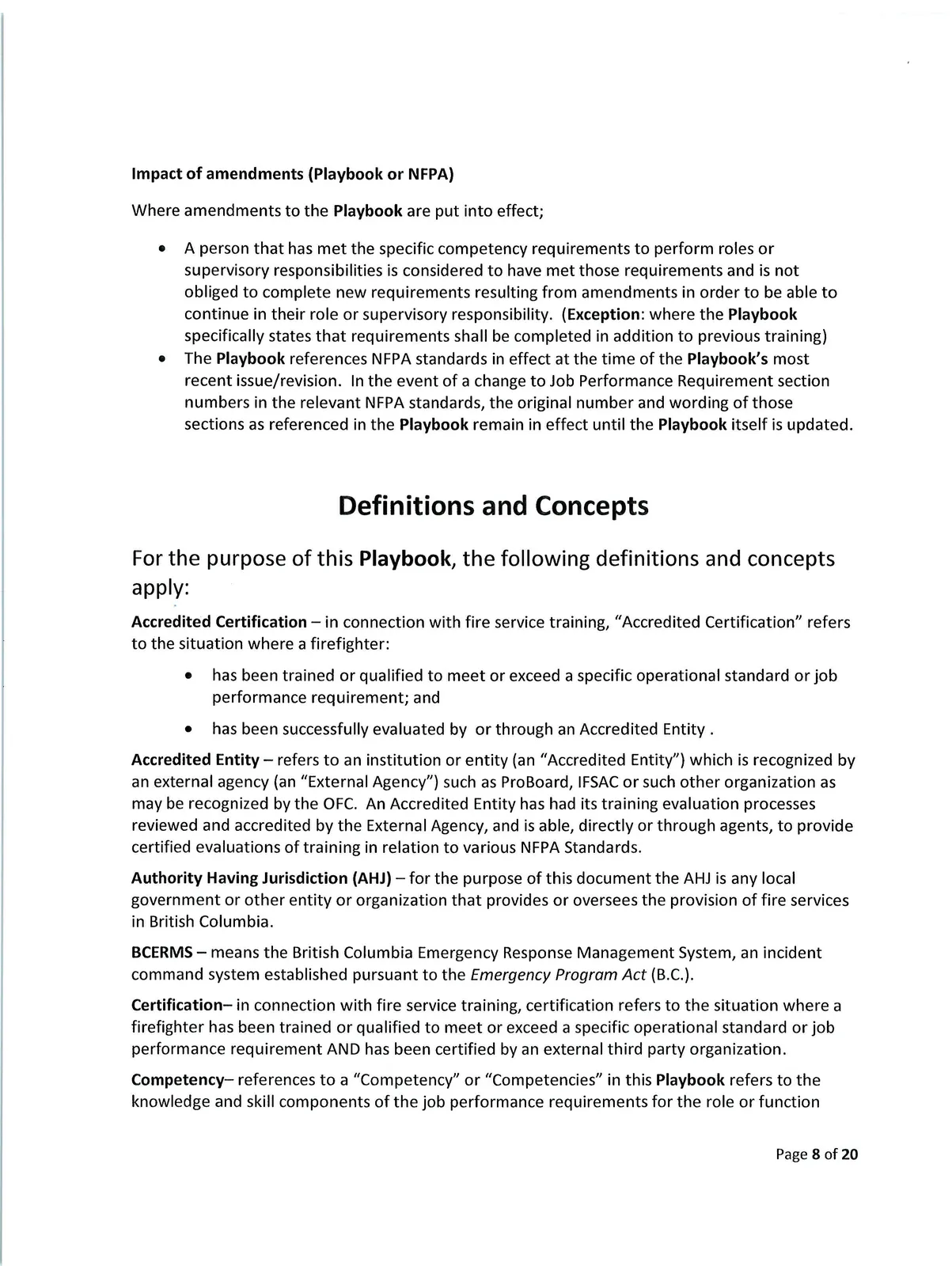
Impact of amendments (Playbook or NFPA)
Where amendments to the Playbook are put into effect;
- A person that has met the specific competency requirements to perform roles or supervisory responsibilities is considered to have met those requirements and is not obliged to complete new requirements resulting from amendments in order to be able to continue in their role or supervisory responsibility. (Exception: where the Playbook specifically states that requirements shall be completed in addition to previous training)
- The Playbook references NFPA standards in effect at the time of the Playbook's most recent issue/revision. In the event of a change to Job Performance Requirement section numbers in the relevant NFPA standards, the original number and wording of those sections as referenced in the Playbook remain in effect until the Playbook itself is updated.
Definitions and Concepts
For the purpose of this Playbook, the following definitions and concepts apply:
Accredited Certification
In connection with fire service training, "Accredited Certification" refers to the situation where a firefighter:
- has been trained or qualified to meet or exceed a specific operational standard or job performance requirement; and
- has been successfully evaluated by or through an Accredited Entity.
Accredited Entity
Refers to an institution or entity (an "Accredited Entity") which is recognized by an external agency (an "External Agency") such as ProBoard, IFSAC or such other organization as may be recognized by the OFC. An Accredited Entity has had its training evaluation processes reviewed and accredited by the External Agency, and is able, directly or through agents, to provide certified evaluations of training in relation to various NFPA Standards.
Authority Having Jurisdiction (AHJ)
For the purpose of this document the AHJ is any local government or other entity or organization that provides or oversees the provision of fire services in British Columbia.
BCERMS
Means the British Columbia Emergency Response Management System, an incident command system established pursuant to the Emergency Program Act (B.C.).
Certification
In connection with fire service training, certification refers to the situation where a firefighter has been trained or qualified to meet or exceed a specific operational standard or job performance requirement AND has been certified by an external third party organization.
Competency
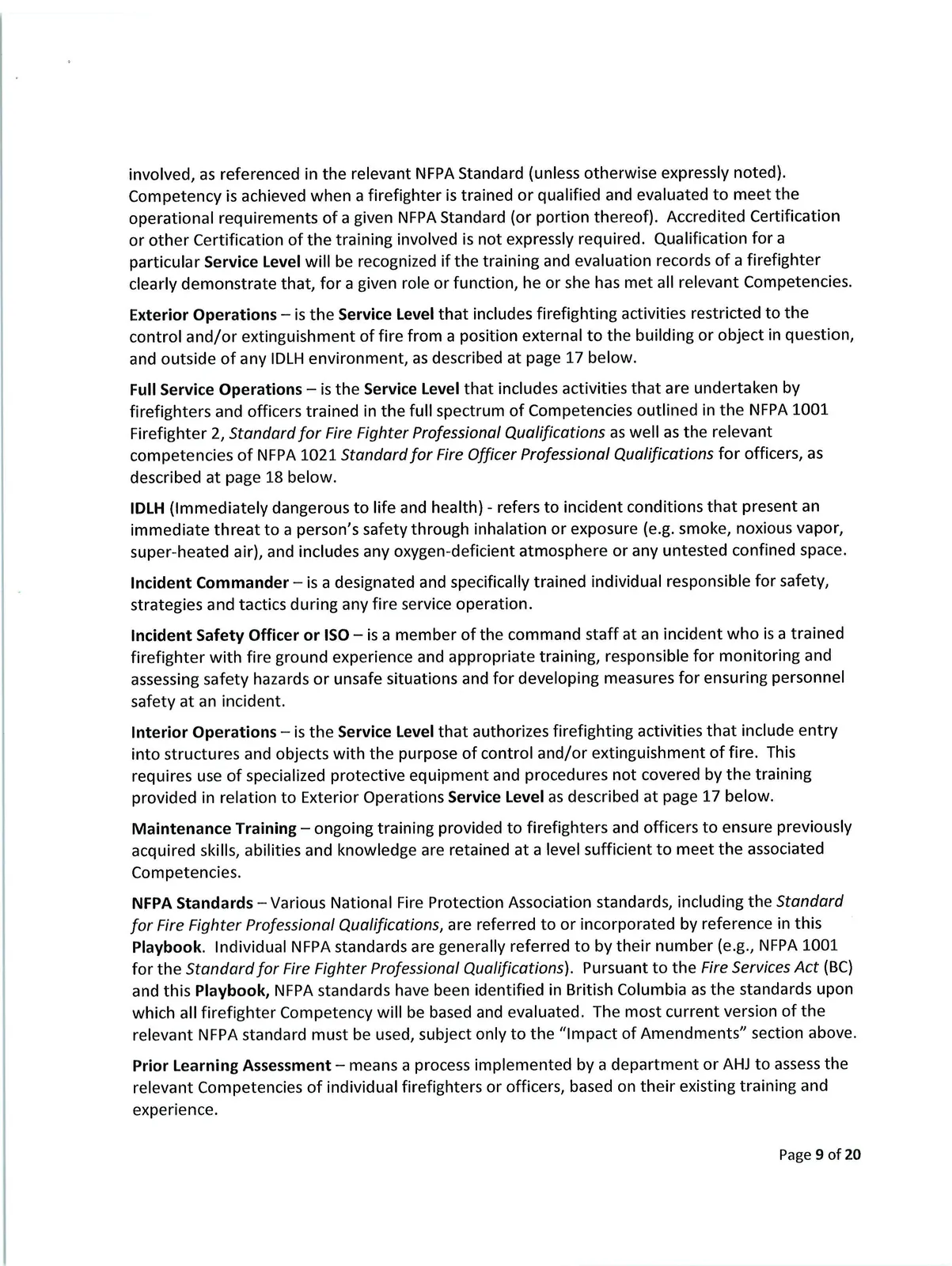
References to a "Competency" or "Competencies" in this Playbook refers to the knowledge and skill components of the job performance requirements for the role or function involved, as referenced in the relevant NFPA Standard (unless otherwise expressly noted). Competency is achieved when a firefighter is trained or qualified and evaluated to meet the operational requirements of a given NFPA Standard (or portion thereof). Accredited Certification or other Certification of the training involved is not expressly required. Qualification for a particular Service Level will be recognized if the training and evaluation records of a firefighter clearly demonstrate that, for a given role or function, he or she has met all relevant Competencies.
Exterior Operations
Is the Service Level that includes firefighting activities restricted to the control and/or extinguishment of fire from a position external to the building or object in question, and outside of any IDLH environment, as described at page 17 below.
Full Service Operations
Is the Service Level that includes activities that are undertaken by firefighters and officers trained in the full spectrum of Competencies outlined in the NFPA 1001 Firefighter 2, Standard for Fire Fighter Professional Qualifications as well as the relevant competencies of NFPA 1021 Standard for Fire Officer Professional Qualifications for officers, as described at page 18 below.
IDLH (Immediately dangerous to life and health)
Refers to incident conditions that present an immediate threat to a person's safety through inhalation or exposure (e.g. smoke, noxious vapor, super-heated air), and includes any oxygen-deficient atmosphere or any untested confined space.
Incident Commander
Is a designated and specifically trained individual responsible for safety, strategies and tactics during any fire service operation.
Incident Safety Officer or ISO
Is a member of the command staff at an incident who is a trained firefighter with fire ground experience and appropriate training, responsible for monitoring and assessing safety hazards or unsafe situations and for developing measures for ensuring personnel safety at an incident.
Interior Operations
Is the Service Level that authorizes firefighting activities that include entry into structures and objects with the purpose of control and/or extinguishment of fire. This requires use of specialized protective equipment and procedures not covered by the training provided in relation to Exterior Operations Service Level as described at page 17 below.
Maintenance Training
Ongoing training provided to firefighters and officers to ensure previously acquired skills, abilities and knowledge are retained at a level sufficient to meet the associated Competencies.
NFPA Standards
Various National Fire Protection Association standards, including the Standard for Fire Fighter Professional Qualifications, are referred to or incorporated by reference in this Playbook. Individual NFPA standards are generally referred to by their number (e.g., NFPA 1001 for the Standard for Fire Fighter Professional Qualifications). Pursuant to the Fire Services Act (BC) and this Playbook, NFPA standards have been identified in British Columbia as the standards upon which all firefighter Competency will be based and evaluated. The most current version of the relevant NFPA standard must be used, subject only to the "Impact of Amendments" section above.
Prior Learning Assessment
Means a process implemented by a department or ARI to assess the relevant Competencies of individual firefighters or officers, based on their existing training and experience.
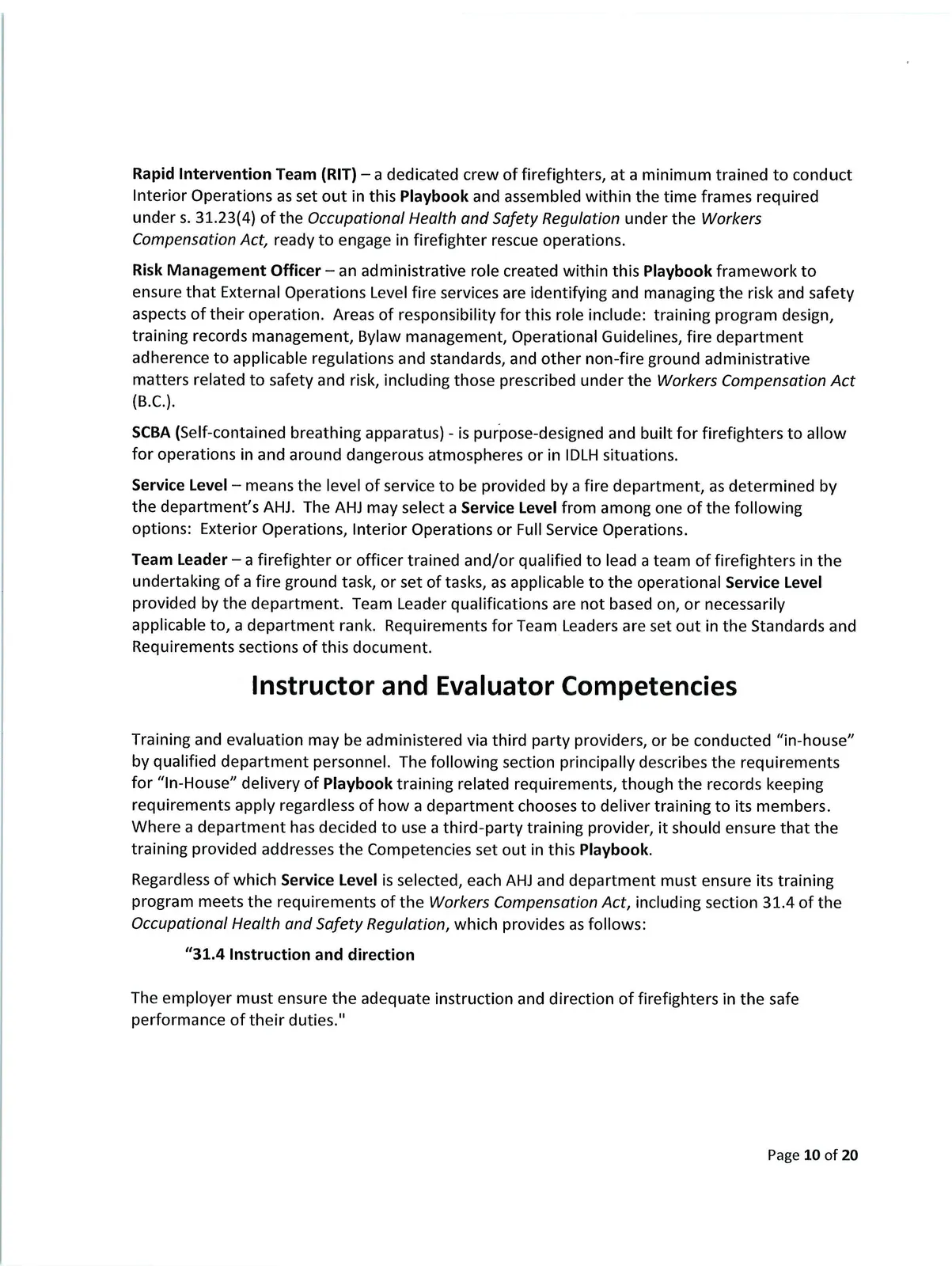
Rapid Intervention Team (RIT)
A dedicated crew of firefighters, at a minimum trained to conduct Interior Operations as set out in this Playbook and assembled within the time frames required under s. 31.23(4) of the Occupational Health and Safety Regulation under the Workers Compensation Act, ready to engage in firefighter rescue operations.
Risk Management Officer
An administrative role created within this Playbook framework to ensure that External Operations Level fire services are identifying and managing the risk and safety aspects of their operation. Areas of responsibility for this role include: training program design, training records management, Bylaw management, Operational Guidelines, fire department adherence to applicable regulations and standards, and other non-fire ground administrative matters related to safety and risk, including those prescribed under the Workers Compensation Act (B.C.).
SCBA (Self-contained breathing apparatus)
Is purpose-designed and built for firefighters to allow for operations in and around dangerous atmospheres or in IDLH situations.
Service Level
Means the level of service to be provided by a fire department, as determined by the department's AHJ. The AHJ may select a Service Level from among one of the following options: Exterior Operations, Interior Operations or Full Service Operations.
Team Leader
A firefighter or officer trained and/or qualified to lead a team of firefighters in the undertaking of a fire ground task, or set of tasks, as applicable to the operational Service Level provided by the department. Team Leader qualifications are not based on, or necessarily applicable to, a department rank. Requirements for Team Leaders are set out in the Standards and Requirements sections of this document.
Instructor and Evaluator Competencies
Training and evaluation may be administered via third party providers, or be conducted "in-house" by qualified department personnel. The following section principally describes the requirements for "In-House" delivery of Playbook training related requirements, though the records keeping requirements apply regardless of how a department chooses to deliver training to its members.
Where a department has decided to use a third-party training provider, it should ensure that the training provided addresses the Competencies set out in this Playbook.
Regardless of which Service Level is selected, each AHJ and department must ensure its training program meets the requirements of the Workers Compensation Act, including section 31.4 of the Occupational Health and Safety Regulation, which provides as follows:
"31.4 Instruction and direction The employer must ensure the adequate instruction and direction of firefighters in the safe performance of their duties."
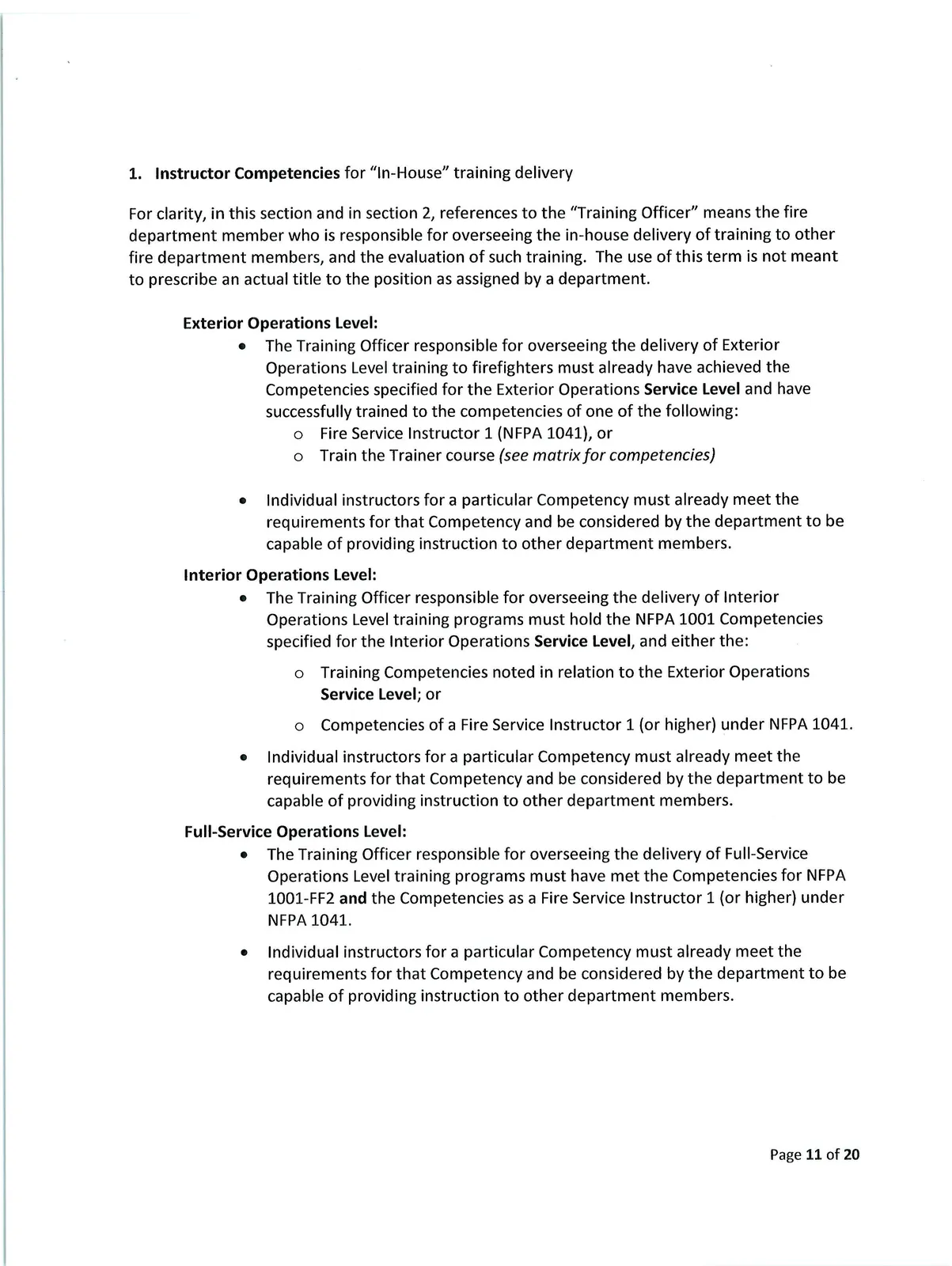
1. Instructor Competencies for "In-House" training delivery
For clarity, in this section and in section 2, references to the "Training Officer" means the fire department member who is responsible for overseeing the in-house delivery of training to other fire department members, and the evaluation of such training. The use of this term is not meant to prescribe an actual title to the position as assigned by a department.
Exterior Operations Level
- The Training Officer responsible for overseeing the delivery of Exterior Operations Level training to firefighters must already have achieved the Competencies specified for the Exterior Operations Service Level and have successfully trained to the competencies of one of the following:
- Fire Service Instructor 1 (NFPA 1041), or
- Train the Trainer course (see matrix for cornpetencies)
- Individual instructors for a particular Competency must already meet the requirements for that Competency and be considered by the department to be capable of providing instruction to other department members.
Interior Operations Level
- The Training Officer responsible for overseeing the delivery of Interior Operations Level training programs must hold the NFPA 1001 Competencies specified for the Interior Operations Service Level, and either the:
- Training Competencies noted in relation to the Exterior Operations Service Level; or
- Competencies of a Fire Service Instructor 1 (or higher) under NFPA 1041.
- Individual instructors for a particular Competency must already meet the requirements for that Competency and be considered by the department to be capable of providing instruction to other department members.
Full-Service Operations Level
- The Training Officer responsible for overseeing the delivery of Full-Service Operations Level training programs must have met the Competencies for NFPA 1001-FF2 and the Competencies as a Fire Service Instructor 1 (or higher) under NFPA 1041.
- Individual instructors for a particular Competency must already meet the requirements for that Competency and be considered by the department to be capable of providing instruction to other department members.
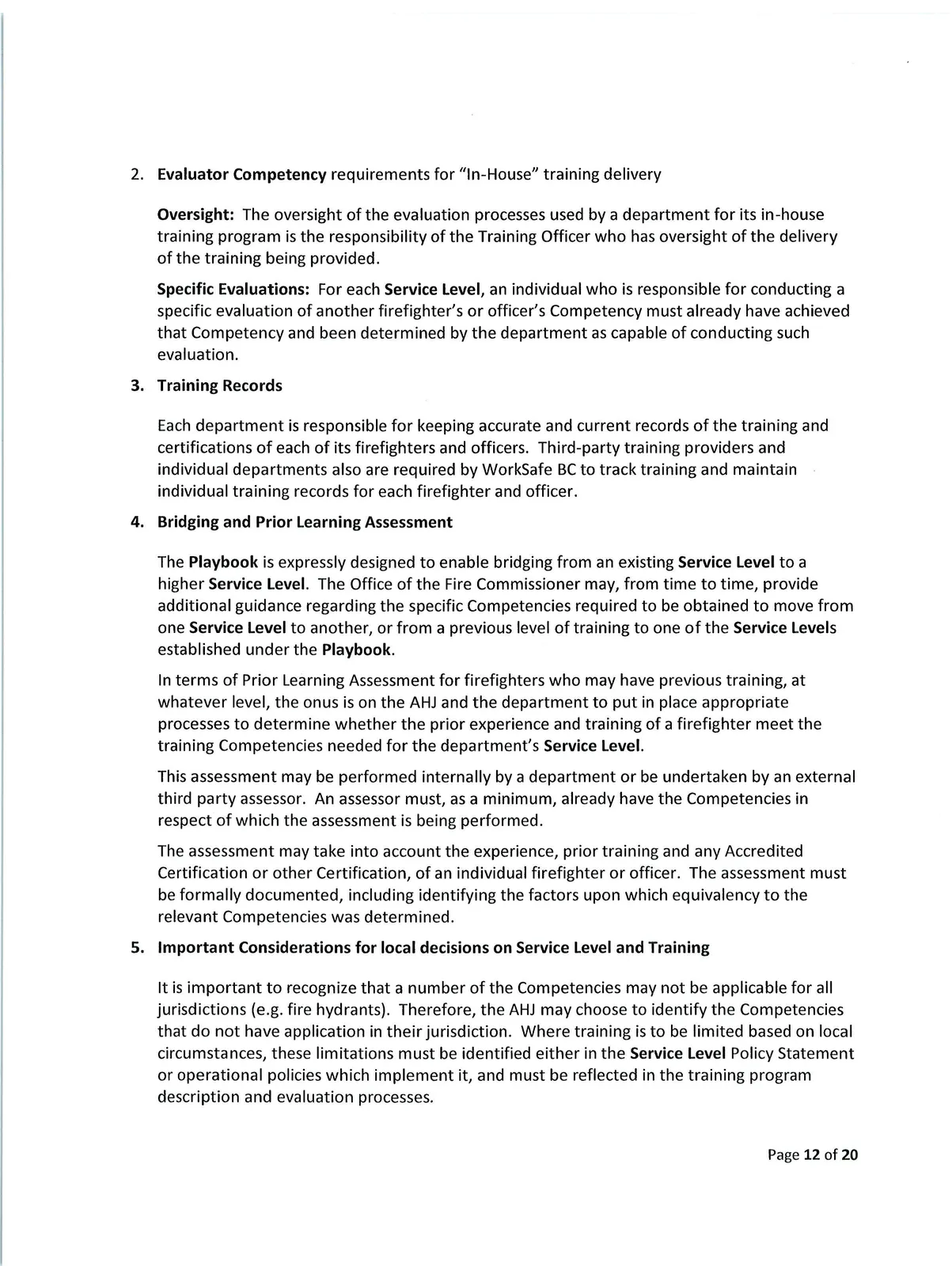
2. Evaluator Competency requirements for "In-House" training delivery
- Oversight: The oversight of the evaluation processes used by a department for its in-house training program is the responsibility of the Training Officer who has oversight of the delivery of the training being provided.
- Specific Evaluations: For each Service Level, an individual who is responsible for conducting a specific evaluation of another firefighter's or officer's Competency must already have achieved that Competency and been determined by the department as capable of conducting such evaluation.
3. Training Records
Each department is responsible for keeping accurate and current records of the training and certifications of each of its firefighters and officers. Third-party training providers and individual departments also are required by WorkSafe BC to track training and maintain individual training records for each firefighter and officer.
4. Bridging and Prior Learning Assessment
- The Playbook is expressly designed to enable bridging from an existing Service Level to a higher Service Level. The Office of the Fire Commissioner may, from time to time, provide additional guidance regarding the specific Competencies required to be obtained to move from one Service Level to another, or from a previous level of training to one of the Service Levels established under the Playbook.
- In terms of Prior Learning Assessment for firefighters who may have previous training, at whatever level, the onus is on the AHJ and the department to put in place appropriate processes to determine whether the prior experience and training of a firefighter meet the training Competencies needed for the department's Service Level.
- This assessment may be performed internally by a department or be undertaken by an external third party assessor. An assessor must, as a minimum, already have the Competencies in respect of which the assessment is being performed.
- The assessment may take into account the experience, prior training and any Accredited Certification or other Certification, of an individual firefighter or officer. The assessment must be formally documented, including identifying the factors upon which equivalency to the relevant Competencies was determined.
5. Important Considerations for local decisions on Service Level and Training
- It is important to recognize that a number of the Competencies may not be applicable for all jurisdictions (e.g. fire hydrants). Therefore, the AHJ may choose to identify the Competencies that do not have application in their jurisdiction. Where training is to be limited based on local circumstances, these limitations must be identified either in the Service Level Policy Statement or operational policies which implement it, and must be reflected in the training program description and evaluation processes.
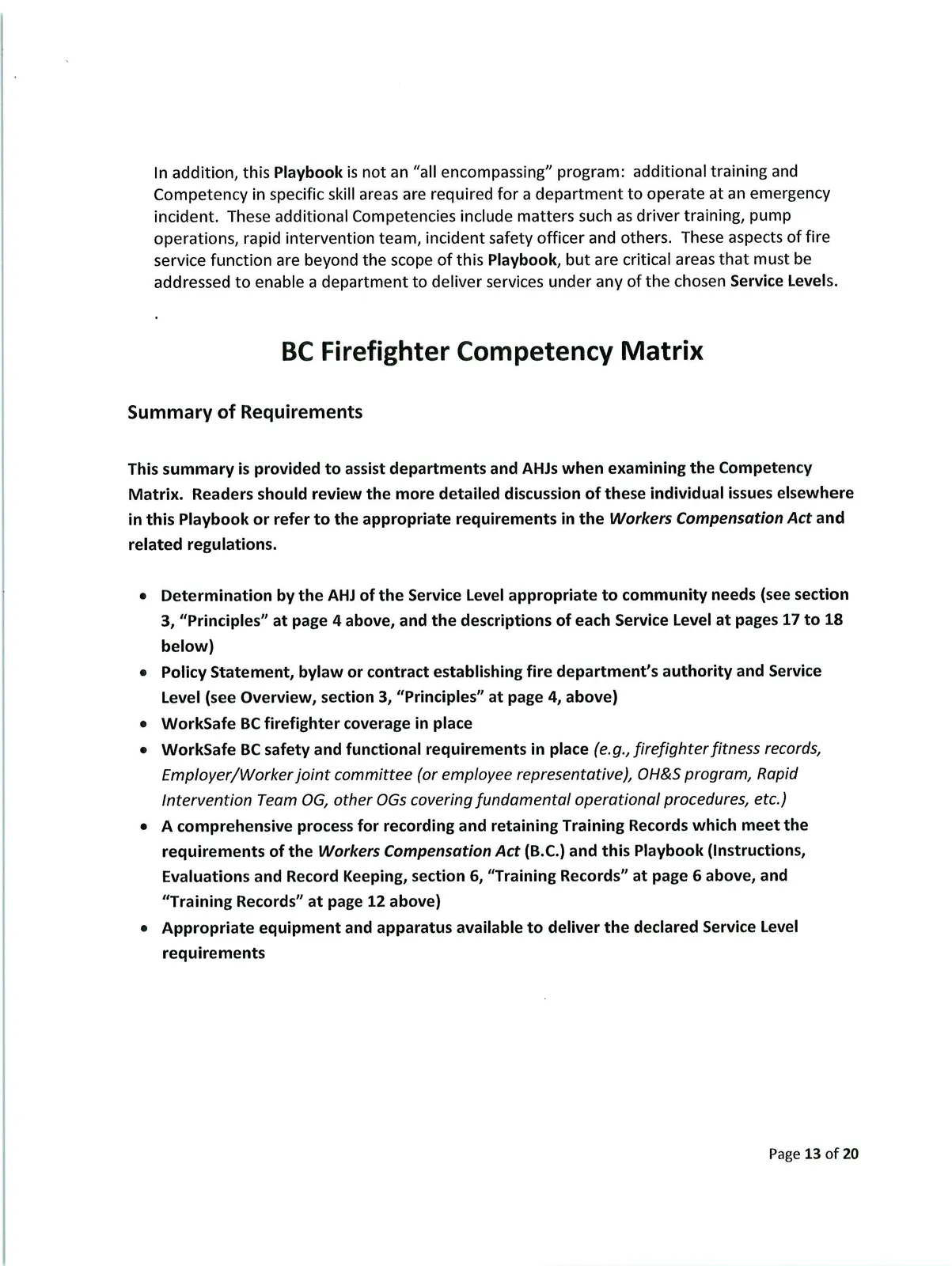
- In addition, this Playbook is not an "all encompassing" program: additional training and Competency in specific skill areas are required for a department to operate at an emergency incident. These additional Competencies include matters such as driver training, pump operations, rapid intervention team, incident safety officer and others. These aspects of fire service function are beyond the scope of this Playbook, but are critical areas that must be addressed to enable a department to deliver services under any of the chosen Service Levels.
BC Firefighter Competency Matrix
Summary of Requirements
This summary is provided to assist departments and AHJs when examining the Competency Matrix. Readers should review the more detailed discussion of these individual issues elsewhere in this Playbook or refer to the appropriate requirements in the Workers Compensation Act and related regulations.
- Determination by the AHJ of the Service Level appropriate to community needs (see section 3, "Principles" at page 4 above, and the descriptions of each Service Level at pages 17 to 18 below)
- Policy Statement, bylaw or contract establishing fire department's authority and Service Level (see Overview, section 3, "Principles" at page 4, above)
- WorkSafe BC firefighter coverage in place
- WorkSafe BC safety and functional requirements in place (e.g., firefighter fitness records, Employer/Worker joint committee (or employee representative), OH&S program, Rapid Intervention Team OG, other OGs covering fundamental operational procedures, etc.)
- A comprehensive process for recording and retaining Training Records which meet the requirements of the Workers Compensation Act (B.C.) and this Playbook (Instructions, Evaluations and Record Keeping, section 6, "Training Records" at page 6 above, and "Training Records" at page 12 above)
- Appropriate equipment and apparatus available to deliver the declared Service Level requirements
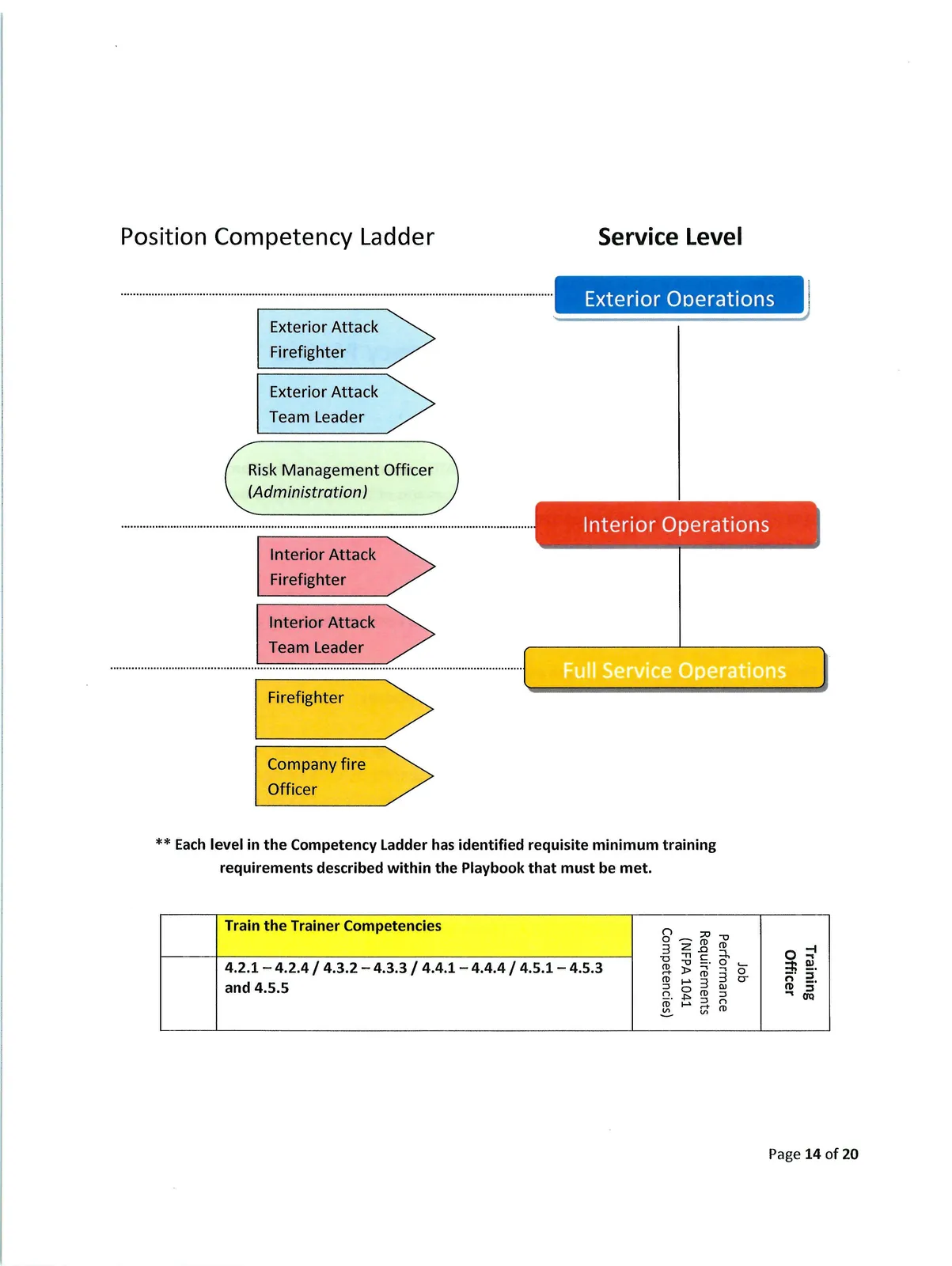
Position Competency Ladder (Summary)
- Exterior Operations
- Exterior Attack Firefighter
- Exterior Attack Team Leader
- Interior Operations
- Interior Attack Firefighter
- Company Fire Officer
- Full Service Operations
- Interior Attack Team Leader
- Firefighter (Full Service)
- Risk Management Officer (Administration)
Each level in the Competency Ladder has identified requisite minimum training requirements described within the Playbook that must be met.
Train the Trainer Competencies
| Job Performance Requirements (NFPA 1041 Competencies) | Training Officer |
|---|---|
| 4.2.1 — 4.2.4 / 4.3.2 — 4.3.3 / 4.4.1 — 4.4.4 / 4.5.1 — 4.5.3 and 4.5.5 | (As required above) |
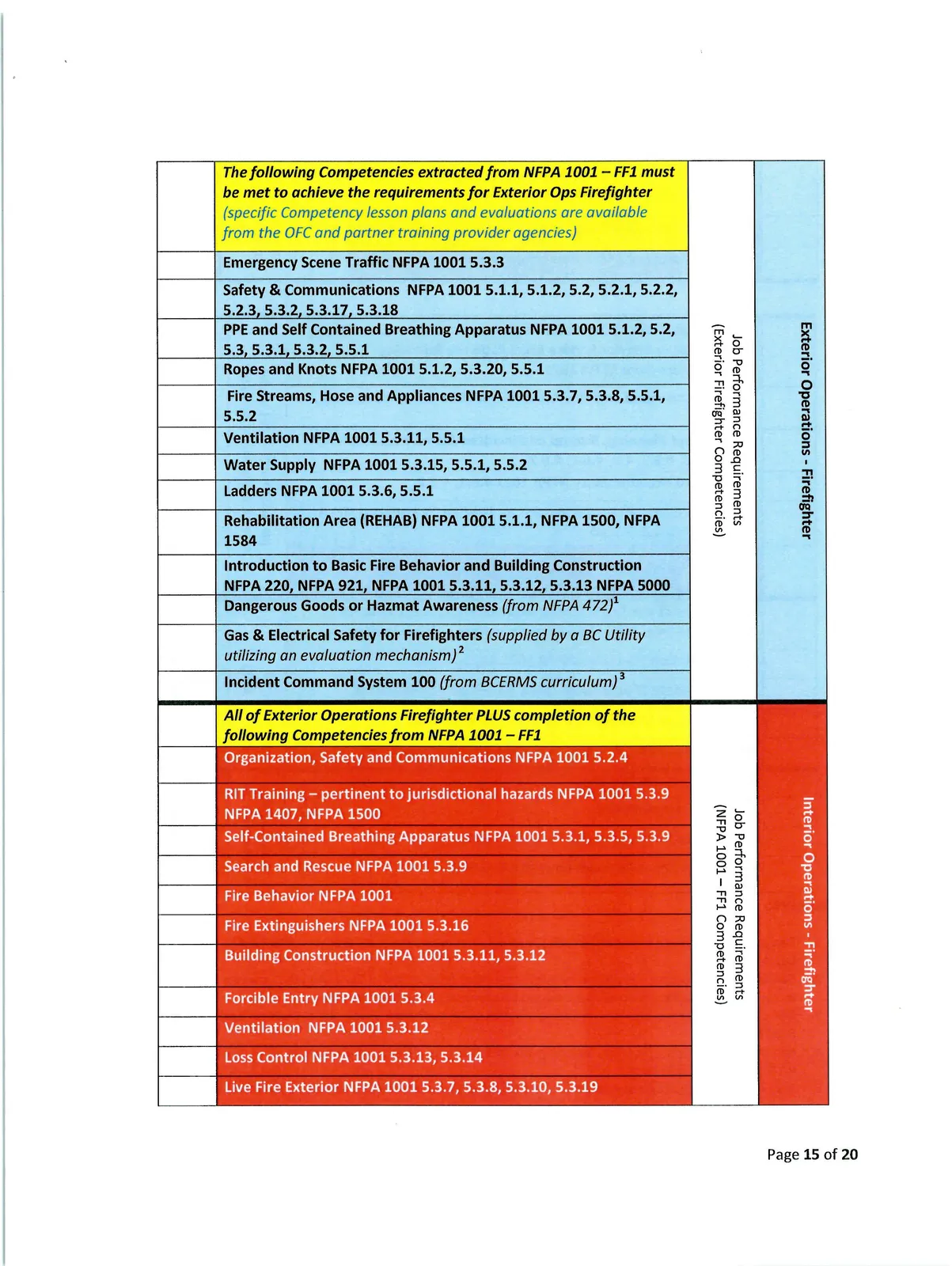
NFPA 1001 — Exterior Operations Firefighter Competencies (FF1)
The following Competencies extracted from NFPA 1001 — FF1 must be met to achieve the requirements for Exterior Ops Firefighter (specific Competency lesson plans and evaluations are available from the OFC and partner training provider agencies).
All of Exterior Operations Firefighter PLUS completion of the following Competencies from NFPA 1001 — FF1:
| Competency | NFPA Reference(s) |
|---|---|
| Emergency Scene Traffic | NFPA 1001 5.3.3 |
| Safety & Communications | NFPA 1001 5.1.1, 5.1.2, 5.2, 5.2.1, 5.2.2, 5.2.3, 5.3.2, 5.3.17, 5.3.18 |
| PPE and Self Contained Breathing Apparatus | NFPA 1001 5.1.2, 5.2, 5.3, 5.3.1, 5.3.2, 5.5.1 |
| Ropes and Knots | NFPA 1001 5.1.2, 5.3.20, 5.5.1 |
| Fire Streams, Hose and Appliances | NFPA 1001 5.3.7, 5.3.8, 5.5.1, 5.5.2 |
| Ventilation | NFPA 1001 5.3.11, 5.5.1 |
| Water Supply | NFPA 1001 5.3.15, 5.5.1, 5.5.2 |
| Ladders | NFPA 1001 5.3.6, 5.5.1 |
| Rehabilitation Area (REHAB) | NFPA 1001 5.1.1, NFPA 1500, NFPA 1584 |
| Introduction to Basic Fire Behavior and Building Construction | NFPA 220, NFPA 921, NFPA 1001 5.3.11, 5.3.12, 5.3.13 NFPA 5000 |
| Dangerous Goods or Hazmat Awareness | (from NFPA 472)1 |
| Gas & Electrical Safety for Firefighters | (supplied by a BC Utility utilizing an evaluation mechanism)2 |
| Incident Command System 100 | (from BCERMS curriculum)3 |
| Organization, Safety and Communications | NFPA 1001 5.2.4 |
| RIT Training — pertinent to jurisdictional hazards | NFPA 1001 5.3.9; NFPA 1407, NFPA 1500 |
| Self-Contained Breathing Apparatus | NFPA 1001 5.3.1, 5.3.5, 5.3.9 |
| Search and Rescue | NFPA 1001 5.3.9 |
| Fire Behavior | NFPA 1001 |
| Fire Extinguishers | NFPA 1001 5.3.16 |
| Building Construction | NFPA 1001 5.3.11, 5.3.12 |
| Forcible Entry | NFPA 1001 5.3.4 |
| Ventilation | NFPA 1001 5.3.12 |
| Loss Control | NFPA 1001 5.3.13, 5.3.14 |
| Live Fire Exterior | NFPA 1001 5.3.7, 5.3.8, 5.3.10, 5.3.19 |
NFPA 1001 — FF2 and Team Leader / Officer Competencies
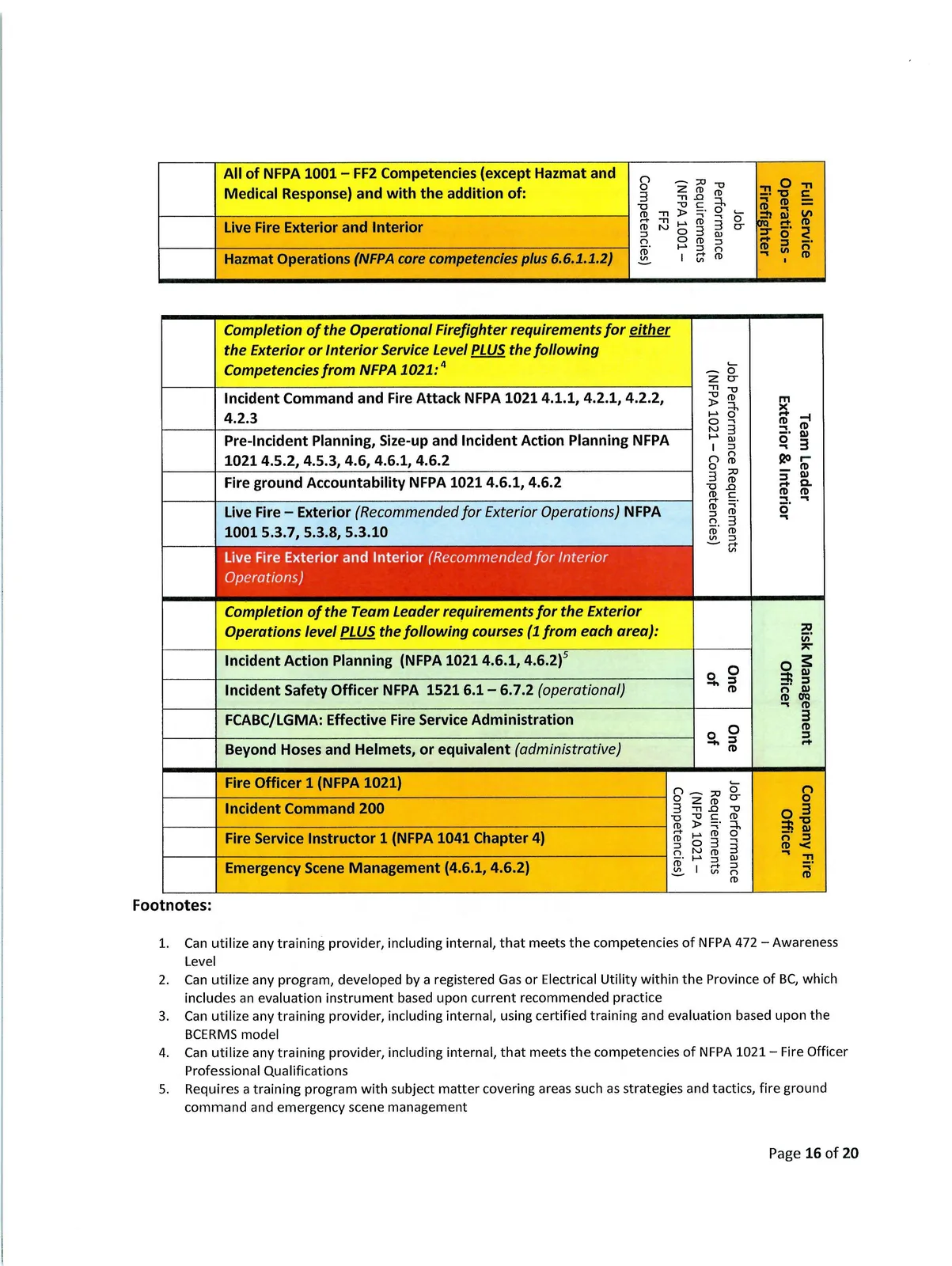
All of NFPA 1001 — FF2 Competencies (except Hazmat and Medical Response) and with the addition of:
Full Service Operations - Firefighter
- Live Fire Exterior and Interior
- Hazmat Operations (NFPA core competencies plus 6.6.1.1.2)
Team Leader (Exterior & Interior)
Completion of the Operational Firefighter requirements for either the Exterior or Interior Service Level PLUS the following Competencies from NFPA 1021:
| Competency Area | NFPA 1021 Reference(s) |
|---|---|
| Incident Command and Fire Attack | NFPA 1021 4.1.1, 4.2.1, 4.2.2, 4.2.3 |
| Pre-Incident Planning, Size-up and Incident Action Planning | NFPA 1021 4.5.2, 4.5.3, 4.6, 4.6.1, 4.6.2 |
| Fire ground Accountability | NFPA 1021 4.6.1, 4.6.2 |
| Live Fire — Exterior (Recommended for Exterior Operations) | NFPA 1001 5.3.7, 5.3.8, 5.3.10 |
| Live Fire Exterior and Interior (Recommended for Interior Operations) | (as above) |
Completion of the Team Leader requirements for the Exterior Operations level PLUS the following courses (1 from each area):
- Incident Action Planning (NFPA 1021 4.6.1, 4.6.2)5
Risk Management Officer
- Incident Safety Officer NFPA 1521 6.1 — 6.7.2 (operational)
- FCABC/LGMA: Effective Fire Service Administration
- Beyond Hoses and Helmets, or equivalent (administrative)
- Fire Officer 1 (NFPA 1021)
Company Fire Officer
- Incident Command 200
- Fire Service Instructor 1 (NFPA 1041 Chapter 4)
- Emergency Scene Management (4.6.1, 4.6.2)
Footnotes:
- Can utilize any training provider, including internal, that meets the competencies of NFPA 472 — Awareness Level
- Can utilize any program, developed by a registered Gas or Electrical Utility within the Province of BC, which includes an evaluation instrument based upon current recommended practice
- Can utilize any training provider, including internal, using certified training and evaluation based upon the BCERMS model
- Can utilize any training provider, including internal, that meets the competencies of NFPA 1021— Fire Officer Professional Qualifications
- Requires a training program with subject matter covering areas such as strategies and tactics, fire ground command and emergency scene management
Service Level Descriptions
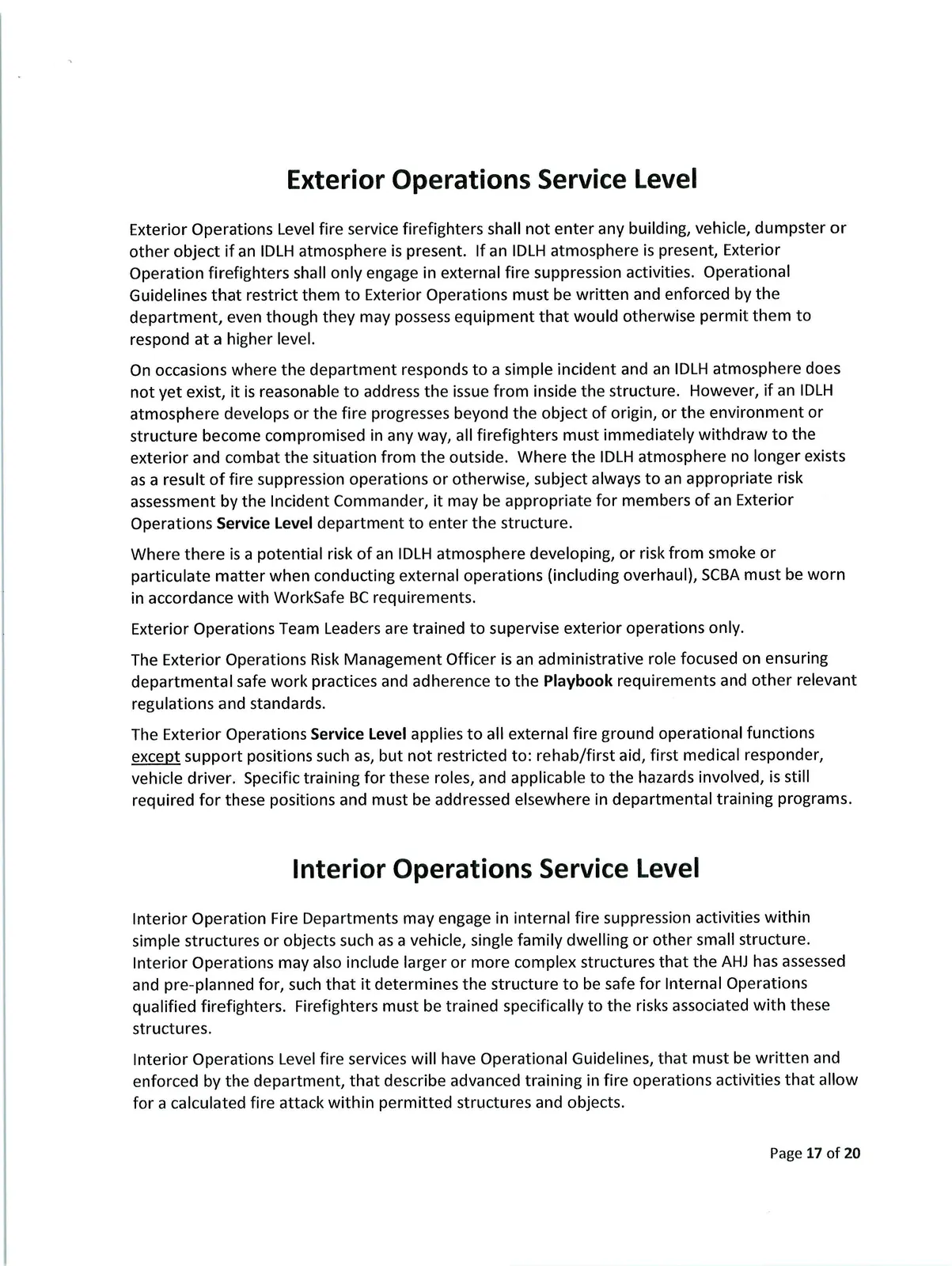
Exterior Operations Service Level
- Exterior Operations Level fire service firefighters shall not enter any building, vehicle, dumpster or other object if an IDLH atmosphere is present. If an IDLH atmosphere is present, Exterior Operation firefighters shall only engage in external fire suppression activities. Operational Guidelines that restrict them to Exterior Operations must be written and enforced by the department, even though they may possess equipment that would otherwise permit them to respond at a higher level.
- On occasions where the department responds to a simple incident and an IDLH atmosphere does not yet exist, it is reasonable to address the issue from inside the structure. However, if an IDLH atmosphere develops or the fire progresses beyond the object of origin, or the environment or structure become compromised in any way, all firefighters must immediately withdraw to the exterior and combat the situation from the outside. Where the IDLH atmosphere no longer exists as a result of fire suppression operations or otherwise, subject always to an appropriate risk assessment by the Incident Commander, it may be appropriate for members of an Exterior Operations Service Level department to enter the structure.
- Where there is a potential risk of an IDLH atmosphere developing, or risk from smoke or particulate matter when conducting external operations (including overhaul), SCBA must be worn in accordance with WorkSafe BC requirements.
- Exterior Operations Team Leaders are trained to supervise exterior operations only.
- The Exterior Operations Risk Management Officer is an administrative role focused on ensuring departmental safe work practices and adherence to the Playbook requirements and other relevant regulations and standards.
- The Exterior Operations Service Level applies to all external fire ground operational functions except support positions such as, but not restricted to: rehab/first aid, first medical responder, vehicle driver. Specific training for these roles, and applicable to the hazards involved, is still required for these positions and must be addressed elsewhere in departmental training programs.
Interior Operations Service Level
- Interior Operation Fire Departments may engage in internal fire suppression activities within simple structures or objects such as a vehicle, single family dwelling or other small structure.
- Interior Operations may also include larger or more complex structures that the AHJ has assessed and pre-planned for, such that it determines the structure to be safe for Internal Operations qualified firefighters. Firefighters must be trained specifically to the risks associated with these structures.
- Interior Operations Level fire services will have Operational Guidelines, that must be written and enforced by the department, that describe advanced training in fire operations activities that allow for a calculated fire attack within permitted structures and objects.
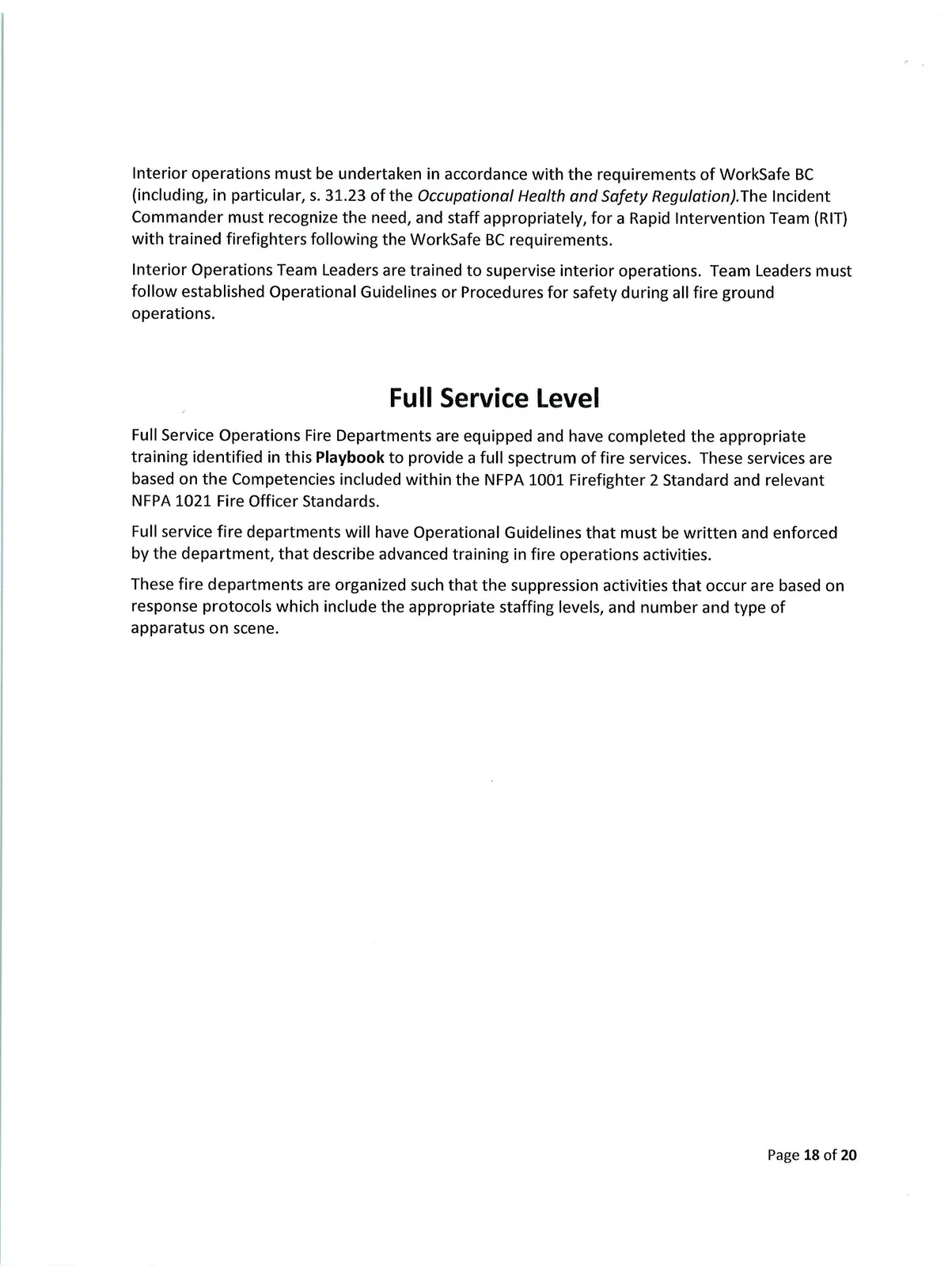
- Interior operations must be undertaken in accordance with the requirements of WorkSafe BC (including, in particular, s. 31.23 of the Occupational Health and Safety Regulation). The Incident Commander must recognize the need, and staff appropriately, for a Rapid Intervention Team (RIT) with trained firefighters following the WorkSafe BC requirements.
- Interior Operations Team Leaders are trained to supervise interior operations. Team Leaders must follow established Operational Guidelines or Procedures for safety during all fire ground operations.
Full Service Level
- Full Service Operations Fire Departments are equipped and have completed the appropriate training identified in this Playbook to provide a full spectrum of fire services. These services are based on the Competencies included within the NFPA 1001 Firefighter 2 Standard and relevant NFPA 1021 Fire Officer Standards.
- Full service fire departments will have Operational Guidelines that must be written and enforced by the department, that describe advanced training in fire operations activities.
- These fire departments are organized such that the suppression activities that occur are based on response protocols which include the appropriate staffing levels, and number and type of apparatus on scene.
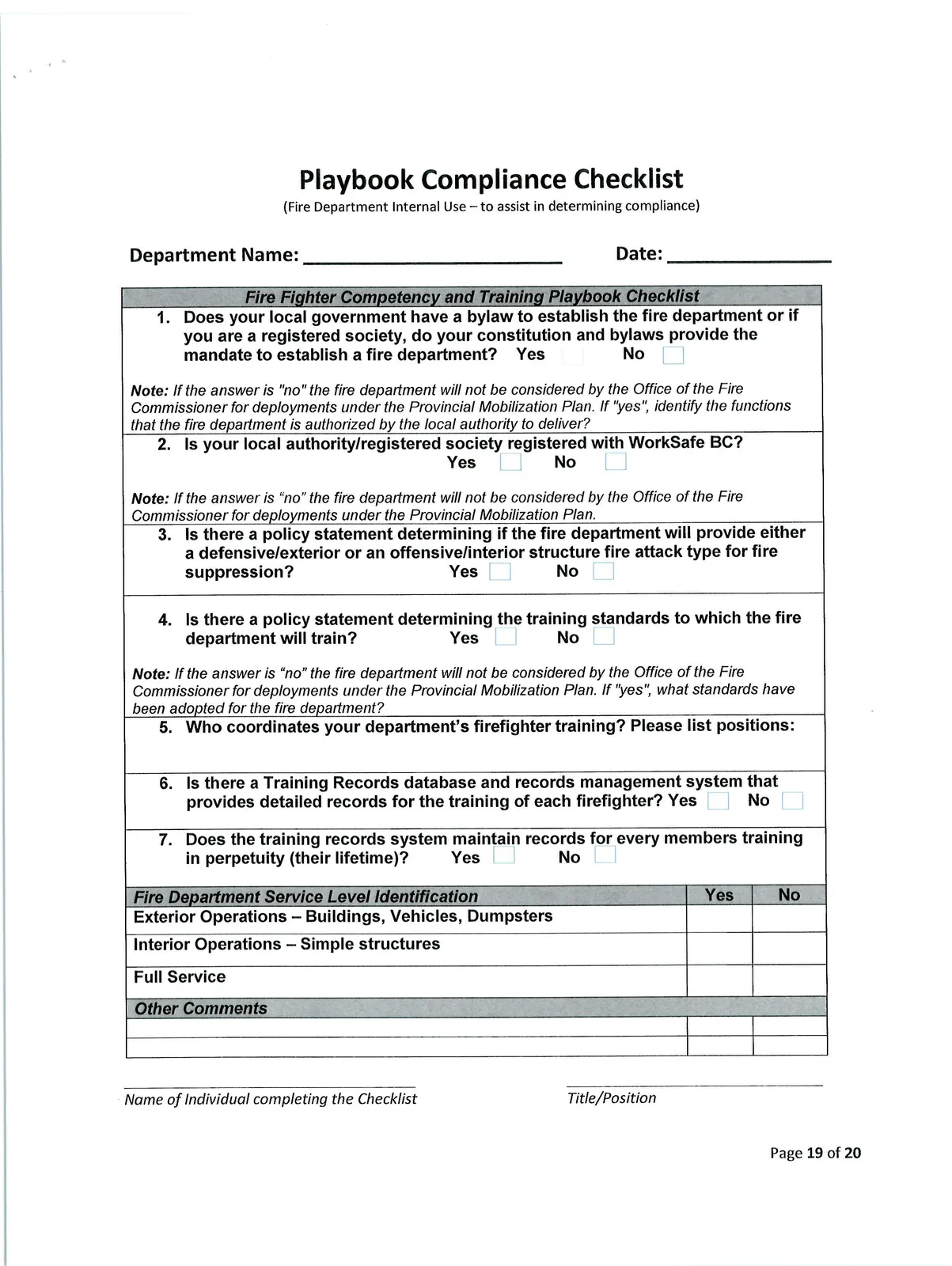
Playbook Compliance Checklist
(Fire Department Internal Use —to assist in determining compliance)
Department Name:
Date:
1 Fire Fighter Competency and Training Playbook Checklist
Does your local government have a bylaw to establish the fire department or if you are a registered society, do your constitution and bylaws provide the mandate to establish a fire department?
- Yes / No
Note: If the answer is "no" the fire department will not be considered by the Office of the Fire Commissioner for deployments under the Provincial Mobilization Plan. If "yes", identify the functions that the fire department is authorized by the local authority to deliver?
- Yes / No
Is your local authority/registered society registered with WorkSafe BC?
- Yes / No
Note: If the answer is "no" the fire department will not be considered by the Office of the Fire Commissioner for deployments under the Provincial Mobilization Plan.
- Yes / No
Is there a policy statement determining if the fire department will provide either a defensive/exterior or an offensive/interior structure fire attack type for fire suppression?
- Yes / No
Is there a policy statement determining the training standards to which the fire department will train?
- Yes / No
Note: If the answer is "no" the fire department will not be considered by the Office of the Fire Commissioner for deployments under the Provincial Mobilization Plan. If "yes", what standards have been adopted for the fire department?
- Yes / No
Who coordinates your department's firefighter training? Please list positions:
Is there a Training Records database and records management system that provides detailed records for the training of each firefighter?
- Yes / No
Does the training records system maintain records for every members training in perpetuity (their lifetime)?
- Yes / No
Fire Department Service Level Identification:
- Exterior Operations — Buildings, Vehicles, Dumpsters
- Interior Operations — Simple structures
- Full Service
- Other Comments:
Name of Individual completing the Checklist:
Title/Position:
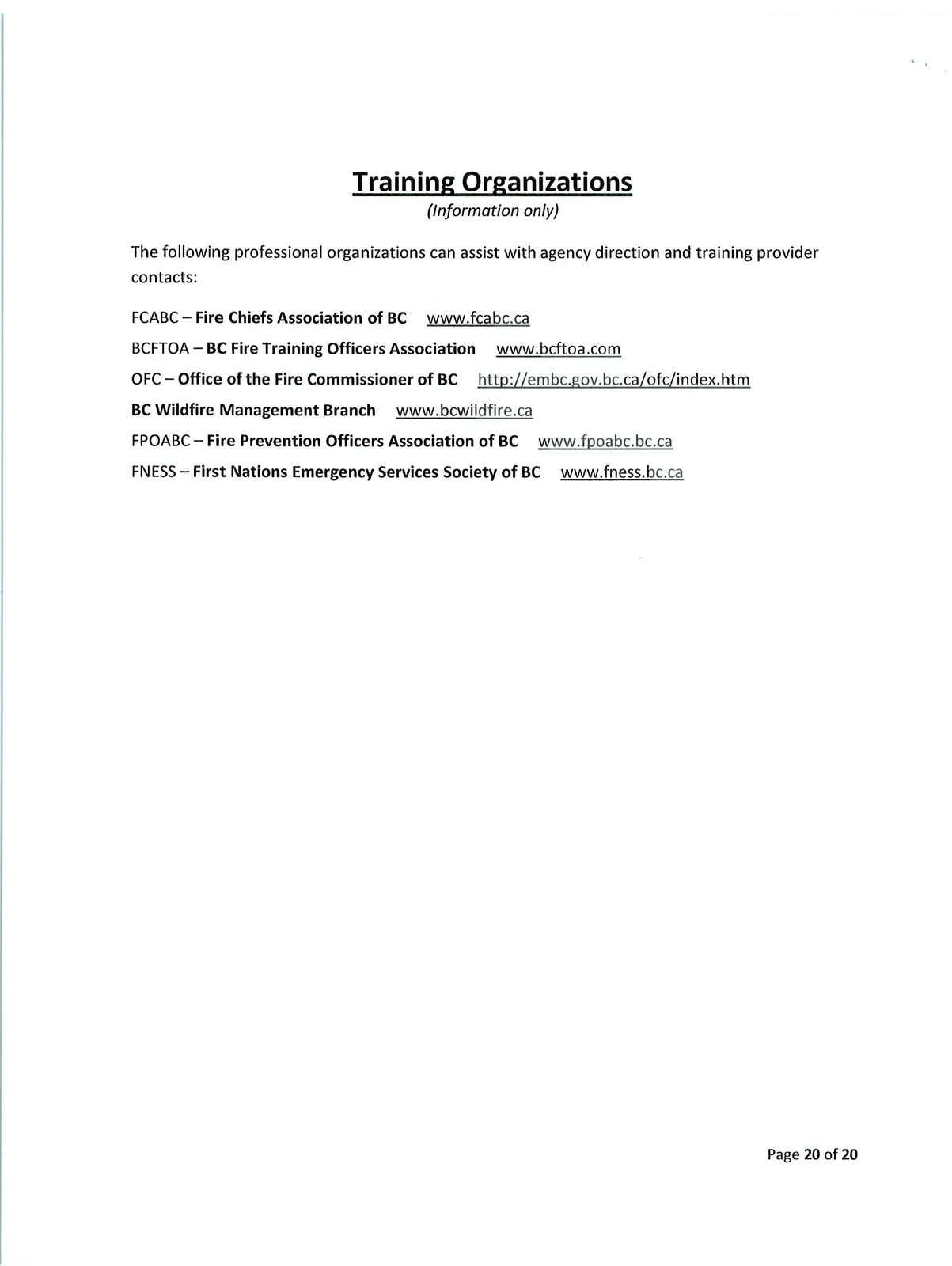
Training Organizations (Information only)
The following professional organizations can assist with agency direction and training provider contacts:
- FCABC — Fire Chiefs Association of BC
www.fcabc.ca - BCFTOA — BC Fire Training Officers Association
www.bcftoa.com - OFC — Office of the Fire Commissioner of BC
http://embc.gov.bc.ca/ofc/index.htm - BC Wildfire Management Branch
www.bcwildfire.ca - FPOABC — Fire Prevention Officers Association of BC
www.fpoabc.bc.ca - FNESS — First Nations Emergency Services Society of BC
www.fness.bc.ca
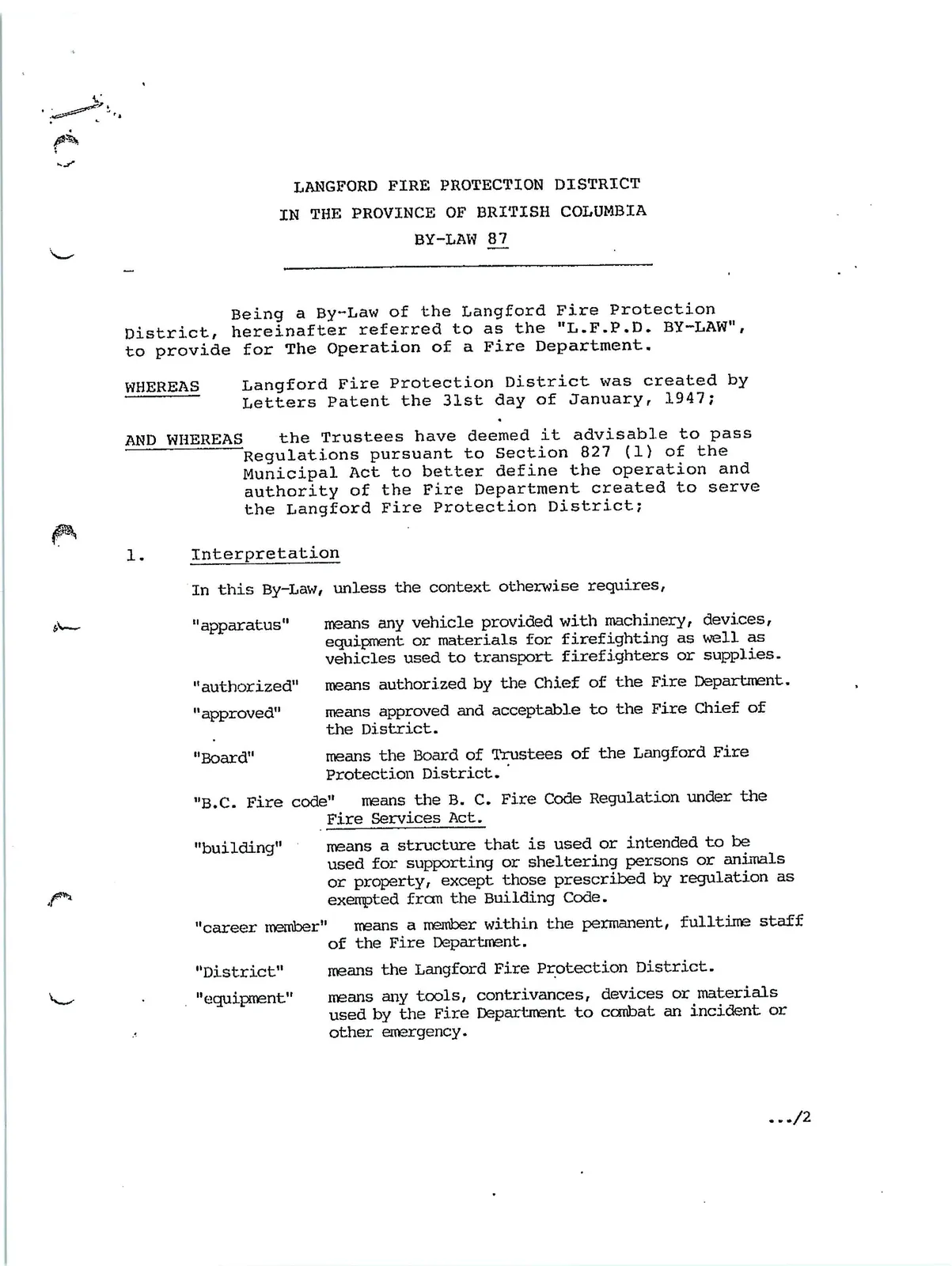
LANGFORD FIRE PROTECTION DISTRICT
IN THE PROVINCE OF BRITISH COLUMBIA
BY-LAW 87
Being a By-Law of the Langford Fire Protection District, hereinafter referred to as the "L.F.P.D. BY-LAW", to provide for The Operation of a Fire Department.
WHEREAS
Langford Fire Protection District was created by Letters Patent the 31st day of January, 1947;
AND WHEREAS
the Trustees have deemed it advisable to pass Regulations pursuant to Section 827 (1) of the Municipal Act to better define the operation and authority of the Fire Department created to serve the Langford Fire Protection District;
1. Interpretation
In this By-Law, unless the context otherwise requires,
- "apparatus" means any vehicle provided with machinery, devices, equipment or materials for firefighting as well as vehicles used to transport firefighters or supplies.
- "authorized" means authorized by the Chief of the Fire Department.
- "approved" means approved and acceptable to the Fire Chief of the District.
- "Board" means the Board of Trustees of the Langford Fire Protection District.
- "B.C. Fire code" means the B. C. Fire Code Regulation under the Fire Services Act.
- "building" means a structure that is used or intended to be used for supporting or sheltering persons or animals or property, except those prescribed by regulation as exempted from the Building Code.
- "career member" means a member within the permanent, fulltime staff of the Fire Department.
- "District" means the Langford Fire Protection District.
- "equipment" means any tools, contrivances, devices or materials used by the Fire Department to coMbat an incident or other emergency.
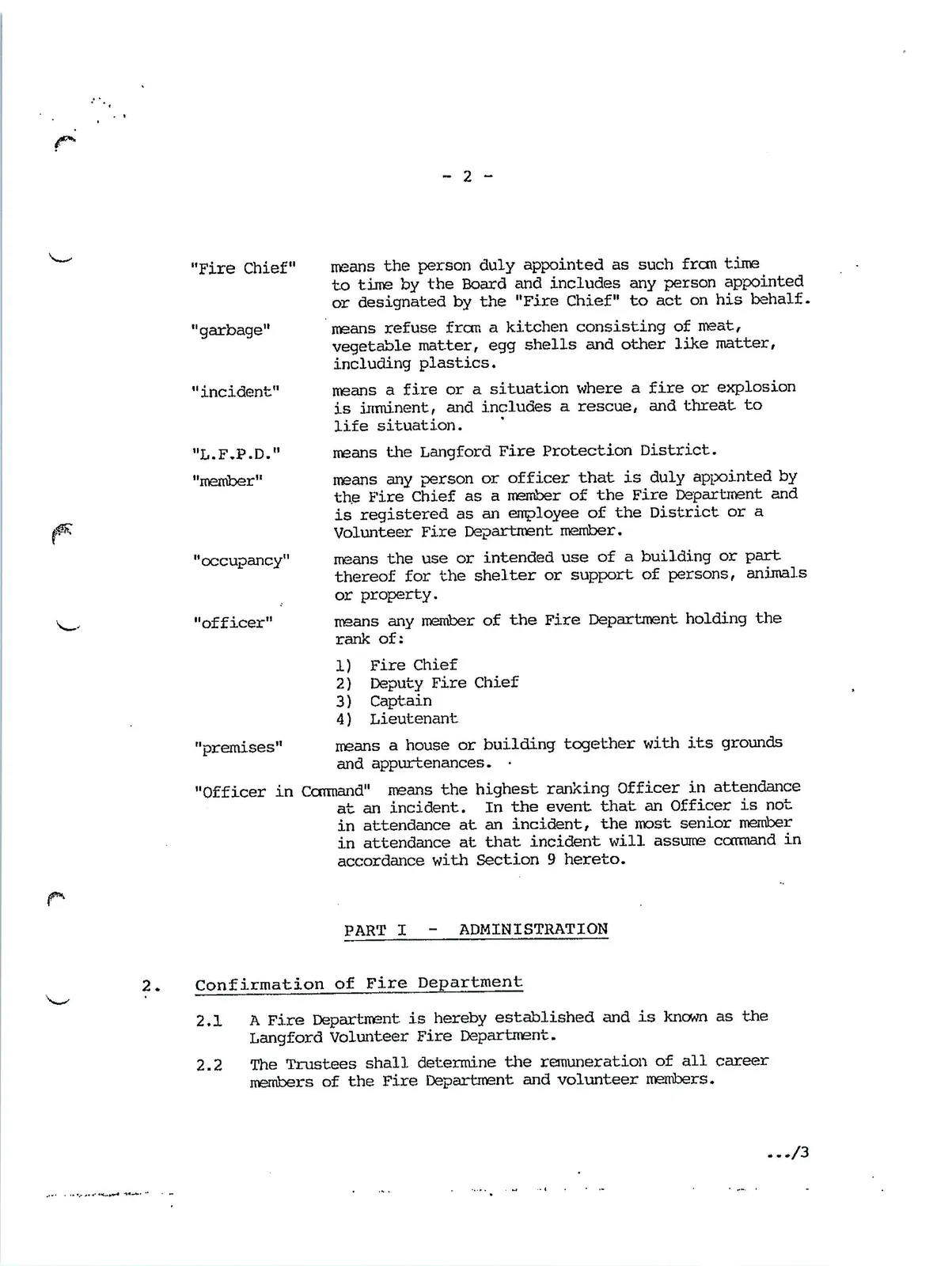
- "Fire Chief" means the person duly appointed as such from time to time by the Board and includes any person appointed or designated by the "Fire Chief" to act on his behalf.
- "garbage" means refuse from a kitchen consisting of meat, vegetable matter, egg shells and ether like matter, including plastics.
- "incident" means a fire or a situation where a fire or explosion is imminent, and includes a rescue, and threat to life situation.
- "member" means any person or officer that is duly appointed by the Fire Chief as a member of the Fire Department and is registered as an employee of the District or a Volunteer Fire Department member.
- "occupancy" means the use or intended use of a building or part thereof for the shelter or support of persons, animals or property.
- "officer" means any member of the Fire Department holding the rank of:
- Fire Chief
- Deputy Fire Chief
- Captain
- Lieutenant
- "premises" means a house or building together with its grounds and appurtenances.
- "Officer in Command" means the highest ranking Officer in attendance at an incident. In the event that an Officer is not in attendance at an incident, the most senior member in attendance at that incident will assume command in accordance with Section 9 hereto.
PART I - ADMINISTRATION
2. Confirmation of Fire Department
2.1 A Fire Department is hereby established and is known as the Langford Volunteer Fire Department.
2.2 The Trustees shall determine the remuneration of all career members of the Fire Department and volunteer members.
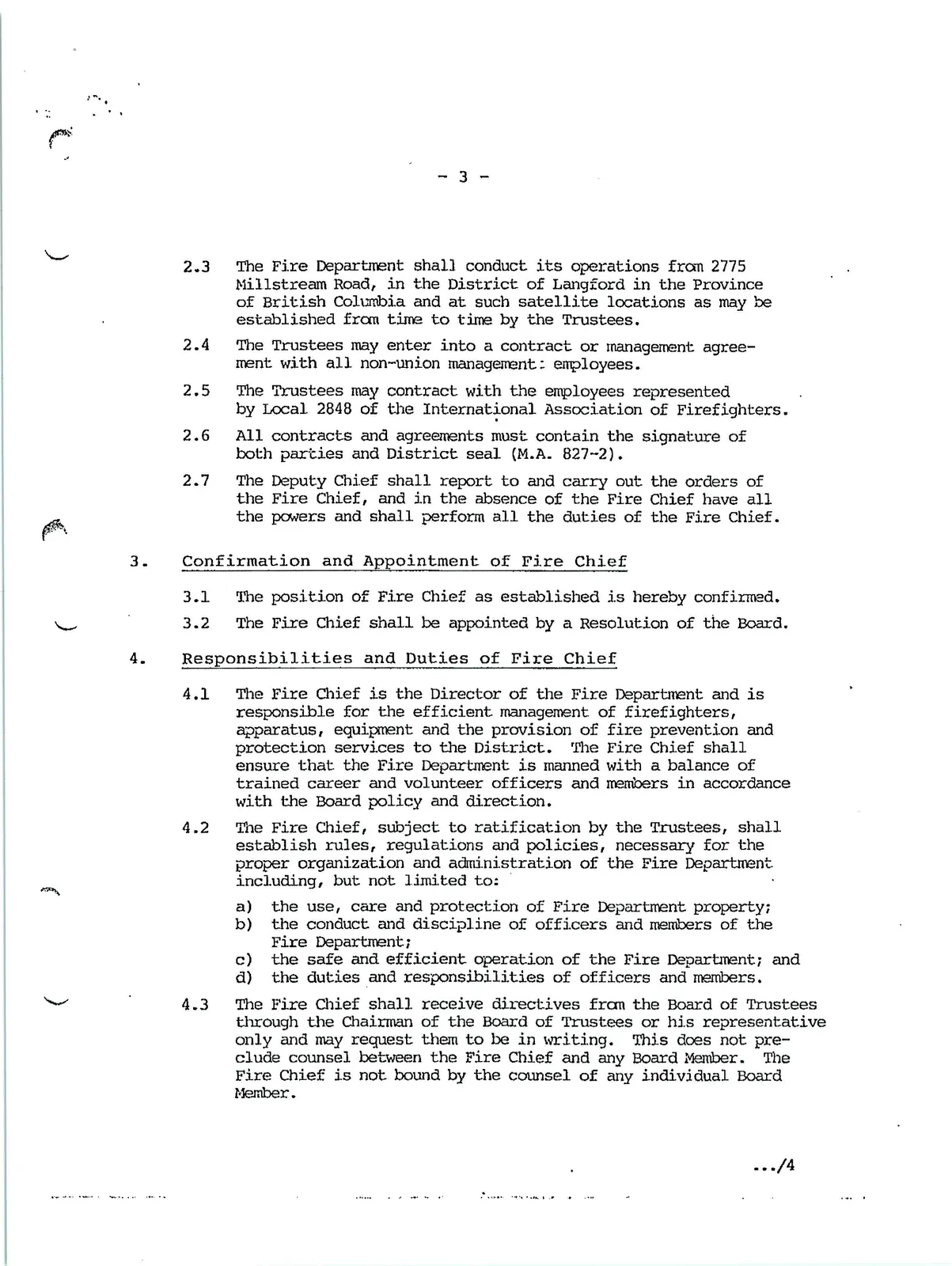
2.3 The Fire Department shall conduct its operations from 2775 Millstream Road, in the District of Langford in the Province of British Columbia and at such satellite locations as may be established from time to time by the Trustees.
2.4 The Trustees may enter into a contract or management agreement with all non-union management: employees.
2.5 The Trustees may contract with the employees represented by Local 2848 of the International Association of Firefighters.
2.6 All contracts and agreements must contain the signature of both parties and District seal (M.A. 827-2).
2.7 The Deputy Chief shall report to and carry out the orders of the Fire Chief, and in the Absence of the Fire Chief have all the powers and shall perform all the duties of the Fire Chief.
3. Confirmation and Appointment of Fire Chief
3.1 The position of Fire Chief as established is hereby confirmed.
3.2 The Fire Chief shall be appointed by a Resolution of the Board.
4. Responsibilities and Duties of Fire Chief
4.1 The Fire Chief is the Director of the Fire Department and is responsible for the efficient management of firefighters, apparatus, equipment and the provision of fire prevention and protection services to the District. The Fire Chief shall ensure that the Fire Department is manned with a balance of trained career and volunteer officers and members in accordance with the Board policy and direction.
4.2 The Fire Chief, subject to ratification by the Trustees, shall establish rules, regulations and policies, necessary for the proper organization and administration of the Fire Department including, but not limited to:
a) the use, care and protection of Fire Department property;
b) the conduct and discipline of officers and members of the Fire Department;
c) the safe and efficient operation of the Fire Department; and
d) the duties and responsibilities of officers and members.
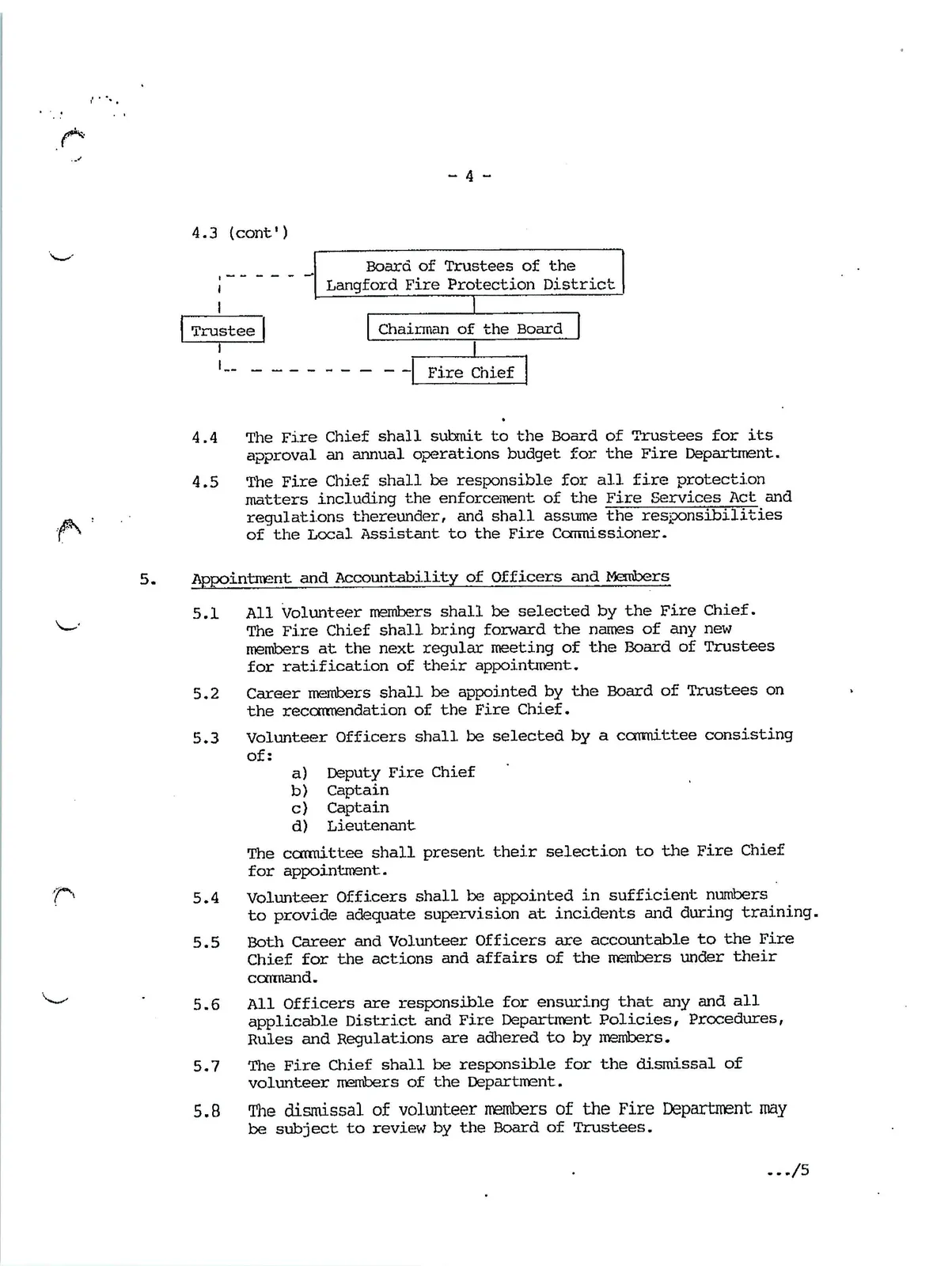
4.3 The Fire Chief shall receive directives from the Board of Trustees through the Chairman of the Board of Trustees or his representative only and may request them to be in writing. This does not preclude counsel between the Fire Chief and any Board Member. The Fire Chief is not bound by the counsel of any individual Board Member.
4.4 The Fire Chief shall submit to the Board of Trustees for its approval an annual operations budget for the Fire Department.
4.5 The Fire Chief shall be responsible for all fire protection matters including the enforcement of the Fire Services Act and regulations thereunder, and shall assume the responsibilities of the Local Assistant to the Fire Commissioner.
5. Appointment and Accountability of Officers and Members
5.1 All Volunteer members shall be selected by the Fire Chief. The Fire Chief shall bring forward the names of any new members at the next regular meeting of the Board of Trustees for ratification of their appointment.
5.2 Career members shall be appointed by the Board of Trustees on the recommendation of the Fire Chief.
5.3 Volunteer Officers shall be selected by a committee consisting of:
a) Deputy Fire Chief
b) Captain
c) Captain
d) Lieutenant
The committee shall present their selection to the Fire Chief for appointment.
5.4 Volunteer Officers shall be appointed in sufficient numbers to provide adequate supervision at incidents and during training.
5.5 Both Career and Volunteer Officers are accountable to the Fire Chief for the actions and affairs of the members under their command.
5.6 All Officers are responsible for ensuring that any and all applicable District and Fire Department Policies, Procedures, Rules and Regulations are adhered to by members.
5.7 The Fire Chief shall be responsible for the dismissal of volunteer members of the Department.
5.8 The dismissal of volunteer members of the Fire Department may be subject to review by the Board of Trustees.
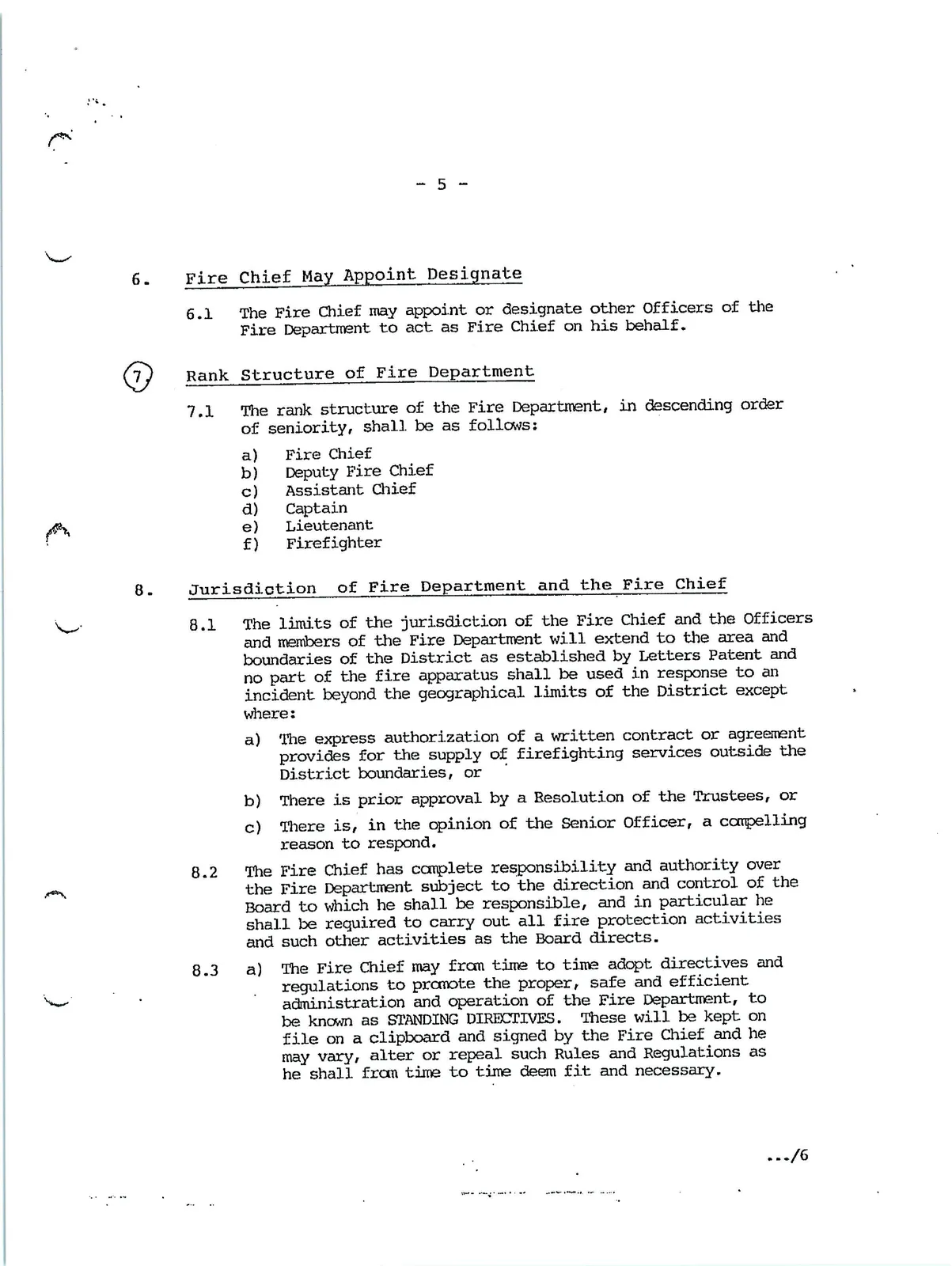
6. Fire Chief May Appoint Designate
6.1 The Fire Chief may appoint or designate other Officers of the Fire Department to act as Fire Chief on his behalf.
7. Rank Structure of Fire Department
7.1 The rank structure of the Fire Department, in descending order of seniority, shall be as follows:
a) Fire Chief
b) Deputy Fire Chief
c) Assistant Chief
d) Captain
e) Lieutenant
f) Firefighter
8. Jurisdiction of Fire Department and the Fire Chief
8.1 The limits of the jurisdiction of the Fire Chief and the Officers and members of the Fire Department will extend to the area and boundaries of the District as established by Letters Patent and no part of the fire apparatus shall be used in response to an incident beyond the geographical limits of the District except where:
a) The express authorization of a written contract or agreement provides for the supply of firefighting services outside the District boundaries, or
b) There is prior approval by a Resolution of the Trustees, or
c) There is, in the opinion of the Senior Officer, a compelling reason to respond.
8.2 The Fire Chief has complete responsibility and authority over the Fire Department subject to the direction and control of the Board to which he shall be responsible, and in particular he shall be required to carry out all fire protection activities and such other activities as the Board directs.
8.3 a) The Fire Chief may from time to time adopt directives and regulations to promote the proper, safe and efficient administration and operation of the Fire Department, to be known as STANDING DIRECTIVES. These will be kept on file on a clipboard and signed by the Fire Chief and he may vary, alter or repeal such Rules and Regulations as he shall from time to time deem fit and necessary.
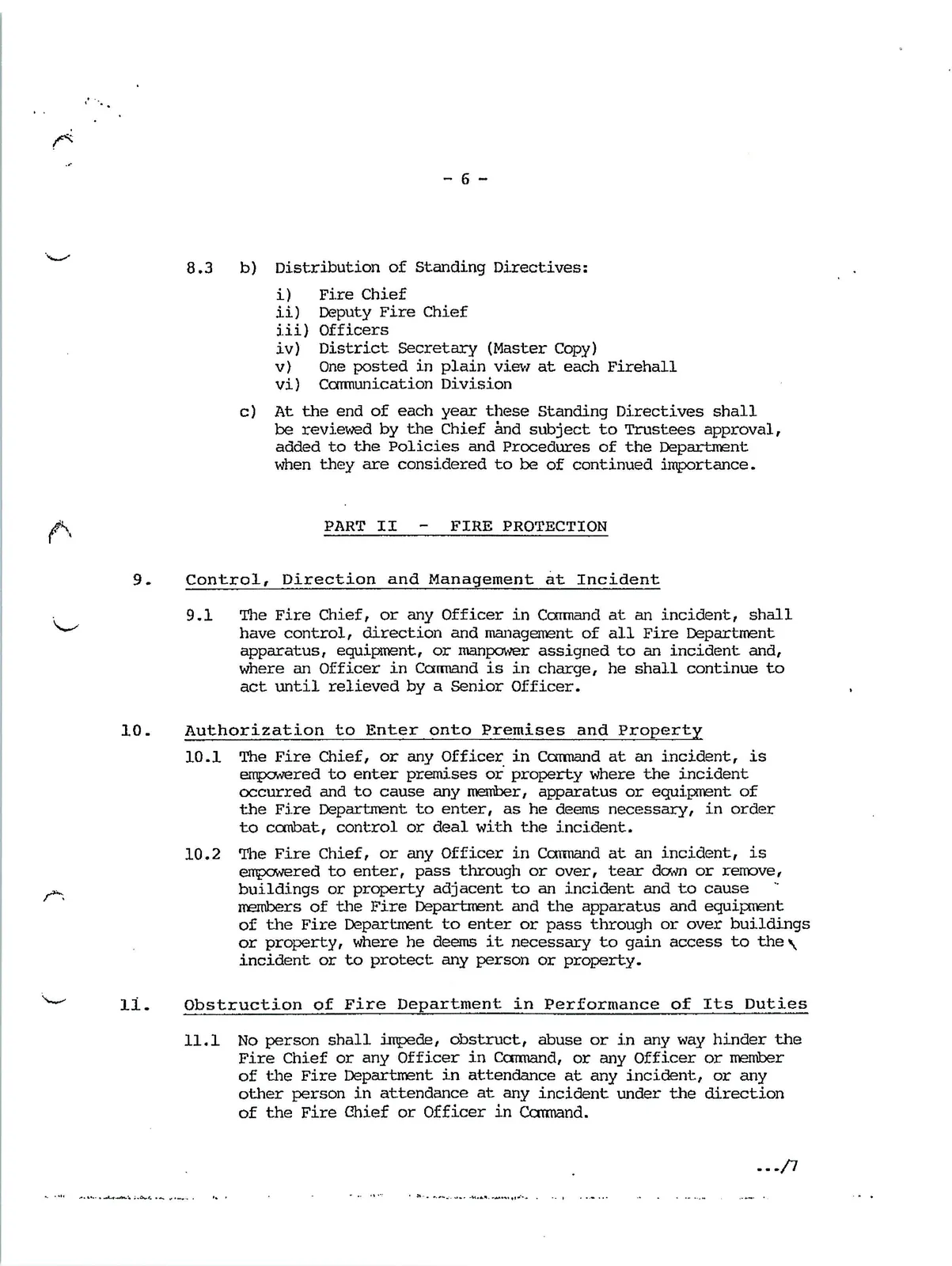
8.3 b) Distribution of Standing Directives:
i) Fire Chief
ii) Deputy Fire Chief
iii) Officers
iv) District Secretary (Master Copy)
v) One posted in plain view at each Firehall
vi) Communication Division
c) At the end of each year these Standing Directives shall be reviewed by the Chief kid subject to Trustees approval, added to the Policies and Procedures of the Department when they are considered to be of continued importance.
PART II - FIRE PROTECTION
9. Control, Direction and Management at Incident
9.1 The Fire Chief, or any Officer in Command at an incident, shall have control, direction and management of all Fire Department apparatus, equipment, or manpower assigned to an incident and, where an Officer in Command is in charge, he shall continue to act until relieved by a Senior Officer.
10. Authorization to Enter onto Premises and Property
10.1 The Fire Chief, or any Officer in Command at an incident, is empowered to enter premises or property where the incident occurred and to cause any member, apparatus or equipment of the Fire Department to enter, as he deems necessary, in order to coMbat, control or deal with the incident.
10.2 The Fire Chief, or any Officer in Command at an incident, is empowered to enter, pass through or over, tear down or remove, buildings or property adjacent to an incident and to cause members of the Fire Department and the apparatus and equipment of the Fire Department to enter or pass through or over buildings or property, where he deems it necessary to gain access to the incident or to protect any person or property.
11. Obstruction of Fire Department in Performance of Its Duties
11.1 No person shall impede, obstruct, abuse or in any way hinder the Fire Chief or any Officer in Command, or any Officer or member of the Fire Department in attendance at any incident, or any other person in attendance at any incident under the direction of the Fire Chief or Officer in Command.
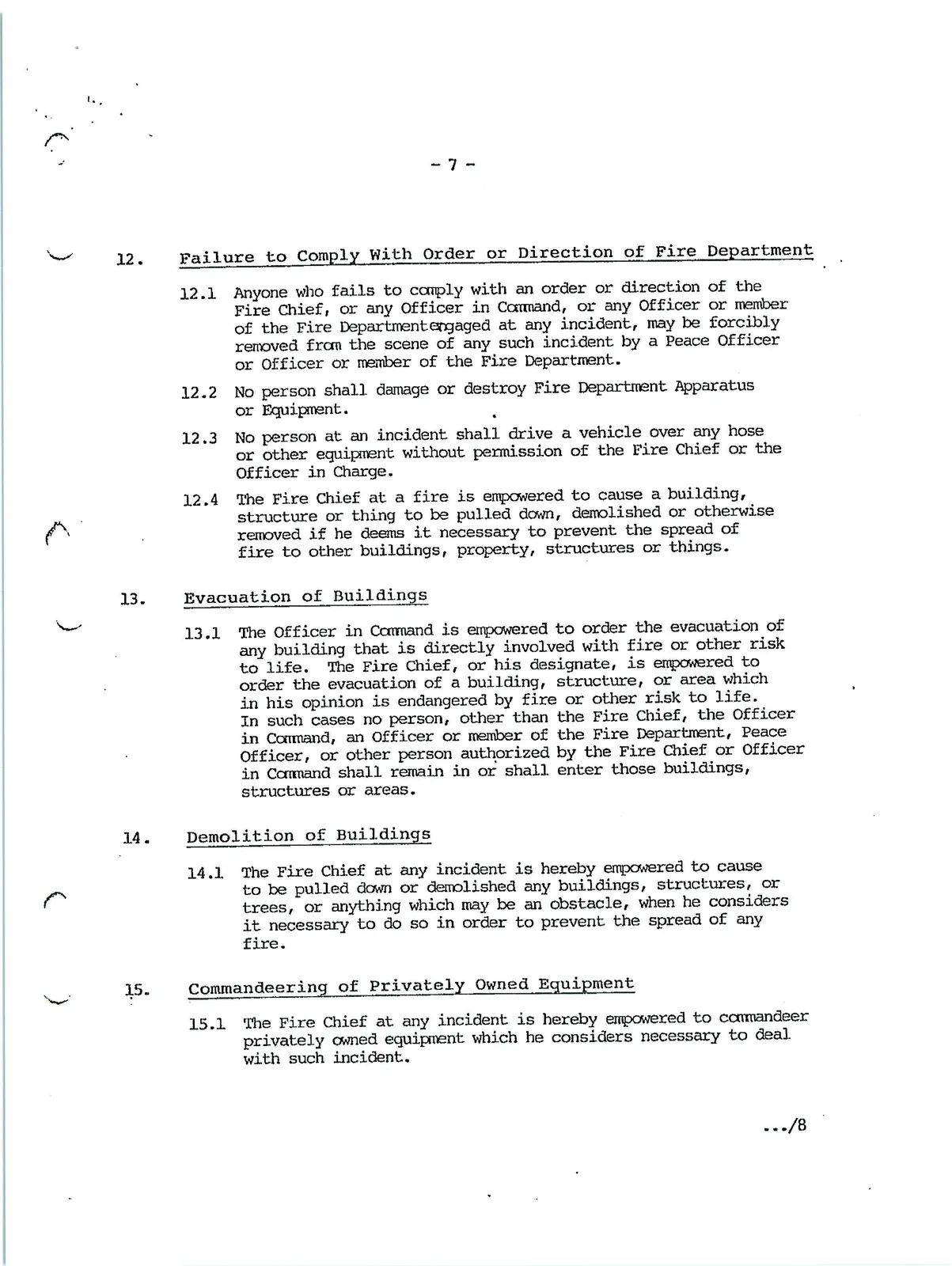
12. Failure to Comply With Order or Direction of Fire Department
12.1 Anyone who fails to comply with an order or direction of the Fire Chief, or any Officer in Command, or any Officer or member of the Fire Departmentergaged at any incident, may be forcibly removed from the scene of any such incident by a Peace Officer or Officer or member of the Fire Department.
12.2 No person shall damage or destroy Fire Department Apparatus CT Equipment.
12.3 No person at an incident shall drive a vehicle over any hose or other equipment without permission of the Fire Chief or the Officer in Charge.
12.4 The Fire Chief at a fire is empowered to cause a building, structure or thing to be pulled down, demolished or otherwise removed if he deems it necessary to prevent the spread of fire to other buildings, property, structures or things.
13. Evacuation of Buildings
13.1 The Officer in Command is empowered to order the evacuation of any building that is directly involved with fire or other risk to life. The Fire Chief, or his designate, is empowered to order the evacuation of a building, structure, or area which in his opinion is endangered by fire or other risk to life. In such cases no person, other than the Fire Chief, the Officer in Command, an Officer or member of the Fire Department, Peace Officer, or other person authorized by the Fire Chief or Officer in Command shall remain in or shall enter those buildings, structures or areas.
14. Demolition of Buildings
14.1 The Fire Chief at any incident is hereby empowered to cause to be pulled down or demolished any buildings, structures, or trees, or anything which may be an obstacle, when he considers it necessary to do so in order to prevent the spread of any fire.
15. Commandeering of Privately Owned Equipment
15.1 The Fire Chief at any incident is hereby empowered to commandeer privately awned equipment which he considers necessary to deal with such incident.
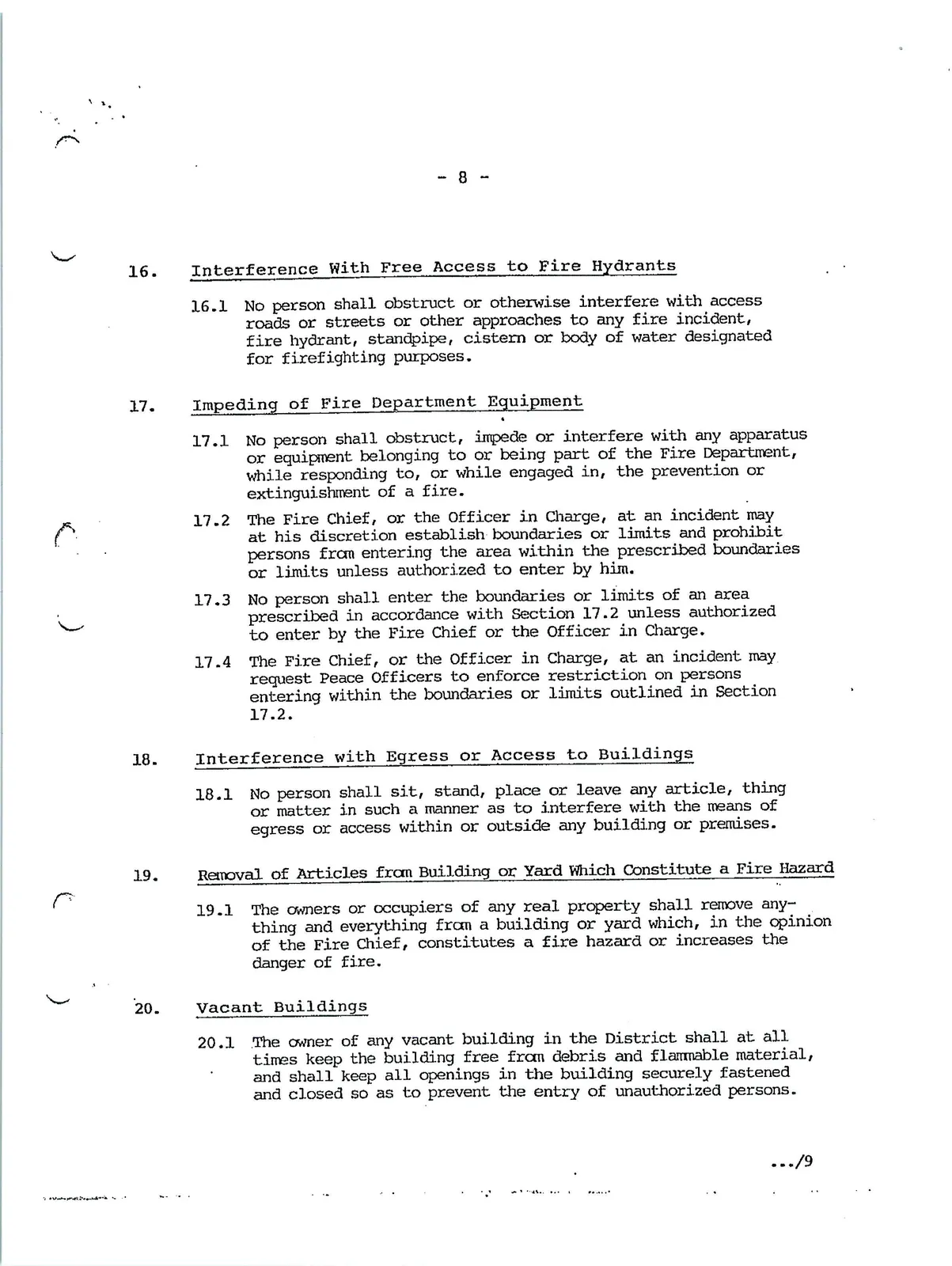
16. Interference With Free Access to Fire Hydrants
16.1 No person shall obstruct or otherwise interfere with access roads or streets or other approaches to any fire incident, fire hydrant, standpipe, cistern or body of water designated for firefighting purposes.
17. Impeding of Fire Department Equipment
17.1 No person shall obstruct, impede or interfere with any apparatus or equipment belonging to or being part of the Fire Department, while responding to, or while engaged in, the prevention or extinguishment of a fire.
17.2 The Fire Chief, or the Officer in Charge, at an incident may at his discretion establish boundaries or limits and prohibit persons from entering the area within the prescribed boundaries or limits unless authorized to enter by him.
17.3 No person shall enter the boundaries or limits of an area prescribed in accordance with Section 17.2 unless authorized to enter by the Fire Chief or the Officer in Charge.
17.4 The Fire Chief, or the Officer in Charge, at an incident may request Peace Officers to enforce restriction on persons entering within the boundaries or limits outlined in Section 17.2.
18. Interference with Egress or Access to Buildings
18.1 No person shall sit, stand, place or leave any article, thing or matter in such a manner as to interfere with the means of egress or access within or outside any building or premises.
19. Removal of Articles from Building or Yard Which Constitute a Fire Hazard
19.1 The owners or occupiers of any real property shall remove anything and everything from a building or yard which, in the opinion of the Fire Chief, constitutes a fire hazard or increases the danger of fire.
20. Vacant Buildings
20.1 The owner of any vacant building in the District shall at all times keep the building free from debris and flammable material, and shall keep all openings in the building securely fastened and closed so as to prevent the entry of unauthorized persons.
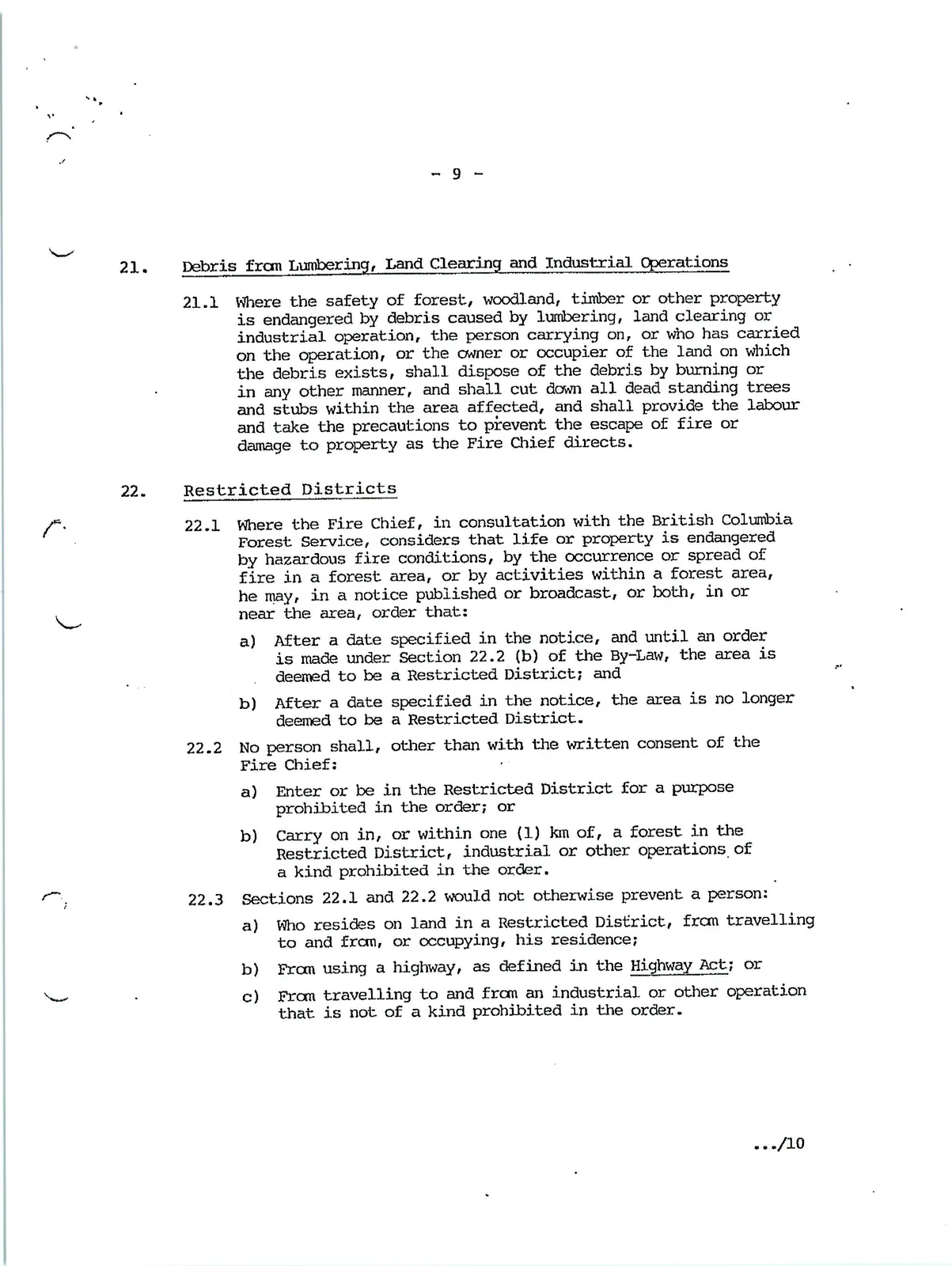
21. Debris from Lumbering, Land Clearing and Industrial Operations
21.1 Where the safety of forest, woodland, timber or other property is endangered by debris caused by lumbering, land clearing or industrial operation, the person carrying on, or who has carried on the operation, or the owner or occupier of the land on which the debris exists, shall dispose of the debris by burning or in any other manner, and shall cut down all dead standing trees and stubs within the area affected, and shall provide the labour and take the precautions to prevent the escape of fire or damage to property as the Fire Chief directs.
22. Restricted Districts
22.1 Where the Fire Chief, in consultation with the British Columbia Forest Service, considers that life or property is endangered by hazardous fire conditions, by the occurrence or spread of fire in a forest area, or by activities within a forest area, he may, in a notice published or broadcast, or both, in or near the area, order that:
a) After a date specified in the notice, and until an order is made under Section 22.2 (b) of the By-Law, the area is deemed to be a Restricted District; and
b) After a date specified in the notice, the area is no longer deemed to be a Restricted District.
22.2 No person shall, other than with the written consent of the Fire Chief:
a) Enter or be in the Restricted District for a purpose prohibited in the order; or
b) Carry on in, or within one (1) km of, a forest in the Restricted District, industrial or other operations of a kind prohibited in the order.
22.3 Sections 22.1 and 22.2 would not otherwise prevent a person:
a) Who resides on land in a Restricted District, from travelling to and from, or occupying, his residence;
b) From using a highway, as defined in the Highway Act; or
c) From travelling to and from an industrial or other operation that is not of a kind prohibited in the order.
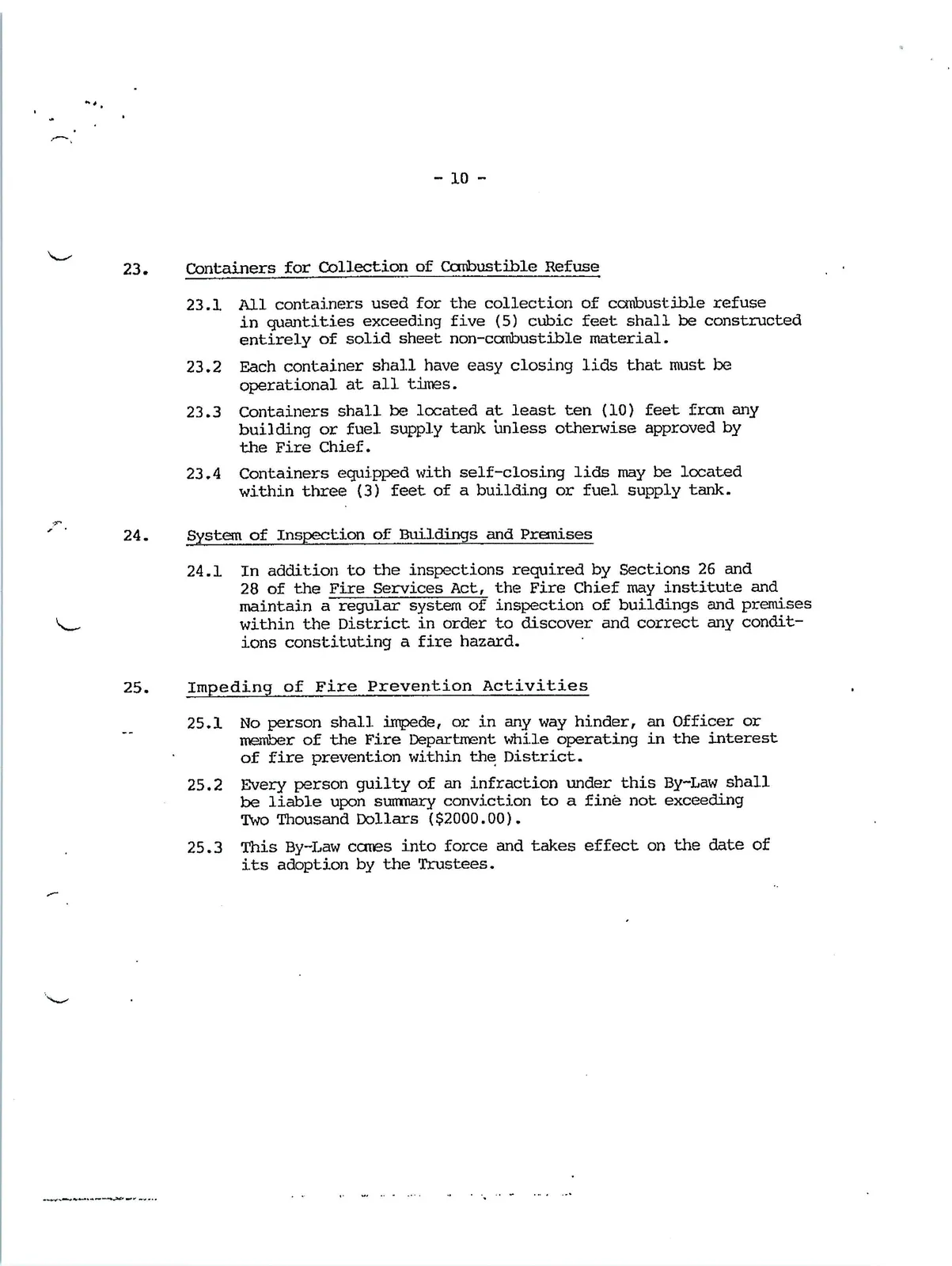
23. Containers for Collection of CoMbustible Refuse
23.1 All containers used for the collection of coMbustible refuse in quantities exceeding five (5) cubic feet shall be constructed entirely of solid sheet non-coMbustible material.
23.2 Each container shall have easy closing lids that must be operational at all times.
23.3 Containers shall be located at least ten (10) feet from any building or fuel supply tank Unless otherwise approved by the Fire Chief.
23.4 Containers equipped with self-closing lids may be located within three (3) feet of a building or fuel supply tank.
24. System of Inspection of Buildings and Premises
24.1 In addition to the inspections required by Sections 26 and 28 of the Fire Services Act, the Fire Chief may institute and maintain a regular system of inspection of buildings and premises within the District in order to discover and correct any conditions constituting a fire hazard.
25. Impeding of Fire Prevention Activities
25.1 No person shall impede, or in any way hinder, an Officer or member of the Fire Department while operating in the interest of fire prevention within the District.
25.2 Every person guilty of an infraction under this By-Law shall be liable upon summary conviction to a fine not exceeding Two Thousand Dollars ($2000.00).
25.3 This By-Law comes into force and takes effect on the date of its adoption by the Trustees.
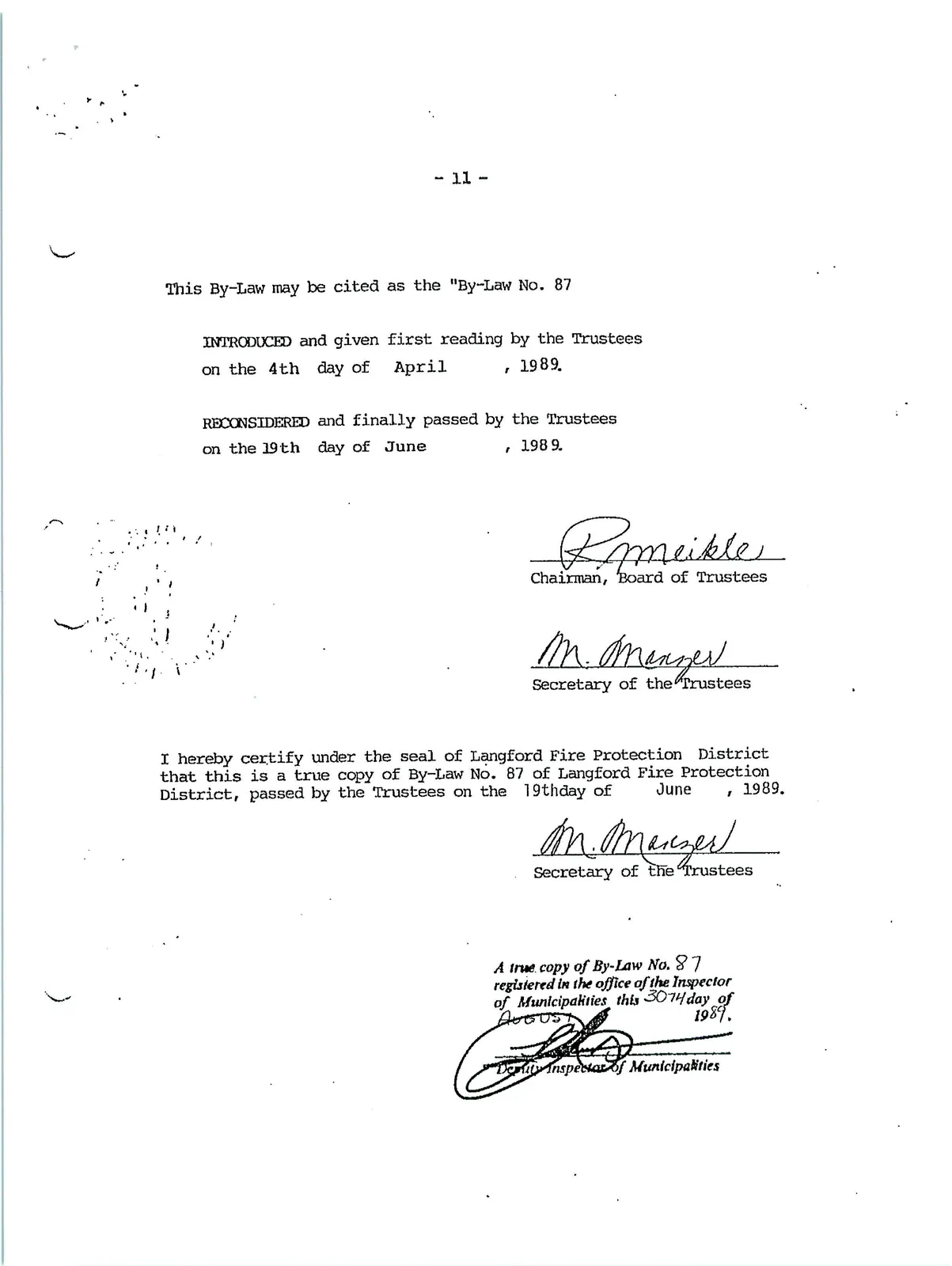
Chairman, ard of Trustees
Secretary of t e rustees
A true. copy of By-Law No. 2 7 registered in the office of the Inspector of Municipalities this 71/ day of 19S7. f Municipalities
This By-Law may be cited as the "By-Law No. 87
INTRODUCED and given first reading by the Trustees on the 4th day of April , 1989.
RECONSIDERED and finally passed by the Trustees on the 19th day of :June ,1989.
Secretary of the stees /4.(44,11
I hereby certify under the seal of Langford Fire Protection District that this is a true copy of By-Law No. 87 of Langford Fire Protection District, passed by the Trustees on the 19aday of June , 1989.
Document Images
(24)