DocumentsAppendixNov 7, 2016Pages 48–54
Appendix: BC Fire Service Minimum Training Standards – Structure Firefighters Playbook (cover and initial pages)
Portion of the BC Fire Service Minimum Training Standards (Playbook) outlining purpose, scope, principles and competency ladders for Exterior, Interior and Full‑Service Operations firefighter roles.
Key facts
- Playbook establishes competency levels: Exterior, Interior, Full‑Service Operations
- Includes supervisory roles: Team Leader and Risk Management Officer
- References NFPA standards and Workers Compensation Act training/record obligations
- Playbook effective/issued: original Sept 2014, amended May 2015
Appendix: BC Fire Service Minimum Training Standards – Structure Firefighters Playbook (cover and initial pages)
British Columbia Fire Service Minimum Training Standards
Structure Firefighters
Competency and Training
PLAYBOOK
Second Edition
Amended: May 2015
Pursuant to paragraph 3(3)(b) of the Fire Services Act of B.C.
Acknowledgements
The Office of the Fire Commissioner wishes to acknowledge the contributions of the following organizations in the compilation, consultation, evaluation and drafting of the B.C. Fire Service Minimum Training Standards:
- Fire Chiefs Association of British Columbia
- British Columbia Fire Training Officers Association
It was through the efforts of these organizations as well as staff and other individuals within the fire service that this Playbook was created. In moving forward, the Playbook is intended to be a living document that will be periodically reassessed with a view to enhancing or clarifying aspects identified by the fire service.
Table of Amendments
| Description | Effective Date |
|---|---|
| Original document issued | September 2014 |
| Amended | May 2015 |
Overview
1. Purpose:
Under paragraph 3(3)(b) of the Fire Services Act (B.C.), the Fire Commissioner is required to establish the minimum standards of training required for fire services personnel in British Columbia. This Playbook sets out a competency-based ladder that provides for a minimum level of sequential training and operational requirements that must be met by each fire department. The Authority Having Jurisdiction will set the Service Level (refer to pages 10, 17 and 18) to be provided by its fire department, which in turn determines the minimum training Competencies that must be met by that department. The Playbook establishes the minimum training Competencies required and the standards from which they are drawn.
2. Scope:
This Playbook is applicable to all fire services personnel in British Columbia, as defined in the Fire Services Act. It covers all fire departments and fire services, including municipal and regional district fire departments, fire brigades, volunteer fire departments, and fire departments established as a society under the Society Act (B.C.). This Playbook does not apply to provincial Wildfire Management Branch resources.
For the purpose of this document, the term "Authority Having Jurisdiction" or "AHJ" describes the relevant local or regional government, or the entity (or persons) legally responsible for the organization and operation of the particular fire service.
This Playbook is intended to provide an industry recognized minimum standard of training that utilizes, and bridges to, the current National Fire Protection Association (NFPA) Firefighter qualifications. The training requirements are expressly tied to the Service Level provided by a fire department, as formally determined by the Authority Having Jurisdiction. This document and program establishes the minimum Competencies necessary to perform the role of a firefighter, instructor/Evaluator and Team Leader at each designated Service Level, as well as for the delivery of in-house training in such Competencies.
The Playbook addresses the principal functional or operational roles for each Service Level but does not encompass all roles or functions of the fire service. The Playbook is not intended to change or nullify any requirements or training related to other roles or functions in the fire service. This document and program does not cover the minimum standards for the skills and training necessary to perform other advanced or specific functions/roles such as, but not limited to: Incident Commander, Driver/Operator, Incident Safety Officer, or Rapid Intervention Team. The training for such roles and functions must meet the requirements of the Workers Compensation Act (B.C.) and any other applicable statutory or regulatory requirements. These additional training requirements need to be considered by the AHJ when determining the Service Level to be provided by its fire service.
Principles
3. Principles:
It is the responsibility of each AHJ to select and declare its firefighting Service Level, which in turn determines the training Competencies that must be met by the fire service for which it is responsible. The Playbook standard outlines the minimum competencies which are drawn from the NFPA standards. The declared Service Level must be established as formal policy for the Department (whether by bylaw, policy or in contract) and needs to be fully reflected in the fire department's operating guidelines and policies. The AHJ's decision as to the appropriate Service Level for its fire service should be based upon:
- local conditions;
- consultation with representatives of local fire service delivery organization;
- availability of resources and the ability of those resources to respond;
- the realities of the community in terms of demographics, risks, travel distances, fire hall locations, equipment and staffing models; and
- the ability of the AHJ to financially support its fire department to enable it to meet all applicable training, safety and operational requirements for the chosen Service Level.
This Playbook establishes three Service Level options from which an AHJ may choose. Once a Service Level is established, each AHJ must ensure that its fire service meets the appropriate competency requirements as identified in the Competency ladder, as well as for the functions and roles not expressly covered by this Playbook. Ensuring compliance with minimum standard established in this Playbook is the responsibility of the AHJ.
As a competency-based program, formal certification (whether Accredited Certification or other third-party Certification), while encouraged, is not required by this Playbook. Each firefighter must be provided training and evaluation in all applicable Competencies, including theoretical classroom and hands-on practical skills, which are required by the chosen Service Level.
Assessments and evaluations of Competencies can be carried out internally by the AHJ so long as the evaluation instruments follow the criteria of this Playbook (and other applicable NFPA Standards) and that detailed records of firefighter training and evaluation are maintained.
4. Competencies
The Playbook establishes and describes the minimum Competencies required of firefighter roles in the following three categories:
- Exterior Operations Level Firefighter;
- Interior Operations Level Firefighter; and
- Full-Service Operations Level Firefighter.
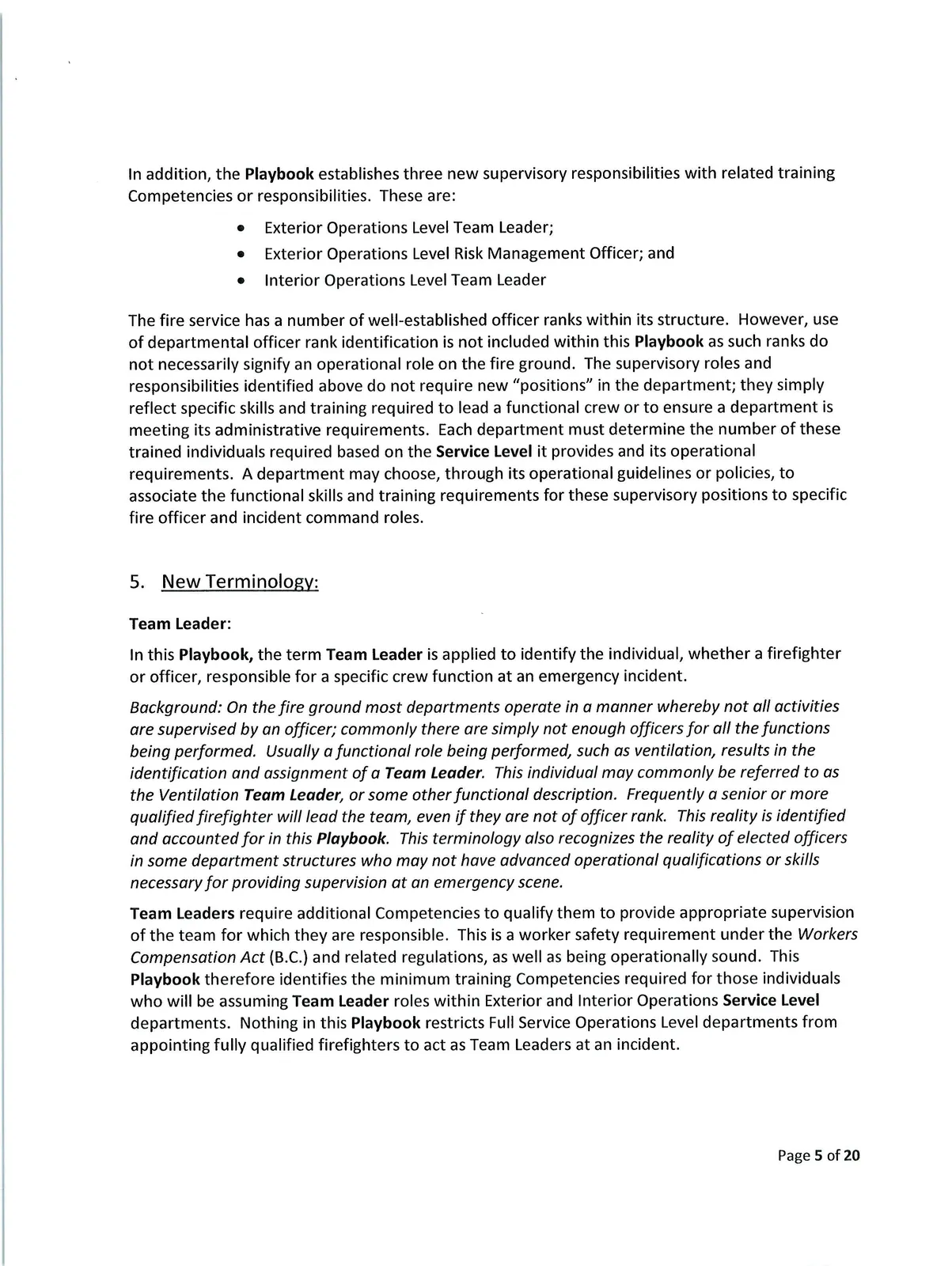
In addition, the Playbook establishes three new supervisory responsibilities with related training Competencies or responsibilities. These are:
- Exterior Operations Level Team Leader;
- Exterior Operations Level Risk Management Officer; and
- Interior Operations Level Team Leader
The fire service has a number of well-established officer ranks within its structure. However, use of departmental officer rank identification is not included within this Playbook as such ranks do not necessarily signify an operational role on the fire ground. The supervisory roles and responsibilities identified above do not require new "positions" in the department; they simply reflect specific skills and training required to lead a functional crew or to ensure a department is meeting its administrative requirements. Each department must determine the number of these trained individuals required based on the Service Level it provides and its operational requirements. A department may choose, through its operational guidelines or policies, to associate the functional skills and training requirements for these supervisory positions to specific fire officer and incident command roles.
New Terminology:
Team Leader:
In this Playbook, the term Team Leader is applied to identify the individual, whether a firefighter or officer, responsible for a specific crew function at an emergency incident.
Background: On the fire ground most departments operate in a manner whereby not all activities are supervised by an officer; commonly there are simply not enough officers for all the functions being performed. Usually a functional role being performed, such as ventilation, results in the identification and assignment of a Team Leader. This individual may commonly be referred to as the Ventilation Team Leader, or some other functional description. Frequently a senior or more qualified firefighter will lead the team, even if they are not of officer rank. This reality is identified and accounted for in this Playbook. This terminology also recognizes the reality of elected officers in some department structures who may not have advanced operational qualifications or skills necessary for providing supervision at an emergency scene.
Team Leaders require additional Competencies to qualify them to provide appropriate supervision of the team for which they are responsible. This is a worker safety requirement under the Workers Compensation Act (B.C.) and related regulations, as well as being operationally sound. This Playbook therefore identifies the minimum training Competencies required for those individuals who will be assuming Team Leader roles within Exterior and Interior Operations Service Level departments. Nothing in this Playbook restricts Full Service Operations Level departments from appointing fully qualified firefighters to act as Team Leaders at an incident.
Risk Management Officer:
The Risk Management Officer is an administrative role that must be formally addressed by all "Exterior Operations Service Level" departments. The individual who fulfils this role is responsible for ensuring that the department has in place Operational Guidelines, training programs and other administrative processes that ensure safe and effective operations at all incidents. In this Playbook, the term Risk Management Officer is applied to identify the individual, usually a senior officer, responsible for overseeing the development and implementation of administrative processes which are necessary to ensure an Exterior Operations Level department practices safe and effective fire ground operations as a matter of principle.
Background: Although the responsibilities that attach to the role of "Risk Management Officer" need to be met by all fire departments, this role is being mandated specifically for Exterior Operations Service Level departments, which typically will be the smaller departments in the Province. The intent is to ensure that these departments are formally addressing their obligations with regards to developing the administrative processes and guidelines that are necessary to implement the requirements of this Playbook as well as to ensure that a department meets its other statutory or regulatory obligations.
This role and the attendant responsibilities of the Risk Management Officer are administrative. It bears no relationship to the operational roles of either the Incident Commander (IC) or Safety Officer (ISO) at an emergency incident (although it may be possible that an individual who fulfils the Risk Management Officer role in a department may also be qualified to act as an IC or ISO at an incident).
The Risk Management Officer may be the Fire Chief, or another member of the department, depending on the composition and structure of the department. This individual needs to have sufficient experience and/or appropriate training to ensure that he or she understands the administrative structures and processes that must be in place to guide a department's training, safety programs and operations.
6. Instruction, Evaluation and Records Keeping:
The Competencies required to act as an in-house instructor and evaluator of the training required by this Playbook are detailed within the document. There are clear expectations identified regarding the provision of training and the creation and management of training records. Training and evaluation can occur using either a third party training organization, or "in-house" by a department using its own instructors and evaluators. The decision on the most appropriate method for each department rests with the AHJ.
It is the responsibility of all fire departments/AHJs to be able to accurately identify record, edit and report out on a complete list of training records for each individual firefighter including specific training subjects covered at each training session. All training records must be kept in accordance with the requirements of the Workers Compensation Act (B.C.) and related regulations, and any other regulatory requirements.
Maintenance Training and Transition
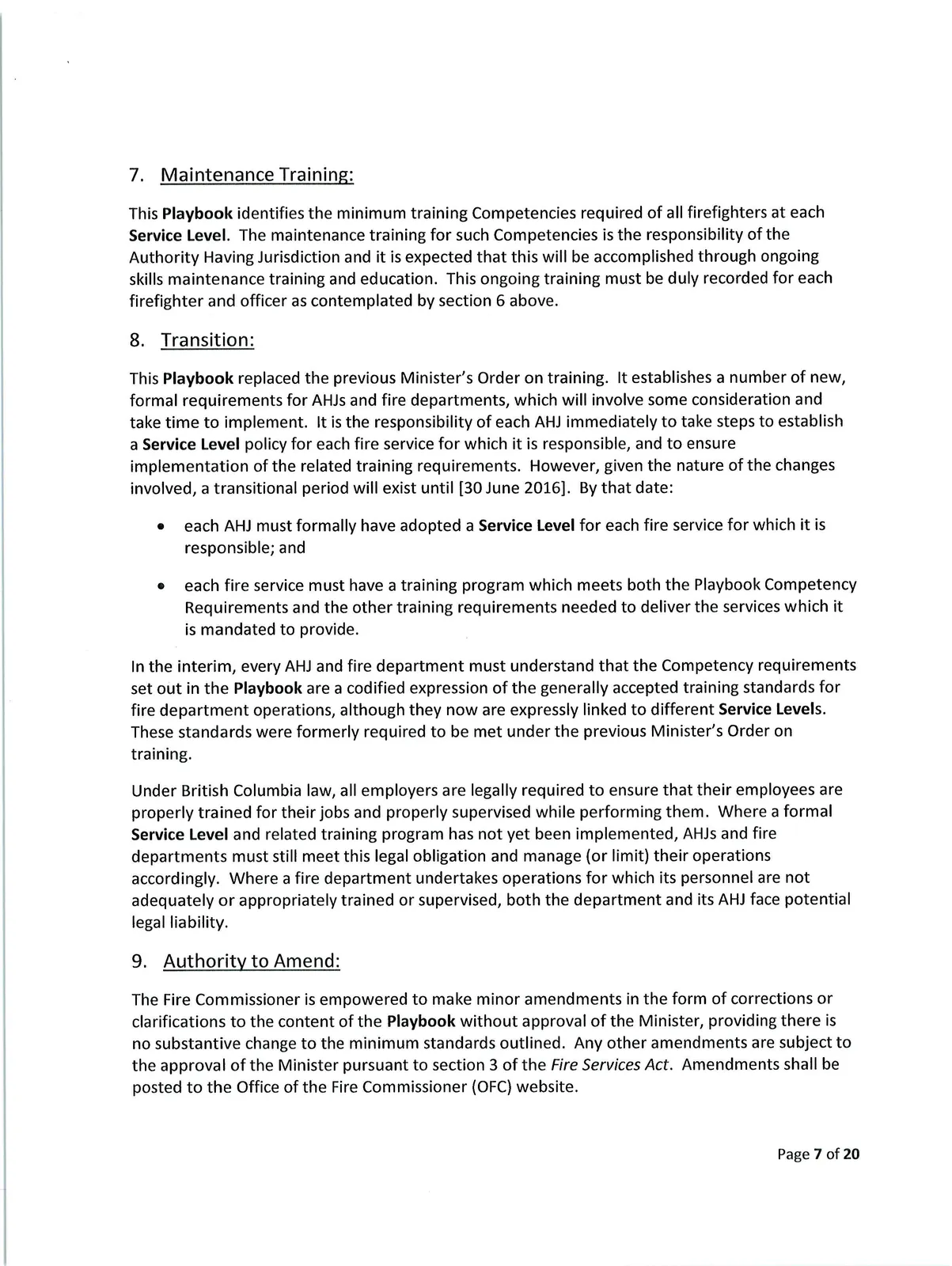
7. Maintenance Training:
This Playbook identifies the minimum training Competencies required of all firefighters at each Service Level. The maintenance training for such Competencies is the responsibility of the Authority Having Jurisdiction and it is expected that this will be accomplished through ongoing skills maintenance training and education. This ongoing training must be duly recorded for each firefighter and officer as contemplated by section 6 above.
8. Transition:
This Playbook replaced the previous Minister's Order on training. It establishes a number of new, formal requirements for AHJs and fire departments, which will involve some consideration and take time to implement. It is the responsibility of each AHJ immediately to take steps to establish a Service Level policy for each fire service for which it is responsible, and to ensure implementation of the related training requirements. However, given the nature of the changes involved, a transitional period will exist until [30 June 2016]. By that date:
- each AHJ must formally have adopted a Service Level for each fire service for which it is responsible; and
- each fire service must have a training program which meets both the Playbook Competency Requirements and the other training requirements needed to deliver the services which it is mandated to provide.
In the interim, every AHJ and fire department must understand that the Competency requirements set out in the Playbook are a codified expression of the generally accepted training standards for fire department operations, although they now are expressly linked to different Service Levels. These standards were formerly required to be met under the previous Minister's Order on training.
Under British Columbia law, all employers are legally required to ensure that their employees are properly trained for their jobs and properly supervised while performing them. Where a formal Service Level and related training program has not yet been implemented, AHJs and fire departments must still meet this legal obligation and manage (or limit) their operations accordingly. Where a fire department undertakes operations for which its personnel are not adequately or appropriately trained or supervised, both the department and its AHJ face potential legal liability.
9. Authority to Amend:
The Fire Commissioner is empowered to make minor amendments in the form of corrections or clarifications to the content of the Playbook without approval of the Minister, providing there is no substantive change to the minimum standards outlined. Any other amendments are subject to the approval of the Minister pursuant to section 3 of the Fire Services Act. Amendments shall be posted to the Office of the Fire Commissioner (OFC) website.