DocumentsBylawOct 3, 2016Pages 56–93
Bylaws & Remaining Agenda Materials (remaining pages/attachments)
Remaining portion of the agenda package containing the bylaws and attachments referenced in the agenda (BYLAW Nos.1531 (second/third reading), 1648, 1653, 1659, 1660) and the meeting adjournment material.
Key facts
- Contains bylaws listed in the agenda: BYLAW NO. 1531, 1648, 1653, 1659, 1660 (referenced on pages 76, 80, 85, 90, 92 in the agenda)
- Includes bylaw readings/adoptions and supporting documents for items appearing later in the package
- Final page of PDF likely contains adjournment (page 93)
Governance and Financial Review of ICF for AVICC
Four categories of issues raised during the review
- Communication and transparency
- Loss of trust on behalf of politicians and the public
- Lack of effort by Regional District Board members to become informed
- Lack of basic corporate planning and performance monitoring tools
1) Communication and Transparency Issues
The most common theme we found in our interviews with politicians was frustration over the lack of communication between the ICF and Regional District members, who regard themselves as co-owners of the corridor. Regional District Board members feel uninformed of the current status of ICF progress on meeting corridor goals and frustrated when their Board representatives are not able to talk to them due in large part to interpretations of the Schlenker decision (see below). This was particularly true of the newer RD Board members in their first term of office who lack history with the organization. Without up-to-date information they are unable to answer questions from their electorate causing embarrassment and over time, a weakening of support for the objectives of the Foundation. It also resulted in a considerable amount of misinformation since, in a vacuum of information, people will fill in the gaps.
A lack of transparency regarding the business case for rail on Vancouver Island has resulted in the lack of trust and support from even some of the most staunch supporters of rail.
The lack of communication has been exacerbated by a lack of understanding of the complexity of the environment in which the Foundation works, involving not only different requirements of Regional District and First Nation members, legal and funding requirements of two senior governments, operating partners, and several regulatory authorities (see below).
The Foundation is statutorily a separate and independent entity for valid reasons. Although it is an independent body and has no legal requirement to be transparent or overly communicative about its affairs, we see no practical reason for them to operate in such a closed manner. It is hurting their credibility and reducing support from politicians and the public.
Simple changes to the bylaws such as permitting the public to attend the Annual General Meeting and regular meetings would help reduce mistrust and would increase transparency. All non-confidential agenda items should be open to the public.
Recommendation #3: That the ICF Board amend section 4.1 of its bylaw to allow the public to attend the Annual General Meeting.
Recommendation #4: That the ICF Board amend its bylaw to designate a portion of each regular meeting as open to the public.
The ICF board has most recently implemented a number of initiatives to address this issue by distributing notes from their Board meetings, initiating a Community Liaison Committee and increasing the number of times the CEO attends Regional District Board meetings. The Frequently Asked Questions (FAQ) section of the ICF web-site is also valuable and should be expanded and updated on a regular basis.
Recommendation #5: That ICF schedule one regular, annual, presentation to the five Regional District Boards focusing on past year accomplishments and objectives for the coming year.
Recommendation #6: That AVICC schedule a regular session at their annual convention for ICF to hold a workshop that provides a business plan update and progress report, allows for a Q and A session to the Board of Directors and senior staff and incorporates interactive small group sessions where the ICF Board can receive input on specific topics/issues.
Recommendation #7: That ICF structure its Board agendas and minutes to allow for public, non-confidential portions of the minutes to be posted on their website and that section 7.7(c) of the ICF bylaws be amended to allow for such distribution.
Recommendation #8: That the FAQ section of the website be expanded and updated on a regular basis.
We found that Regional District directors expect to hear about the dealings of the ICF from their representatives on the ICF Board. They are perplexed and frustrated to find that their representatives not only refuse to discuss these matters but also leave the Regional Board table when items pertaining to the ICF are raised. This appears to stem not from direction of the ICF Executive but largely from interpretation of the 2013 Schlenker V. Torgrimson BC Court of Appeal decision, which broadened the interpretation of a pecuniary interest subject to the conflict of interest provisions of the Community Charter. For many, this has been interpreted to mean that Regional District Directors cannot discuss any affairs of the society.
The Schlenker V. Torgrimson decision was referred to in the CEO’s report at the 2015 Annual General Meeting indicating that it had “virtually eliminated directors from reporting about the ICF to their respective regional boards or councils due to the conflict of interest ruling. The Provincial Government enacted a Conflict of Interest Exceptions Regulation in 2016 to address some of the resulting problems faced by local government politicians in similar circumstances, but it is clear that relief is afforded only to those who are appointed, rather than nominated, as are the ICF Regional District representatives.
Two questions remain: 1) does the new Provincial regulation solve this problem for the ICF Board of Directors; and 2) to what extent can Regional District Board representatives report to their Regional District Boards on the activities of the ICF.
To address these questions a legal opinion was sought from Stewart McDannold Stuart (SMS) (Attachment 2). In essence this opinion states that:
- The Conflict of Interest Exceptions Regulation does provide relief for Regional District representatives on the ICF Board. A key factor in this opinion was the requirement for Regional Districts to appoint their members directly to the corporation or society. SMS concluded that while the bylaws of the ICF state that Regional Districts nominate a candidate, in essence the candidates are deemed to be appointed. The wording of the ICF Bylaw states that once the nominees have been selected, ”the members (through their designated representatives shall meet and shall elect the nominees to the Board” [my emphasis]. In effect, the bylaws of the ICF mandate the election by the Members of the person nominated by the Regional District Board. SMS further suggests that “any doubt about a regional board’s intent could be clarified by the board of the nominating regional district confirming and ratifying its elected official as its appointment to the Board of the ICF.”
Recommendation #9: That Regional District use the wording “that (appointee) be confirmed and ratified as the (specific) Regional District’s nominee to be appointed to the ICF Board.”
- On the second question of ICF Board members having limited to no ability to speak to their respective Regional District Boards on ICF matters, SMS found that “there are circumstances in which it is perfectly proper for a board of directors to communicate with its membership, and that organizations established to represent the interest of their members may need to maintain good communication with those who have an interest in the organization.” SMS is also very clear, however, that this communication must be tempered with the fiduciary duty Board members have to the corporation.
While a member of a society board should be cautious when representing the society so as not to put the business interests of the organization in jeopardy, it is clear that the ICF Board members are acting with an over abundance of caution by not speaking on more general ICF issues. By structuring the ICF Board agenda as recommended above, and providing directors with clear policy or a code of conduct, the Board members will more clearly understand what they can reveal publicly and what must remain confidential.
Recommendation #10: That ICF provide Board members with clear policy guidelines (Code of Conduct), based on the attached legal opinion, indicating the range of matters about which they can communicate to their Regional District Boards.
By adopting the principles of an open and accountable governing body the ICF will take a major step toward resolving many complaints.
2) Loss of Trust
A recurring theme in the interviews with RD Board members was the lack of trust in, and credibility of, the Chief Executive Officer (CEO) and by association the ICF Board. Much of this dissatisfaction was generated in the last couple of years when expectations were raised by overly optimistic predictions and public promises of funding expectations, contracts or agreements which then did not materialize. While not all of these instances were within the control of the ICF (for example federal funding has not been provided as expected due to the Snaw-na-as First Nation’s lawsuit regarding the corridor lands within their territory) there is a general perception of over-promising and under-delivering, particularly on the part of the CEO. The CEO and ICF Board members have identified this as an issue and they have curtailed making similar pronouncements or projections but the damage to the trust and credibility of the Board, and particularly the CEO, lingers.
While ICF has acted to improve communication issues with members, it is apparent that the CEO continues to be a lightning rod for Regional District politicians’ discontent. Whether it is his salary, the perceived lack of performance in achieving a train service on Vancouver Island, the fact he was found to have been in violation of the federal lobbying code of conduct, or the perception of his controlling and non-transparent approach to management, in their minds, he is a major source of the discontent and loss of credibility with the ICF.
While some of these perceptions may be grounded in reality they are nonetheless by association damaging to ICF. This is particularly true for many of those interviewed who saw the recent contract extension of the CEO to be an example of the level and quality of oversight by the Board of Directors.
However, it must also be said that there have been some significant gains in the development of the corridor. To appreciate this fully one has to understand the complexities of dealing with at least eight federal and provincial regulatory bodies, a private rail operator, disaffected rail companies who don’t want to discuss rail on Vancouver Island anymore, two senior levels of government and many local and First Nation governments. There are also, we understand, approximately 1000 agreements that exist to keep the line active as well as ongoing corridor land use requests, and issues with adjacent landowners.
Recommendation #11: That a regular agenda item for an ICF update be placed on Regional District Board agendas along with the ICF Board Meeting Notes when available.
3) Lack of effort by Regional District members to become informed
While there is a responsibility and political imperative on the part of ICF to communicate better to the Regional District Board members and the public, Regional Board members also have a responsibility to get and keep themselves informed by taking advantage of information that is provided. Regional District Board members could be more conscientious about reading the Board Meeting Notes distributed to them, attending the twice yearly meetings of the newly created Community Liaison Committee, reviewing the ICF website on a regular basis, and attending and asking questions at sessions offered at the AVICC Conference.
4) Lack of basic corporate planning and performance monitoring tools
Local politicians lack confidence and trust partly because of a perceived absence of transparency on the part of the ICF regarding the viability of rail. Responsible for the use of public funds and answerable to their constituents, they are reluctant to authorize expenditures for something about which they feel inadequately informed, and for which there is neither a supportable business case nor a public business plan.
The FAQ section of the ICF website makes reference to a business plan, prepared in 2014 and recently updated, that suggests the rail operation and ICF will have “financial success”. This business plan is not available on the ICF website, has not been provided in response to requests by members, and was not made available for this review. Such a plan could be developed without disclosing sensitive financial or proprietary information relating to the current operator, Southern Railway of Vancouver Island (SRVI) or of the ICF. If it does what the website suggests, it would be a strong document to support grant funding and to address the concerns of many who believe rail operations on Vancouver Island are not financially viable. A public business plan to address just these issues was recommended in the 2003 MNP report.
There has been a suggestion that because of the over-riding mandate of the ICF as a land manager of the corridor it is not appropriate or required for the ICF to show a business case for rail but that it is the responsibility of the rail operator. However, the politicians and the public look to ICF to justify the expenditure of funds on trying to secure rail on the corridor. For the ICF not to make public a business plan that confirms and supports their commitment to pursuing rail on the corridor is not acceptable nor in the best interests of the citizens of Vancouver Island.
The Province’s 2010 E&N Corridor Study indicated that “the future success of the E&N rail line is dependent on a number of factors, including:
- Increased population growth and transit-oriented development near the E&N corridor.
- Increased industrial and commercial development along the E&N rail corridor that would benefit from rail.
- Improved economic conditions, particularly in forestry, mining and tourism.
- Transit service improvements and connections in communities near the E&N rail line.”
It behooves ICF to address these issues in a business planning manner that is clear and transparent and lets the corridor members, and the public, know that there is an action plan that is viable. The business plan would also help each level of government understand and ascertain what is required from them to make rail on Vancouver Island viable.
The Foundation’s bylaws state that implementing strategic planning is one of the responsibilities of the CEO. We are not aware that such a document currently exists. A longer term vision for the corridor and ICF in the form of a strategic plan would give Regional District Boards, First Nations and the public clarity for the future and confidence in the direction of ICF. An expanded role for the member representatives would be a positive step to including the Regional Districts and First Nations in the long range planning of the corridor. Consideration should be given to amending the role of the Member Representatives to work with the CEO to direct the strategic planning process and recommend a plan to the Board of Directors for approval.
It is hoped that in making a recommendation of a strategic plan to the ICF Board, the arms-length relationship, which is critical to maintaining charitable status, would not be jeopardized. Regardless, a legal opinion will likely be required to explore an expanded role for the Member Representatives.
Recommendation #12: That ICF, with input from all stakeholders, develop a long term strategic plan to be reviewed annually and updated every three years and made public on the ICF website.
Recommendation #13: That ICF seek a legal opinion about expanding the role of the Member Representatives to direct the process of developing a strategic plan for recommendation to the ICF Board.
Recommendation #14: That ICF make public a comprehensive business plan that addresses the strategic priorities of the ICF and the key components required to achieving a viable rail service on Vancouver Island.
Recommendation #15: That a review and update of the business plan be conducted annually and reported to the members at the Annual General Meeting.
The performance of the CEO was a consistent topic of comment during the interview portion of the review. To ensure best practices are followed in the oversight of the Foundation by the Board of Directors an annual review of the CEO should be conducted and based on achieving measureable benchmarks in the strategic focus areas and business plan objectives set annually by the Board. Knowing that there is a regular process of evaluation based on tangible and measureable performance expectations would also help to improve the reputation of the CEO and the Board.
Recommendation #16: That the CEO’s annual performance review include an evaluation of progress toward measureable benchmarks in the strategic focus areas and business plan objectives set annually by the Board of Directors of the ICF.
Financial Review
A high level review of the finances of the Foundation was conducted by both the consultant and qualified outside sources. While the budget appears to be reasonable and appropriate for an organization of its size and complexity, there are concerns regarding the audited financial statements that need to be dealt with by the ICF Board and administration. It should be noted that an audit of the books was not undertaken but the comments below represent concerns that arose in a review of the 2015 financial statement. We were not able to confirm whether these concerns were being addressed through any strategy or financial plan. [Highlights are the author’s.]
Specifically:
Current assets of $434,741 are insufficient to cover current liabilities of $1,324,681, making liquidity a concern. A significant portion of the current liability is a debt to CIBC, which has the right to demand payment within one year. The debt is secured by a first charge over all property owned by ICF, registered assignment of rents and a $1.1 million registered first charge over the Nanaimo Train Station property. The charge over all property limits ICF from obtaining other financing if needed;
There is a current loan to SRVI of $175,000 secured by a promissory note and a second charge over all ICF’s assets. The new Long Term Operating Agreement, under negotiation, is expected to have a general security agreement over all the present and after-acquired property, including accounts receivable.
The continued viable operations of ICF are dependent upon the continued support of the Canadian Pacific Railway which provides the primary source of revenue of $329,940, although this is at odds with the 2016 budget which suggests the amount comes from a Telus lease. We assume this is a flow-through payment from CP due to a lease with Telus, but have not been able to confirm that.
In addition to the credit and liquidity risks identified above, ICF debt has floating rates for interest resulting in interest rate risk.
Recommendation #17: That the ICF Board ensure the business plan includes a strategy to address the financial issues noted in the 2015 Notes to the Financial Statements.
As identified in section 8.2(e) of the ICF bylaws, and confirmed by the CEO, the Board of Directors receives at every Board meeting “an accounting of all transactions and a statement of the financial position of the Corporation” from the Treasurer of the Corporation. It is our understanding that the responsibilities of the Treasurer, as identified in the bylaws, is being undertaken by the position of Financial Officer as noted in the organization structure above.
Local governments are billed directly by SRVI for maintenance on the rail crossings within their jurisdictions. While the posted budget shows a minor amount of money committed to the maintenance of the Alberni Sub Station, a larger amount for crossings along the line does not appear in the budget.
We assume the contract with SRVI provides for SRVI to be the sole entity to provide maintenance to the crossings. If this is true ICF needs to be transparent in managing this work to ensure local governments can have confidence that the work performed is billed out at a rate that is competitive in the market place and that the ICF books show the true cost of maintaining the rail line. The alternative would be to require municipalities to maintain the crossings themselves.
Recommendation #18: That all financial transactions for line and crossing maintenance be shown in the annual budget as revenue and expense amounts and billing be managed by the ICF.
Summary and Conclusions
The governance structure was initially designed to ensure a balance of representation and power among First Nations and Regional Districts, as well as to allow for charitable status so that a tax receipt could be provided to CP and Rail America to compensate them for the transfer of land. The structure is therefore important and generally appears to be doing the job originally intended.
However, the ICF Board and Administration have taken an unnecessarily restrictive attitude towards the independent nature of the Foundation that, while legal, is not supportable or necessary to the extent they have implemented and in fact has been very damaging to their reputation with many Regional Districts. It has resulted in a loss of trust and political support for their efforts. The Board and management must adopt a much more open and transparent relationship with their members.
A significant majority of Regional District Board members interviewed expressed a high degree of disillusionment with the CEO and his management style as well as his ability to achieve rail on Vancouver Island. Early poor communication and unfulfilled promises have resulted in a significant loss of trust and confidence in the CEO that also reflects badly on the ICF Board. The damage to their reputation will be a significant hurdle to overcome in their efforts to gain back political support at the local level. The CEO's contract was extended in the spring of 2016 by the ICF Board for a further two years. Recent efforts to improve communication with, and awareness of, members have been positive and should continue. Further steps as identified in the recommendations need also to be implemented.
A legal opinion obtained as part of this review confirms that the new Provincial Regulation on Conflict of Interest Exceptions provides relief for Board Members of the ICF Board. Furthermore, that Board members can, and should, provide a stronger level of communication about the activities of the Foundation. It is recommended that a code of conduct be adopted to provide clear direction to Board members on this matter.
It is recognized that ICF in their regular dealings must walk a fine line to ensure their charitable status is monitored and liability risk is kept to a minimum. The need for transparency and accountability must be weighed against this risk and maximized whenever and wherever possible.
To reiterate, the structure is basically a sound one and with minor adjustments will guide the Board well. It is the day to day performance and attitude of the organization that has resulted in a loss of trust, confidence and credibility.
It is crucial, if ICF is ever to repair broad RD Board member support, that they make public a strategic plan for the corridor and a business plan for rail operations on Vancouver Island.
Recommendations (Consolidated)
To the Association of Vancouver Island and Coastal Communities:
- Recommendation #6: That AVICC schedule a regular session at their annual convention for the ICF to conduct a workshop that provides a business plan update and progress report, allows for a Q and A session to the Board of Directors and senior staff and incorporates interactive small group sessions where the ICF Board can receive input on specific topics/issues.
To the Island Corridor Foundation:
- Recommendation #1: That the ICF Board appoint members-at-large from the public based on a strategic evaluation of skill sets that will provide added value to the Board.
- Recommendation #3: That the ICF Board amend section 4.1 of its bylaw to allow public attendance at the Annual General Meeting.
- Recommendation #4: That the ICF Board amend its bylaw to designate a portion of each regular meeting as open to the public.
- Recommendation #5: That ICF schedule one regular, annual, presentation to the five Regional District Boards focusing on the past years accomplishments and objectives for the coming year.
- Recommendation #7: That ICF structure its Board agendas and minutes to allow for public, non-confidential portions of the minutes to be posted on their website and that section 7.7(c) of the ICF bylaws be amended to allow for such distribution.
- Recommendation #8: That the FAQ section of the website be expanded and updated on a regular basis.
- Recommendation #9: That Regional Districts use the wording “that (appointee) be confirmed and ratified as the (specific) Regional District’s nominee to be appointed to the ICF Board.”
- Recommendation #10: That ICF provide Board members with clear policy guidelines (Code of Conduct), based on the attached legal opinion, indicating the range of matters about which they can communicate to their Regional District Boards.
- Recommendation #12: That ICF, with input from all stakeholders, develop a long term strategic plan to be reviewed annually and updated every three years and made public on the ICF website.
- Recommendation #13: That ICF seek a legal opinion about expanding the role of the Member Representatives to direct the process of developing a strategic plan for recommendation to the ICF Board.
- Recommendation #14: That ICF make public a comprehensive business plan that addresses the strategic priorities of the ICF and the key components required to achieving a viable rail service on Vancouver Island.
- Recommendation #15: That a review and update of the business plan be conducted annually and reported to the members at the Annual General Meeting.
- Recommendation #16: That the CEO’s annual performance review include an evaluation of progress toward measureable benchmarks in the strategic focus areas and business plan objectives set annually by the Board of Directors of the ICF.
- Recommendation #17: That the ICF Board ensure the business plan includes a strategy to address the financial issues noted in the 2015 Notes to the Financial Statements.
- Recommendation #18: That all financial transactions for line and crossing maintenance be shown in the annual budget as revenue and expense amounts and billing be managed by the ICF.
To Regional District Boards:
- Recommendation #2: That in the future Regional District Boards consider nominating Board Members to the ICF Board from the community based on specific skill set requirements.
- Recommendation #11: That a regular agenda item for an ICF Update, be placed on Regional District Board agendas along with the ICF Board Meeting Notes when available.
Attachment 1: AVICC Resolution
R18 Island Corridor Foundation City of Langford
Whereas the Island Corridor Foundation (ICF) was established in 2003 to oversee the management and operations of the Esquimalt and Nanaimo (E&N) rail line which has a direct impact on many municipalities on Vancouver Island but these same municipalities have no direct representation on the ICF board;
And whereas although the rail service has not been operating for the past several years, and the services provided to municipalities along the corridor by the management of ICF have not met the standard expected, the costs to local governments to support the ICF continue to be significant;
Therefore be it resolved that AVICC work with impacted local governments and the ICF board to conduct a financial and governance review of the Island Corridor Foundation.
Attachment 2: Stewart McDannold Stuart Legal Opinion
PRIVILEGED AND CONFIDENTIAL
August 12, 2016
File No.: 682 004
Email: kapow2@shaw.ca
aKd Resource
Mr. Kelly Daniels
5124 Brenton Page Road
Ladysmith, BC V9G 1L6
Dear Mr. Daniels
RE: Island Corridor Foundation and Conflict of Interest Issues
We have been asked to provide our opinion on matters relating to the Island Corridor Foundation and in particular, the role of elected officials who serve as appointees to the Board of Directors of the Island Corridor Foundation.
The particular questions we have addressed in this opinion are the following:
Would the Conflict of Interest Exceptions Regulation, BC Reg. 91/2016 (the “Regulation”) recently enacted by the Province provide any relief to members of the Board of Directors of the Island Corridor Foundation who are elected officials serving on the boards of regional districts?; and
Does the fiduciary duty that directors of the Island Corridor Foundation owe to the Island Corridor Foundation or the Schlenker decision preclude such persons from discussing ICF matters with their respective regional district boards?
Would the Conflict of Interest Exceptions Regulation, BC Reg. 91/2016 (the “Regulation”) recently enacted by the Province provide any relief to members of the Board of Directors of the Island Corridor Foundation who are elected officials serving on the boards of regional districts?
The Province has recently enacted the Regulation in order to alleviate some of the concerns created by the decision of the BC Court of Appeal in Schlenker v. Torgrimson 2013 BCCA 9. The Regulation provides relief for elected officials who also sit as directors on the boards of societies and corporations in the following fairly limited circumstances:
- In the case of societies (including extra-provincial societies), the relief extends to situations where a matter that falls within the definition of “specified interest” comes before the board of a local government and one (1) or more of the elected officials also sit on the board of the society because of an appointment to the society board by the local government.
- In the case of corporations, the matter must also be a “specified interest” as defined in the Regulation, the corporation must be one that was incorporated by a public authority and not only must the elected official have been appointed by the local government to the board of the corporation, but the corporation must also be providing a service to the local government.
As you can see from this, it is not every situation where a director sits on the board of a society or corporation that is the subject of a vote at a regional district board meeting that will be covered by the Regulation. Moreover, even for situations where the elected official has been appointed to the board of the society or corporation, it is not every vote on every matter that will be protected. The vote must involve a “specified interest” defined as follows:
(a) an expenditure of public funds to or on behalf of an entity;
(b) an advantage, benefit, grant or other form of assistance to or on behalf of an entity;
(c) an acquisition or disposition of an interest or right in real or personal property that results in an advantage, benefit or disadvantage to or on behalf of an entity;
(d) an agreement respecting a matter described in paragraphs (a), (b) or (c).
Is the ICF a Society or a Corporation?
In my opinion the ICF is likely a corporation.
“Society” is defined in the Regulation as having the same meaning as in the B.C. Society Act. The definition of “society” also includes an extra-provincial society.
In the Society Act, an extra-provincial society is defined as being “formed outside British Columbia”. The Island Corridor Foundation (“ICF”) was not technically formed “outside” British Columbia, but formed in British Columbia under federal legislation, the Canada Not-For-Profit Corporations Act. While the ICF resembles a society created under the Society Act, it likely does not meet the definition of “society” in the Regulation. In my opinion it is more likely that the ICF should be considered as a “corporation” for the purposes of the Regulation.
Therefore, the Regulation will only apply to the directors who are on the Board of the ICF if:
(a) the members are “appointed” by the regional board as that term might be interpreted under the Regulation;
(b) the ICF provides a service to the regional district that has appointed an elected official to the ICF board of directors; and
(c) where the matter falls within the definition of “specified interest” under the Regulation.
Does the ICF Provide a Service to a Regional District?
Typically the ICF would not, in its role as the operator of a rail line, provide a service to a regional district.
Under the Local Government Act “service” in relation to a regional district is defined in part as: “(a) an activity, work or facility undertaken or provided by or on behalf of the regional district …”
However, one of the purposes of the Island Corridor Foundation is stated to be creating trails, parks, gardens, greenways and other public areas for use of members of the public along the length of the Island corridor railway line on the southern part of Vancouver Island. If the ICF provides land for trails to a regional district for use and benefit to be managed through the regional district’s regional trail service, this would, in my opinion, likely be considered a service to a regional district in this context.
Given that, even if the Island Corridor Foundation does not qualify as an “extra-provincial society” as defined in the Society Act of British Columbia, in our opinion it would constitute a corporation to which the Regulation could apply in circumstances where it makes lands available to regional districts for public trail purposes.
Are ICF Directors appointed to the Board of the ICF by a regional district?
On the issue of the manner in which ICF directors are elected to the Board, there is some ambiguity about whether the phrase “appointed to” would actually cover the situation of the Island Corridor Foundation.
In the case of the ICF, Bylaw 5.1 provides that the “the board shall be comprised of an equal number of directors from Regional Governments (the “Regional Government Directors”)…”
However, the process for the ICF is that Bylaw 5.2(a) provides that “The Regional Government Members shall each nominate one (1) director for election to the board. Such persons need not be elected public officials”. There is no requirement in the bylaws that the person so nominated be an elected official. Under bylaw 5.2(d) once the nominees have been selected, “the members (through their designated representatives shall meet and shall elect the nominees to the board” (my emphasis). This process reflects the wording of the Canada Not-for-profit Business Corporations Act which provides for election of directors by the members and no provisions to reject the nominees. The ICF bylaws appear to leave the member representatives with no alternative but to “elect” the “nominees” to the Board but puts the authority for the selection of the actual director to represent each member squarely in the control of the nominating member itself. Accordingly a regional district putting forward the name of a nominee can be assured that such nominee is going to be that regional district’s appointee to the Board of the ICF.
The term “appoint” is not defined in the Regulation but there is case authority from the Federal Court in which it was given a broad reading to include a ‘designation’ and not just a formal Ministerial appointment: Houle v. Canada (Minister of Employment and Immigration, [1997] 2 F.C. 493.
At paragraph 22 of the decision, the court stated the following: “22 I attach no particular significance to the use of the word “designate” in subs. 61(1) of the Immigration Act, 1976 and to the use of the words ‘appointed’ and ‘appointment’ in ss. 22 and 23 of the Interpretation Act. The effect of what was done by the Governor in Council on December 19, 1969 was that the plaintiff became a vice-chairman of the immigration appeal board, a public officer in the public service of Canada. Whether he was appointed, constituted, designated, named or called to that office would nevertheless, in my opinion, subject him to the limitations imposed by reason of s. 22 and 23 of the Interpretation Act.”
There is a reasonable argument that a regional board which puts forward the name of an elected official as its nominee is, for its purposes and within the meaning of the Regulation, “appointing” that person to be its representative on the ICF board, given the bylaws of the ICF which mandate the election by the members of the person nominated. To paraphrase the court in Houle, the effect of what is being done is that the director so nominated becomes that regional district’s appointment to the board of the ICF.
Given the nature of the Regulation (providing relief from disqualification), in my opinion it is not unreasonable to give the word “appoint” a broader rather than narrower interpretation.
Any doubt about a regional board’s intent could be clarified by the board of the nominating regional district confirming and ratifying its elected official as its appointment to the Board of the ICF, remembering that the intent of the Regulation is to empower elected officials to represent their boards and councils while sitting as the designated appointee on the boards of other entities—a reflection of the fact that there truly is no reasonable basis for holding such persons to be in positions of pecuniary conflict of interest. Then, if there were ever to be a challenge, the Board would have a resolution confirming that its nominee is to be the Board “appointed” ICF director within the intent of section 2 of the Regulation.
The best approach to eliminate any uncertainty would be for the bylaws of the Island Corridor Foundation to be amended to provide for a process of direct appointment by the regional district and First Nation members, but that may be problematic given the wording of the Canada Not-for-profit Corporations Act under which the ICF is incorporated, which does not appear to provide that flexibility.
- Must local government appointees refrain from communicating any confidences of the ICF Board of Directors to their respective regional districts?
As a general principle, directors of a corporation, including a corporation such as ICF incorporated under the Canada Not For Profit Corporations Act, owe fiduciary duties to the corporation of which they are appointed directors. This point was reiterated in the case of Society Act directors by the Court of Appeal in Schlenker. While the Schlenker decision does not apply directly to the ICF which is not incorporated under the Society Act, the same principles would apply to ICF directors who also owe a fiduciary duty to the ICF as a separate corporate entity from their regional districts.
In the case of a not for profit society incorporated under the Canada Not-for-profit Corporations Act, the common law would impose fiduciary duties on such person. These common law duties would include a duty to preserve the confidences of the Board of directors. However, that duty is not an absolute one. In some circumstances, the members of a not for profit corporation such as the ICF will have a legitimate interest in being kept aware of matters that materially affect the interests of the members. In some circumstances where there is no apparent prejudice to the ICF, it may not be considered a breach of fiduciary duty on the part of directors to make information available.
In Wang v. British Columbia Medical Association 2014 BCCA 162, a member of the Board of Directors of the BCMA who was involved in a fractious dispute with other members of the board, sued the BCMA directors that she felt had wrongly disclosed to BCMA members information about her battle with the board directors.
In its analysis of the validity of such a claim (before dismissing it), the B.C. Supreme Court had spent time considering the nature of the relationship between not for profit organizations and their members. In reviewing an earlier case involving communications about a member of the English bar, Kearns v General Council of the Bar [2003] 1 W.L.R. 1357 (Eng. C.A.) and stated:
“…It matters not at all whether Mr. Stobbs and the Bar Council are properly to be regarded as owing a duty to the Bar to rule on questions of professional conduct such as arose here, or as sharing with the Bar a common interest in maintaining professional standards. What matters it that the relationship between them is an established one which plainly requires the flow of free and frank communications in both directions on all questions relevant to the discharge of the Bar Council’s functions.” (emphasis in original)
The B.C. Supreme Court also stated the following:
“…Here, the board of directors of a private society was communicating through its spokesperson to its members in connection with the conduct of one of the directors and its effect on the board’s function. …in the context of a whole history of communications dealing with the increasing tension between Dr. Wang and the rest of the board. Dr. Wang had not hesitated to communicate to her perceived constituents on these issues.” (emphasis in original)
This was a case where the Code of Conduct designated the President of the BCMA as being free to communicate with the general membership as the official spokesperson – rather than a one-off communication between a director and the members, however the Court does not posit that Dr. Wang, herself a member of the board, had communicated with some members of the society following directors’ meetings. And noted that she too was protected by the qualified privilege that attached to her statements against actions in defamation from other members of the board:
“A board should be able to communicate to the members of the Association it governs about matters that were interfering with its ability to function, without the threat of civil liability for defamation. That is why the defence exists. It provides equal protection to Dr. Wang with respect to the many potentially defamatory comments she published concerning board members and others.” (my emphasis)
Schlenker v Torgrimson addressed a regional board vote; it did not address mere communication of information that remained governed by the common law fiduciary obligations of ICF directors. It is clear from the Wang decision that there are circumstances in which it is perfectly proper for a board of directors to communicate with its membership, and that organizations established to represent the interests of their members may need to maintain good communications with those who have an interest in the organization.
Therefore a blanket statement by ICF prohibiting all communication between ICF directors reporting back to the individual members (who have themselves each nominated an individual for appointment to the Board) has no real foundation in law, even under the Schlenker v Torgrimson decision.
That said, the fact that there may be limited circumstances in which disclosure of a Board confidence may not be a breach of fiduciary duty does not mean that this duty is to be taken lightly. I would advise against individual directors making unilateral disclosures which compromise the legitimate legal interests of the ICF without the direction of the ICF Board. Individual directors doing so could place themselves at legal risk for breach of a fiduciary obligation.
In the case of the BCMA, it had adopted a Code of Conduct for Board directors which allowed for individual directors to communicate with the members. Given the representative nature of the ICF, and the legitimate interests of the regional and First Nations members in the governance and operations of the ICF, it may make sense for the ICF to have a similar Code of Conduct, similarly allowing for communication of information between the directors representing the members and the boards or band councils of those members. This reflects a common sense position that a “wall of silence” is not necessary or desirable to insulate the governing body of an organization from its members.
In extreme circumstances, if members of the ICF believe that the interests of the members are not being adequately protected by the Board of Directors, there are remedies available under the Canada Not-for-profit Corporations Act to apply to the court for relief against this situation. Section 253 of the Canada Not-for-Profit Corporations Act provides:
Application to court re oppression
253 (1) On the application of a complainant, a court may make an order if it is satisfied that, in respect of a corporation or any of its affiliates, any of the following is oppressive or unfairly prejudicial to or unfairly disregards the interests of any shareholder, creditor, director, officer or member, or causes such a result:
(a) any act or omission of the corporation or any of its affiliates;
(b) the conduct of the activities or affairs of the corporation or any of its affiliates; or
(c) the exercise of the powers of the directors or officers of the corporation or any of its affiliates.
Obviously, it would be preferable to have a system of appropriate communication between the directors and the members so that circumstances never gave rise to the need for an expensive and divisive court action just to protect the legitimate expectations and interests of the parties that formed the corporation in the first place. A Code of Conduct for ICF Board members which recognized the need to balance their duties to the ICF as an organization with the legitimate interests of the ICF member which they are nominated to represent could assist in improving communications and provide for the kinds of open and frank flow of information that would benefit all parties.
Yours truly,
STEWART McDANNOLD STUART
Per:
Colin Stewart *
CS/dw
*Law Corporation
CITY OF LANGFORD — Bylaws and Related Materials
BYLAW NO. 1531
A BYLAW TO AMEND BYLAW NO. 300, “LANGFORD ZONING BYLAW, 1999"
The Council of the City of Langford, in open meeting assembled, hereby enacts as follows:
A. Langford Zoning Bylaw No. 300, 1999 is amended as follows:
By deleting from the RS3 (Residential Small Lot 3) Zone and adding to the CH4 (Cluster Housing the property shown shaded on plan no. 1 attached as appendix “A”;
By replacing subsection 6.32.06(1) with the following: “No apartment building may exceed a height of six (6) storeys”;
By replacing Section 6.32.06(1) with the following: “No apartment building may exceed a height of six (6) storeys”;
By replacing subsection 6.32A.05(1) with the following: “No apartment building may exceed a height of six (6) storeys”;
By replacing subsection 6.33.05 with the following: “Height and Size of Principal Use Buildings No building or structure may exceed a height of six (6) storeys”;
By replacing subsection 6.36.05(1) with the following: “No apartment building may exceed a height of six (6) storeys”;
By replacing subsection 6.36A.05(1) with the following: “No apartment building may exceed a height of six (6) storeys”;
By replacing subsection 6.38.05(1) with the following: “Height and Size of Principal Use Buildings No building or structure may exceed a height of six (6) storeys”;
By replacing subsection 6.39.05(1) with the following: “No apartment building may exceed a height of six (6) storeys”;
By replacing Sec. 6.44.06(1), (2) and (3) with the following: “No building or structure may exceed a height of six (6) storeys”;
By deleting subsection 6.44.09(3);
By replacing subsection 6.44A.06(1) with the following: “No building or structure may exceed a height of six (6) storeys”;
By replacing subsection 6.51.06 with the following: “Height and Size of Principal Use Buildings No building or structure may exceed a height of six (6) storeys”;
By replacing subsection 6.51A.06 with the following: “Height and Size of Principal Use Buildings No building or structure may exceed a height of six (6) storeys”;
By replacing subsection 6.64.01(4) with the following: “mini storage on land that are not subject to Schedule “T”;
By adding the following as subsection 6.67.01(2) and renumbering subsequent subsections accordingly: “apartment on the lots legally described as LOT G SECTION 99 ESQUIMALT DISTRICT PLAN EPP20282 (2757 Leigh Rd) and LOT F SECTION 99 ESQUIMALT DISTRICT PLAN EPP20282 (2763 Leigh Rd)”;
By adding the following as section 6.67.02 and renumbering subsequent sections accordingly:
“6.67.02 Regulations of Use for Apartment
An apartment use, where permitted, will be subject to the regulations and density bonus provisions of the Medium Density Apartment A (RM7A) Zone and not the regulations of this Zone”
By adding the following as subsection 6.70.01(15), and renumbering subsequent subsections accordingly: “Towing companies and parking facilities for towing companies on land legally described as LOT 9, BLOCK F, SECTIONS 88 AND 90, ESQUIMALT DISTRICT, PLAN 1139 (1245 Parkdale Drive);
By adding the following as subsection 6.91.01(1)(bb), and renumbering subsequent subsections accordingly: “schools”;
By adding the following line to Table 1 of Schedule AD:
| Zone | Bylaw No. | Legal Description | Amenity Contributions Eligible for Reduction in Section 2 of Schedule AD (Column 5) |
|---|---|---|---|
| BT1 | 1531 | LOT G SECTION 99 ESQUIMALT DISTRICT PLAN EPP20282 (2757 Leigh Rd) And LOT F SECTION 99 ESQUIMALT DISTRICT PLAN EPP20282 (2763 Leigh Rd) | a) $2562 per dwelling unit towards the General Amenity Reserve fund; b) $610 per dwelling unit towards the Affordable Housing Reserve fund; |
| N/A |
By renaming Section IND4 of Appendix “F”: “Storage: Enclosed and Unenclosed”;
By adding the following as Subsection 4.4 of Section IND4 of Appendix “F”:
“Where storage containers designed and constructed for shipping are permitted and used for on-site storage (whether permanent or temporary), the placement of the containers must comply with the setback requirements for accessory buildings, except when in proximity to a residential use. In those instances, storage containers are expected to be fully screened from the view of the residential use, and situated at least 6m (20 ft) from a property boundary common to a residential use, and preferably separated further by a permanent building or structure. Storage containers should also not be stacked, unless the resulting stack is unobtrusive to adjacent properties and uses.”By renaming Section COM5 of Appendix “G”: “Storage: Enclosed and Unenclosed”
By adding the following as Subsection 1.2 of Section COM5 of Appendix “G”:
“Where storage containers designed and constructed for shipping are permitted and used for on-site storage (whether permanent or temporary), the placement of the containers must comply with the setback requirements for accessory buildings, except when in proximity to a residential use. In those instances, storage containers are expected to be fully screened from the view of the residential use, and situated at least 6m (20 ft) from a property boundary common to a residential use, and preferably separated further by a permanent building or structure. Storage containers should also not be stacked, unless the resulting stack is unobtrusive to adjacent properties and uses.”
B. This Bylaw may be cited for all purposes as “Langford Zoning Bylaw, Amendment No. 409, (Omnibus No. 39 – Various Amendments), 2016".
READ A FIRST TIME this 6th day of September, 2016.
PUBLIC HEARING held this day of , 2016.
READ A SECOND TIME this day of , 2016.
READ A THIRD TIME this day of , 2016.
ADOPTED this day of , 2016.
MAYOR
(Certified Correct)
CORPORATE OFFICER
Staff Report (Bylaw No. 1648) — Planning Department
2nd Floor · 877 Goldstream Avenue · Langford, BC Canada · V9B 2X8
T · 250-478-7882 F · 250-478-7864
Staff Report to Council
Date: 03/10/2016
Department: Planning
Application No.: Z16-0008
Subject: Bylaw No. 1648 - Application to amend the text and Schedule Z map of the CD15 Zone
At their Regular Meeting of July 18th 2016, Council passed the following resolution with respect to this application:
That Council:
Direct staff to prepare a bylaw to amend the CD15 Zone by: a) Increasing the number of lots that must have a lot width of no less than 14m from 27 to 80;
b) Decreasing the number of lots that may have a lot width of less than 13m but no less than 12m from 27 to 18;
c) By increasing the minimum required interior side lot line setback to 1.5m;
d) By deleting the Buffer Lot Line setback section;
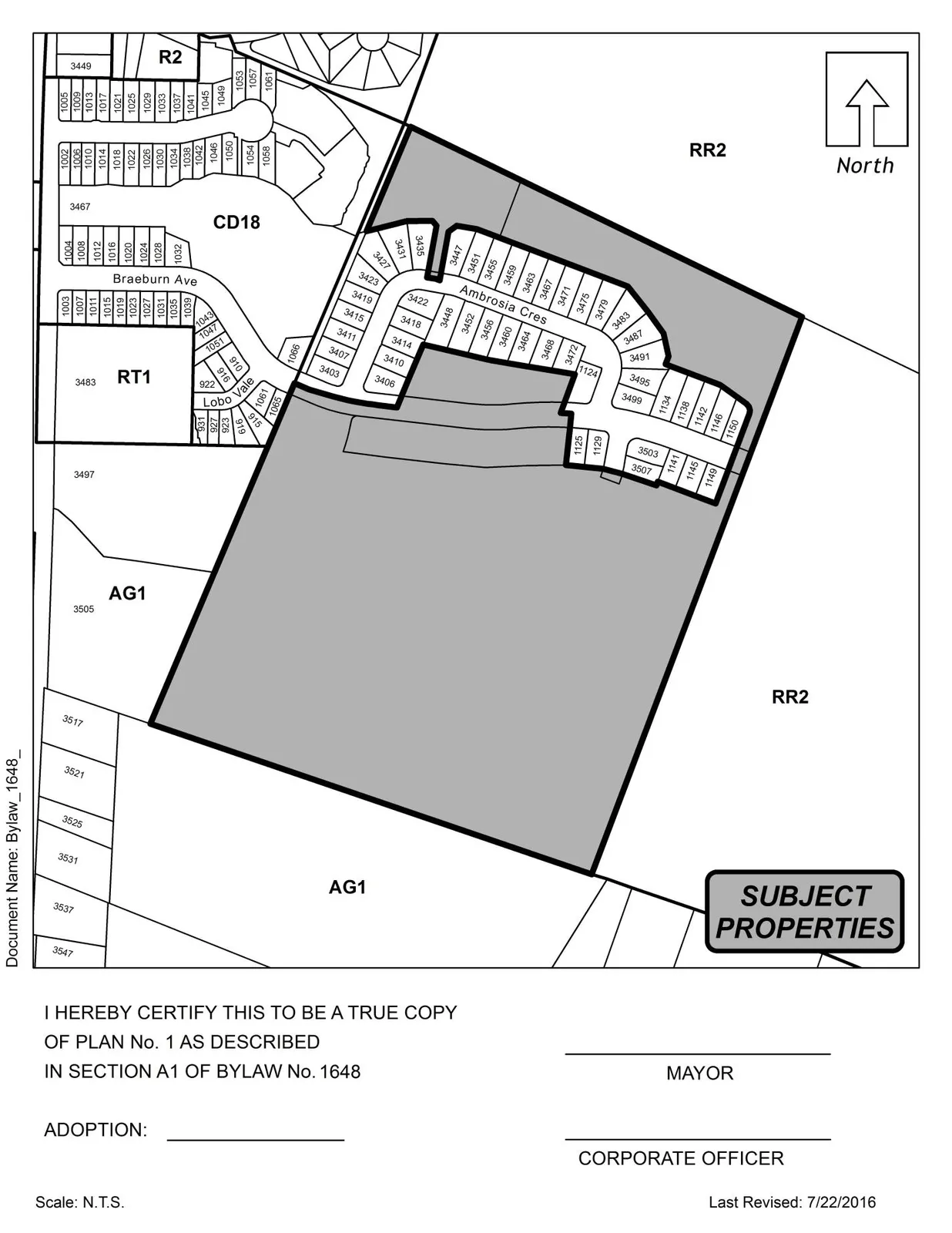
e) By amending the Schedule “Z” open space plan to include those lands within the CD15 Zone shown on the plan attached to this report as Appendix A;
f) By deleting the requirement to provide $300,000 to the General Amenity Reserve Fund;
g) Accept the applicant’s proposed open space plan;That the applicant provides, prior to Bylaw Adoption,: a. A Section 219 covenant modification to implement the revised open space plan (as accepted by Council) and the agricultural buffer plan; and
b. A fully executed purchase and sale agreement with regards to the 1.1 ha of land at 960 Latoria Rd (if accepted by Council).
CARRIED.
Subject: Bylaw No. 1648
COMMENTS
Bylaw No. 1648 includes all of the changes authorized by Council in item (1) of the resolution above.
The applicant has submitted the required Section 219 Covenant modification and Option to Purchase to fulfill item (2) to the Land Title Office, along with a letter of undertaking from his solicitor to attend to any deficiencies in the event any are noted by the LTO.
OPTIONS
That Council:
- Adopt Bylaw No. 1648; or
- Take no action at this time with respect to Bylaw No. 1648;
Submitted by:
Leah Stohmann, MCIP, RPP Deputy Director of Planning
Concurrence:
Matthew Baldwin, MCIP, RPP Director of Planning
Michelle Mahovlich, P.Eng, P.Geo, Director of Engineering
Brent Molnar, Manager of Land Development
Audrey Kryklywyj, Deputy Director of Finance
Jim Bowden, Chief Administrative Officer
:ls
BYLAW NO. 1648
A BYLAW TO AMEND BYLAW NO. 300, “LANGFORD ZONING BYLAW, 1999"
The Council of the City of Langford, in open meeting assembled, hereby enacts as follows:
A. Langford Zoning Bylaw No. 300, 1999 is amended as follows:
- By replacing the words “a minimum of 27 lots” in subsection 6.104.02(3) with “a minimum of 80 lots”;
- By replacing the words “a maximum of 27 lots” in subsection 6.104.02(4) with “a maximum of 18 lots”;
- By deleing subsection 6.104.03(3) and renumbering subsequent subsections accordingly;
- By replacing subsection 6.104.06 One-Family Dwellings (1)(b) with “within 1.5 m of any interior lot line”;
- By deleting subsections 6.104.06 Buffer Setbacks (1)(a), (b) and (c);
- By replacing Schedule Z of Zoning Bylaw No. 300 with Schedule A attached to and forming part of this Bylaw;
B. This Bylaw may be cited for all purposes as “Langford Zoning Bylaw, Amendment No. 460, (1067, 1099, 1124 & 1164 Braeburn Ave; 3439 Ambrosia Cres), 2016".
READ A FIRST TIME this 15th day of August, 2016.
PUBLIC HEARING held this 6th day of September, 2016.
READ A SECOND TIME this 6th day of September, 2016.
READ A THIRD TIME this 6th day of September, 2016.
ADOPTED this day of , 2016.
MAYOR
(Certified Correct)
CORPORATE OFFICER
BYLAW NO. 1653
A BYLAW TO EXEMPT CERTAIN LANDS AND IMPROVEMENTS WITHIN THE CITY OF LANGFORD FROM TAXATION FOR THE YEAR 2017
WHEREAS Council may exempt land and improvements from taxation under Section 224 of the Community Charter;
NOW THEREFORE the Council of the City of Langford, in open meeting assembled, hereby enacts as follows:
- The buildings and improvements together with certain lands surrounding the buildings and improvements and more particularly described as:
a) Roll No. 01-62-327-06159.000
Lot 7, Pl 6190, Section 79, Esquimalt District
Juan de Fuca Cadet Youth Society
948 Dunford Road
b) Roll No. 01-62-327-07522.001
Lot 10, Pl 10901, Section 111, Esquimalt District
Langford Fifty and Up Club
2637 Sunderland Road
c) Roll No. 01-62-327-06411.005
Section 84, Esquimalt District, All that portion of the Hollywood Road (renamed Hazelwood Road by Gazette notice dated February 22, 1956), as dedicated by Pl 1718 and extending northerly from the extension easterly of the south boundary of Block 2, Pl 1718, Section 84, Esquimalt District to the extension north-easterly of the north-west boundary of Lot A, Pl 13728
Metchosin Farmers’ Institute
1040 Marwood Avenue
d) Roll No. 01-62-327-06411.008
Lot 1, Pl EPP26925, Section 84 Esquimalt District, Section 90, 86 and 87 Metchosin District (PID #029-207-908)
Metchosin Farmers’ Institute
1040 Marwood Avenue
e) Roll No. 01-62-327-06439.250
Esquimalt District, LD 30 & 21 PT Sections 83, 84, 85, 86 Metchosin District & Sections 83 & 84 Esquimalt District except parcel M (DD15125) shown outlined in red on Pl 82 RW Part held under licence of occupation by the Metchosin Farmers’ Institute
Metchosin Farmers’ Institute
1040 Marwood Avenue
f) Roll No. 01-62-327-13906.060
Esquimalt District, Lot 1 of Pl 17393, Sections 79 Metchosin District, 83, 84 and 90, Esquimalt District (PID #003-908-968)
South Vancouver Island Rangers
3498 Luxton Road
g) Roll No. 01-62-327-04124.001
Lot 4, Pl 9088, Section 5, Esquimalt District
Trustees United Church of Canada (Gordon United Church)
929 Goldstream Avenue
h) Roll No. 01-62-327-04125.001
Lot 1, Pl 14459, Section 5, Esquimalt District
Gordon United Church of Canada
935 Goldstream Avenue
i) Roll No. 01-62-327-06299.010
Lot 1, Pl 15933, Section 88 & 89, Esquimalt District
Trustees – Lighthouse Christian Academy
1289 Parkdale Drive
j) Roll No. 01-62-327-04250.003
Lot A, Pl 28120, Esquimalt District
Grace Baptist Church of Victoria
2731 Matson Road
k) Roll No. 01-62-327-05647.010
Lot A, Pl 42956, Esquimalt District
Society of St. Vincent De Paul
2784 Claude Road
l) Roll No. 01-62-327-05790.021
Lot B, Pl VIP64037, Esquimalt District
West Shore Chamber of Commerce
2830 Aldwynd Road
m) Roll No. 01-62-327-05646.100
Lot 1, Pl VIP69262, Esquimalt District
Bishop of Victoria Corp
798 Goldstream Avenue
n) Roll No. 01-62-327-06694.030
Lot 1, Pl 44619, Esquimalt District
The Forge (formerly the Western Community Baptist Church)
2610-2612 Sooke Road
o) Roll No. 01-62-327-05709.202
Lot 2, Pl VIS6677, Section 72, Esquimalt District
Westwind Plaza (JV) Properties Ltd. (Goudy Library)
119-755 Goldstream Avenue
p) Roll No. 01-62-327-05709.203
Portion of Lot 3, Pl VIS6677, Section 72, Esquimalt District
Westwind Plaza (JV) Properties Ltd. (Goudy Library)
115-755 Goldstream Avenue
q) Roll No. 01-62-327-04188.140
Lot 4, Pl VIS4874, Section 5 Esquimalt District
Habitat for Humanity Victoria
849 Orono Avenue
r) Roll No. 01-62-327-05731.100
Lot 1, Pl VIP78559, Section 72, Esquimalt District
Royal Canadian Legion
761 Station Road
s) Roll No. 01-62-327-06385.006
Portion of Lot 1, Pl EPP38718, Section 86 and 87, Esquimalt District
Westhills Land Corp (Victoria Conservatory of Music)
210-1314 Dumont Avenue
t) Roll No. 01-62-327-05886.008
Lot 8, Pl VIS6662, Section 72, Esquimalt District
Victoria Association for Community Living
157-2745 Veterans Memorial Parkway
u) Roll No. 01-62-327-05886.144
Lot 144, Pl VIS6662, Section 72, Esquimalt District
Victoria Association for Community Living
P44-2745 Veterans Memorial Parkway
v) Roll No. 01-62-327-05886.145
Lot 145, Pl VIS6662, Section 72, Esquimalt District
Victoria Association for Community Living
P45-2745 Veterans Memorial Parkway
w) Roll No. 01-62-327-05886.146
Lot 146, Pl VIS6662, Section 72, Esquimalt District
Victoria Association for Community Living
P46-2745 Veterans Memorial Parkway
x) Roll No. 01-62-327-05886.147
Lot 147, Pl VIS6662, Section 72, Esquimalt District
Victoria Association for Community Living
P47-2745 Veterans Memorial Parkway
y) Roll No. 01-62-327-05886.148
Lot 148, Pl VIS6662, Section 72, Esquimalt District
Victoria Association for Community Living
P48-2745 Veterans Memorial Parkway
z) Roll No. 01-62-327-05764.000
Lot 23, Pl VIP7235, Section 72, Esquimalt District
Goldstream Masonic Hall
679 Goldstream Ave
aa) Roll No. 01-62-327-18809.000
Lot A, Pl VIP65123, Section 1,2,4 &5, Lot A, Pl VIP65129, Section 7980, 86 & 87, Esquimalt Land District, Sections 79, 80, 86 and 87, Lot A Plan VIP65130, Section 72, Esquimalt Land District, Except Plan VIP86164, Lot 2, Plan VIP45768, Section 73 Esquimalt Land District
Island Corridor Foundation
E&N Railway
Shall hereby be exempt from taxation for the year 2016.
- This bylaw may be cited for all purposes as “City of Langford Permissive Tax Exemption Bylaw No. 1653, 2016.”
READ A FIRST TIME this 19th day of September, 2016.
READ A SECOND TIME this 19th day of September, 2016.
READ A THIRD TIME this 19th day of September, 2016.
ADOPTED this … day of …., 2016.
MAYOR
(Certified Correct)
CORPORATE OFFICER
BYLAW NO. 1659
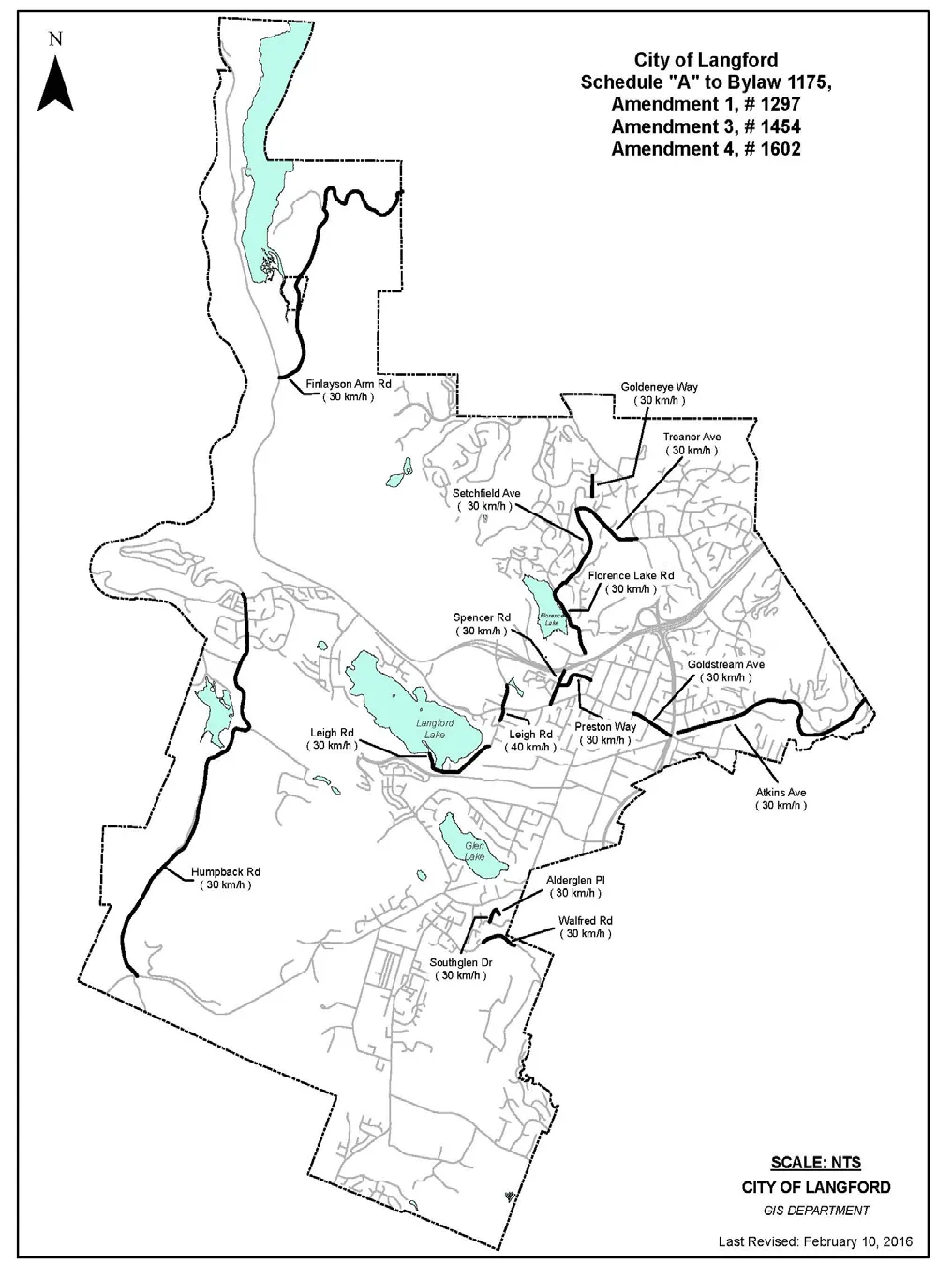
A BYLAW TO AMEND BYLAW NO. 1175 “A BYLAW TO REGULATE VEHICLULAR SPEED IN THE CITY OF LANGFORD”
The Council of the City of Langford, in open meeting assembled, enacts the following:
- Bylaw No. 1175 “A Bylaw to Regulate Vehicular Speed in the City of Langford” is amended as follows:
i. REMOVE FROM SECTION 1:
- Leigh Road (South of Dunford Avenue)
ii. ADD TO SECTION 1:
- Leigh Place
iii. REPLACE Schedule “A” with the attached Schedule “A”
- This Bylaw may be cited as “Langford Speed Limit Bylaw, Amendment No. 5, Bylaw No. 1659, 2016”.
READ A FIRST TIME this day of , 2016.
READ A SECOND TIME this day of, 2016.
READ A THIRD TIME this day of, 2016.
ADOPTED this day of , 2016.
MAYOR
(Certified Correct)
CORPORATE OFFICER
BYLAW NO. 1660
A BYLAW TO AMEND BYLAW NO. 300, “LANGFORD ZONING BYLAW, 1999"
The Council of the City of Langford, in open meeting assembled, hereby enacts as follows:
A. Langford Zoning Bylaw No. 300, 1999 is amended as follows:
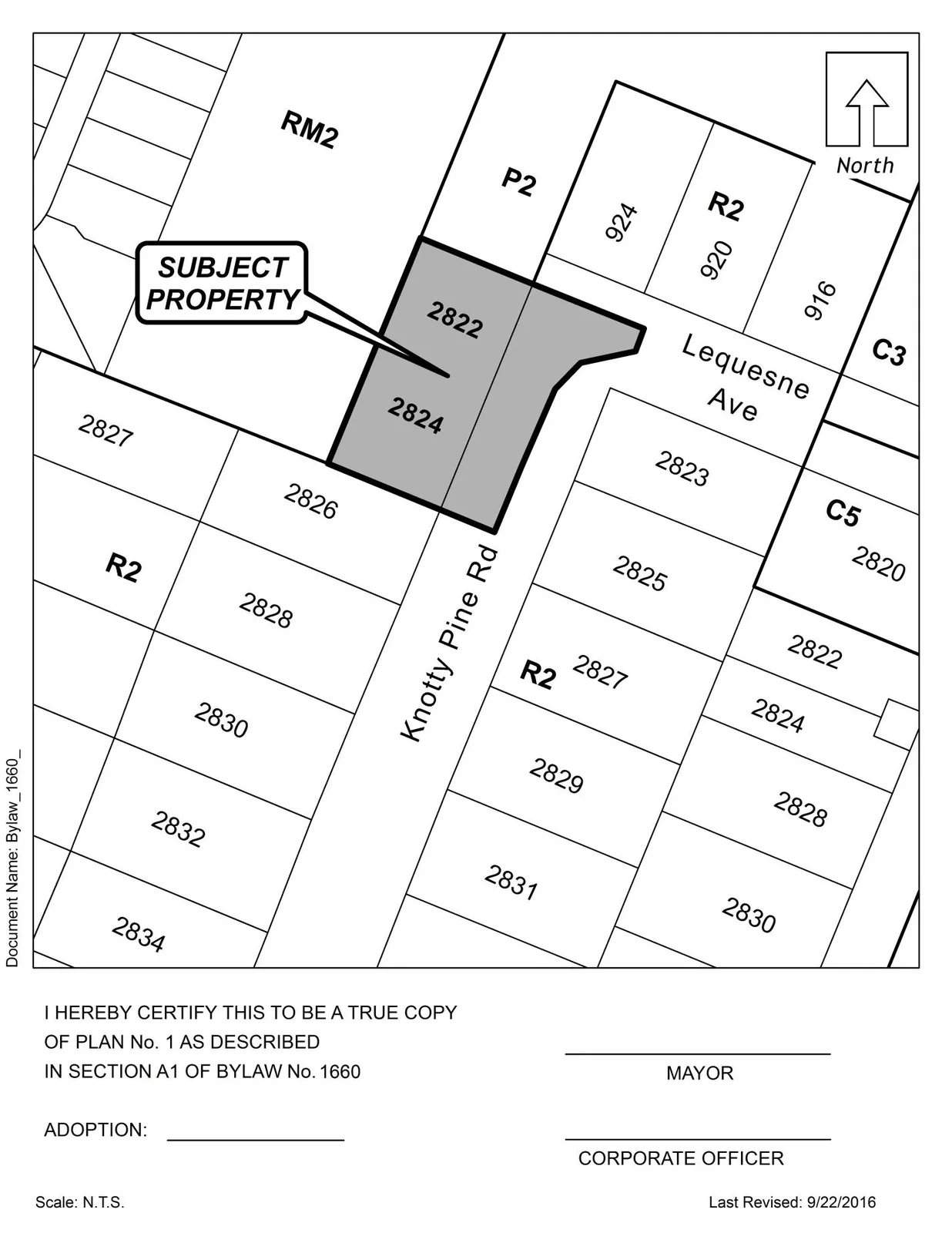
By deleting from the R2 (One- and Two-Family Residential) Zone and adding to the RM7A (Medium Density Apartment A) Zone the property legally described as LOT 10, SECTION 5, ESQUIMALT DISTRICT, PLAN 10444; PID No.: 000-050-041 (2822 and 2824 Knotty Pine Rd) in the portions as shown shaded on Plan No. 1 attached to and forming part of this Bylaw
By adding the following line to Table 1 of Schedule AD:
| Zone | Bylaw No. | Legal Description | Amenity Contributions Eligible for Reduction in Section 2 of Schedule AD (Column 5) |
|---|---|---|---|
| RM7A | 1660 | LOT 10, SECTION 5, ESQUIMALT DISTRICT, PLAN 10444 (2822 & 2824 Knotty Pine Rd) | a) $2,562 per townhouse unit towards the General Amenity Reserve Fund; b) $610 per townhouse unit towards the Affordable Housing Reserve Fund. |
| No |
B. This Bylaw may be cited for all purposes as “Langford Zoning Bylaw, Amendment No. 464, (2822 & 2824 Knotty Pine Rd), 2016".
READ A FIRST TIME this day of , 2016.
PUBLIC HEARING held this day of , 2016.
READ A SECOND TIME this day of , 2016.
READ A THIRD TIME this day of , 2016.
APPROVED BY THE MINISTRY OF TRANSPORTATION this day of , 2016.
ADOPTED this day of , 2016.
MAYOR
(Certified Correct)
CORPORATE OFFICER