DocumentsCorrespondenceSep 6, 2016Pages 152–155
Correspondence - Canadian Cancer Society: Endorsement for expanding smoke & vape-free outdoor public places
Letter from the Canadian Cancer Society requesting Council endorsement to expand smoke and vape-free outdoor public places.
Key facts
- Correspondence page: 152
- Subject: Endorsement for Expanding Scope of Smoke and Vape Free Outdoor Public Places
Correspondence - Canadian Cancer Society: Endorsement for expanding smoke & vape-free outdoor public places
August 12, 2016
His Worship, Mayor Young of Langford
2nd Floor, 877 Goldstream Avenue
Langford, BC V9B 2X8
Dear Mayor Young and Langford Council,
On behalf of the Canadian Cancer Society, BC and Yukon, we are writing to invite the City of Langford to endorse the Society's recommendation that the BC government expand the scope of BC's Tobacco and Vapour Products Control Act to prohibit use in outdoor public places province-wide. We recommend that the province prohibit smoking and vaping at patios, parks, playgrounds and beaches, and include guidelines for post-secondary campuses.
We know that many BC municipalities are in favour of amendments to provincial tobacco legislation, as evidenced by the 68 communities, such as yours, currently sheltered with municipal or regional district tobacco bylaws, along with Resolution B92, endorsed by UBCM in 2012. Presently, a report is underway to evaluate the successes, issues and costs associated with BC's tobacco bylaws.
Outside of your community's boundaries, more than 1 million British Columbians in 125 communities do not have bylaws that prohibit smoking in outdoor public places, and for those communities with bylaws, the level of protection varies. This patchwork contributes to tobacco-related health inequities; across the province, smoking rates in the various health service delivery areas vary from a low of 8.9% to a high of 33.6%. This exposure differential contributes to both health inequities and a larger provincial economic burden. In BC, the annual economic burden attributed to tobacco is $2 billion.
In addition to protecting citizens from second-hand smoke exposure, smoke and vape-free outdoor places support people who want to quit smoking and provide positive role modeling for children and youth. A comprehensive provincial policy would help change social norms about tobacco use and provide equitable protection from second-hand smoke and vapour. Effective tobacco control measures save lives, financial resources and are vital to protecting the integrity of BC's healthcare system.
The Society believes that preventing half of all cancers is within our grasp and together we can support the vision to stop cancer before it starts. We appreciate your commitment to your community's health, and ask that you send us your endorsement (found on the back side of this letter) to protect the health of all British Columbians by October 31, 2016.
Sincerely,
Megan Klitch
Tobacco Lead
Canadian Cancer Society, BC and Yukon
Jenny Byford
Advocacy Lead
Canadian Cancer Society, BC and Yukon
Megan Klitch
Canadian Cancer Society
1100 Alward Street
Prince George BC V2M 7B1
TF 1-800-811-566 F 250-563-0385
mklitch@bc.cancer.ca
Endorsement of Smoke and Vape-free Outdoor Public Places in BC
Smoke and vape-free outdoor public places legislation would prohibit smoking and vaping in BC's outdoor public places, including restaurant and bar patios, playgrounds, parks and beaches, with ministry guidelines legislated for post-secondary campuses. "Smoking" would include burning a cigarette or cigar, or burning any substance using a pipe, hookah pipe, lighted smoking device or electronic smoking device, with some exemptions for the ceremonial use of tobacco in relation to traditional aboriginal cultural activities.
Our community endorses a requirement in British Columbia for smoke and vape-free outdoor public places, as outlined above.
Or
E Our community endorses a requirement in British Columbia for smoke and vape-free outdoor public places, as outlined above, but with the following modifications (please list):
Name of Community:
Name of Mayor (or representative):
Title:
Signature:
Date:
Name, phone and email for community contact:
The names of communities that endorse this policy will be shared with the provincial government and may be used in communications with stakeholders and mass communications. Endorsement letters will be received by Megan Klitch, Tobacco Lead, Canadian Cancer Society, BC and Yukon Division, until October 31, 2016 via fax, email or mail.
takeaction.cancer.ca
Megan Klitch
Canadian Cancer Society
1100 Alward Street
Prince George BC V2M 7B1
TF 1-800-811-566 F 250-563-0385
mklitch@bc.cancer.ca
Rationale and Supporting Information
Positive role modeling
Tobacco use is started and established primarily during adolescence. Since most smokers start before the age of 18, it is important to model healthy behaviours. Youth who do not see adults smoking or vaping will be less likely to view these as normal social behaviors and, thereby, are less likely to start themselves.
Consistency can improve compliance
With universal provincial policy and broad awareness measures, BC residents and tourists will be more aware of smoking restrictions. Research tells us that when people understand what tobacco restrictions are in place and why they have been implemented, they are more likely to comply, and are also more likely to speak up, encouraging others to comply. Evaluations have found that the fear of compliance issues exceeds the actual number of compliance issues that occur.
Canadian precedent
The majority of Canadian provinces and territories ban smoking on bar and restaurant patios and a growing number have recently expanded restrictions to other public outdoor places. Ontario, for example, banned smoking on restaurant/bar patios, playgrounds and sports fields, effective January 1, 2015. Smoking behaviour and exposure to secondhand smoke decreased within the first year of implementation at all affected venues, and compliance was perceived to be moderate to high with variations observed by the type of outdoor venue.
Public Support
A 2013 Angus Reid poll conducted on behalf of the Canadian Cancer Society revealed the following support for smoke-free places policy by British Columbians:
- Bar and restaurant patios: 66% of adults and 79% of youth
- Children's playgrounds: 91% of adults and 96% of youth
- Parks and beaches: 66% of adults and 80% of youth
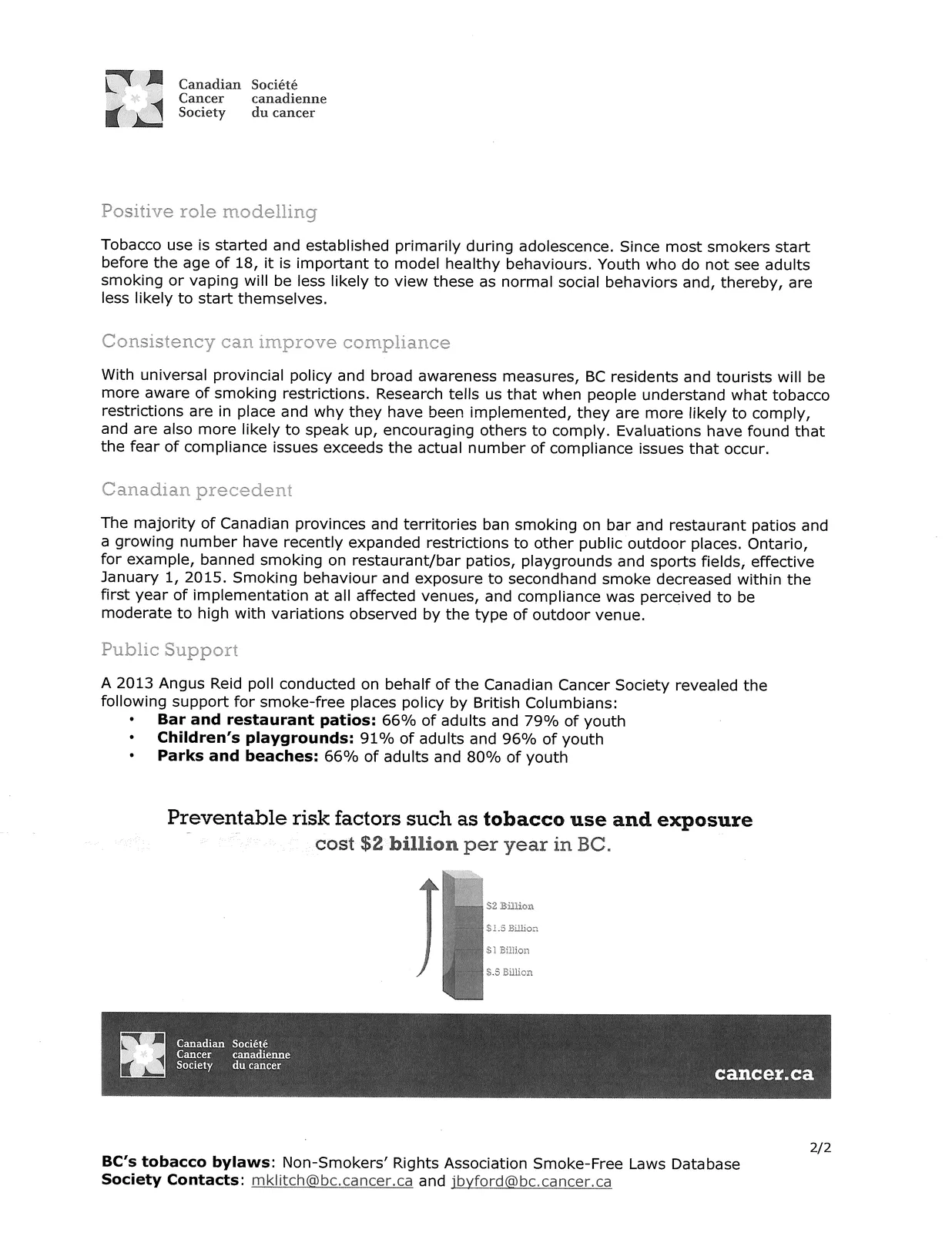
Preventable risk factors such as tobacco use and exposure cost $2 billion per year in BC.
BC's tobacco bylaws: Non-Smokers' Rights Association Smoke-Free Laws Database
Society Contacts: mklitch@bc.cancer.ca and jbyford@bc.cancer.ca
Recommended bylaws
Recommended bylaws prohibit smoking and vaping:
- on restaurant and bar patios
- on city-managed properties: parks, playgrounds, trails, plazas, beaches, playing fields, recreation facilities and venues
- within a buffer zone of 7.5 metres of the above mentioned, as well as the doors, windows and air intakes of public buildings
Key Facts
- Tobacco is a major health issue that needs the attention of political leaders.
- Almost 70 BC communities and three-quarters of BC's population are sheltered from tobacco modeling and exposure in outdoor public places. More than one million British Columbians remain unprotected.
- The Union of BC Municipalities supports smoke-free outdoor public places.
Protection from second-hand smoke
Secondhand smoke is extremely toxic. Studies of particulate matter have shown that in an outdoor setting, second-hand smoke can be as concentrated as in an indoor setting. Children experience greater impacts from second-hand smoke due to their developing immune and respiratory systems. Every year, more than 800 Canadians who don't smoke die from second-hand smoke exposure.
Increase motivation to quit smoking
People who smoke tend to respond to restrictions by cutting back or quitting. The majority (85.7%) of British Columbians do not smoke. Of the minority who do smoke, two-thirds want to quit and are looking for tools to help them. Several studies have shown that when smoking bans have been implemented, smokers have chosen to quit or cut back and that smoke-free patio regulations may help former smokers avoid relapse.
Equitable access to an air for all British Columbians
To date, 68 communities in BC are sheltered by tobacco bylaws with stronger protections than BC's Tobacco Control Act. Approximately three quarters of these communities fall within the Lower Mainland and Southern Vancouver Island. Outside of these boundaries, more than 1 million British Columbians in 125 communities, many of which are rural and remote, remain unprotected from tobacco related exposure and role-modelling.
Updated August 2016
takeaction.cancer.ca