DocumentsOtherMay 16, 2016Pages 8–11
NOTICE OF PUBLIC HEARING – Bylaw No. 1608 (advertisements and public notices)
Public notices/advertisements placed announcing the Public Hearing for Bylaw No. 1608 including meeting date, time, location and file details.
Key facts
- Meeting Date: Monday, 16 May 2016 at 7:00 pm
- Location: City of Langford Council Chambers, Third Floor, 877 Goldstream Avenue
- File: Z15-0026; Bylaw Number: 1608
- Availability: copies viewable at Langford City Hall between May 3 and May 16, 2016
NOTICE OF PUBLIC HEARING – Bylaw No. 1608 (advertisements and public notices)
Meeting Details
- Meeting Date: Monday, 16 May 2016
- Meeting Time: 7 pm
- Meeting Place: City Hall Council Chambers, Third Floor, 877 Goldstream Avenue
Subject Property
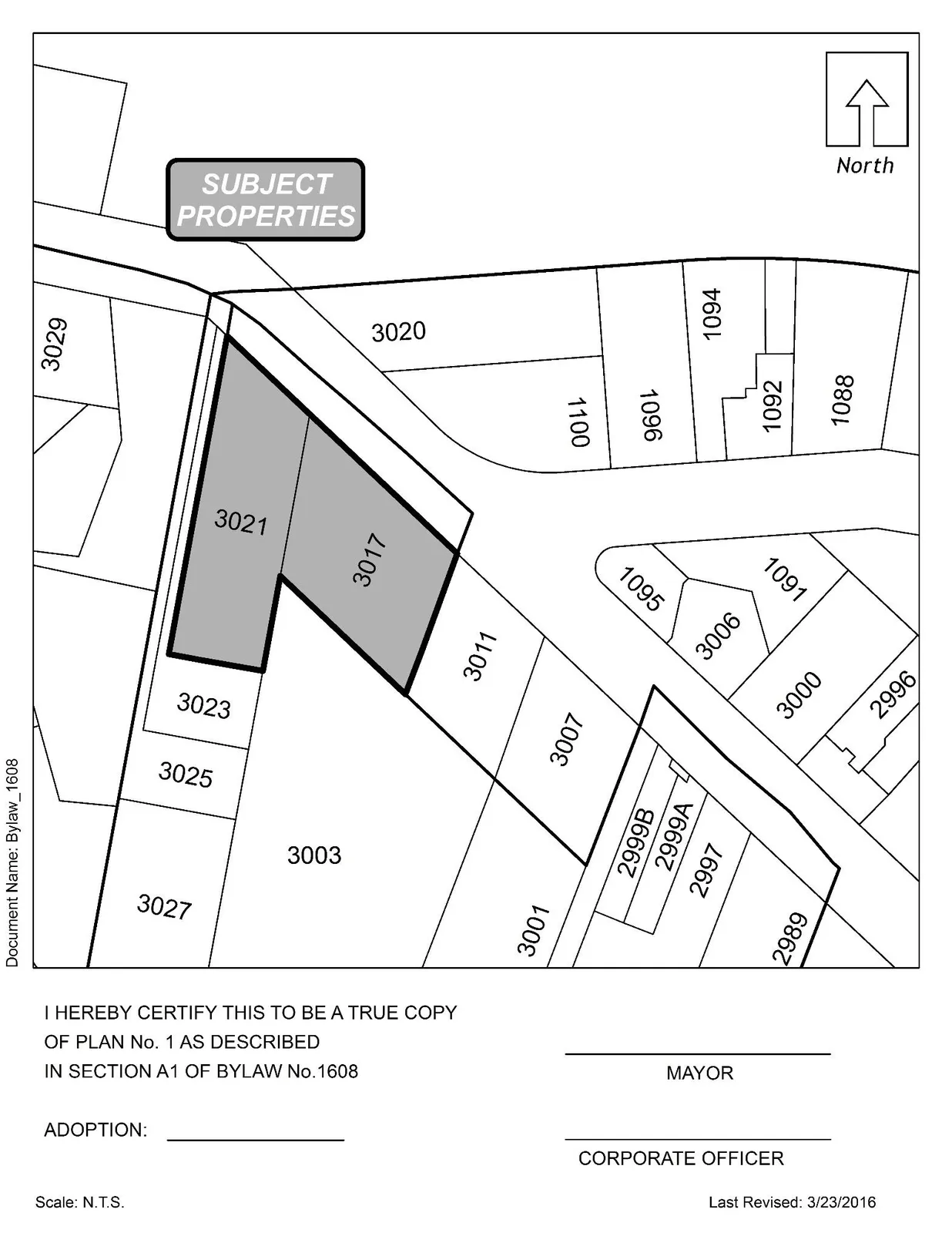
- 3017 and 3021 Glen Lake Rd
File
- Z15-0026
Bylaw Number
- 1608
Official Community Plan
| Current | Proposed |
|---|---|
| Hillside or Shoreline | No Change |
Zoning
| Current | Proposed |
|---|---|
| PIB (Neighbourhood Institutional) | Amended PIB (Neighbourhood Institutional) |
Proposal (summary)
To allow offices to occur as an accessory use, instead of as a principal use.
Purpose (detailed)
The purpose of Bylaw No. 1608 is to amend the City of Langford Zoning Bylaw No. 300 by amending General Regulations relating to Home Occupation, permitted projections into required setbacks, and maximum fence height, by amending the text of the P1B Zone to change the permitted Office use to accessory only, by amending the text of the RS4 Zone to allow secondary suites on lots greater than or equal to 400 m2, and by differentiating between cardlock gasoline stations and retail gasoline service stations.
Applicant
City of Langford
Location (detailed)
The land that is the subject of Bylaw No. 1608 are lands within Zones that permit a Residential Use, lands within the P1B Zone (3017 and 3021 Glen Lake Rd as shown shaded on the plan), lands within the RS4 Zone and lands within Zones that permit gasoline service stations.
COPIES of the complete proposed Bylaw and other material that the Council may consider in relation to the Bylaw may be viewed from 8:30 am to 4:30 pm, Monday to Friday (holidays excluded), from Tuesday, 3 May 2016 to Monday, 16 May 2016, inclusive, at Langford City Hall, 2nd Floor, 877 Goldstream Avenue, Langford, BC, V9B 2X8. Please contact Leah Stohmann in the Planning Department at 250-478-7882 with any questions on this Bylaw.
Jim Bowden
Administrator
2016-05-03
News Articles (excerpts from Goldstream Gazette)
Casino redevelopment would be major economic driver
"We've been looking at a fairly significant redevelopment plan," he said. With a price tag of upwards of $20 million, he added, they will not be pursuing those plans until they know exactly what BCLC has proposed. "If there's going to be a fundamental change to the marketplace, we need to know exactly what that is."
In the meantime, he said, "it's business as usual for us."
Screech called the potential to lose the redevelopment "a huge loss, not just for the West Shore but for the region." The loss of additional jobs and spin-off business that would be created by the redevelopment would also be a huge blow, he added.
When View Royal Casino became the only facility of its kind in the region, there was an expectation that it would remain that way, the mayor said. He noted it was established on the West Shore as a way to attract more residents and tourists out of the downtown core. This was meant as a way to help diversify the locations of the region's tourism industries. A move to locate a second casino closer to the downtown core would undermine that, he said.
While details from BCLC's market assessment are confidential and contain competitive information, the corporation plans to meet with Screech and Langford Mayor Stew Young this Friday (May 6) to give them more in-depth details.
As for a second facility's effect on View Royal Casino, Keeling said it's uncertain what that could be without knowing more about the size of the new facility, its location, the gaming infrastructure it might offer, and other details. "We believe it would have some type of impact."
The BCLC recently announced it had concluded the first phase of investigation to determine a potential host community for a new gaming facility. The District of Saanich and City of Victoria will continue on to the next phase of this evaluation. Any sites being considered must be able to accommodate a gaming floor in the range of 15,000 to 30,000 square feet, with a minimum of 400 parking stalls.
Angela Koulyras, a BCLC spokesperson, said they requested additional information from the two municipalities, and given them a deadline of June 23. BCLC will then spend the summer reviewing the submissions.
"There's no timeline with this, necessarily," Koulyras said. Once BCLC decides on a host municipality, a formal proposal will be developed to be brought before that council. It would include information on the size and scope of the facility. She added, "the community ultimately has the final say"
Expressions of interest were also received from Esquimalt First Nation, Songhees First Nations and the Township of Esquimalt. However, these groups were eliminated from the running during the first phase, where submissions were scored on criteria related to community support and geographic, economic and demographic considerations.
Screech noted a second casino would significantly reduce municipal revenues. A letter from Screech due to be heard by Langford on Monday stated that in 2015 View Royal Casino revenues were shared roughly as follows: View Royal, $1.838 million; Langford, $1.234 million; Colwood and Esquimalt, $317,000 each; Sooke $242,000; Metchosin, $93,690 and Highlands $41,000.
Koulyras said their assessment "indicated there is a market not being served by the View Royal Casino." She noted a second facility would generate an additional $30 to $45 million in revenue annually.
"There are two distinct markets," she said of Greater Victoria, noting one is the West Shore area with the other being Victoria and Saanich. "We know the View Royal Casino has been very successful."
She added the West Shore has seen record population growth in recent years and this growing player base, right in the View Royal Casino's backyard, is waiting to be captured. She gave as an example Kamloops, which has two successful gaming facilities serving a population roughly a quarter the size of Greater Victoria.
A number of factors, including location, population trends, tourism and consumer behaviour, were used to assess the need for a second location.
Two types of gaming facilities (as described by B.C. Lottery Corporation)
- The first is a community gaming centre, which would see a combination of bingo, slot machines, traditional lottery products, a restaurant, lounge, tele-theatre and a small stage for live entertainment performances.
- The second option would be a full-service gambling facility with slot machines and table games. This option could also include additional amenities such as restaurants, lounges, theatres, a conference centre, hotel, spa and a stage area for live entertainment.
Storytelling event also a fundraiser
To keep those messages in the light and help reduce the stigma and shame around mental illness in the community, Carlie has organized Remembering Cliff Kilduff. It's an afternoon of spoken word poetry and storytelling, with music performed by Terry Brennan, Daniel Oliver Francis and Rude Beauty.
The event is also a fundraiser, with all proceeds to be split between the Sooke School District and NEED2: Suicide education, prevention and support.
"You don't have to have known Cliff to come. This is a conversation for anybody who has had depression or lived with it, or knows someone who was touched by suicide," Carlie said.
She followed in the footsteps of her uncle and went into teaching in the fall of 2003. In December of that same year he was gone. Carlie went on to teach 10 years, at Edward Milne secondary in Sooke and John Stubbs elementary.
The event happens at the Isabelle Reader Theatre on May 7 — two days after Cliff's birthday — and remembers the man whose name adorns the gym at Happy Valley elementary.
"My greater mission is to continue this discussion, but to (also) really promote that people understand how valuable they are," Carlie said.
Tickets are available at the door at the Isabelle Reader Theatre at Spencer middle school for $10 per person, on May 7 from 3 to 5 p.m.
Metchosin house concert on tap for Friday evening
Shauna Janz and Martin Matychuk bring the house down this Friday (May 6) at the Metchosin Community House.
The house concert features their indie-folk sounds, with Janz on guitar and vocals and Matychuk on cello. The performance gets underway at 7 p.m. and the admission cost is a suggested donation of between $7 to $12. Everyone is welcome.
Metchosin Community House is at 4430 Happy Valley Rd.
Opinion / Special to the Gazette
Local scientists question federal sewage regulations
Considerable attention has been paid recently to the numerical values assigned by the federal government to the Macaulay Point and Clover Point wastewater outfalls. The scores for these two locations are 126 and 112, respectively, considerably above 70 and so leading to designation as high risk and requiring secondary treatment by Dec. 31, 2020.
A score between 50 and 70 is allegedly medium risk, with a treatment deadline of Dec. 31, 2030. Less than 50 qualifies the discharge as low risk, and comes with a 2040 deadline.
We suggest the methodology and resulting scores are inappropriate and misleading.
For both outfalls, 25 points are assigned because of the discharge volume and five because the discharge is into open marine waters. For Macaulay, 96 points come from the combined carbonaceous biological oxygen demand (CBOD) of the wastewater and its suspended solids (SS). For Clover, the number is 82.
Assigning points to the daily outfall volume, without comparison to anything else, makes no sense. Characteristics of the receiving environment should be taken into account. For Victoria, one could compare the discharges with the much larger tidal and estuarine flows in the Salish Sea. The combined outfall flows are approximately one part in 50,000 of the average outflow through Juan de Fuca Strait into the North Pacific.
It's difficult to see the relevance of this very small fraction. Furthermore, the discharge is over 99 per cent water that is just making its way to the sea. So let's knock off the 25 points. It's not the volume of the wastewater that matters, but its contents and environmental impact.
With regard to the contents, the federal regulations focus on CBOD and SS values. CBOD is an index of the amount of dissolved oxygen required for oxidation of the organic matter in the effluent. High CBOD may result in oxygen depletion and dead zones in some receiving environments. There are no signs of oxygen deficiency resulting from the CRD outfall effluent, due to the strong flows and vigorous mixing of the receiving environment, so we can surely knock off any points associated with the CBOD.
This amounts to 44 points at Macaulay, bringing the total score down to 57 and "medium risk." The score for the Clover Point outfall by these arguments is 49.
We could also argue for a reduction of the SS number. Suspended solids can be a proxy for contaminants that get attached to the particles, but this is a very unfocused way of regulating them. The federal regulations do not address specific individual contaminants such as metals and organic compounds. Detailed analysis of these by CRD scientists and others shows that their effect is minor.
In particular, the excellent source control programs introduced by the CRD and followed by many public-spirited businesses remove many contaminants before they can enter the waste stream. The lack of major industrial activity locally also means that our wastewater presents less of a problem than that in many other places. We could easily argue for a halving of the SS score of 52 for Macaulay, bringing the total down to 31, well into the "low risk" zone. Clover would be lower still at 27.
Thus, even adopting the federal regulations but with site-specific scoring, we could argue for a low risk classification. But really the above discussion just shows how inappropriate the federal approach is.
Everything should be discussed in terms of the site-specific effects on the receiving environment, not some vague hope that potential wastewater effects will be eliminated with largely arbitrary requirements based on end-of-pipe discharge criteria.
Criticisms of the draft regulations by marine scientists at the local DFO Institute of Ocean Science were ignored. The CRD's own scientists also wrote on two occasions to comment on the lack of site-specific assessments in the draft regulations. While the CRD's scientists conduct excellent monitoring programs around the outfalls, publish comprehensive reports, and can respond to specific enquiries, the CRD is not proactive in correcting the large amount of misinformation that is propagated in the media.
Overall, it's mind-boggling that a billion-dollar project continues to be justified on the basis of the inappropriate and easily challenged federal regulations. It is sad that local officials pursue land-based sewage treatment with such meekness and apparent enthusiasm, without at least calling for a moratorium until real or potential problems have been quantified. The tens of millions of dollars that have apparently already been squandered could have been devoted to projects that really would lead to clarification of potential issues and better marine environmental protection.
Throwing more money at land-based treatment without any clear expectation of benefits is tragic.
Chris Garrett and Jack Littlepage are former UVic professors of ocean physics and biological oceanography, respectively. They were featured in a March 25 story in our Sewage in the CRD series.
Sangster Elementary School's PAC — Thank You
Staff and students would like to say THANK YOU to all of the businesses and individuals who generously donated to our Annual Spring Fair and Silent Auction.
Particular thanks to the generosity of The Royal Bank, The Victoria Grizzlies, Colwood Fire Department, Girl Guides and Boy Scouts of Canada.
Thanks to our donators:
- Bear Mountain
- Kal Tire
- Elizabeth Hardy RMT
- White Spot
- Great Canadian Oil Change
- Langford City Centre Park
- Superstore
- Simply Gifted
- Cloth Castle
- Glow in the Dark mini golf
- Colwood House of Nutrition Colleen Morton
- Darcy's Pub
- The Market
- Front Runners
- Staples
- Cooks Day Off
- Island Pet Source
- Purdy's
- Cinecenta
- Brown's Social Club
- Thrifty's
- Booster Juice
- My Chosen Cafe
- Winners/Home Sense
- Lisa Koop Photography
- West Shore Parks Rec
- Western Foods
- Vicki Waters Jazzercise
- Sante Spa
- Harbour Cats Baseball
- Rejuvinations
- Breakwater photography
- Canadian Tire
Document Images
(2)