DocumentsOtherSep 21, 2026Pages 1–33
Engagement Summary — City of Langford Amenity Cost Charge, Inclusionary Zoning, and Housing Strategy
Engagement summary report describing public survey and external interest-holder feedback on Langford’s Housing Strategy and proposed Inclusionary Zoning and Amenity Cost Charge bylaws. It presents survey results, recurring themes, and workshop feedback on housing needs, affordability, development, and community amenities.
Key facts
- Dated June 5, 2026
- Engagement took place in April 2026
- Public feedback survey ran April 10–May 3, 2026
- Langford has a projected need for 17,000 new housing units by 2044
Engagement Summary
June 5, 2026
City of Langford Amenity Cost Charge, Inclusionary Zoning, and Housing Strategy
Table of Contents
- Introduction
- Project Background
- Engagement Purpose & Objectives
- What We Did
- Public Feedback Survey
- External Interest-Holder Workshops
- Who We Heard From
- Public Feedback Survey
- External Interest-Holder Workshops
- What We Heard
- Engagement Results at a Glance
- Public Feedback Survey Results
- External Interest-Holder Workshops
- Appendix A
- Interest-Holder Workshop Breakout Room Questions
Introduction
Project Background
Over the last two decades, Langford has been a leader in developing innovative housing policies and programs that have resulted in the delivery of affordable home ownership and rental units. Despite this success, housing is still needed across the housing continuum to meet local and regional demand - Langford has a projected need for 17,000 new housing units by 2044. The City’s 2020 Housing Needs Assessment also shows many households are in core need¹, particularly renter households, single parent households, Indigenous households, and newcomers.
The City is working on two major initiatives to help deliver the housing and community amenities, such as public spaces and services, that make our city livable and inclusive. These initiatives include:
- Langford’s first-ever Housing Strategy; and
- New bylaws to support the delivery of affordable housing and community amenities.
These initiatives align with OCP objectives for housing and complete communities, and will help ensure that housing and community amenities keep pace with growth.
Engagement Purpose & Objectives
An Engagement Strategy was drafted at the outset of these projects to identify objectives, audiences, and engagement methods, and has informed all engagement activities undertaken to date.
In support of developing a Housing Strategy and IZ and ACC Bylaws for Langford, the purpose of engagement is to:
- Understand existing systems and municipal-level barriers to a range of housing needs;
- Build or support existing or new relationships in the housing sector;
- Gain local insights and knowledge about building and operating housing in Langford; and
- Seek public and interest-holder feedback on the direction of the Housing Strategy and the implementation of Inclusionary Zoning/Amenity Charge Contribution Bylaws.
¹ Core housing need occurs when people are living in housing that is not affordable, adequate or suitable and would have to spend 30% or more of their total before-tax income to pay the median rent of alternative local housing that is acceptable.
Insights gathered through engagement make up one of several important streams of information that will be considered alongside technical analysis and policy review to inform the development of the best possible Housing Strategy and bylaws.
What We Did
Engagement for the Housing Strategy and the IZ/ACC bylaws occurred in April 2026 and consisted of two streams: a Public Feedback Survey and External Interest-Holder Workshops.
Public Feedback Survey
Engagement Period: April 10 2026 - May 3 2026
The Public Feedback Survey was available on the City’s Let’s Chat Langford webpage with the purpose of gaining public opinions and insights on:
- Priorities for new housing;
- The types of housing people need most (for example, apartments, larger family homes, seniors’ housing, or affordable rental housing);
- Which people or groups don’t have enough good housing options right now; and
- Which community amenities are the most important to provide as the community grows.
The survey included three open-ended questions and six close-ended questions, and included questions on both the Housing Strategy and the development of IZ and ACC bylaws. The survey concluded with seven demographic questions on housing tenure, income, neighbourhood, mode of transportation, and identity for the purpose of understanding the audience that responded to the survey and their background.
External Interest-Holder Workshops
The purpose of these workshops was to engage with external interest holders that deliver, operate, or advocate for housing in Langford. External interest holders consisted of two groups: 1) developers, builders, and real estate professionals; and 2) non-profit developers, operators and advocates.
In April 2026, a separate workshop was held online for each group. Each workshop was 2 hours long and followed the same format:
- Welcome and introductions
- Project Background
- Existing and proposed approaches to Housing Strategy and Bylaws
- Breakout Sessions - Now, Wow, How
- Session A: Developing a Housing Strategy for Langford
- Session B: Inclusionary Zoning and Amenity Cost Charge Bylaws
Separate breakout sessions were held for discussion on the Housing Strategy and IZ and ACC bylaws (Session A and Session B). In each breakout session, participants were led through questions on the “Now” (current needs and challenges), the “Wow” (hopes for the future) and the “How” (how do we get from ‘now’ to ‘wow’) of housing in Langford. Break-out Session questions can be found in Appendix A.
Who We Heard From
Public Feedback Survey
Housing Tenure
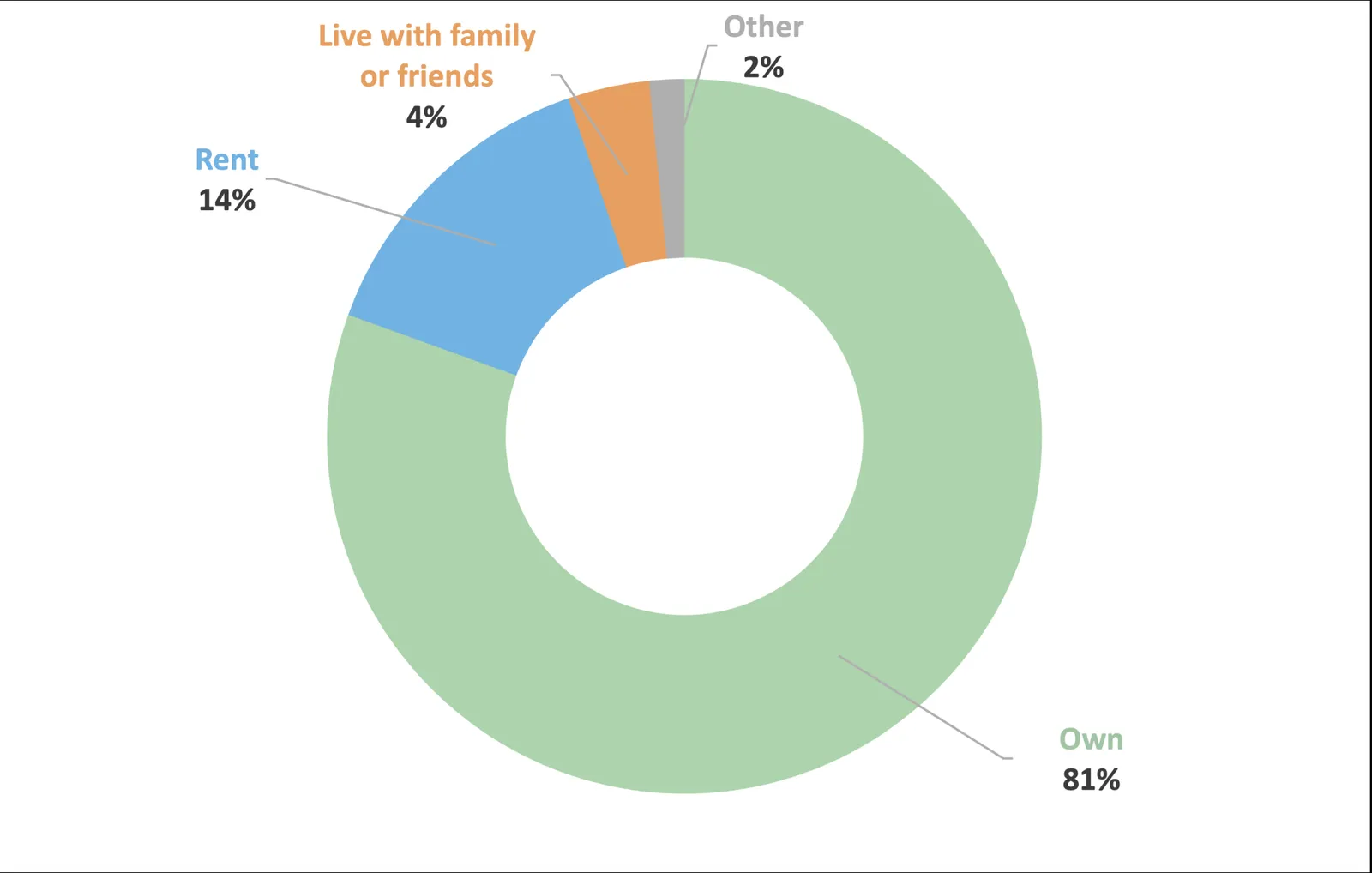
The majority of survey respondents (81%) own their home. 14% of survey respondents are renters, and 4% live with family or friends. Other respondents (2%) own their home but lease the land, or live in co-operative housing. While the 2021 Census² reports more owners (65%) than renters (35%) in Langford, owners are still over-represented in the results of this survey.
Neighbourhoods
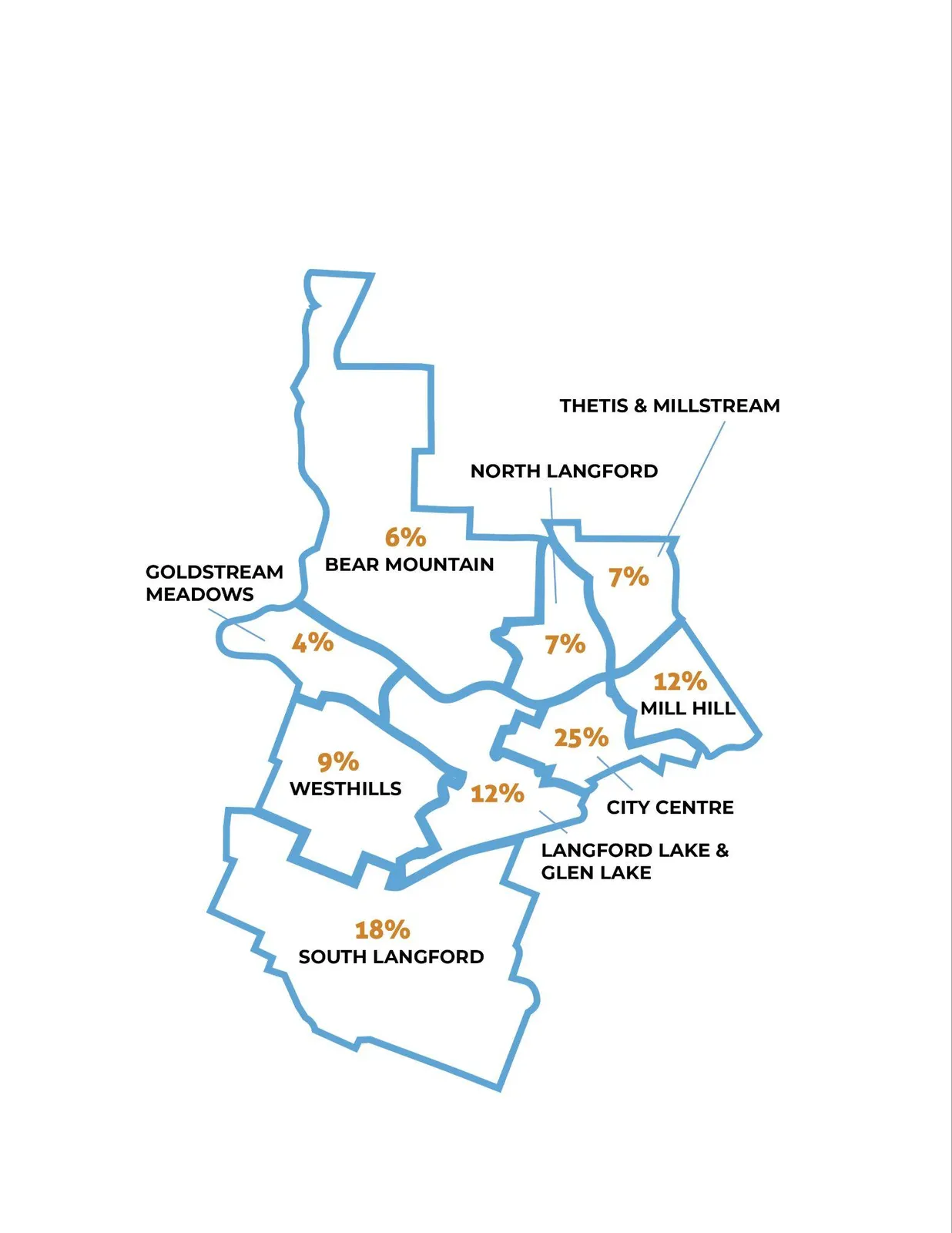
The highest number of survey respondents (25%) live in the City Centre neighbourhood. A moderately high percentage (18%) live in South Langford, Langford Lake & Glen Lake (12%), and Mill Hill (12%) neighbourhoods. The smallest percentage of respondents live in the Westhills (9%), North Langford (7%), Thetis & Millstream (7%), Bear Mountain (6%), and Goldstream Meadows (4%) neighbourhoods.
² Statistics Canada. 2023. (table). Census Profile. 2021 Census of Population. Statistics Canada Catalogue no. 98-316-X2021001. Ottawa. Released November 15, 2023. https://www12.statcan.gc.ca/census-recensement/2021/dp-pd/prof/index.cfm?Lang=E (accessed May 14, 2026).
Age Groups
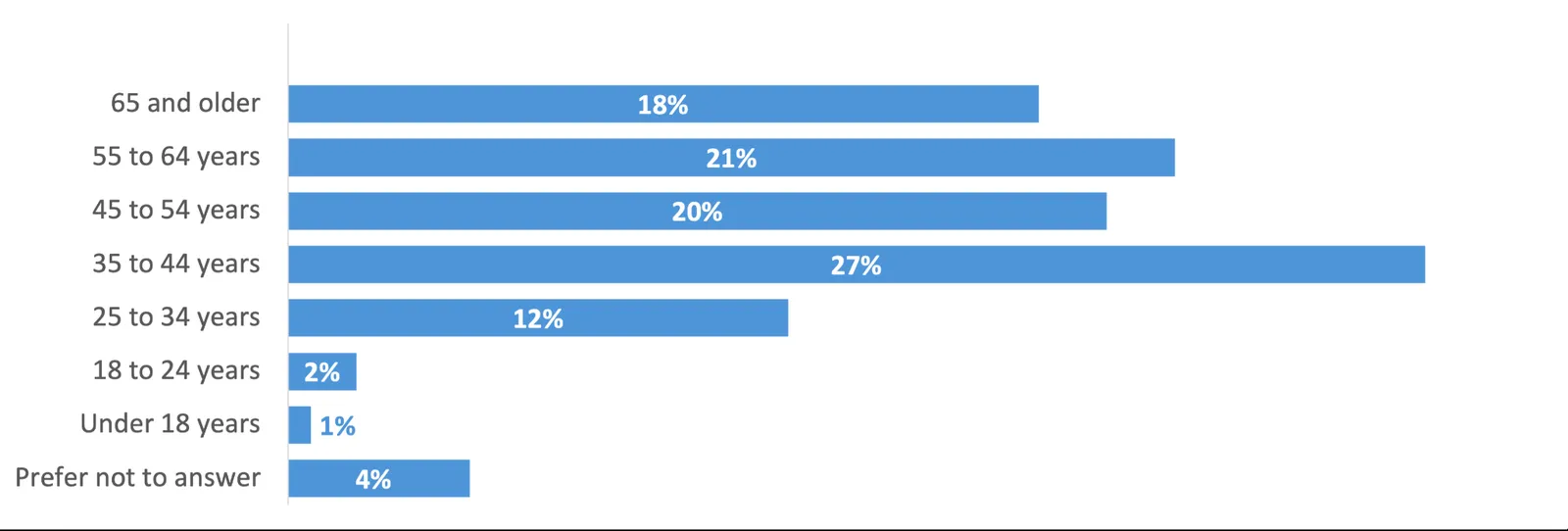
The vast majority of survey respondents (86%) are over the age of 35 with 39% being over the age of 55. A smaller percentage of respondents (15%) are under the age of 35. 4% of respondents preferred not to disclose their age.
Household Income
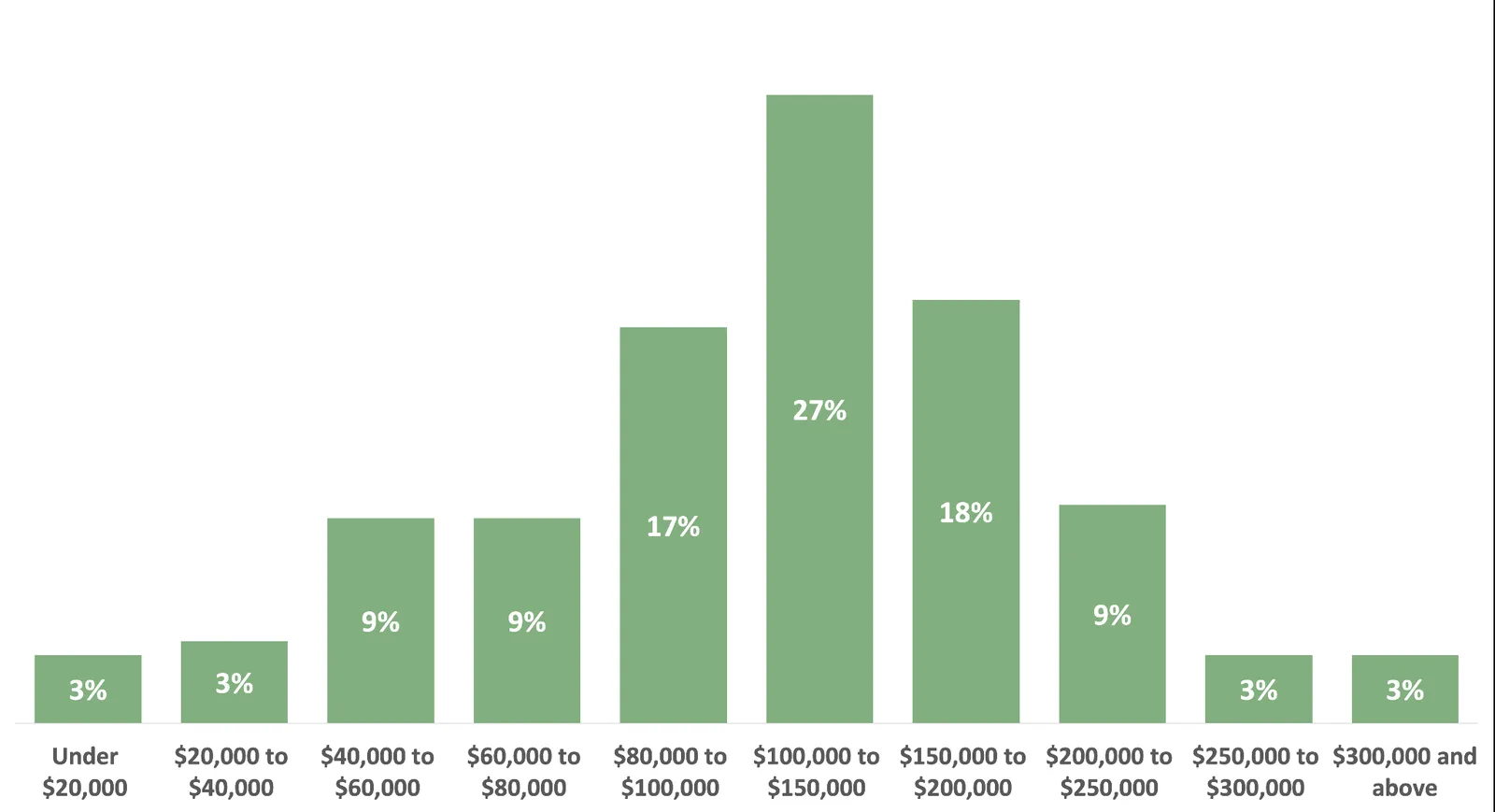
The majority of survey respondents (60%) have an annual before-tax total household income of over $100,000, and 40% of respondents have an annual household income of less than $100,000. 15% of respondents have an annual household income of less than $60,000.
External Interest-Holder Workshops
A wide variety of local developers, builders, real estate professionals, non-profit, local government, and advocacy groups were invited to participate in the virtual interest-holder workshops.
What We Heard
This section summarizes what we heard from respondents who took the Public Feedback Survey and from attendees at external interest-holder workshops.
Engagement Results at a Glance
Several themes were repeatedly heard from public and community interest-holder comments. A summary of these common themes, and direct quotes from engagement, are described below:
Family-Friendly Housing
“There seems to be lots of rentals lately, but very few that are both affordable and suitable for a family (3 bedrooms+) - this is a big problem and in my mind the most urgent housing one.” - Public Feedback Survey Respondent
While Langford has delivered a lot of new housing, we frequently heard about the need for more affordable, family-friendly housing with 3 or more bedrooms. Family-friendly housing with storage, private outdoor space, adequate parking, and easy-access to shops and services was also frequently mentioned.
Parks & Greenspace
“With the development of new housing, neighbourhoods (regardless of average household income and housing density) still require amenities like safe parks, greenspace, canopy, and walkable/bikeable routes.” - Public Feedback Survey Respondent
We frequently heard how much Langford residents value easy-access to quality outdoor spaces in the form of parks, trails, wooded-areas, and community gardens.
Complete Communities
"The focus is often on providing the 'unit' of housing rather than 'home' – rather than creating a home in Langford for them, and that involves their community, their building, and where they live." - Interest-Holder Workshop Participant
While we heard that new housing development is appreciated and necessary, we also heard that complete communities with walkable streets, cycling infrastructure, and easy-access to shops, services, and amenities are highly desired.
Intergovernmental Collaboration
“[Affordable housing]... needs to be a collaborative effort from all levels of government, developers, and supported by non-profit organizations.” - Public Feedback Survey Respondent
Both survey respondents and interest-holder workshop attendees recognize that building affordable housing is a challenging task in the current real estate market. Their reflections highlight the importance of a collaborative, synchronized effort between multiple levels of government and non-profit organizations towards developing affordable housing development.
Public Feedback Survey Results
Housing Affordability
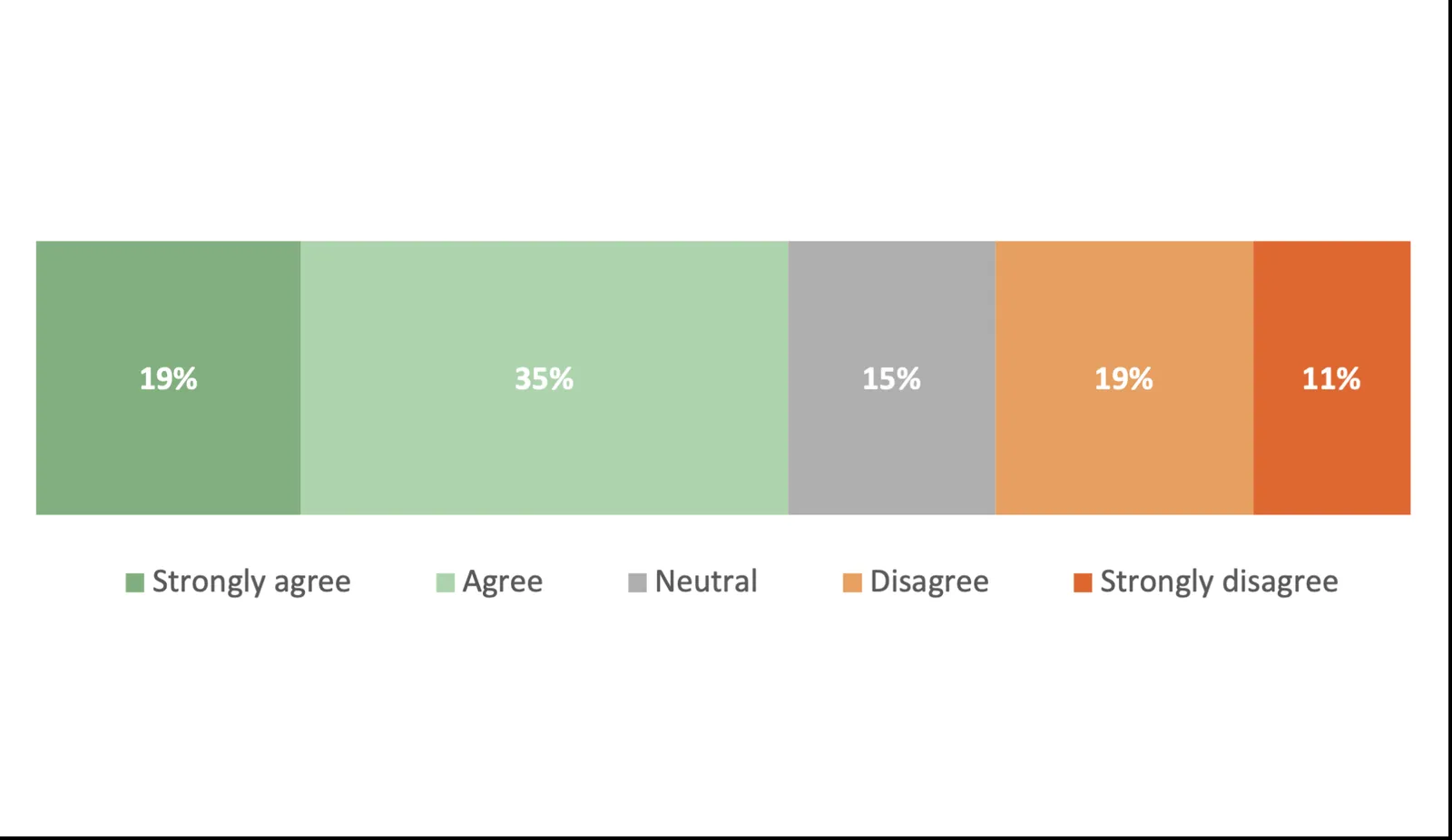
Q1. Housing is generally considered affordable if it costs less than 30% of your household income.
“When I consider all of my expenses, my housing is generally affordable to me.”
To what extent do you agree with this statement?
The majority of respondents (54%) strongly agree or agree that their housing is generally affordable to them. 30% of respondents disagree or strongly disagree that their housing is generally affordable to them, and 15% are neutral.
Q2. Approximately how much of your monthly income is spent on housing costs?
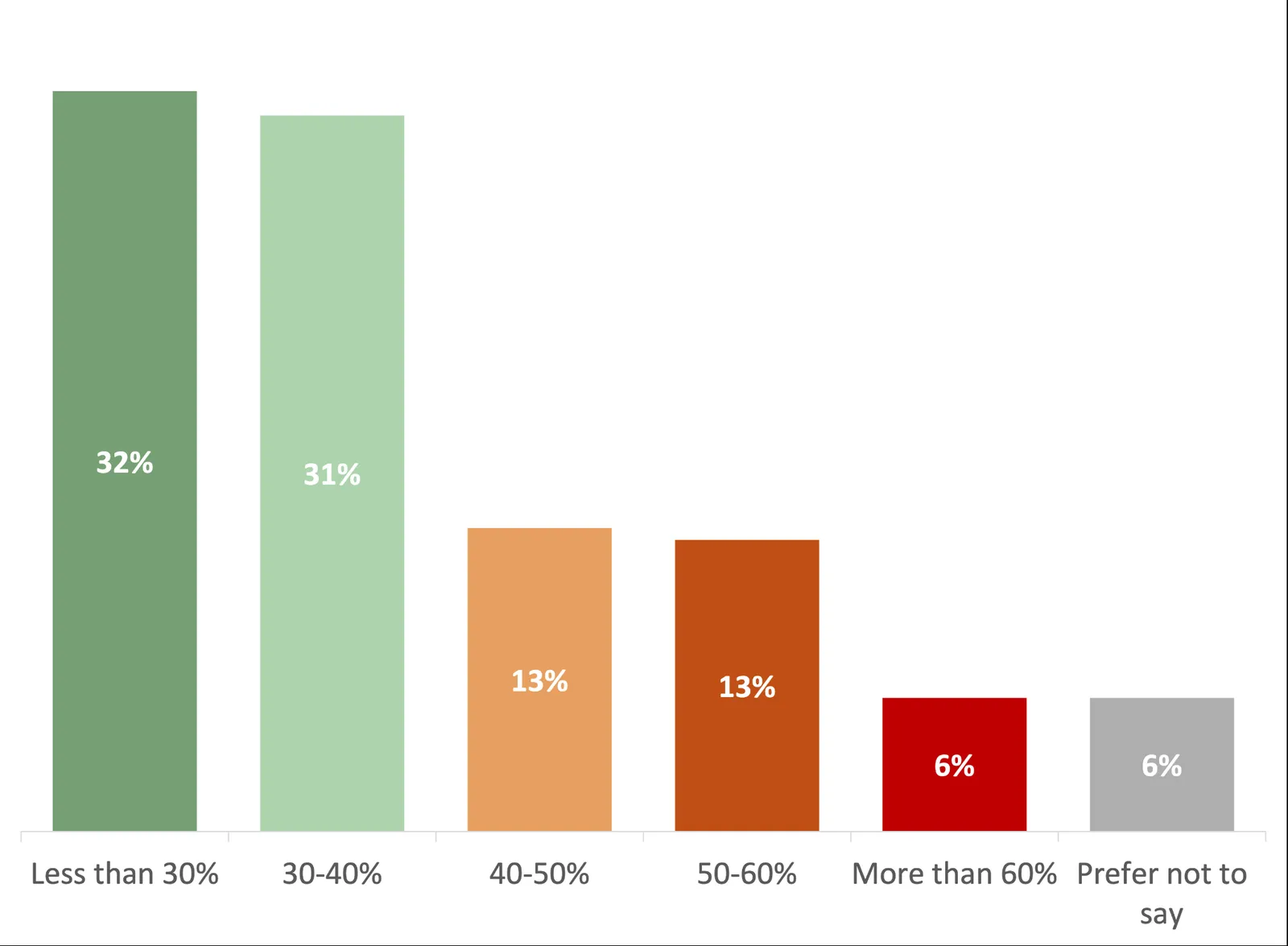
Paying no more than 30% of income on housing is a common metric of affordability. The highest number of respondents (32%) spend less than 30% of their monthly income on housing costs, followed closely by 31% of respondents who spend between 30-40%. 32% of respondents are spending over 40% on their housing costs, with 13% spending between 40-50%, and 13% spending between 50-60%. 6% of respondents are spending more than 60% of their monthly income on housing costs. 6% of respondents selected the option 'prefer not to answer', which may include respondents that don't know what percentage of their monthly income goes towards housing cost.
The 2021 Census³ shows that 74% of Langford households spend less than 30% of their income on shelter costs, and 26% spend 30% or more. This data suggests that Langford residents who spend more than 30% of their household income on housing costs are either over-represented in the results of this survey, or housing costs have become less affordable since the release of the 2021 Census.
³ Statistics Canada. 2023. (table). Census Profile. 2021 Census of Population. Statistics Canada Catalogue no. 98-316-X2021001. Ottawa. Released November 15, 2023. https://www12.statcan.gc.ca/census-recensement/2021/dp-pd/prof/index.cfm?Lang=E (accessed May 14, 2026).
Top Priorities for Housing in Langford
Q3. Which of the following are your top priorities for housing in Langford? (Select up to three)
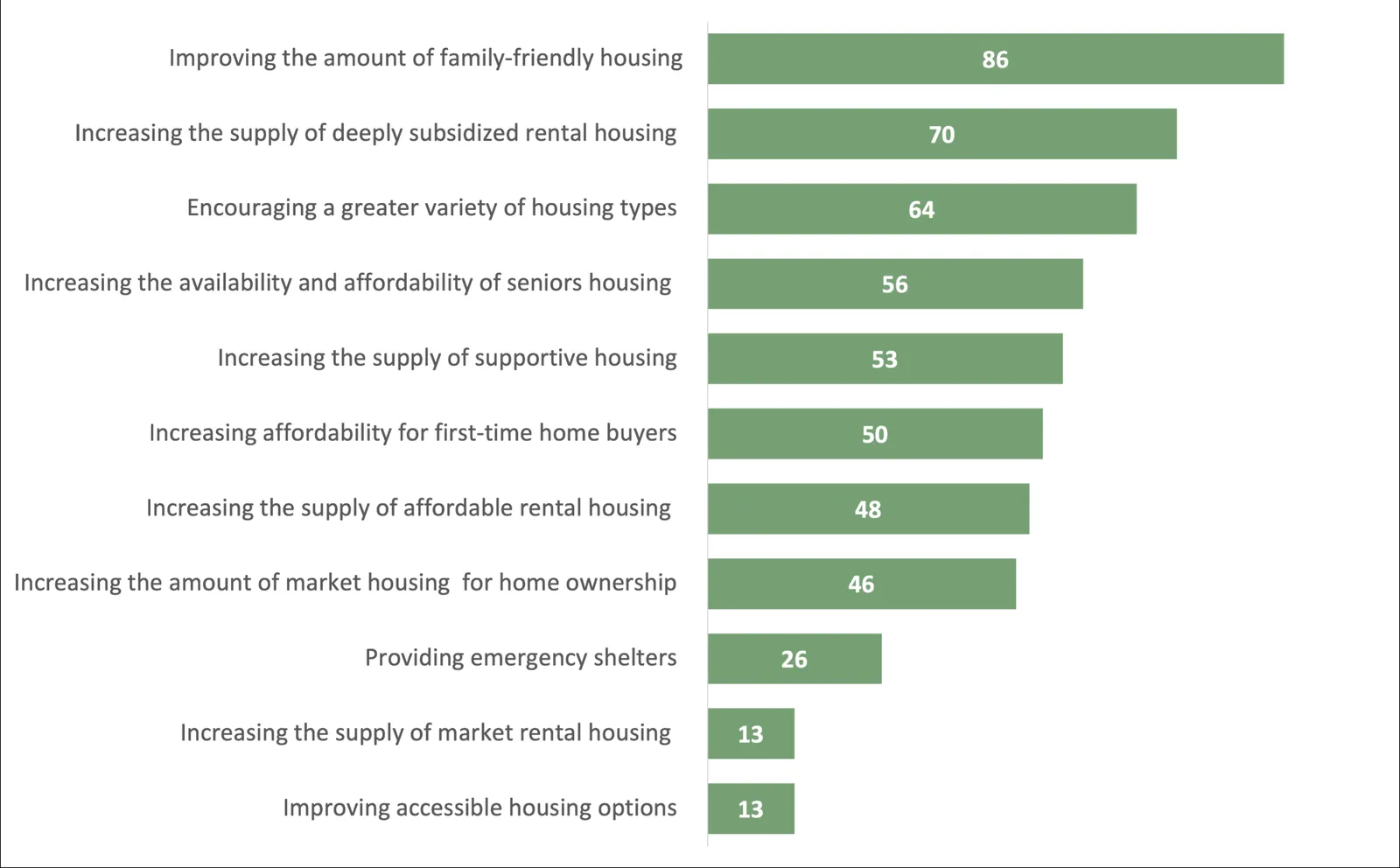
The top three most frequently selected housing priorities included: Improving the amount of family-friendly housing (86), increasing the supply of deeply subsidized rental housing (70), and encouraging a greater variety of housing types (64).
Somewhat less frequently selected priorities included: increasing the availability and affordability of seniors housing (56), increasing the supply of supportive housing (53), increasing affordability for first-time home buyers (50), increasing the supply of affordable rental housing (48), and increasing the amount of market housing for home ownership (46).
Housing priorities selected the least often included: Providing emergency shelters (26), increasing the supply of market rental housing (13), and improving accessible housing options (13).
Housing Priorities and Household Income
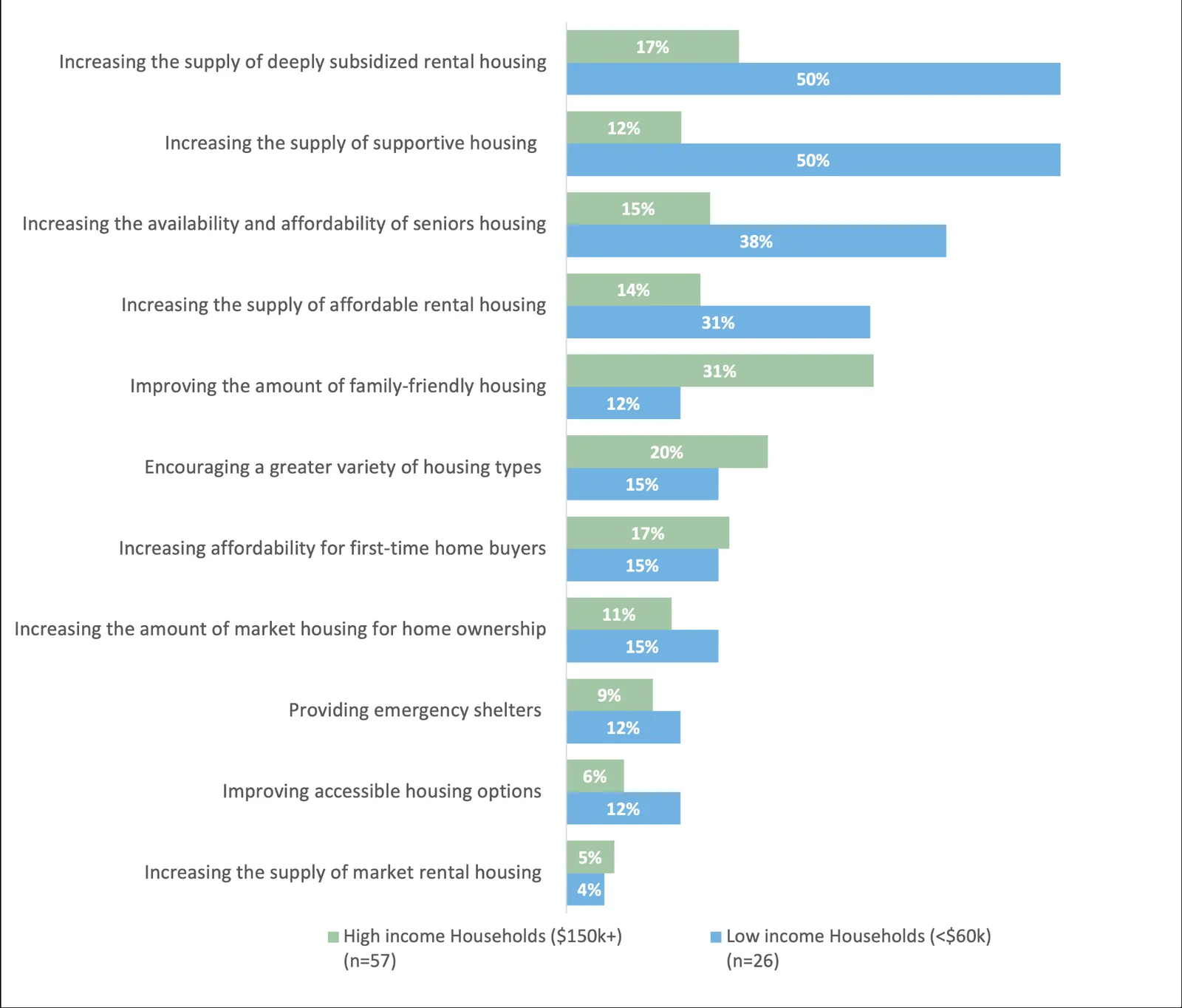
This chart shows housing priorities among those who reported a higher household income versus a lower household income. Households of over $150k can generally be considered higher income, and households of less than $60k may struggle more with affordability.
Comparing housing priorities between these two income groups reveals differing priorities: Respondents who reported a higher household income ($150k+) were more likely to list family-friendly housing and a greater variety of housing types as their top priorities. Respondents who reported a lower household income (<$60k) were significantly more likely to list increasing the supply of supportive housing, increasing the availability and affordability of seniors housing, increasing the supply of deeply subsidized rental housing, and increasing the supply of affordable rental housing as their top priorities.
Community Outcomes
Q4. As Langford’s population grows and new housing is built, which community outcomes are most important to you? (Select up to three)
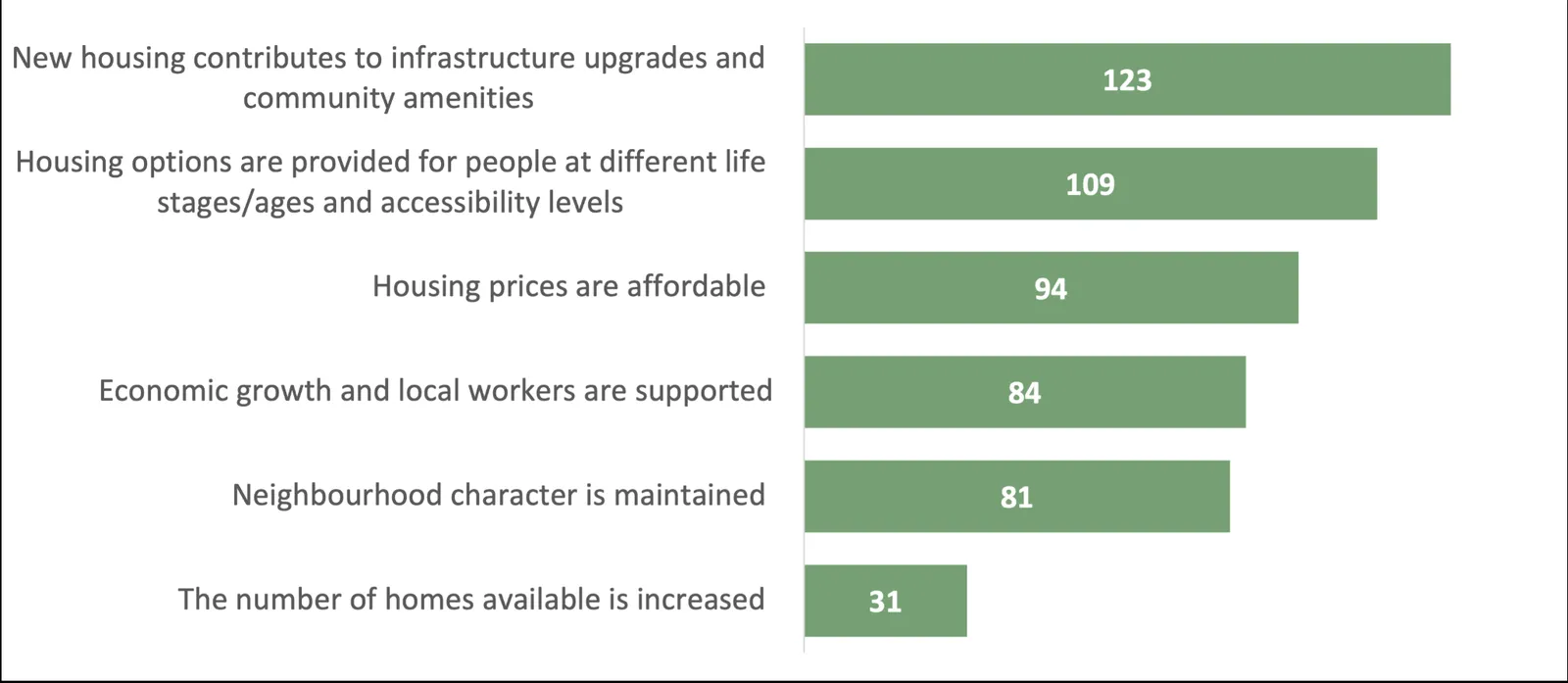
The highest number of respondents (123) said their most important community outcome is that new housing contributes to infrastructure upgrades and community amenities.
Respondents also frequently reported (109) that having housing options provided for people at different life stages/ages and accessibility levels is an important community outcome, and that housing prices are affordable (94).
Supporting economic growth and local workers (84) and maintaining neighbourhood character (81) were selected somewhat frequently as respondents' most important community outcomes.
Increasing the number of available homes was selected significantly less frequently (31) than other options.
Additional Thoughts About Housing in Langford
Q5. Please tell us anything else you’d like to share about housing in Langford.
| Theme | Sub-Theme | Frequency | Description |
|---|---|---|---|
| Housing Form | Less Apartments | 8 | Respondents feel that there are too many condominiums and apartments, and desire more diversity in housing options (townhomes and single-detached homes). |
| Housing Form | Single-Detached Homes | 6 | Respondents would like to see more small, single-storey detached homes for seniors wanting to downsize. |
| Housing Form | Co-Op Housing | 6 | Respondents want to see more housing co-ops, noting the community benefits of co-operative housing and its general shortage in Langford. |
| Housing Form | Townhomes | 5 | Respondents are interested in seeing more townhomes that are well-built, have outdoor yards, and are family-friendly. |
| Housing Form | Family-Friendly | 4 | Respondents feel that there are not enough affordable, spacious, and family-friendly housing options that have 3 or more bedrooms. |
| Housing Form | Housing Quality | 3 | Respondents note the tendency to emphasize the quantity of homes and point out that quality housing that is aesthetically pleasing, incorporates nature, and meets people's needs is equally as important. |
| Community Development | Rate of Change | 14 | Respondents express concern about how fast new development is being built. Concerns are based on construction-based disruption and that new housing development is outpacing infrastructure upgrades. Overcrowding, lack of medical services, and lack of green space are primary concerns. |
| Theme | Sub-Theme | Frequency | Description |
|---|---|---|---|
| Community Development | Neighbourhood Character | 13 | Respondents note the importance of maintaining neighbourhood character while new housing is built. This includes limiting tall apartment buildings in quiet residential areas, and creating housing that suits its neighbourhood, including mixed-use developments, incorporating nature, and finding the balance between affordability and “nice neighbourhoods”. |
| Community Development | Complete Communities | 8 | Respondents note that more emphasis is needed on creating complete communities rather than only developing new housing. This includes incorporating schools, shops, emergency services, parks, walkable/bikeable routes, mixed-use developments, restaurants, cafes, post offices, medical centres, and recreation facilities. |
| Transportation Infrastructure | Roads | 10 | Respondents express concern that current road infrastructure cannot support new housing and will lead to traffic and overcrowding. |
| Transportation Infrastructure | Parking | 4 | Respondents note the importance of maintaining street parking availability by having adequate parking, such as 2+ stalls per unit, in new housing developments. |
| Municipal Process | Taxes | 8 | 7 respondents would not favour increasing municipal taxes to fund affordable housing. 1 respondent would like to see higher taxes in single-family, low-density neighbourhoods and lower taxes in higher-density buildings. |
| Municipal Process | Application Process | 6 | Respondents state that municipal policies should make it easier to build projects. Suggestions include streamlining and speeding up building permit/development permit and rezoning approval timelines, reducing delays, and having predictable processes. |
| Theme | Sub-Theme | Frequency | Description |
|---|---|---|---|
| Municipal Process | ACCs/DCCs | 3 | 2 respondents note a desire for developers to fund infrastructure upgrades and affordable housing. 1 respondent notes that developers should not be overburdened with ACCs and DCCs. |
| Parks and Environmental Protection | Greenspace | 9 | Respondents state the importance of balancing new development with adequate greenspace in the form of parks, community gardens, trails, dog parks, and wildlife. |
| Parks and Environmental Protection | Protection of Trees | 6 | Respondents note the protection of trees and wooded areas needs to be a priority throughout new development. |
| Social Supports | Affordable Housing | 21 | Respondents state that more affordable housing is needed in Langford. Expanding the affordable housing program, affordable housing for families and seniors, and developing larger units with storage and parking are noted as top priorities. Respondents also note that affordability is relative, and that 30% of income does not always equate to affordability. |
| Social Supports | Addressing Homelessness | 6 | Respondents state that more long-term, deeply subsidized, and supportive housing is needed in Langford. Suggestion to have ‘nobody is homeless’ as a housing priority. |
| Social Supports | Against Supportive Housing | 3 | Respondents express concern about supportive housing due to perception that it attracts crime and drug use. |
| Social Supports | Accessibility | 2 | Respondents state that more accessible and affordable housing options are needed for those with disabilities. |
| Social Supports | Other | 4 | Other responses included comments on: keeping the vacancy rate above 5%, having smoking areas in multi-unit complexes, being against rezoning existing older neighbourhoods, ensuring that properties are maintained and cleanliness standards are upheld. |
Funding Below-Market Affordable Housing
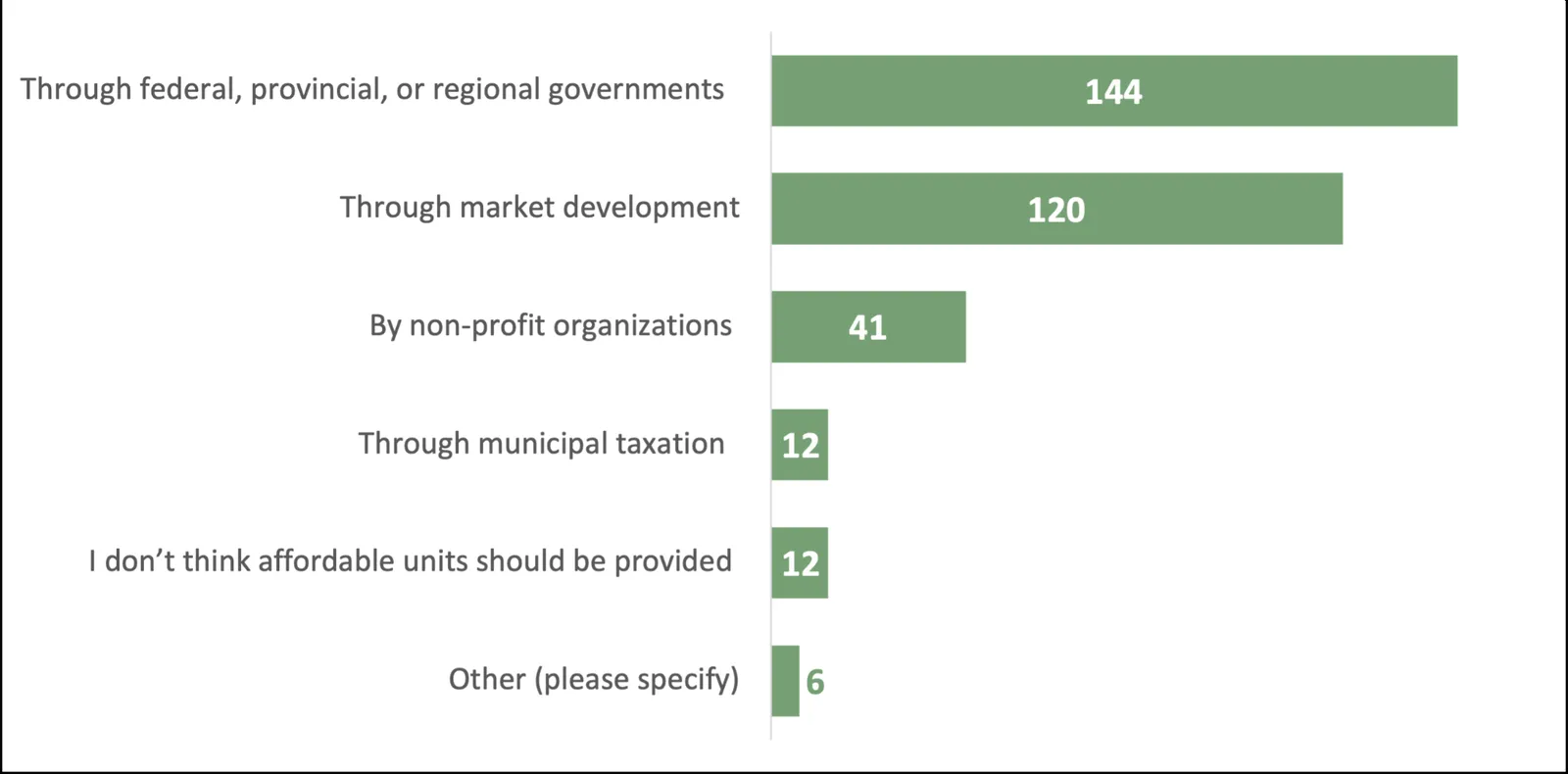
Q6. How should below-market affordable housing be funded? (Select up to two)
The highest number of respondents (144) believe that below-market affordable housing should be funded through federal, provincial, or regional governments and through market development (120). A moderate number of respondents (41) think that affordable housing should be funded by non-profit organizations. The least number of respondents think that affordable housing should be delivered through municipal taxation (12) and do not think that affordable units should be provided (12). Other responses (6), which allowed for comments from respondents, included questions about land economics and housing affordability, concerns about tax dollars funding affordable housing, and a suggestion to build manufactured homes.
Other Suggestions Related to Funding Below-Market Affordable Housing in Langford
Q7. Do you have any other suggestions for how below-market affordable housing should be funded?
| Theme | Sub-Theme | Frequency | Description |
|---|---|---|---|
| Municipal Taxes | 15 | Respondents are somewhat divided on using municipal taxes to fund affordable housing. 9 respondents would not favour higher property taxes to help fund affordable housing. 6 respondents think that high taxes for higher tax brackets and implementing extremely high tax rates on unoccupied property could help fund affordable housing. | |
| Policy Change | 13 | Respondents state that municipal policy change could help fund affordable housing. Examples of suggested policy changes include: taxation control, reallocation of amenity and reserve funds, incentives for homeowners to build secondary suites, a shallow capital subsidy, productive land use, using funds from tourism, removing regulatory barriers for manufactured homes, and finding ways to reduce financial stress for Langford residents. | |
| Non-Profit Partnerships | 6 | Respondents note that affordable and accessible housing should be funded by the municipality in collaboration with non-profit developers and operators. | |
| Developers | 13 | Most respondents feel that all new developments should contribute to funding affordable housing. 1 respondent would like to see revenue from mixed-use developments fund affordable housing, and 2 respondents do not want developers to fund affordable housing. | |
| Provincial & Federal | 11 | Respondents feel that federal and provincial governments should support and fund affordable housing development through grants, subsidies, loans, or using profits from government-owned businesses. | |
| Co-Op Housing | 7 | Respondents state that co-op housing programs should be encouraged, supported, and expanded by all levels of government. | |
| Against Affordable Housing | 4 | Respondents are generally against funding affordable housing development and the subsidization of affordable units. | |
| Collaboration Between Governments | 3 | Respondents state that affordable housing should be collaboratively funded by all levels of government. | |
| Other | 4 | Other responses included comments on: affordable units not being affordable enough, being against redevelopment of low-income housing, needing more information on different funding models. |
Balancing Affordable Housing and Community Amenities
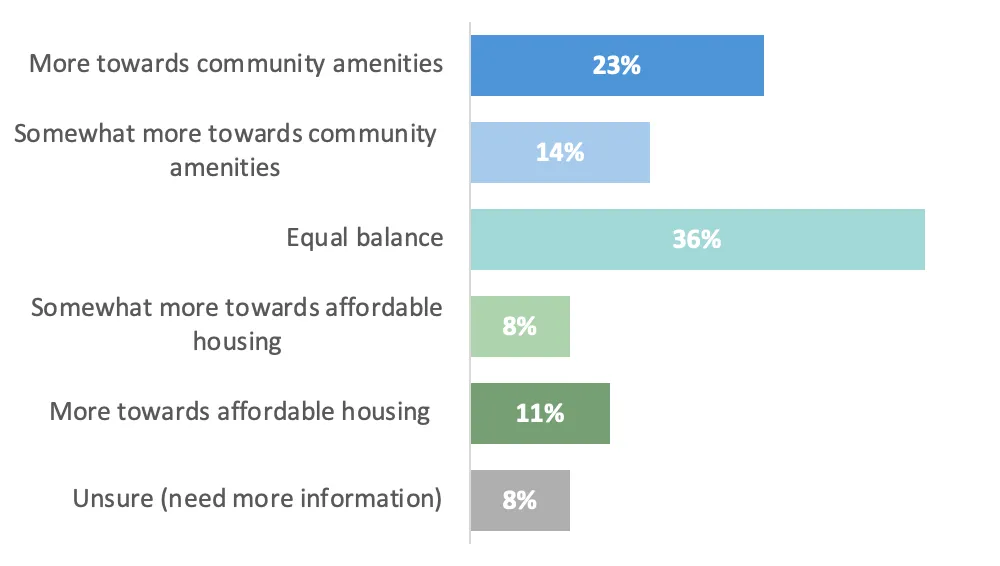
Q8. How do you think the City should balance contributions from new developments between building affordable housing and community amenities? (Select one)
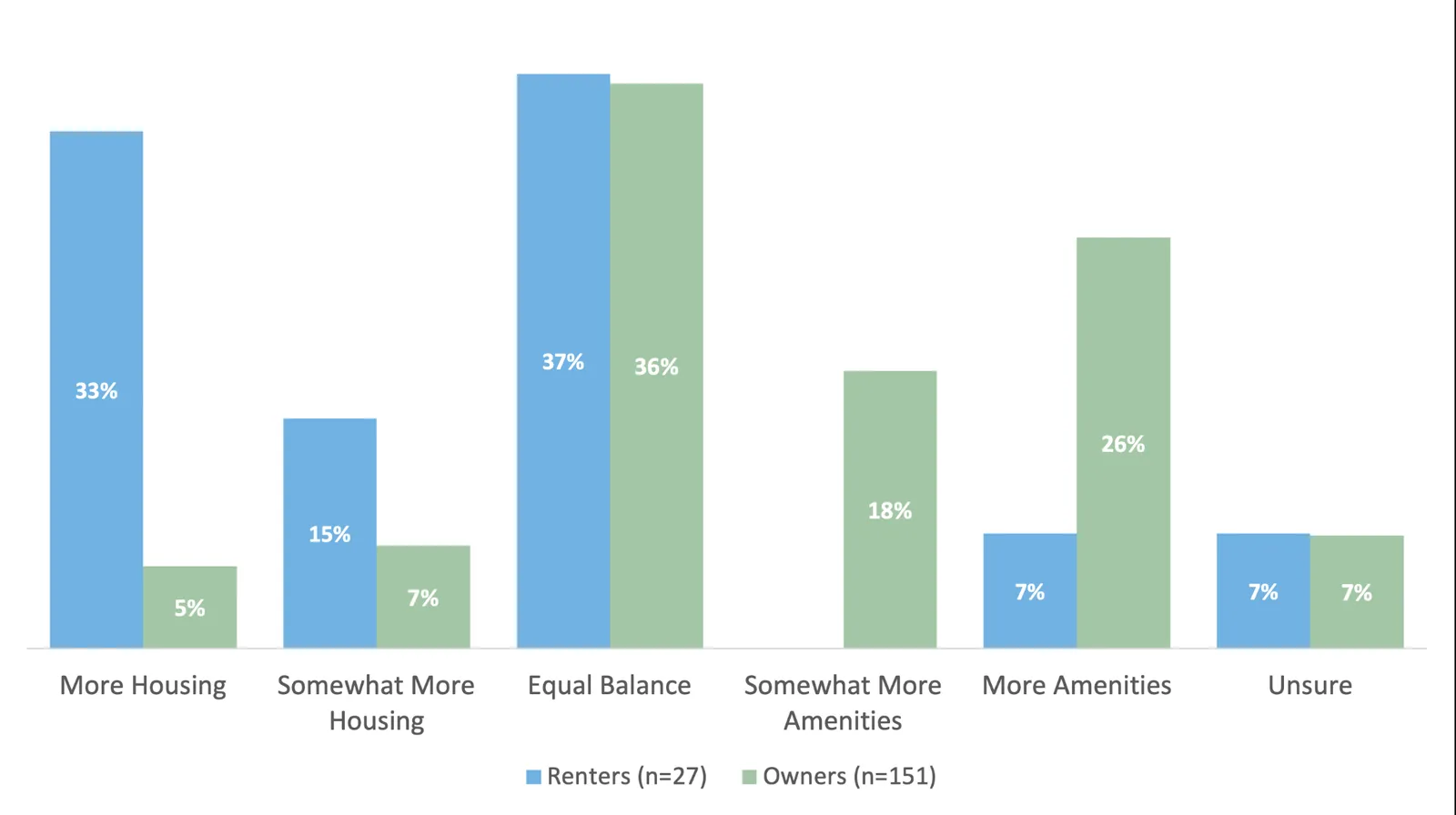
The highest percentage of respondents (37%) think that the City should focus more or somewhat more of the funding secured through development contributions towards community amenities than affordable housing. 36% also think that the City should equally balance contributions between building affordable housing and community amenities. A smaller percentage of respondents (19%) think that the City should focus more or somewhat more of the funding secured through development contributions towards affordable housing. 8% of respondents are unsure or need more information.
Balance of Amenities and Affordable Housing by Respondents
Housing Tenure
This chart shows preferences for how contributions from new developments are spent by those who reported being a renter versus an owner. Each column shows the percentage of respondents by housing tenure.
In general, respondents who are renters prefer using contributions towards affordable housing rather than towards amenities (33% and 15% of renters, versus 5% and 7% of owners). Respondents who own their home prefer using contributions towards amenities rather than affordable housing (26% and 18% of owners, versus 7% of renters). A nearly equal share of renters (37%) and owners (36%) think that contributions should be balanced between funding amenities and affordable housing.
Top Priorities for Community Amenities in Langford
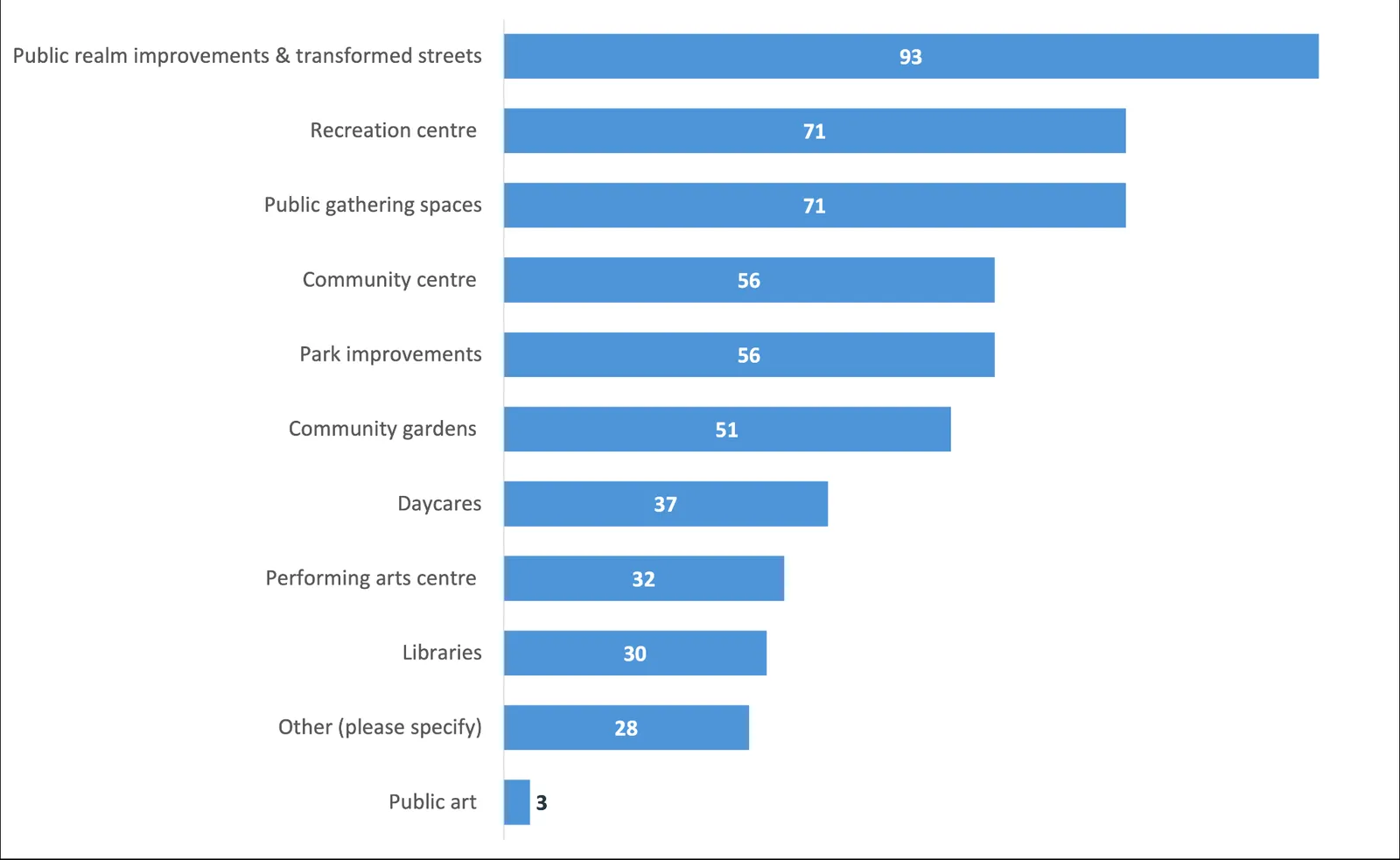
Q9. Which of the following community amenities do you think should be a priority for Langford? (Select up to three)
The top three amenities that respondents think should be a priority for Langford include public realm improvements and transformed streets (93), a recreation centre (71), and public gathering spaces (71).
Amenities that were selected by respondents somewhat often include a community centre (56), park improvements (56), and community gardens (51).
Amenities that were selected the least often by respondents include daycares (37), a performing arts centre (32), and libraries (30), and, the least frequently, public art (3).
Where ‘Other’ was selected (28), respondents suggested the following amenities: maintaining public access to lakes and trails, increasing urban tree canopy, softball diamonds, active transportation infrastructure, a medical clinic, sports fields, a race track, waterslides, general greenspace, dog parks, road infrastructure, swimming pool, and a youth centre⁴.
⁴ Note that not all of these suggestions qualify for Amenity Cost Charge funding.
Other Suggested Community Facilities or Amenities
Q10. Do you have any other suggestions for types of community facilities or amenities or how they should be funded in Langford?
| Theme | Frequency | Description |
|---|---|---|
| Community Gathering Spaces | 12 | Respondents suggest having more community gathering spaces such as community centres, makers spaces, libraries, and spaces that are able to be rented out. |
| Sport Centres, Arenas, & Courts | 12 | Respondents suggest having more sports-oriented amenities such as aquatic facilities, recreation centres, community wellness parks with outdoor workout equipment, a sports arena, a covered lacrosse box, an ice rink, football and soccer fields, and a softball centre. |
| Parks, Trails, Gardens | 11 | Respondents suggest having more amenities that contribute to the City’s green space, such as parks, walking trails, community gardens, dog parks, picnic areas, playgrounds, and conservation areas. |
| Taxes | 10 | Respondents are concerned that improving or developing new amenities will increase taxes. Suggested alternatives to funding amenities with tax dollars include having fund-raising events, taxing developers, and slowing population growth. |
| Active Transport | 5 | Respondents suggest having more active transportation options to reduce car dependency, such as bike paths, improved sidewalks and street lighting, and car-free streets. |
| No new amenities | 5 | Respondents state that there are enough amenities in Langford, that no more are needed, and that the focus should be on maintaining existing amenity spaces. |
| Healthcare | 4 | Respondents would like to see more healthcare facilities such as hospitals and medical centres. |
| Arts & Culture | 4 | Respondents would like to see a dedicated performing arts centre for concerts and public art that is incorporated into public spaces. |
| Funding | 3 | Respondents share suggestions for funding amenities, such as having developers fund amenities and funding amenities through the City budget. |
| Other | 6 | Other responses included comments on: roads and transportation, the struggle to engage with amenities with high cost of living expenses, government-owned grocery stores, needing more information, City needing a better understanding of needs, having facilities and amenities be accessible from various areas of Langford. |
External Interest-Holder Workshops
Two virtual workshops were held, one with local developers and builders, and another with non-profit developers, operators, and advocacy groups. Each workshop focused on the Housing Strategy as well as the Inclusionary Zoning and Amenity Cost Charge Bylaws, with prompting questions on each of the topics questions (Appendix A). The Housing Strategy and the IZ and ACC Bylaws were discussed in separate breakout sessions attended by all participants. Breakout groups were led by a facilitator and followed a “Now, Wow, How” structure to map out current challenges and successes and brainstorm what future success could look like. A summary of what we heard in each workshop is described below.
Developers & Builders: Current Challenges & Successes
Feasibility Challenges
- Participants noted general feasibility challenges for the development of all housing types due to high construction and land costs. Participants also noted that feasibility becomes more challenging when building high-density development closer to the City’s core centre, and that Langford’s seismic hazard risk also leads to higher due diligence costs.
Changing Regulations
- Participants noted that a changing and increasing amount of regulations and a lack of coordination between levels of government leads to greater complications for developers, which ultimately leads to higher costs.
High Expectations for Developers to Provide Multiple Community Benefits
- Participants noted high expectations for developers to provide multiple community benefits, such as amenities and affordable housing, and that development is often treated as a “catch-all”. They noted that this is an additional challenge in an already challenging housing market.
Strong City Collaboration with Development Community
- Participants expressed appreciation for the City’s strong partnerships, collaboration, and communication with the development community.
"Langford is definitely one of the better places to do business because they have the knowledge ... having the ability to speak to the chief building inspector, chief planner, CAO … that's gold."
- Diverse Property Types and Attainable Housing Policy
- Participants stated that Langford is doing well at meeting the general needs of the community, remarking on Langford’s diverse property types, long history of attainable housing policy, and creating amenities for families. Participants also expressed the benefit of adding more missing-middle housing to the community, particularly SSMUH homes for families that are either growing or downsizing.
Developers & Builders: Future Success
- Clarity, Consistency, & Simplicity
- Participants expressed the importance of having clear, streamlined, and simple policies as well as having a consistent and reliable interpretation of bylaws amongst City staff.. Participants noted that more prescriptive requirements are beneficial because they help to remove unknowns and make requirements more quantified, allowing developers to reduce risk and have more financial certainty. Participants also expressed the benefit of leaning on current policies rather than creating new ones to reduce complication, and the importance of increasing cohesion with senior levels of government.
"If I had a dream, it would be one year from buying a property to building it... if you de-risk the processes and reduce the amount of burden carried by development, you can take smaller margins because you know you can crank-out product."
More Development-Friendly Incentives and Tools
- Participants noted the benefits of moving to an incentive-based system with tools like tax breaks to accommodate the inclusion of affordable units. Participants expressed that developer-friendly policies result in more housing of all types.
Greater Flexibility in Requirements
- Participants noted the benefit of having greater flexibility within City regulations and requirements, leading to the subsequent ability to pivot, change, and amend regulations to keep development moving and avoid stagnation. Examples of areas needing more flexibility included: minimum frontage requirements, landscaping requirements, parking, and 5-10% inclusion of below-market housing.
Non-Profit Developers, Operators, & Advocacy Groups: Current Challenges & Successes
- Vulnerable Populations
- Participants noted that more low- and lower-income housing is needed. There is a high percentage of families and single parents who are in need of affordable housing, and 10% of these single parents are fleeing violence. It was also noted that 17% of those who have been approved for housing loans in Langford are seniors.
"[Langford has a]...high number of families—a higher percentage than the larger region—and a large percentage of those are single parents... that comes back to childcare obviously being an important piece."
Cost of Construction and Funding Programs
- Participants noted that the high cost of construction and land as well as the reduction in Provincial and Federal affordable housing funding programs makes it challenging to build affordable homes.
Affordable Home Ownership Program and New Housing
- Participants noted the success of Langford’s Attainable Home Ownership program and that Langford has been generally successful at delivering new housing.
Operational Complications
- Participants noted the operating cost of affordable units that are scattered across different buildings (with less than five units per building) is often too high to justify, and the preference is to own or manage at least 20 or more housing units in one building. While participants prefer having larger blocks of units in a single building, they also noted that a housing-first scattered-site model can make use of any affordable units across a range of buildings.
Income Testing Challenges
- Participants noted concerns with the rigidity of income testing within certain housing agreements. They noted that if a tenant’s income rises slightly above the threshold, strict agreements might require eviction. Participants stated that income testing should account for modest income fluctuations due to factors such as gig economy work.
"We had some... funders say if a tenant is over a dollar over that income limit after say one year, they get evicted. Our response was: we’re in the business of housing people, not in making people homeless... there has to be some leeway."
- Unit Size Mismatch
- Participants note that current housing agreements often result in 1 or 2-bedroom affordable units because they are easier for developers to deliver. Participants stated the community’s deep need for 3 and 4-bedroom units to support Langford’s family-oriented demographic.
Non-Profit Developers, Operators, & Advocacy Groups: Future Success
Municipal Land Allocation & Strategic Acquisition
- Participants noted that allocating municipal land to non-profits can help with affordability challenges by lowering or omitting the cost of land. Participants also noted that strategic acquisition of existing properties could increase affordable rental units, and that there may be opportunities to buy relatively new rental buildings or buildings that require retrofitting.
Partnerships with Non-Profits for Management, Ownership or Administration of Affordable Units
- Participants mentioned opportunities for strategic municipal partnerships with non-profits to administer, manage or track affordable units and programs, and that non-profits who have experience with many different types of housing agreements would be beneficial. Non-profit organizations are also available to purchase affordable ownership units and re-selling units in accordance with their specific mandates.
- Access to Services and Transportation
- Participants noted the importance of creating communities by building affordable housing that’s close to existing services. They expressed that transportation, walkability, affordable home ownership, and accessible childcare go hand-in-hand.
"The focus is often on providing the 'unit' of housing rather than 'home' – rather than creating a home in Langford for them, and that involves their community, their building, where they live."
Per-Door Unit Funding for Non-Profit Affordable Housing Projects
- Participants noted that having a formalized program for per-door unit funding for non-profit affordable housing projects would help create simplicity and clarity.
Accurate Homeless Counts
- Participants expressed the importance of accurate point-in-time homeless counts so that existing needs can be accurately addressed.
Duration of Affordability in Housing Agreements
- Participants expressed concern that current housing agreements are not long enough, and advocated for affordability “in perpetuity” to prevent units from reverting back to market rates after a few decades. On the other hand, requiring affordability in perpetuity can also impact the ability of organizations to leverage their assets towards future projects.
Affordability Calculations
- Participants stated that units at 10% below-market are not affordable enough for low-income households. They note the importance of recognizing low- and very low-income households in Langford, especially those headed by single parents.
Volume of Units vs. Deeply Subsidized Units
- Participants highlighted the necessity of increasing the supply of all below market housing types, while balancing overall unit delivery with the creation of deeply affordable housing.
Deepening Affordability Over Time
- Participants expressed that market-rate housing built by non-profits for feasibility reasons becomes more affordable over time. As inflation drives up market rents, the rent of non-profit-owned units stays the same.
"A lot of our housing is coming of age... those all built from say the 60s to the 90s are all coming to … either end of life or in need of major repair. And that is the stuff that is our most affordable housing right now."