DocumentsStaff ReportFeb 2, 2026Pages 588–593
Report: Langford Lake Sedimentation Update
Council report providing an update on Langford Lake sedimentation issues, monitoring and proposed mitigations (detailed contents in report pages).
Key facts
- Agenda item: 9.1
- Report provides technical/program update regarding sedimentation at Langford Lake
- Pages assigned: 588-593
Report: Langford Lake Sedimentation Update
t 250.478.7882
e administration@langford.ca
2nd Floor, 877 Goldstream Avenue
Langford, BC V9B 2X8
DATE: Monday, February 2, 2026
DEPARTMENT: Engineering
SUBJECT: Langford Lake Sedimentation Update
Executive Summary
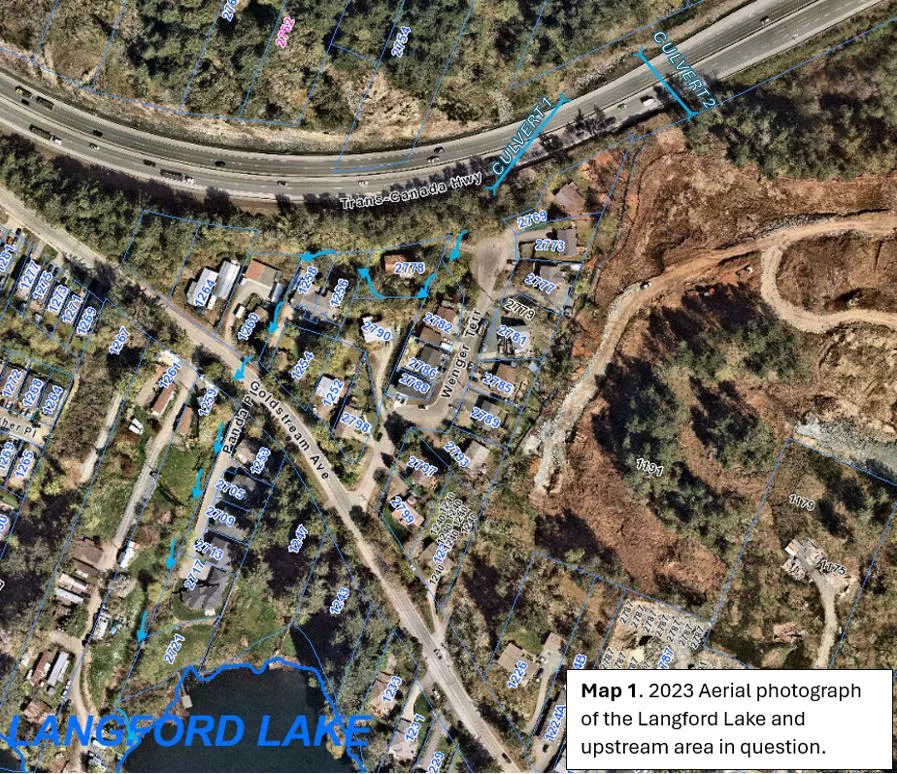
The purpose of this report is to provide Council with an update on investigations and actions taken to date with respect to the sediment of unknown origin in and upstream of Langford Lake in the Goldstream Avenue and Wenger Terrace area (Map 1). While it has been confirmed that the foam and film produced by the sediment are not hazardous to the public and wildlife, the sudden onset of this phenomenon in 2023, the continuing spread of this nuisance upstream, and the coating of the bottom of the lake at the outfall remain a concern.

Background
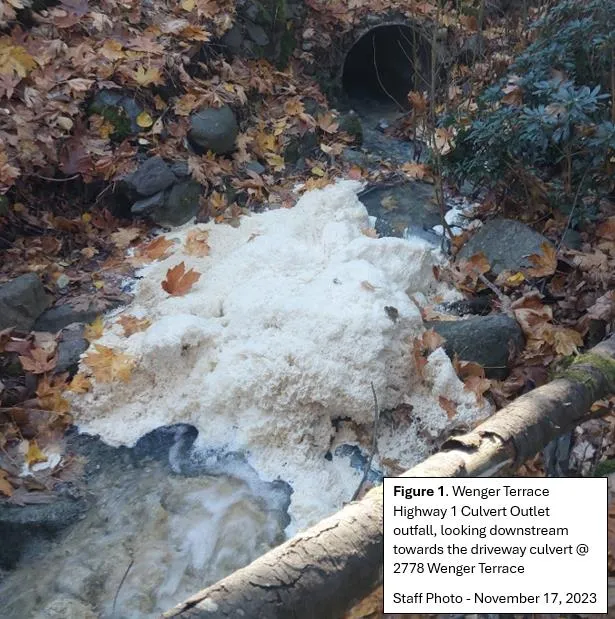
In November 2023, staff received a concern from a resident about a potential contaminant spill in the outfall of a Trans-Canada Highway culvert (“Culvert 1”) outlet and downstream creek located at the end of Wenger Terrace. Staff investigated on November 17, 2023, and found a buildup of odourless off-white foam on the surface of the outfall pool and dispersed in the downstream creek, as well as a film of sediment on the rocks and concrete (Figure 1).
On the same day, staff reported the findings of a possible spill to the Ministry of Environment’s dangerous goods incident report line (reference # 234497) and to the Ministry of Transportation as it concerned a Highway 1 culvert. At that time, the sediment film and foam did not appear any further upstream than partway into the culvert inlet.
Staff retained the services of Island Environmental Health & Safety Ltd. (Island EHS) to carry out testing on the substance to determine if there were any hazards to the public and wildlife. Island EHS carried out sampling November 24, 2023, and followed up with their report dated December 1, 2023. The report indicated that “the foam is likely natural, and no evidence of sewage contamination was found.”
By way of explanation for the foam and layer of sediment, the report explained “Water that contains substances like dissolved salts and organic matter (dead algae, decaying leaves, etc.) is aerated, forming persistent bubbles. When the bubbles burst, the salts and other matter can form a slimy mat.”
The Island EHS report concluded that no action was necessary. Having taken initial steps to rule out immediate hazards, staff engaged the services of Corvidae Environmental Consulting Inc. (“Corvidae”) to investigate further. The scope of work was to identify and control the source of the sediment and foam, to ultimately prevent further occurrence, and clean it up. This investigation was initiated on December 19, 2023.
Shortly after engaging with Corvidae, a resident contacted staff with concerns about sediment building up in Langford Lake at the lake outfall of the naturalized stormwater channel downstream of Culvert 1. Staff confirmed the spread of the sediment and the scope of Corvidae’s investigation was increased to include all affected areas.
Corvidae conducted their investigation from December 2023 to December 2024, reporting on water and sediment sampling both in-stream along the stormwater course and within the outfall area of Langford Lake. Reporting noted the following (all quotes below come from the Corvidae Summary Report dated June 13, 2024):
Concerning Water Quality:
“Water quality parameters analysed in Langford Lake were all well below the applicable standards / guidelines and it is reasonable to state that the input from the watercourse is not having a deleterious effect on Langford Lake’s water quality with respect to human health or aquatic life.”Concerning Sediment Analysis:
“The sampled accumulated sediment was mainly composed of fine inorganic material with a high calcium content, characteristic of limestone and sedimentary rocks… No samples exceeded the guidelines for any regulated elements (i.e., arsenic, cadmium, chromium, copper, lead and mercury). However, the laboratory provided commentary on the presence of unusually high levels of Calcium (1368 ug/g) for a freshwater system, likely due to freshly exposed calcium carbonate rock surfaces due to construction.”Recommendations:
“No efforts to remove accumulated sediment from the watercourse or the lake are required as none of the materials analysed exceed any standards or guidelines for the parameters sampled…Water quality parameters analysed in Langford Lake were all well below the applicable standards / guidelines and it is reasonable to state that the input from the watercourse is not having a deleterious effect on Langford Lake’s water quality with respect to human health or aquatic life.”
Corvidae ended the report with suggestions for future monitoring and sampling.
The Corvidae approach to testing the effects of the sediment layer within the outfall area of Langford Lake involved a comparison of benthic (lakebed) invertebrate organism abundance in several testing sites at varying degrees of proximity to the sediment. This study, dated December 18, 2024, suggested “that conditions at the sediment deposition area are not currently suitable for supporting a diversity of aquatic invertebrate life and that these conditions are a result of sediment deposition. The impacts appear to be localized to the area of sediment deposition only.” Ultimately, because the lake testing was a single event at one area of the lake, further monitoring and sampling at other locations in the lake to better compare conditions was recommended.
In early 2025, with the sediment still recurring and no evidence of a source being forthcoming, staff decided to seek advice from alternate consultants, eventually leading to the hiring of SLR Consulting, to help identify the source of the sediment. In fall of 2025, Colquitz Engineering, a local Water Resource Civil Engineering firm, was also hired to pursue mitigation and control of the sediment. These works are currently underway.
On a recent set of site inspections, the stormwater channel from Culvert 2 down to the Langford Lake outfall was noted as clear of signs of the sediment and foam (October 21, 2025) and soon after a fresh reappearance of both the foam and sediment was noted (November 14, 2025), indicating the storm system undergoes periodic flushes of the sediment and fresh accumulations, two years after it first being reported.
Commentary
From the outset, staff took the approach of ruling out any immediate hazard to the public and wildlife, followed by a cautious investigation under the guidance of environmental consultants to identify, control, and ultimately clean up the sediment. Throughout the investigations, staff followed the advice of professionals in determining whether any kind of cleanup of the sediment was warranted and feasible given what was known about the substance. Staff were advised by professionals that the best course of action prior to determining the source and identity of the sediment was not to attempt any cleanup.
Despite all the investigations undertaken to date by multiple professionals, the source of the sediment remains unknown. All incidents of the foam and sediment film appear in-stream, without a clear trail to follow that would allow us to clearly point to its origin. While the Corvidae report, dated June 13, 2024, indicated a potential link to rock processing activities of the upstream development, staff confirmed that approved Erosion and Sediment Control Plan measures were in place.
While advice from experts has been to hold off on cleaning up the sediment, the continual visual presence of foam and film in the watercourse and the sediment layer at the Langford Lake outfall has staff and residents in the area continually concerned. Having investigated the sediment over the past two years with little in the way of a concrete action plan to control and remove it from the environment, staff are pursuing an approach that balances source investigation with control measures, as recommended by the currently engaged engineering and biologist consultants. This includes:
Source Identification: Conduct targeted sampling related to potential sediment sources, such as nearby exposed rock erosion, scaling, and crushing, as well as groundwater sampling;
Monitoring and Cleanup: Perform water quality monitoring at the Langford Lake outfall and provide recommendations for lake sediment cleanup and/or environmental restoration; and
Mitigation and Maintenance: Develop a mitigation strategy, which may include intercepting the sediment in a forebay and removing it before it enters the lake, or similar infrastructure and maintenance methodologies.
Financial Implications
All costs to date have been covered by operational budgets. There is a placeholder of $250,000 in the 2026 budget for potential capital costs related to the engineer’s proposed design solution which is currently underway. Staff will provide more detailed information as it becomes available for Council’s consideration as part of the 5-year financial plan.
Legal Implications
Any work in and around streams, and future work within Langford Lake (such as sediment removal or plant restoration) will require Section 11 (“Changes in and around a stream”) approval under the Water Sustainability Act of BC. Additional approvals may be required for any works or investigations within the Ministry of Transportation and Transit (MOTT) right-of-way or on private property.
Strategic Plan Alignment
2 – Climate Change and Environmental Stewardship.
Options
THAT Council receive the February 2, 2026, report titled “Langford Lake Sedimentation Update” for information.
Submitted By
SUBMITTED BY: Phillip Le Ross, AScT., Senior Engineering Technologist
Concurrence:
Melisa Miles, Manager of Legislative Services
Concurrence:
Donna Petrie, Senior Manager of Communications & Economic Development
Concurrence:
Yari Nielsen, Director of Parks, Recreation and Facilities
Concurrence:
Leah Stohmann, RPP, MCIP, Director of Community Planning and Development
Concurrence:
Katelyn Balzer, P.Eng., Director of Engineering and Public Works
Concurrence:
Michael Dillabaugh, CPA, CA, Director of Finance
Concurrence:
Marie Watmough, Director of Legislative & Protective Services
Concurrence: Braden Hutchins, Deputy Chief Administrative Officer
Concurrence:
Darren Kiedyk, Chief Administrative Officer