DocumentsAppendixOct 7, 2024Pages 23–27
Appendix A – Interim Housing Needs Report (HNR Appendix material)
Appendix material to the Interim Housing Needs Report containing HNR Method explanation, component breakdowns and data figures (household tenure, building permits, dwellings by type).
Key facts
- HNR calculator result: 5,081 new units needed in 5 years and 16,942 new units needed in 20 years for Langford
- Six components considered: extreme core housing need, homelessness, suppressed household formation, household growth, 3% vacancy, local demand
- Data highlights: owner households declined from 79% (2006) to 65% (2021); 66.9% of new dwellings 2015–2023 were apartments
- Includes figures/tables from Capital Regional District Housing Needs Assessment
Appendix A – Interim Housing Needs Report (HNR Appendix material)
1. 5-Year and 20-Year Housing Need – HNR Method
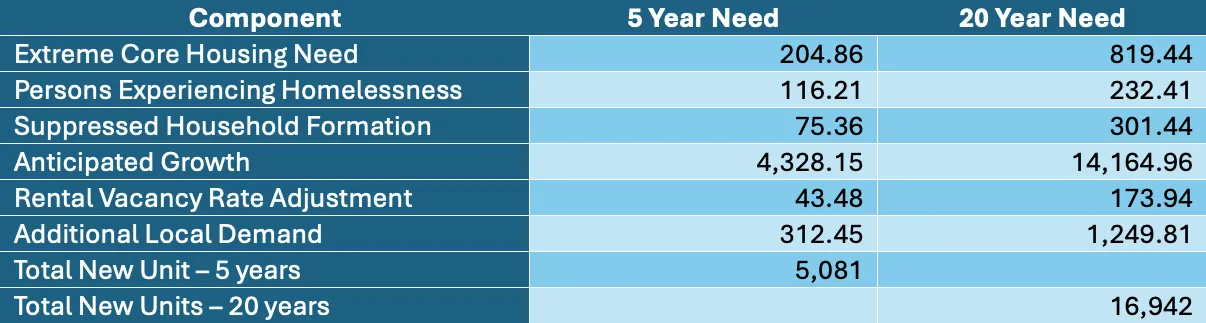
The HNR Method is the methodology that local governments are required by the Province to utilize in order to calculate the total number of housing units their communities will need for the next 5 and 20 year periods. The HNR Calculator, developed by the University of British Columbia (UBC) Housing Assessment Resource Tools (HART) program, analyzes and calculates six components of housing need based on publicly available data, that are then added together to provide the total number of housing units needed in a municipality.
As shown in Table 1 below, to address anticipated housing needs, the HNR calculator has determined that 5,081 new units are needed in the next five years and 16,942 new units are needed in the next 20 years to address housing need in Langford.
Table 1 – Housing Unit Need
| Period | Housing Units Needed |
|---|---|
| 5 years | 5,081 |
| 20 years | 16,942 |
2. Descriptions of Actions taken by Langford
The City of Langford’s Strategic Plan 2023-2027 sets out the vision of Council. The objectives include developing plans or updating policies that contribute to addressing housing need such as:
- refreshing the Official Community Plan,
- updating the Design Guidelines,
- reviewing the zoning bylaw off-street parking requirements for the City,
- updating the zoning bylaw to ensure alignment with the housing needs report,
- pursuing programs and partnerships for affordable housing, and
- maintaining the City’s long standing corporate efficiencies, which include a streamlined development approvals process.
Additionally, Council has taken action to address housing need in the City by:
- implementing an attainable home ownership program and attainable rental program,
- adopting the small-scale multi-unit and transit-oriented areas legislation set forth by the Province,
- establishing that Council will no longer require multi-family housing be strata-titled as a condition of rezoning, and
- continuing to support a diversity of new housing development.
Housing tenure and recent building activity
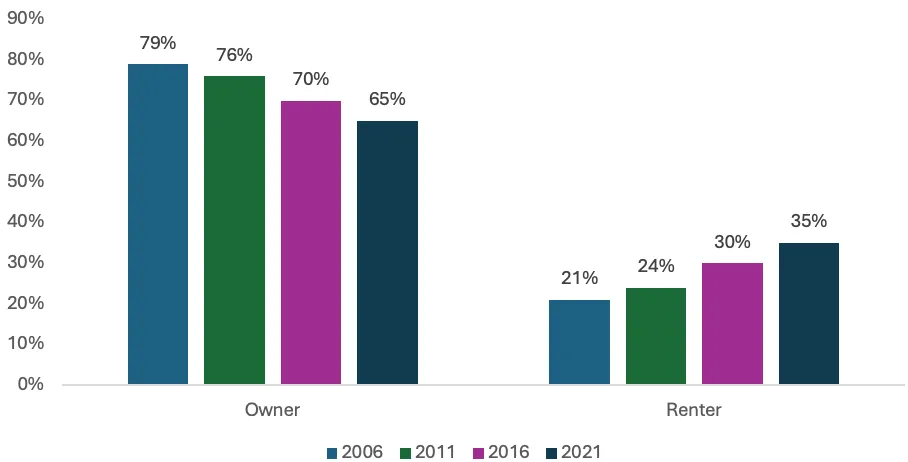
As shown in Figure 1 below, Langford has seen the proportion of owner and renter household change over the past four census periods. Owner households decreased from 79% of all households in 2006 to 65% in 2021, while there was a corresponding increase in renter households from 21% of all households to 35% during the same period.
Between 2015 and 2023:
- 66.9% of new dwelling units in Langford were apartments,
- 20% were single-family dwellings,
- 11.5% were townhouses, and
- 1.5% were duplexes.
The proportion of single-family houses and townhouses represent a small portion of housing that is built each year, indicating that the demand is strong for apartments, and that favourable financial conditions are supporting the development of this housing form. In particular, financial support for purpose-built rentals through CMHC may have contributed to this trend.
Of note, the COVID-19 pandemic in 2020 contributed to fewer new units proceeding to building permit that year. The following years, 2021 and 2022, saw a strong increase, likely in part due to low interest rates and repressed demand. As interest rates started to climb at the end of 2022 and throughout 2023, the number of new units dropped in 2023 but appear to be rebounding in 2024 as interest rates decrease and inflation rates stabilize.
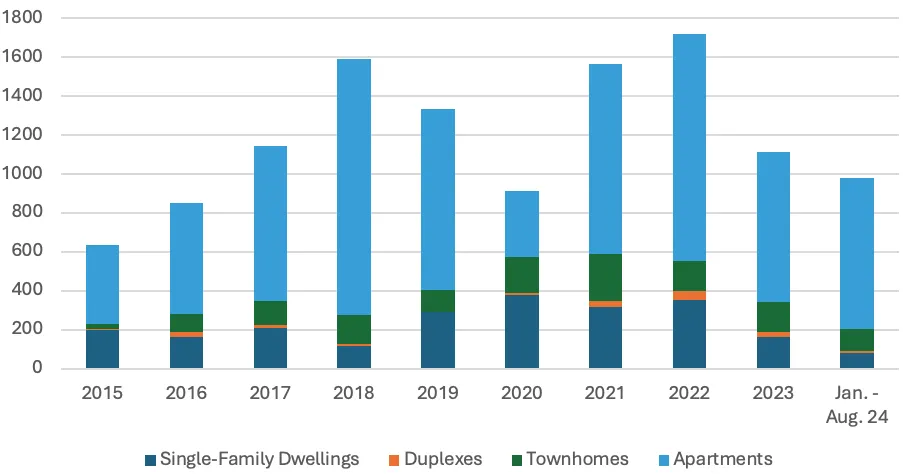
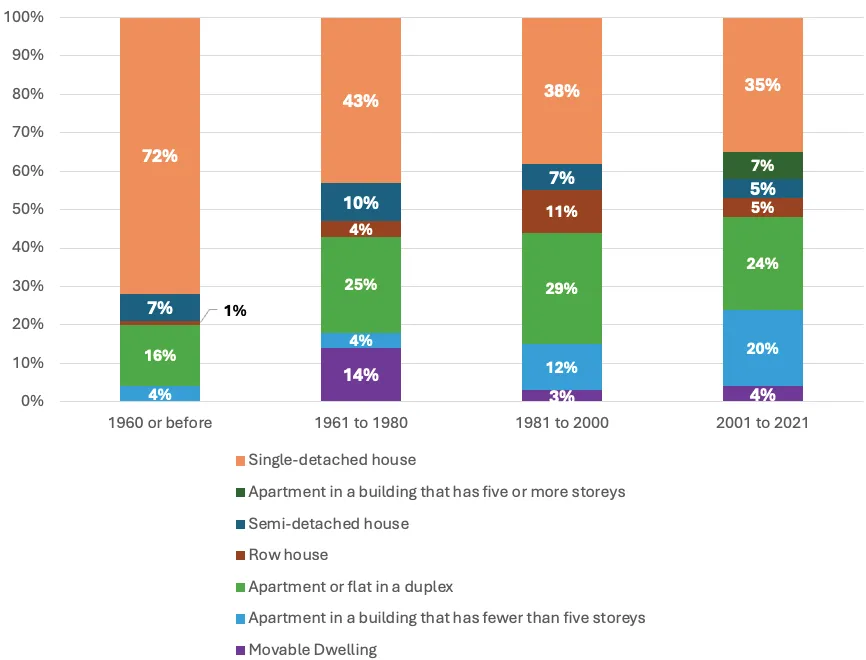
Figure 3 shows that single-detached houses are the predominant structural type of housing built in each prescribed timeline however, the proportion has been decreasing over time. Meanwhile, there has been an increase of apartments in a building that has five or more storeys, apartment in a building that has fewer than five storeys, and semi-detached dwellings.
3. Statement of Need for Housing in Proximity to Alternate and Active Transportation
The City of Langford recognizes the need for housing near transportation infrastructure that supports walking, bicycling, public transit, and other alternative forms of transportation. Integrating housing with these transportation options is essential to successful, sustainable community growth, as it helps to reduce vehicle traffic on roads, lower emissions, improve social equity, and enhance quality of life among residents. Higher density housing is prioritized within walking distance of the Langford Bus Exchange on Station Avenue and in the City Centre along the bus rapid transit route.