DocumentsStaff ReportMay 1, 2023Pages 115–121
Staff Report: 2023 Tax Rates distribution by Property Class
Staff report setting out the 2023 tax rates distribution across property classes for municipal taxation purposes.
Key facts
- Item pertains to 2023 tax rate distribution by property class
- Listed as agenda item 9.3 on the May 1, 2023 Council agenda
- Intended to detail tax rates applied to different property classes for 2023 (municipal)
Staff Report: 2023 Tax Rates distribution by Property Class
t 250.478.7882
e administration@langford.ca
2nd Floor, 877 Goldstream Avenue
Langford, BC V9B 2X8
Staff Report to Council
DATE: Monday, May 1, 2023
DEPARTMENT: Finance
SUBJECT: 2023 Tax Rates distribution by Property Class
BACKGROUND:
The Community Charter requires Council to adopt a Five-Year Financial Plan Bylaw each year and subsequently adopt a Tax Rate Bylaw before May 15.
As part of the Financial Plan process, the overall property tax increase % is determined.
In addition, the City receives the final (revised) Assessment Roll from BC Assessment which allows the calculation of the tax rates for each property class to ensure the proper amount of Property Tax revenue is collected in the year.
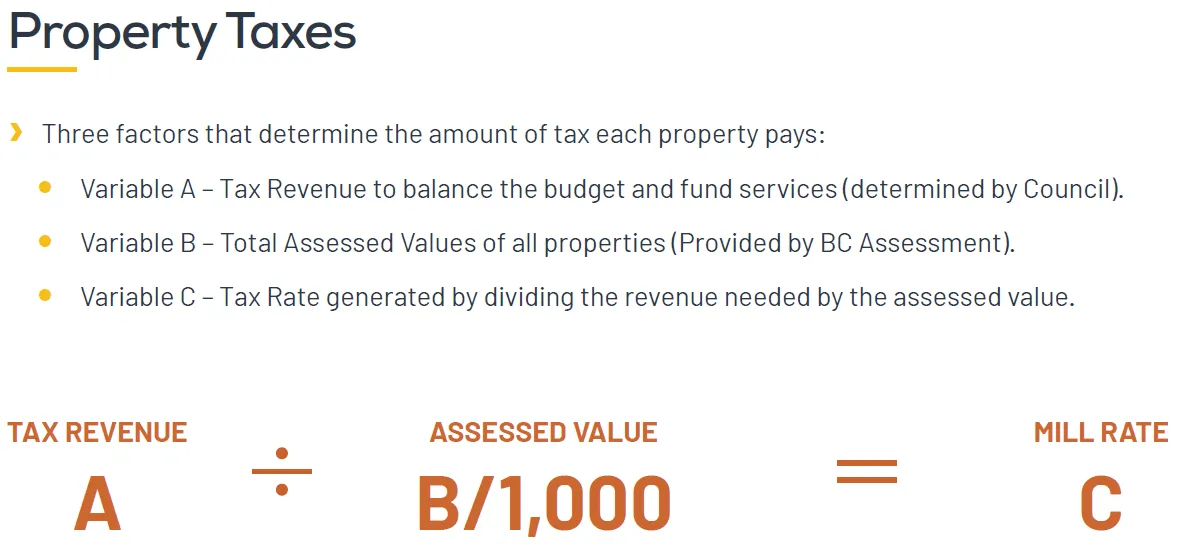
There are three factors that determine how much property tax a property pays:
There are nine property classes (Langford has properties in seven). It is very important to note that all properties within the same property class have the same Tax Rate. Within the same property class, the only variable of how much property tax a property will pay is the assessed value of the property.
The Property Class’s that Langford has properties within are as follows:
- Class 1 – Residential
- Class 2 - Utilities
- Class 5 – Light Industry
- Class 6 – Business and Other
- Class 7 – Managed Forest Land
- Class 8 – Recreational Property, Non-profit Organization
- Class 9 – Farm

COMMENTARY:
Aside from a couple of Provincially legislated rules to prevent unreasonable taxation, the municipal Council has discretion over what the property tax rate “multiple” is for each property class. The multiple is how many times more, or less, the tax rate is for the applicable property class when compared to the Class 1 tax rate. For example, if the Class 1 tax rate is 2.0000 and the Class 6 multiple is 3.0, the corresponding tax rate for Class 6 would be 6.0000.
In 2017, Council embarked on a 10-year program to reduce the property tax burden on Class 6 – Business/other properties by reducing the multiple by 0.05 each year so that by 2026 the business multiple will be 2.5.
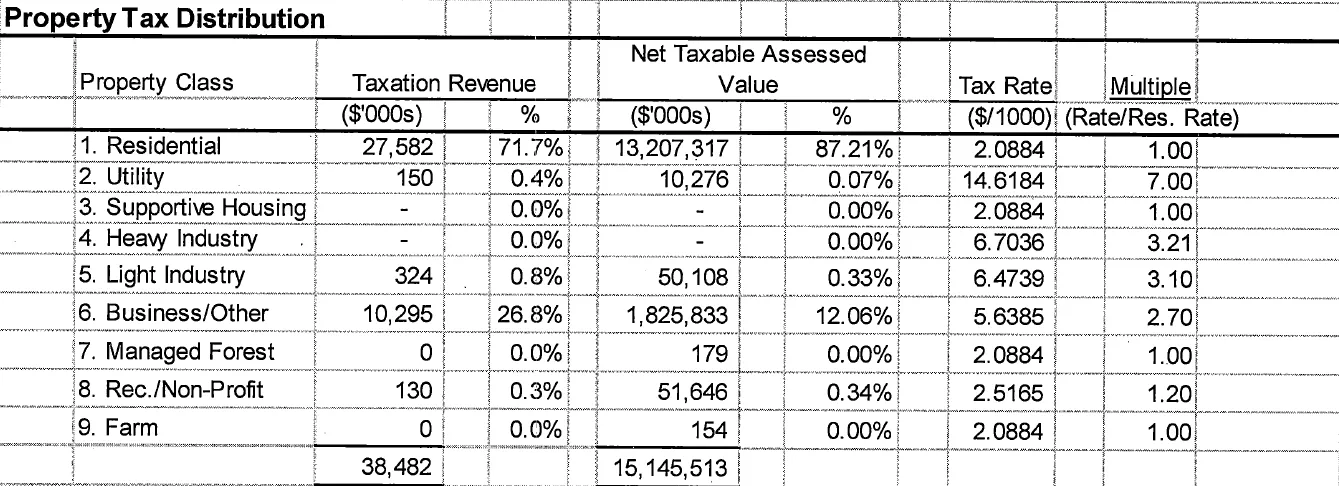
For 2022 the Property Tax Distribution was as follows:
In 2022, given the reduction of the Class 6 multiple from 2.75 (2021) to 2.7 (2022) and given the assessment changes within these two property classes, the 2.95% overall tax increase resulted in the
average increase for Class 1 – Residential being 9.04% and the average property tax impact for Class 6 – Business/other was a reduction of 5.94% (-5.97%).
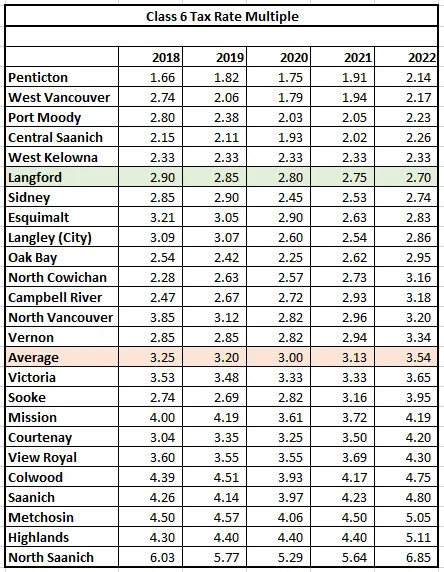
When comparing the 2022 Class 6 multiple to the other CRD municipalities and similar sized municipalities across the province, the City’s multiple is lower than the average.
The following evaluation is based on the Currently Proposed 2023-2027 Five Year Financial Plan that has the proposed tax increase for 2023 at 12.41%. While this increase is still subject to change, the fundamentals of these comparisons will remain the same, just the % change may differ.
OPTIONS EVALUATION
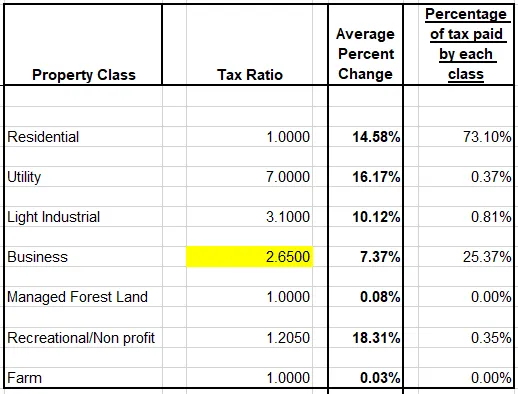
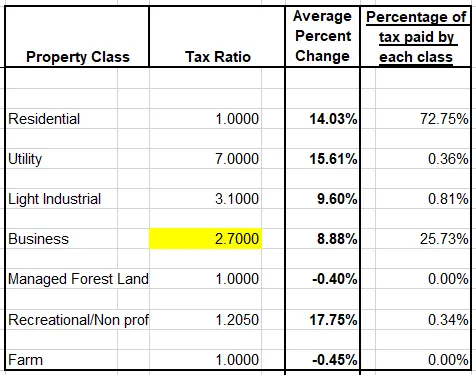
Option A – Maintain current policy and reduce the Class 6 multiple to 2.65 to 2.7 for 2023:
Under this option the 12.41% tax increase would result in the following average impact to the property classes:
It is worth noting that this option continues to shift the tax burden from Class 6 to Class 1. One of the potential benefits of keeping the Class 6 multiple lower is the level of property taxes may be a factor in a business opening within the municipality and thus increasing the overall property taxes collected from Class 6 overall.
Option B – Freeze the Class 6 multiple at 2.7 for 2023:
Under this option the 12.41% tax increase would result in the following average impact to the property classes:
While this option still has a higher average percent change applicable to Class 1, it does reduce that by 0.55% when compared to Option A, and it ensures the Class 6 multiple doesn’t move in the opposite direction after 6 years of shifting it down.
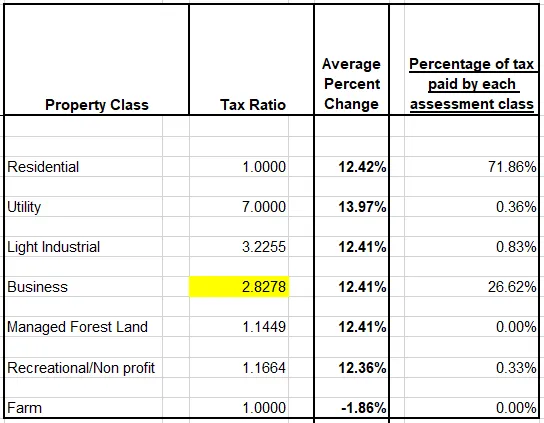
Option C: Abandon the current policy and adjust the Class 6 multiple in order to spread the tax increase impact equally across all property classes:
Under this option the 12.41% tax increase would result in the following average impact to the property classes:
As can be seen under this option, the average percent change is evenly applied across the property classes. The downside to this option is that it shifts the Class 6 multiple from 2.7 (2022) back to 2.8278, essentially moving back three years as per the current policy. The effect of this will be that Class 6 properties will pay a higher amount compared to Class 1 for the same assessed value.
It is worth noting that in addition to spreading the property tax increase evenly across the property classes under this option, it also maintains the percentage of overall property tax paid by each assessment class.
FINANCIAL IMPLICATIONS:
Regardless of the option chosen, the tax rates will be calculated to ensure the appropriate level of property taxes are collected based on the approved Financial Plan.
LEGAL IMPLICATIONS:
The City must adopt a Tax Rates Bylaw before May 15th each year.
OPTIONS:
Option 1
THAT Council direct staff to continue with the current policy to reduce the Class 6 Multiple by 0.05 per year until the multiple is 2.5, with the 2023 multiple being 2.65;
AND THAT Council direct staff to calculate the 2023 tax rates accordingly and bring forward the 2023 Tax Rates Bylaw.
OR Option 2
THAT Council direct staff to freeze the Class 6 Multiple at 2.7 for the 2023 tax year;
AND THAT Council direct staff to calculate the 2023 tax rates accordingly and bring forward the 2023 Tax Rates Bylaw.
OR Option 3
THAT Council direct staff to adjust all property tax multiples to evenly spread the tax increase across all property classes for the 2023 tax year;
AND THAT Council direct staff to calculate the 2023 tax rates accordingly and bring forward the 2023 Tax Rates Bylaw.
SUBMITTED BY: Michael Dillabaugh, CPA, CA, Director of Finance
Concurrence:
Donna Petrie, Senior Manager of Business Development and Events
Concurrence:
Yari Nielsen, Director of Parks, Recreation and Facilities
Concurrence:
Matthew Baldwin, MCIP, RPP, Director of Planning and Subdivision
Concurrence:
Katelyn Balzer, P.Eng., Director of Engineering and Public Works
Concurrence:
Marie Watmough, Deputy Director of Corporate Services
Concurrence: Braden Hutchins, Director of Corporate Services
Concurrence:
Darren Kiedyk, Chief Administrative Officer