DocumentsStaff ReportMar 20, 2017Pages 35–99
Staff Report: Capital Regional District Regional Growth Strategy — Acceptance and Non-Acceptance of Bylaw 4017
Planning staff report summarizing the 2016 CRD Regional Growth Strategy (Bylaw 4017), municipal referral responses, implications of acceptance vs non-acceptance under the Local Government Act, and options for Council direction; includes an appendix of municipal letters/resolutions.
Key facts
- Bylaw referenced: CRD Regional Growth Strategy No. 1, 2016 (Bylaw 4017)
- Referral period and responses: municipalities were asked to accept or not accept; several municipalities objected (various appended letters)
- Legislative references: Section 436/439 of the Local Government Act regarding referral and dispute resolution (binding vs non-binding processes)
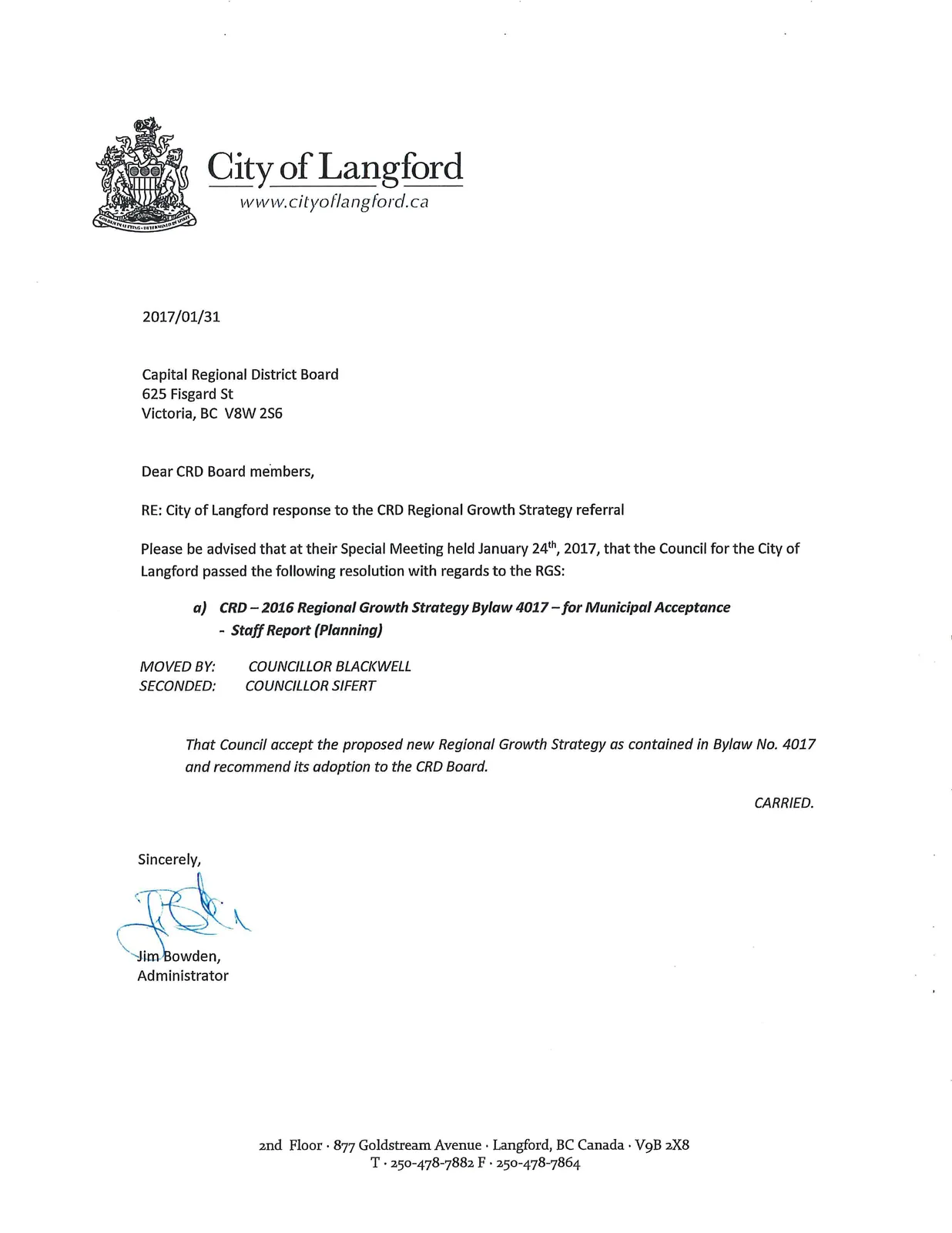
- City of Langford resolution: Council accepted Bylaw 4017 at Special Meeting on January 24, 2017 (letter included in appendices)
Staff Report: Capital Regional District Regional Growth Strategy — Acceptance and Non-Acceptance of Bylaw 4017
Page 35
2nd Floor · 877 Goldstream Avenue · Langford, BC Canada · V9B 2X8 T · 250-478-7882 F · 250-478-7864 Staff Report to Council Date: March 20, 2017 Department: Planning Subject: Capital District Regional Growth Strategy Acceptance and Non-Acceptance of Bylaw 4017 Background In 2011 the Capital Regional District underwent a 5 year review of the 2003 Reginal Growth Strategy (RGS) Bylaw (Bylaw No. 2952) in order to refine policy options and prepare draft policy documents. The newly developed policy document was drafted as Bylaw 4017, “Regional Grown Strategy No. 1, 2016.” The thirteen municipalities and one electoral area (EA) that make up the CRD were referred Bylaw 4017 and requested to state their acceptance or non-acceptance of the new Bylaw. As per the Local Government Act, all municipalities and areas must accept the RGS Bylaw prior to it being adopted by the Regional Board. The CRD received “non-acceptance” of the draft bylaw from seven of the thirteen municipalities, and input from the Juan de Fuca electoral area was provided at an informal referral as well as at a second reading. Many concerns were regarding the content contained within the policy statements. Several municipalities felt that policies regarding climate action, agriculture, transportation, economic development, water servicing and growth management provisions lacked solid wording that could be implemented. Municipalities also felt that policies presented by the RGS did not align with the economic, social and environmental reality or future goals and plans. Most complaints surrounded the differing opinions around water servicing and growth management policies where divergent opinions have remained ongoing and unresolved. Correspondence from each of the municipalities is attached to this report as Appendix A. Page 35 of 154 Page 35 of 154
Page 36
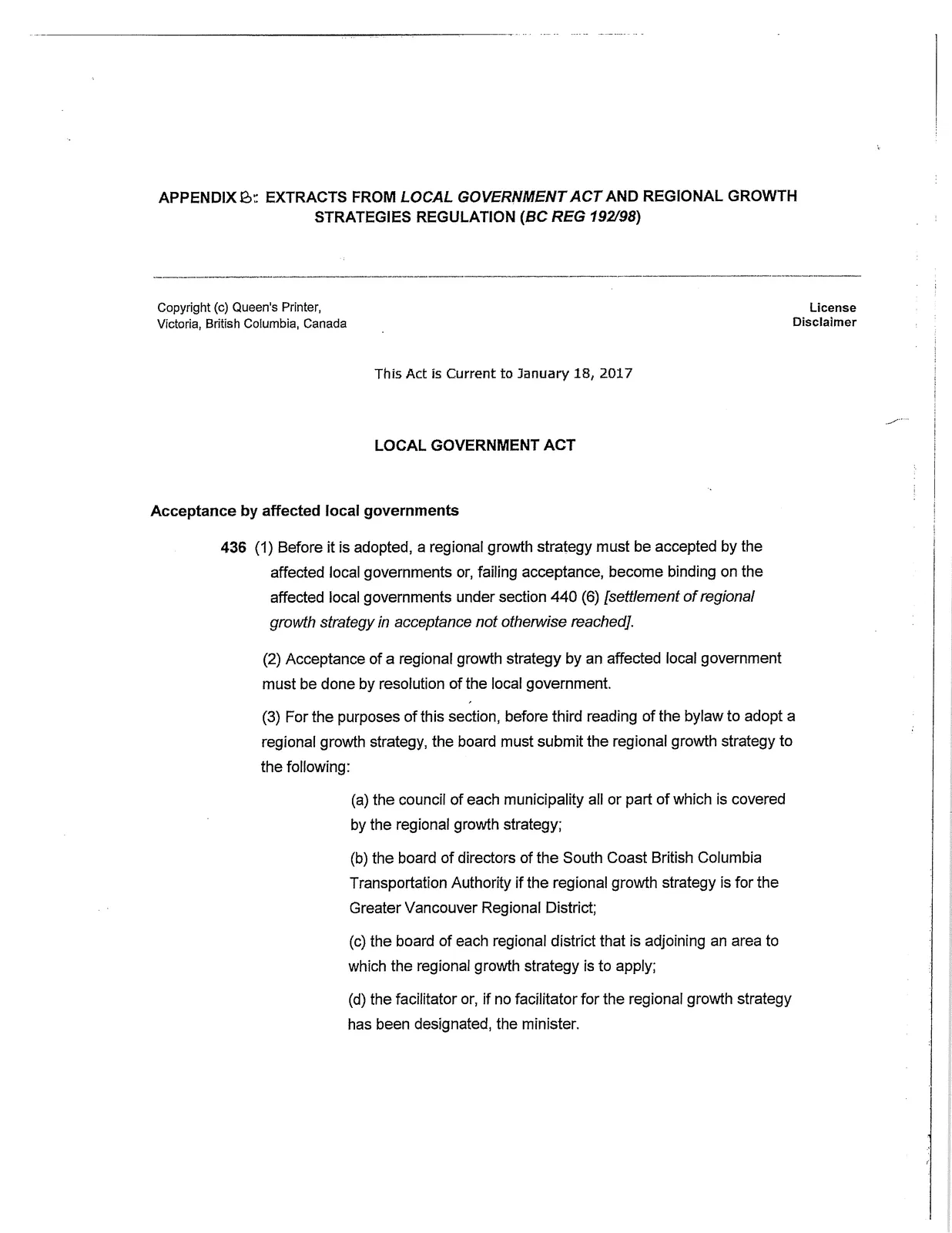
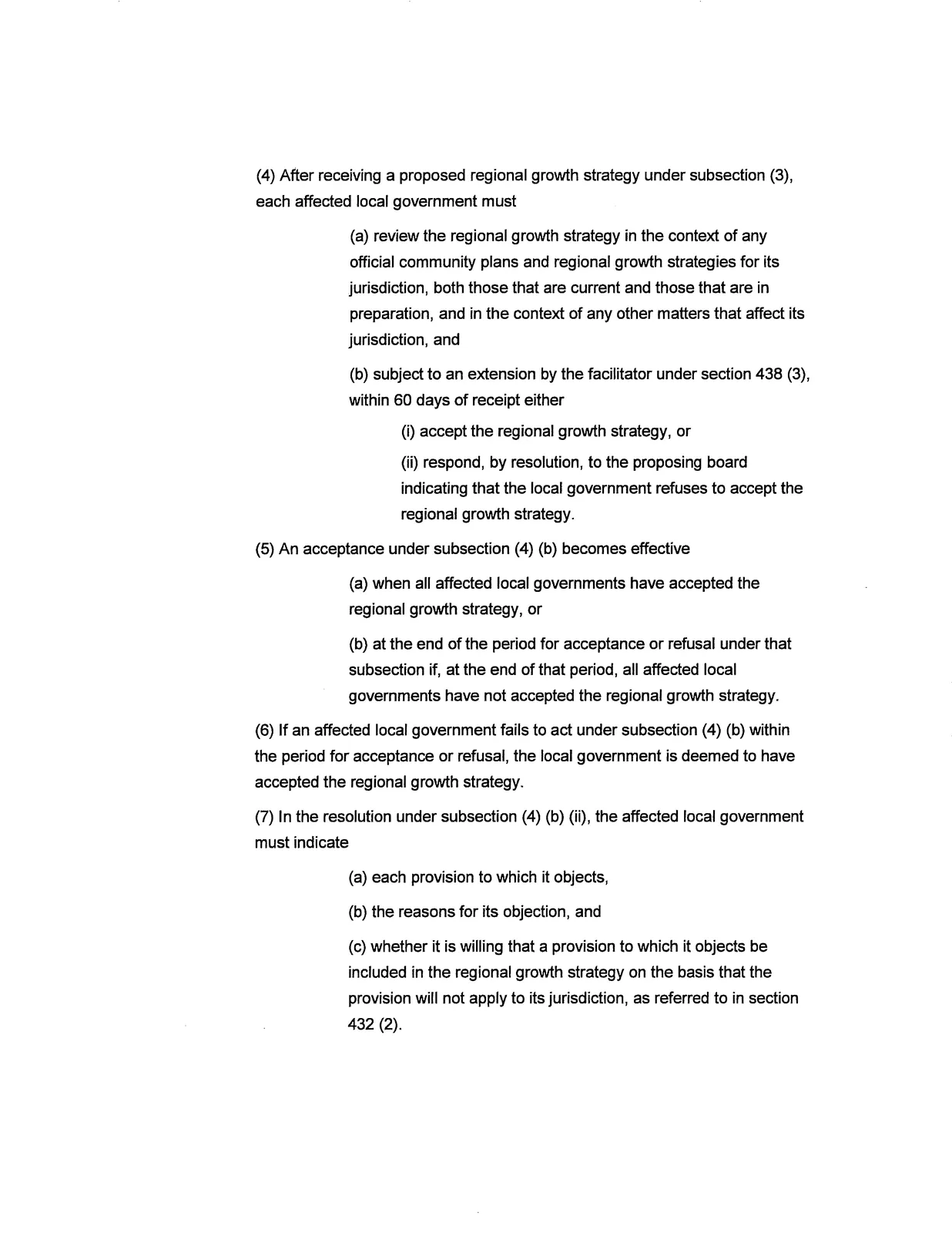
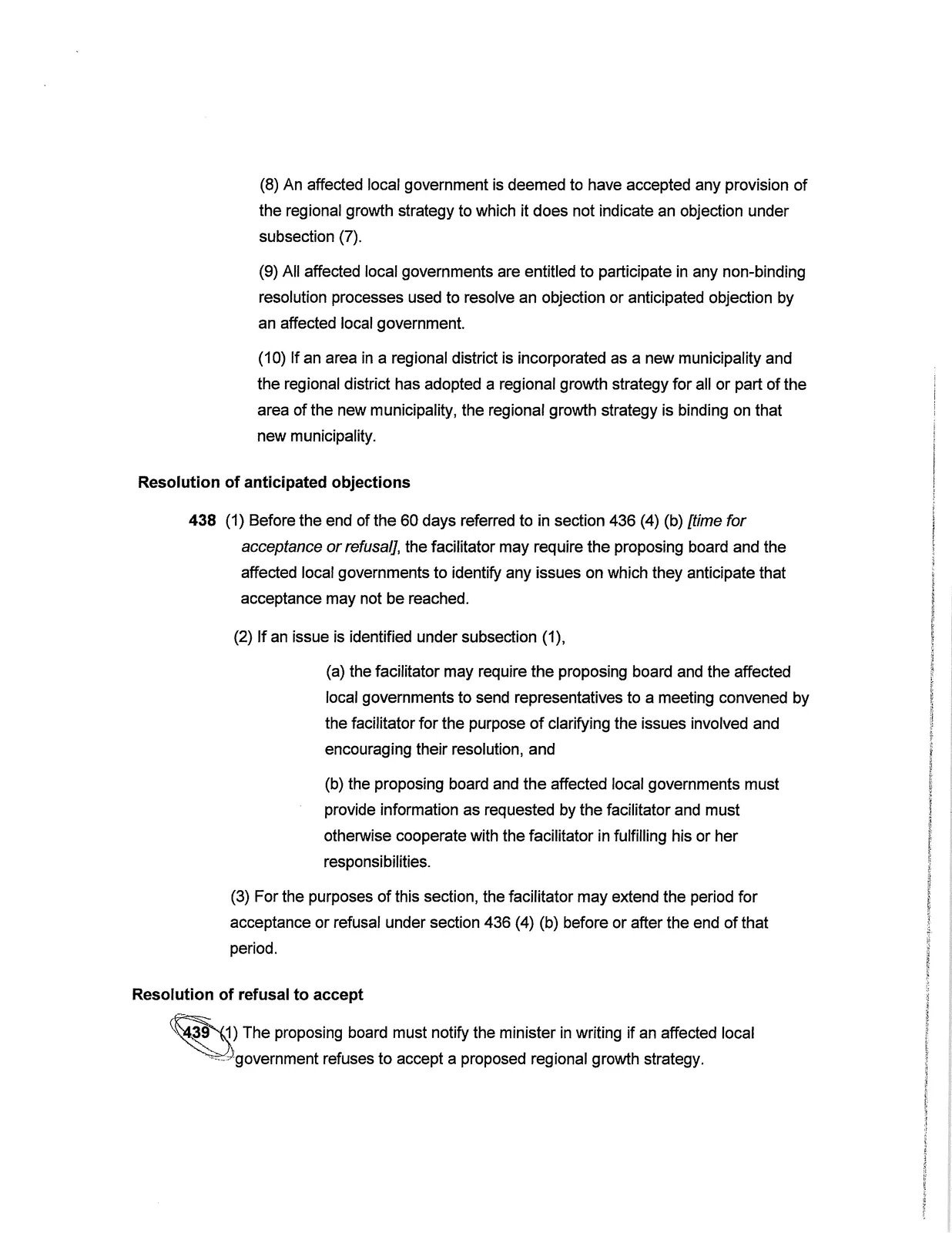
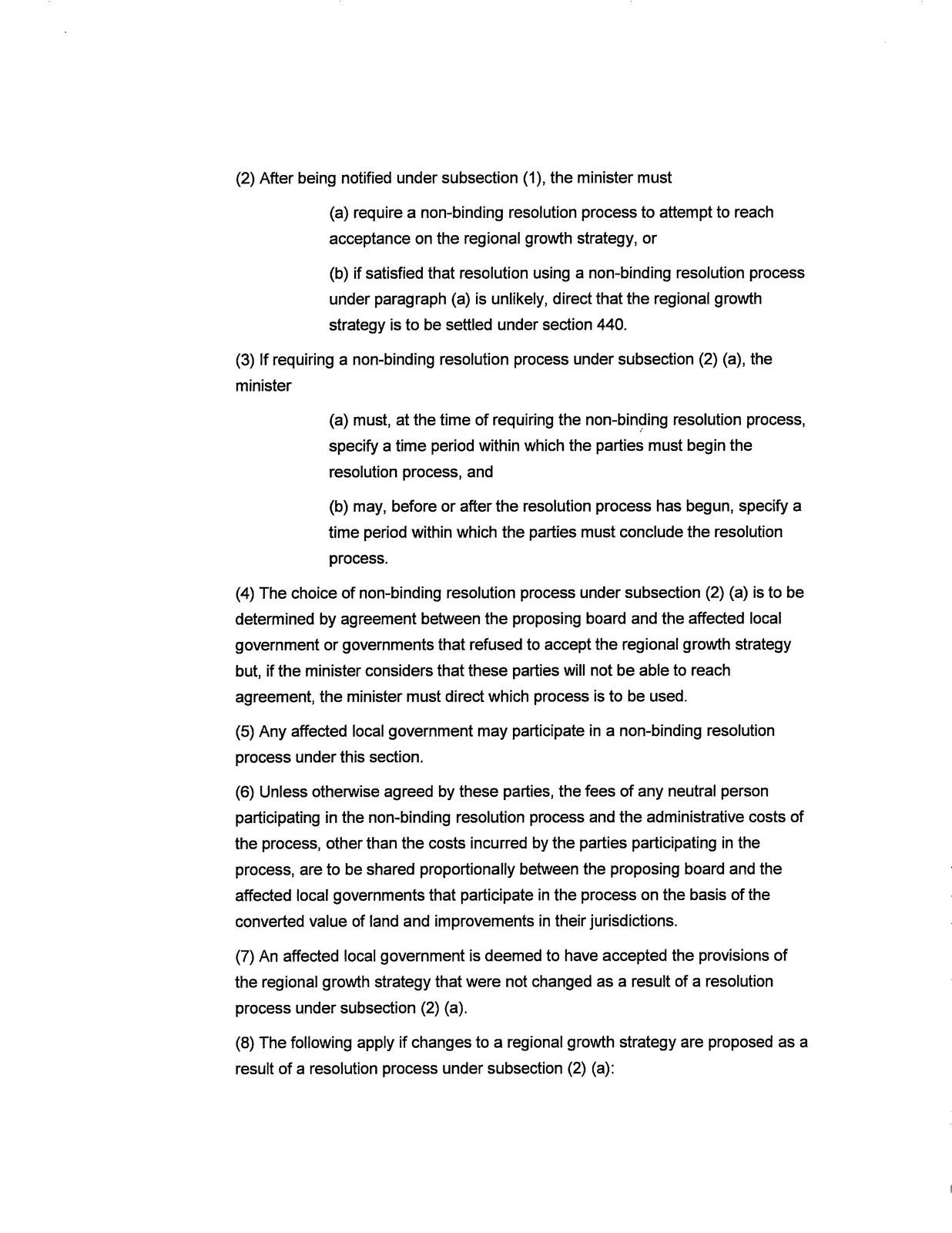
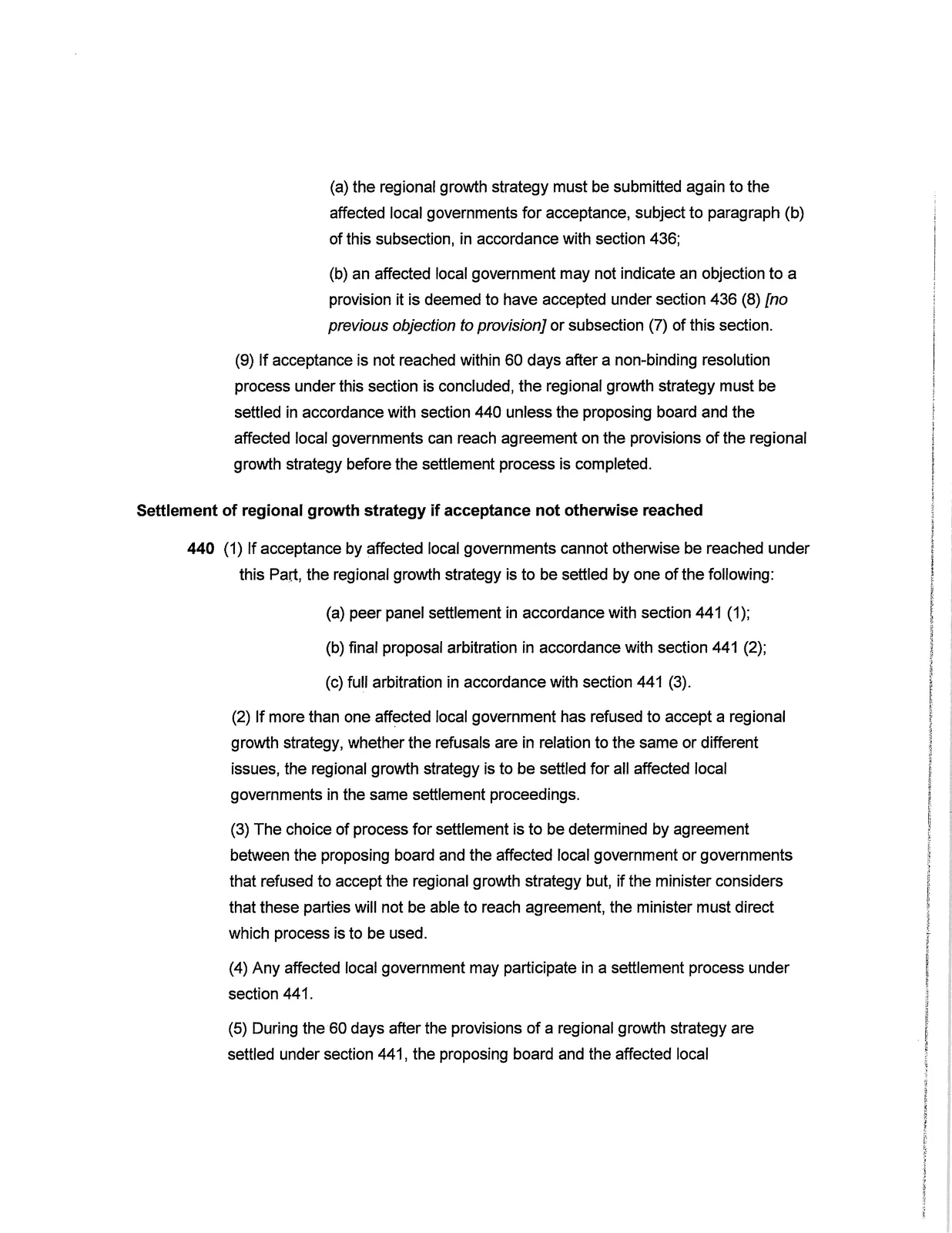
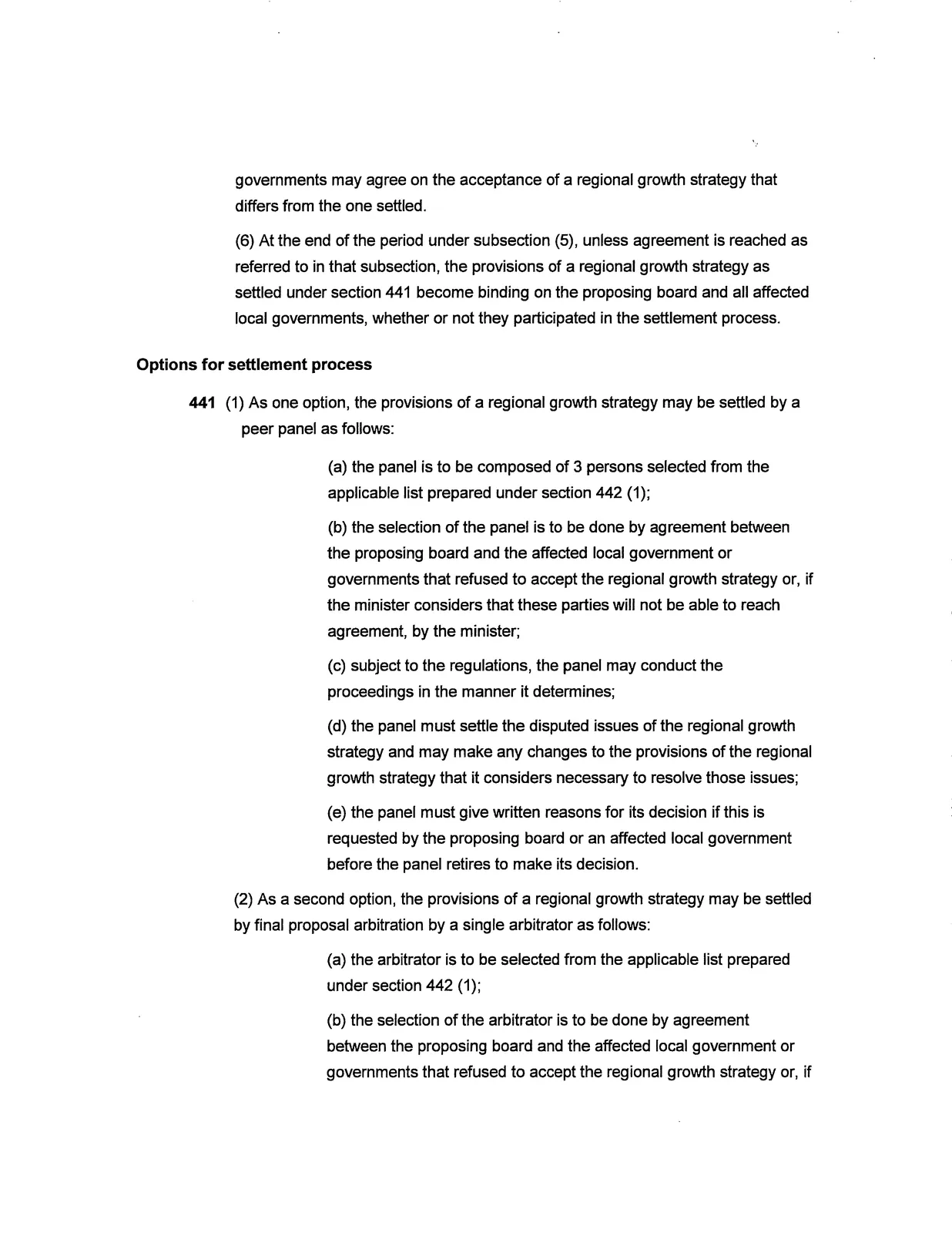
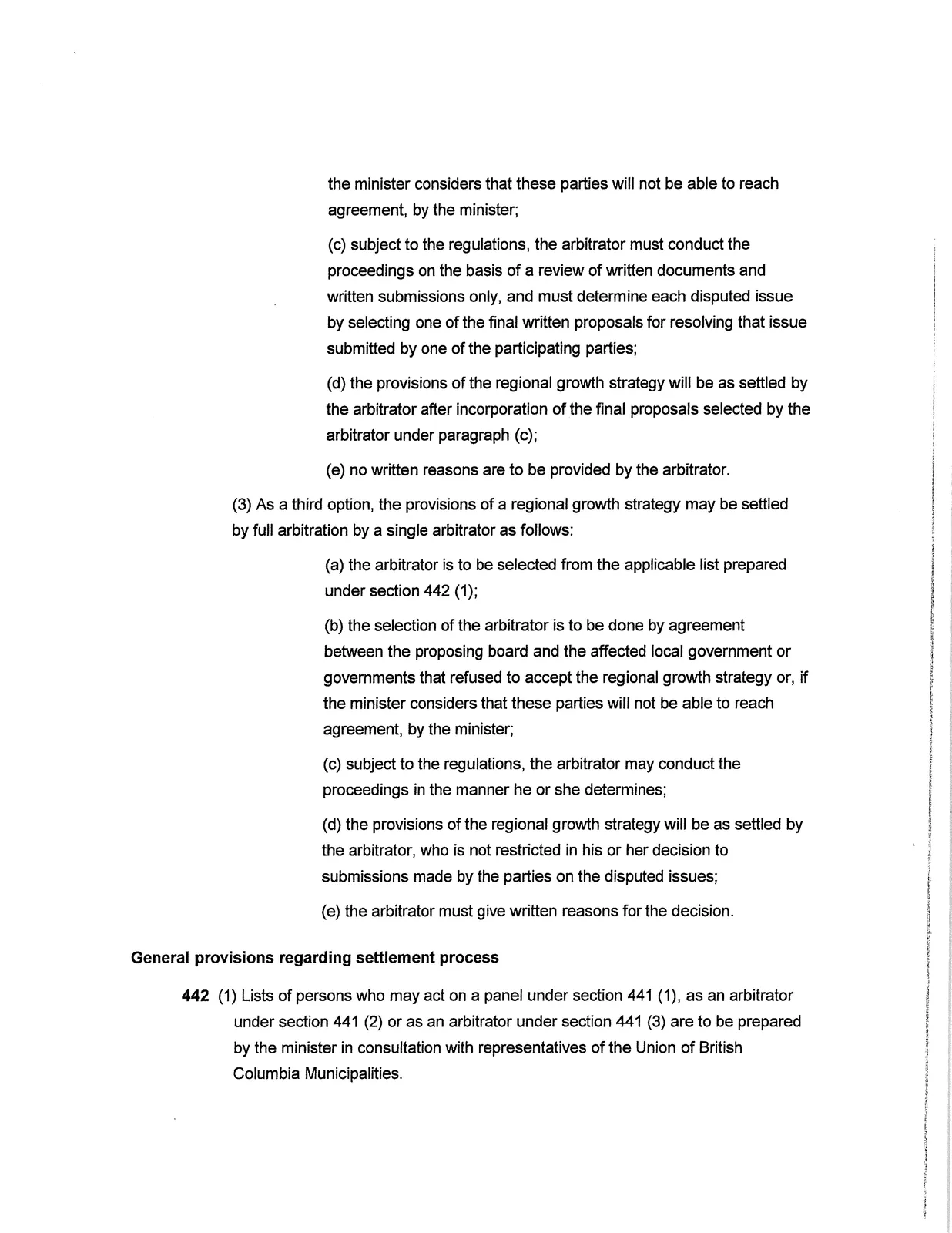
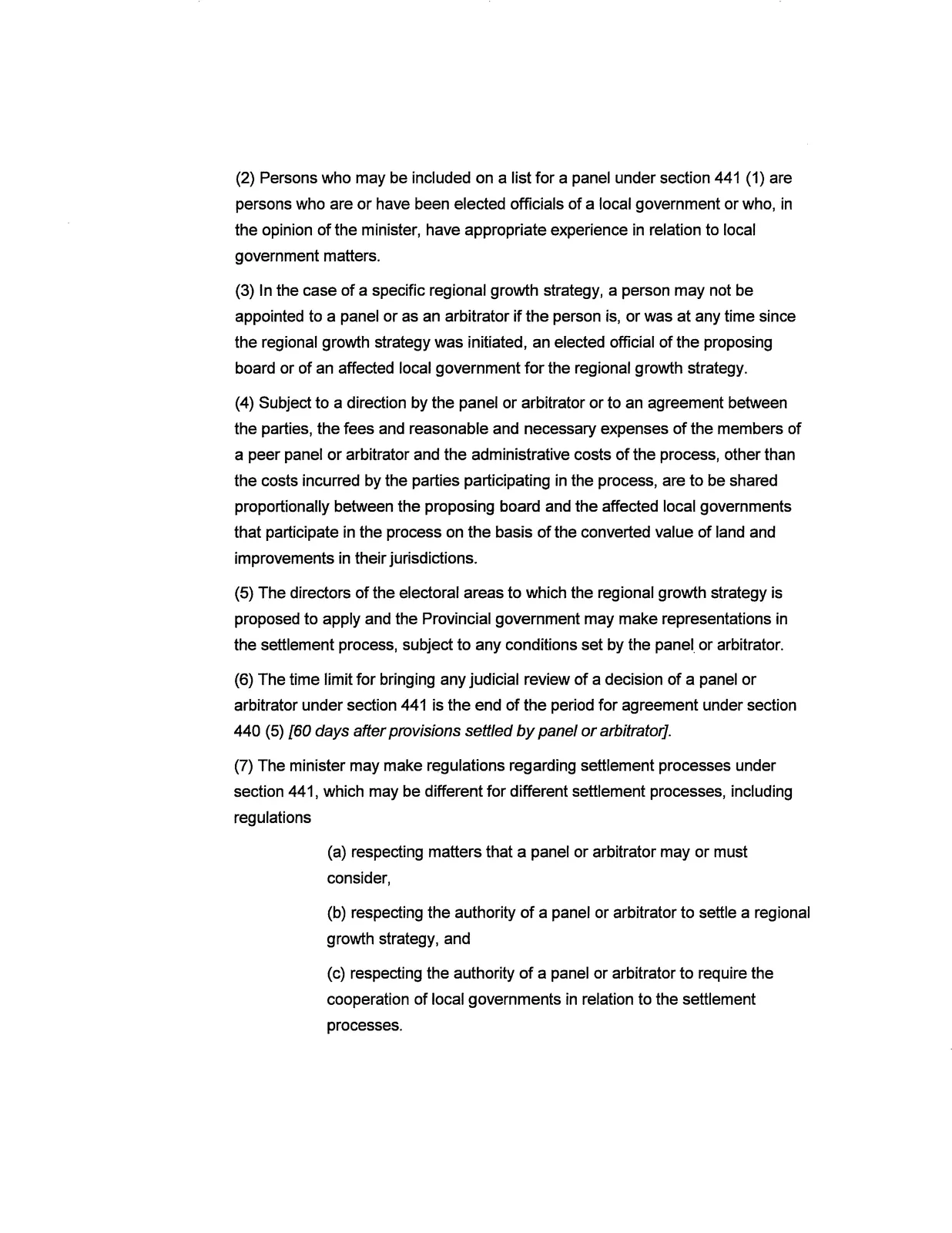
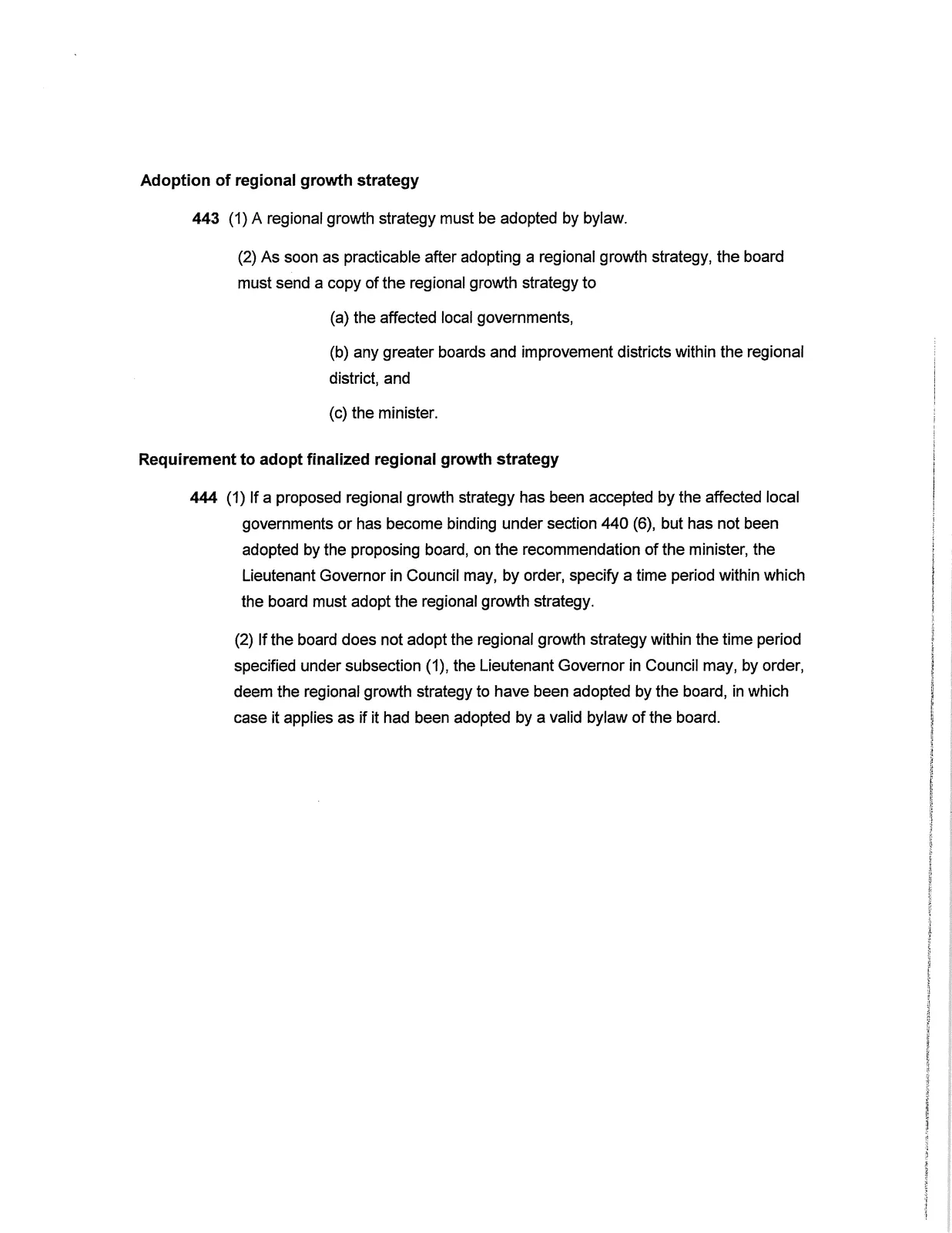
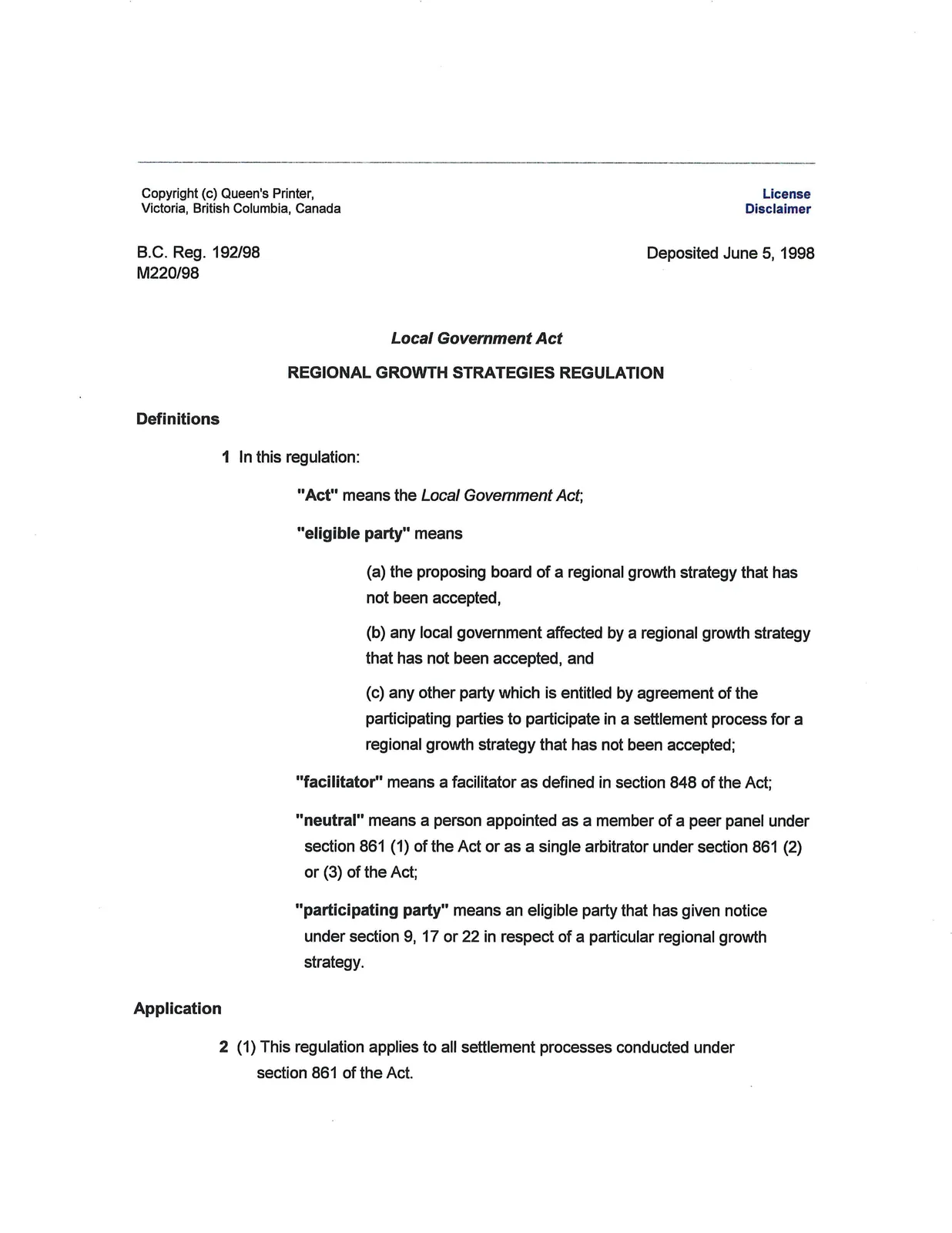
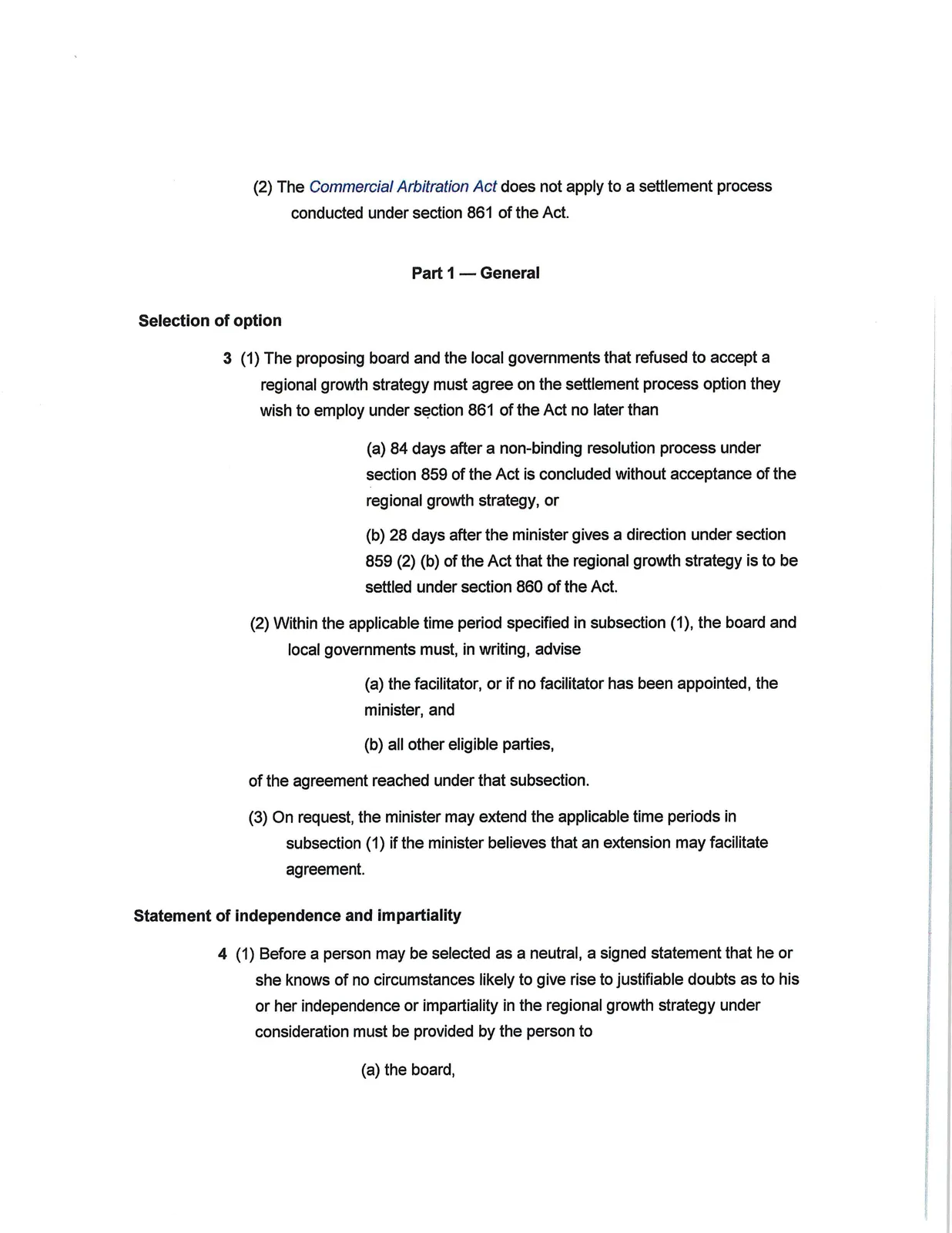
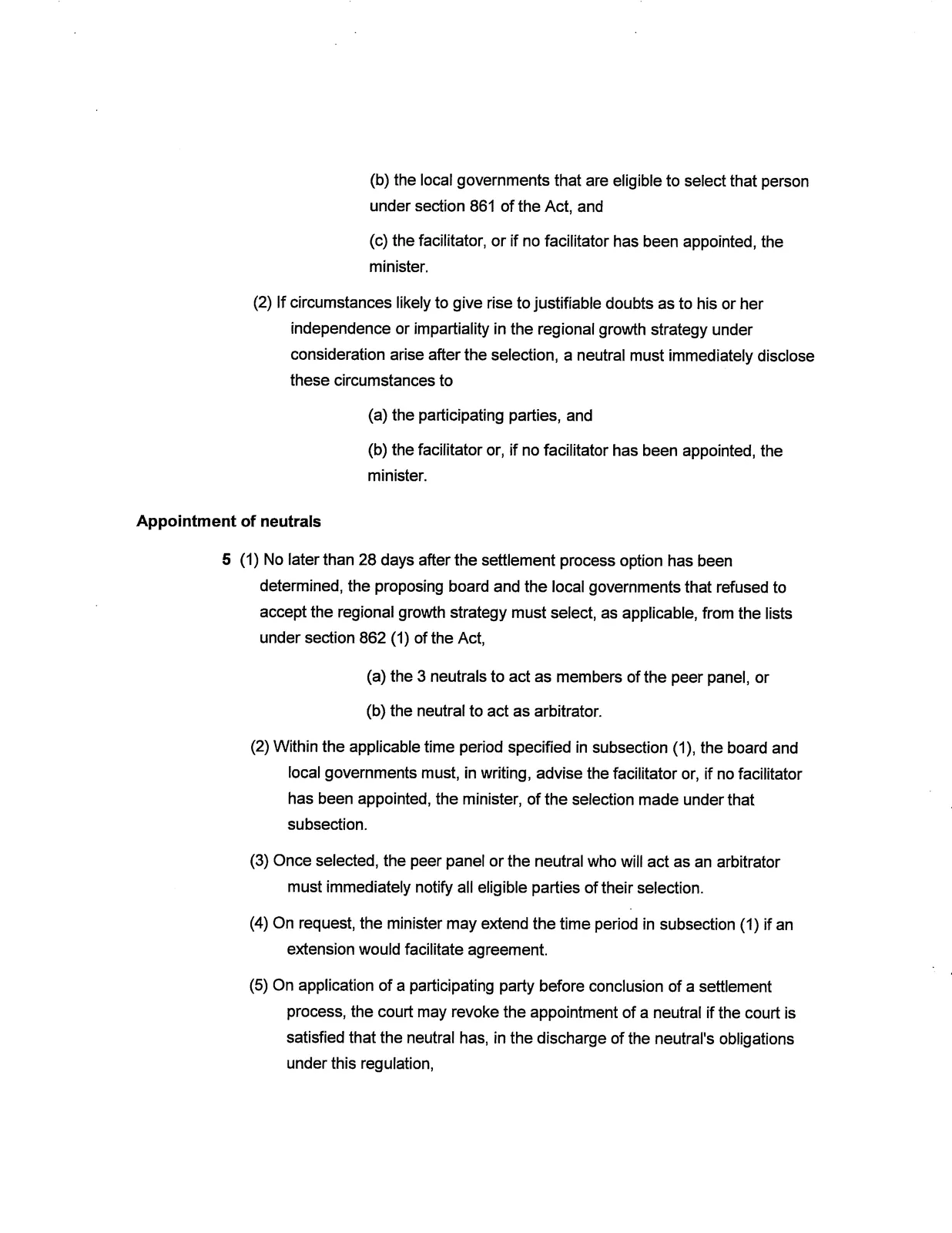
Process Following Non-Acceptance of the RGS Bylaw In accordance with Section 439 of the Local Government Act receiving “non-acceptance” for the RGS requires the CRD to enter into a either a binding or a non-binding process. What process is chosen is the decision of the Ministry of Community, Sport and Cultural Development. A non-binding agreement would follow a process determined by the CRD Board (See Section 439 of the Local Government Act, attached as Appendix B) and participating municipalities. At the conclusion of the non-binding process the RGS would have to be re-referred to all of the CRD municipalities. If any municipalities do not accept the re-referred RGS the Minister would be required to default to a binding settlement process. A binding settlement would require a settlement option, and a peer panel or arbitrator would be chosen and agreed upon by those municipalities who rejected the RGS, if the Minister does not specify a binding settlement approach. If the municipalities cannot reach an agreement then the Minister must direct the binding settlement approach and chose an arbitrator or peer panel. At the conclusion of a binding settlement process a decision is made by an arbitrator or peer panel and is considered final unless an agreement can, within 60 days of the decision, be reached on an RGS that differs from the one settled. Under the binding settlement process, there is nothing that precludes the participating parties from reaching an agreement on an RGS. The chances that a non-binding process would resolve matters are negligible given the divergent goals and perceptions of the municipalities and RGS policies. Therefore the CRD Board is considering recommending binding arbitration process and circumventing a potentially unnecessary process of re- referring the RGS to the CRD municipalities. Langford’s Role If the Minister decides to undertake a non-binding resolution, the City will be involved in the process to establish a process to do so and will be re-referred the RGS Bylaw. If the Minister directs a binding resolution process, as is the recommendation from the Board, a settlement option and peer panel or arbitrator must be selected and agreed upon by the municipalities that rejected the RGS Bylaw. As Langford stated their acceptance of the RGS, they would not be involved in binding resolution. Options Option 1: That Council receive this report for information Or Option 2: That Council reject this report. Page 36 of 154 Page 36 of 154
Page 37
Respectfully submitted, Submitted by: Lauren Morhart, MCIP, RPP, Planner 2 Concurrence: Matthew Baldwin, MCIP, RPP Director of Planning Concurrence: Michelle Mahovlich, P.Eng, P.Geo, Director of Engineering Concurrence: Steve Ternent, Director of Finance Concurrence: Braden Hutchins, Director of Corporate Services Concurrence: Jim Bowden, Chief Administrative Officer Concurrence: Darren Kiedyk, Deputy Chief Administrative Officer :lhm Page 37 of 154 Page 37 of 154
Page 38
APPENDIX A RECORD OF RESOLUTIONS TO ACCEPT AND NOT ACCEPT THE RGS Page 38 of 154 Page 38 of 154
Page 39
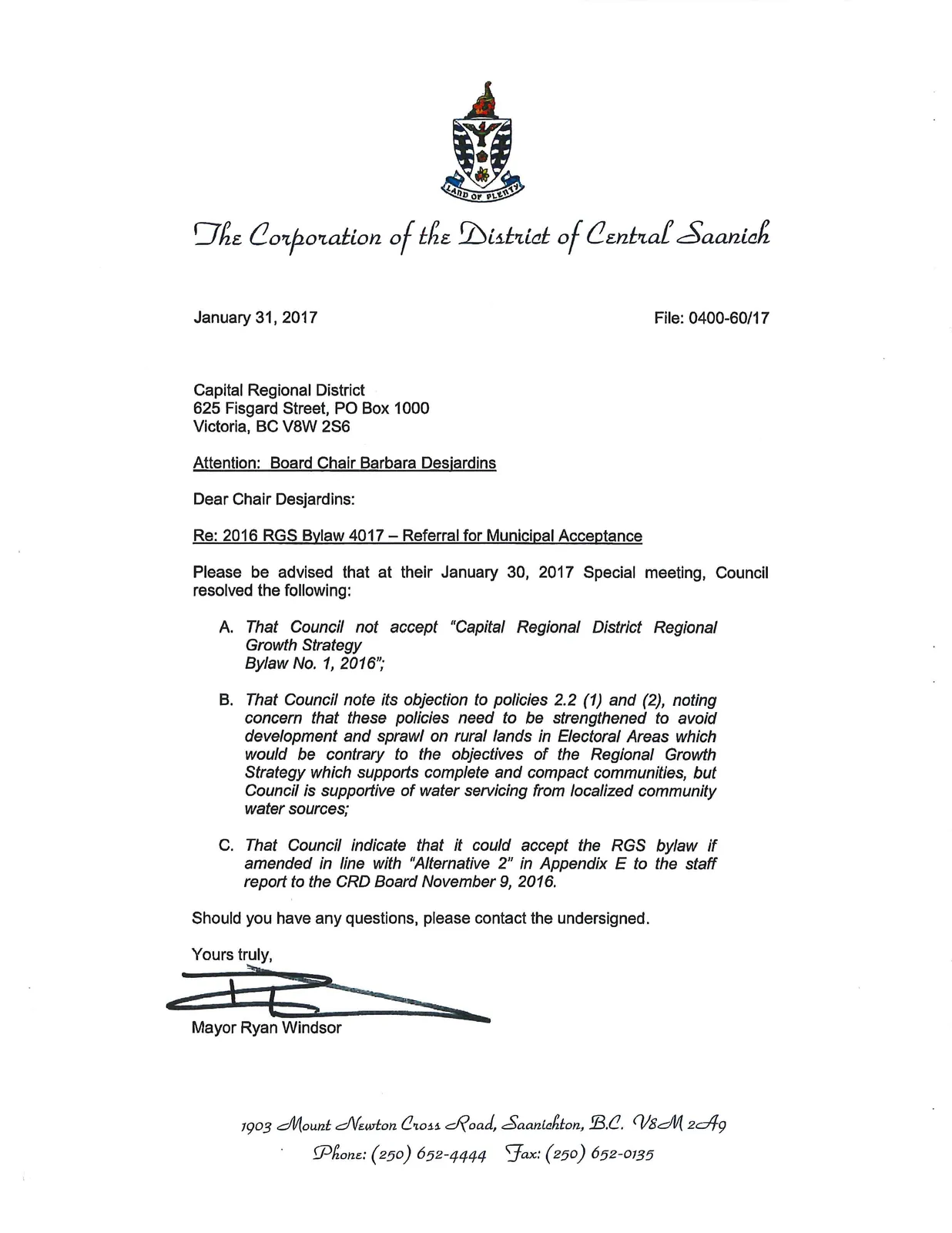
g4E eoltunation of tf2E .11tTiet of CEntzcif <--Saaniefi January 31, 2017 File: 0400-60/17 Capital Regional District 625 Fisgard Street, PO Box 1000 Victoria, BC V8W 2S6 Attention: Board Chair Barbara Desiardins Dear Chair Desjardins: Re: 2016 RGS Bylaw 4017— Referral for Municipal Acceptance Please be advised that at their January 30, 2017 Special meeting, Council resolved the following: A. That Council not accept "Capital Regional District Regional Growth Strategy Bylaw No. 1, 2016"; B. That Council note its objection to policies 2.2 (1) and (2), noting concern that these policies need to be strengthened to avoid development and sprawl on rural lands in Electoral Areas which would be contrary to the objectives of the Regional Growth Strategy which supports complete and compact communities, but Council is supportive of water servicing from localized community water sources; C. That Council indicate that it could accept the RGS bylaw if amended in line with "Alternative 2" in Appendix E to the staff report to the CRD Board November 9, 2016. Should you have any questions, please contact the undersigned. Yours truly, 1903 111ou.i2t- .111E(Altor2 e70J4 cRoad, cS'aanlefitorz, BE, (1/817( 2c..49 iNotzE: (250) 652-444q c:t)c: (250) 652-0135 Page 39 of 154 Page 39 of 154
Page 40
Adv.. Colwood CRD EXECUTIVE OFFICE Received JAN 30 2017 Capital Regional District Regional and Strategic Planning 625 Fisgard Street, PO Box 1000 Victoria, BC V8W 2S6 January 24, 2017 File: 6440-40-REG-12811 Cit/Chair / /b1K" Li Board GeCAO 0 Communications Er NI Pilf For action / resp. by c 0 Corre,sp. for Board / Corn liitee meeting C1,7'-or Information Only El Copies to
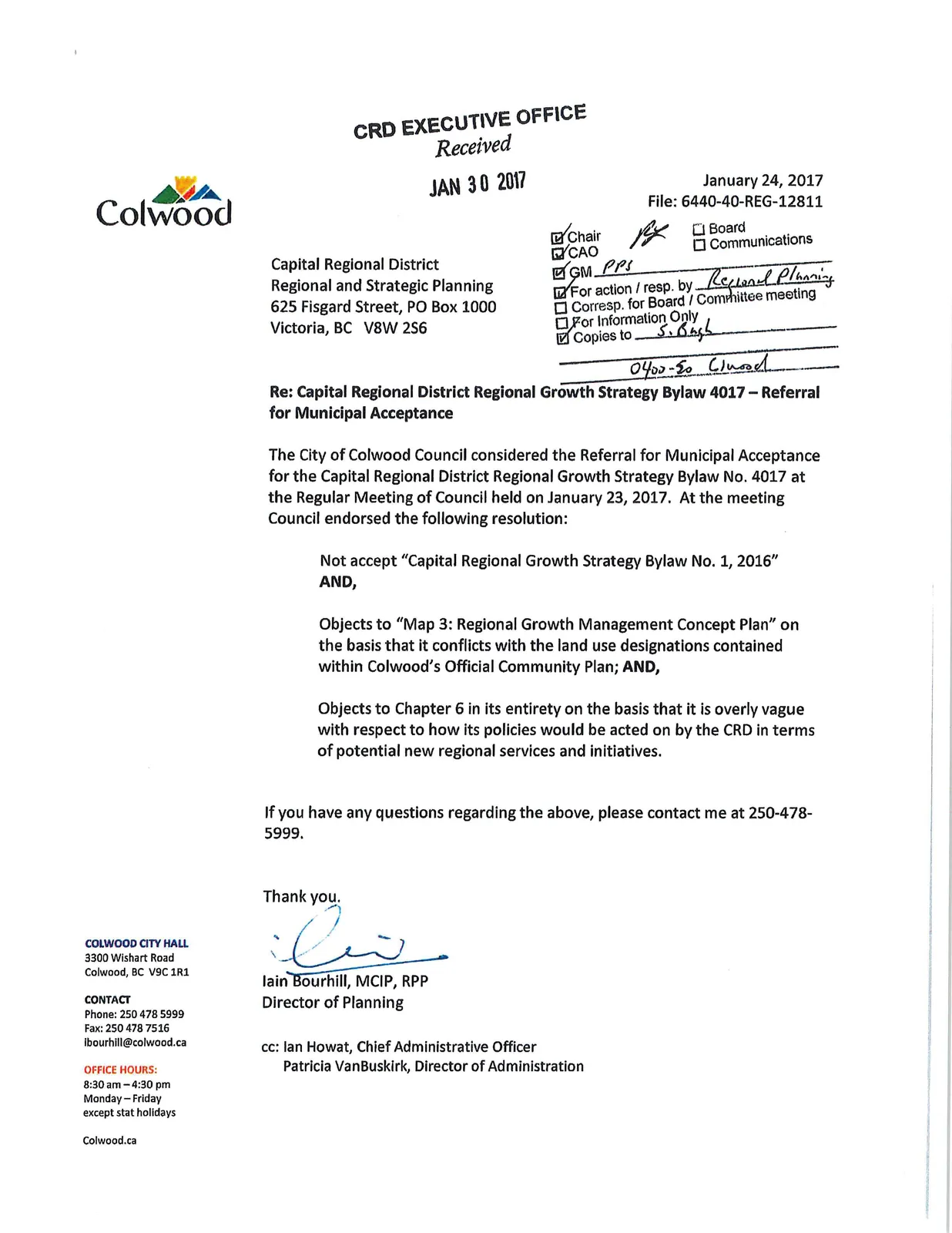
Re: Capital Regional District Regional Growth Strategy Bylaw 4017 — Referral for Municipal Acceptance The City of Colwood Council considered the Referral for Municipal Acceptance for the Capital Regional District Regional Growth Strategy Bylaw No. 4017 at the Regular Meeting of Council held on January 23, 2017. At the meeting Council endorsed the following resolution: Not accept "Capital Regional Growth Strategy Bylaw No. 1, 2016" AND, Objects to "Map 3: Regional Growth Management Concept Plan" on the basis that it conflicts with the land use designations contained within Colwood's Official Community Plan; AND, Objects to Chapter 6 in its entirety on the basis that it is overly vague with respect to how its policies would be acted on by the CRD in terms of potential new regional services and initiatives. If you have any questions regarding the above, please contact me at 250-478- 5999. Thank you. COLWOOD CITY HALL 3300 Wishart Road Colwood, BC V9C 1R1 CONTACT Phone: 250 478 5999 Fax: 250 478 7516 ibourhill@colwood.ca OFFICE HOURS: 8:30 am — 4:30 pm Monday — Friday except stat holidays Colwood.ca lain ourhill, MCIP, RPP Director of Planning cc: Ian Howat, Chief Administrative Officer Patricia VanBuskirk, Director of Administration Page 40 of 154 Page 40 of 154
Page 41
Township of ES UM/TT
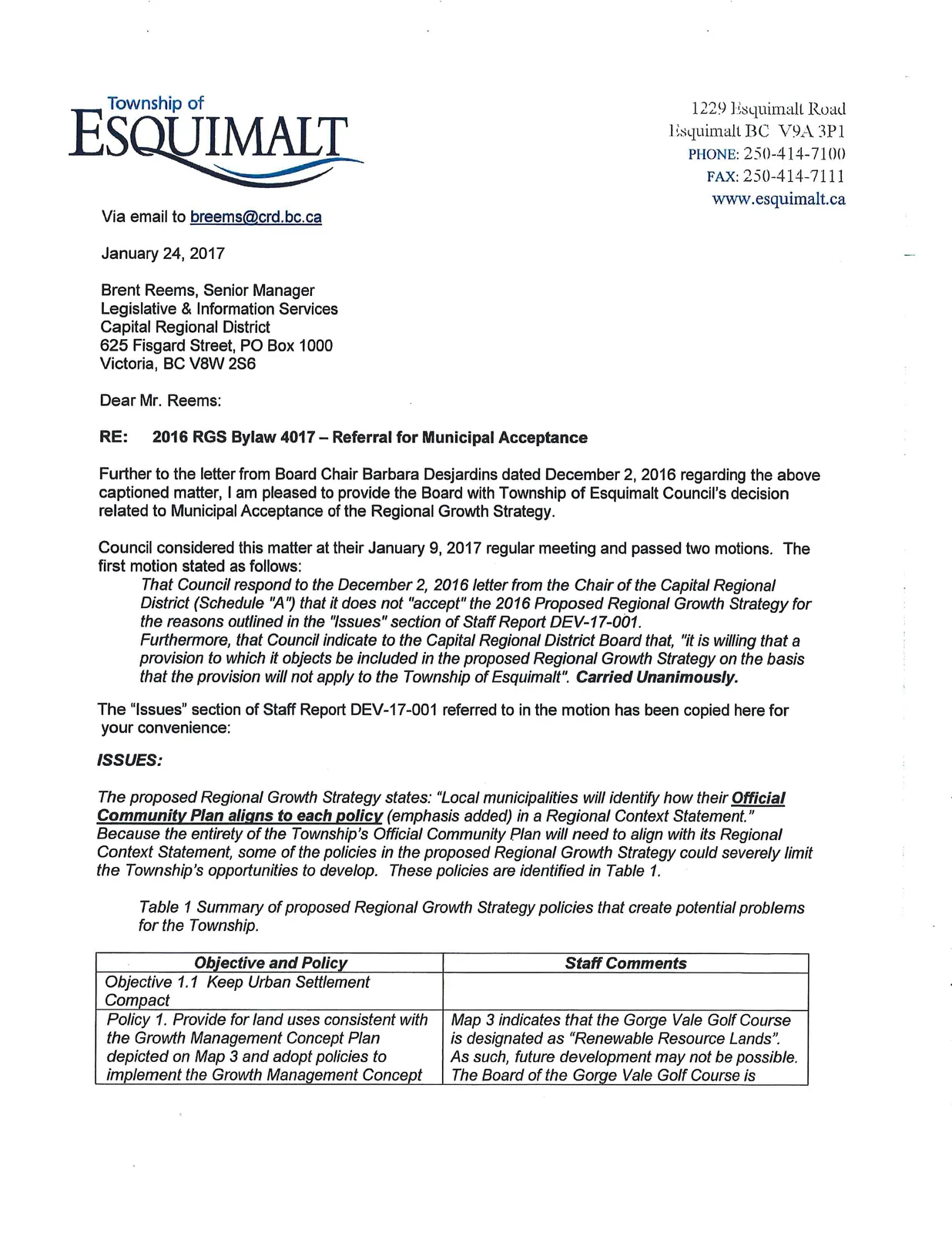
Via email to breemsacrd.bc.ca 12291-.squirna1t Road lsquimalt BC V9.-1. 3P1 PHONE: 250-414-7100 FAX: 250-414-7111 www.esquimaltca January 24, 2017 Brent Reems, Senior Manager Legislative & Information Services Capital Regional District 625 Fisgard Street, PO Box 1000 Victoria, BC V8W 2S6 Dear Mr. Reems: RE: 2016 RGS Bylaw 4017 — Referral for Municipal Acceptance Further to the letter from Board Chair Barbara Desjardins dated December 2, 2016 regarding the above captioned matter, I am pleased to provide the Board with Township of Esquimalt Council's decision related to Municipal Acceptance of the Regional Growth Strategy. Council considered this matter at their January 9, 2017 regular meeting and passed two motions. The first motion stated as follows: That Council respond to the December 2, 2016 letter from the Chair of the Capital Regional District (Schedule "A") that it does not "accept" the 2016 Proposed Regional Growth Strategy for the reasons outlined in the "Issues" section of Staff Report DEV-17-001. Furthermore, that Council indicate to the Capital Regional District Board that, "ft is willing that a provision to which it objects be included in the proposed Regional Growth Strategy on the basis that the provision will not apply to the Township of Esquimalt". Carried Unanimously. The "Issues" section of Staff Report DEV-17-001 referred to in the motion has been copied here for your convenience: ISSUES: The proposed Regional Growth Strategy states: "Local municipalities will identify how their Official Community Plan aligns to each policy (emphasis added) in a Regional Context Statement." Because the entirety of the Township's Official Community Plan will need to align with its Regional Context Statement, some of the policies in the proposed Regional Growth Strategy could severely limit the Township's opportunities to develop. These policies are identified in Table 1. Table 1 Summary of proposed Regional Growth Strategy policies that create potential problems for the Township. Objective and Policy Staff Comments Objective 1.1 Keep Urban Settlement Compact Policy 1. Provide for land uses consistent with the Growth Management Concept Plan depicted on Map 3 and adopt policies to implement the Growth Management Concept Map 3 indicates that the Gorge Vale Golf Course is designated as "Renewable Resource Lands". As such, future development may not be possible. The Board of the Gorge Vale Golf Course is Page 41 of 154 Page 41 of 154
Page 42
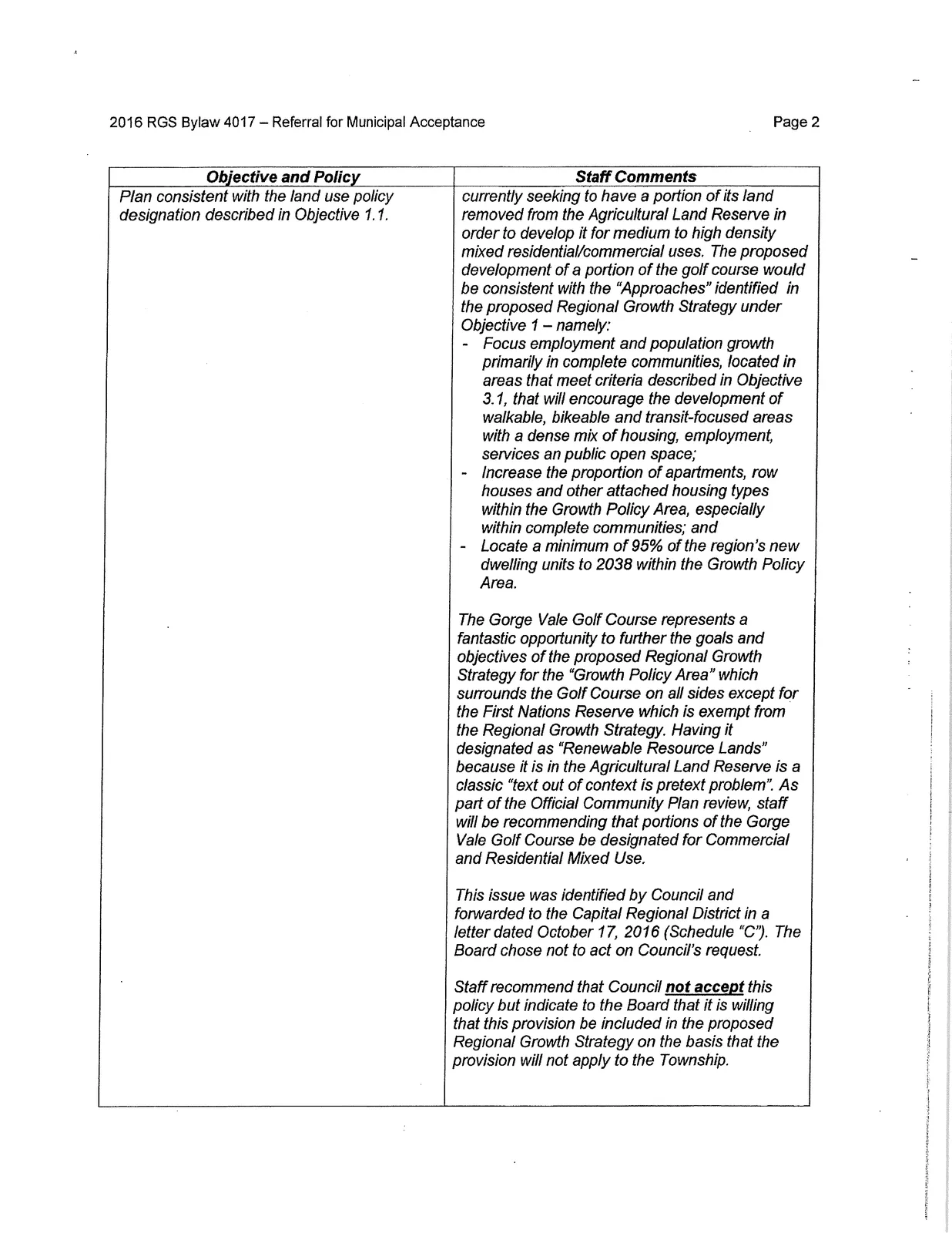
2016 RGS Bylaw 4017 — Referral for Municipal Acceptance Page 2 Objective and Policy Plan consistent with the land use policy designation described in Objective 1.1. Staff Comments currently seeking to have a portion of its land removed from the Agricultural Land Reserve in order to develop it for medium to high density mixed residential/commercial uses. The proposed development of a portion of the golf course would be consistent with the "Approaches" identified in the proposed Regional Growth Strategy under Objective 1 — namely: Focus employment and population growth primarily in complete communities, located in areas that meet criteria described in Objective 3.1, that will encourage the development of walkable, bikeable and transit-focused areas with a dense mix of housing, employment, services an public open space; Increase the proportion of apartments, row houses and other attached housing types within the Growth Policy Area, especially within complete communities; and Locate a minimum of 95% of the region's new dwelling units to 2038 within the Growth Policy Area. The Gorge Vale Golf Course represents a fantastic opportunity to further the goals and objectives of the proposed Regional Growth Strategy for the "Growth Policy Area" which surrounds the Golf Course on all sides except for the First Nations Reserve which is exempt from the Regional Growth Strategy. Having it designated as "Renewable Resource Lands" because it is in the Agricultural Land Reserve is a classic "text out of context is pretext problem". As part of the Official Community Plan review, staff will be recommending that portions of the Gorge Vale Goff Course be designated for Commercial and Residential Mixed Use. This issue was identified by Council and forwarded to the Capital Regional District in a letter dated October 17, 2016 (Schedule "C'). The Board chose not to act on Council's request. Staff recommend that Council not accept this policy but indicate to the Board that it is willing that this provision be included in the proposed Regional Growth Strategy on the basis that the provision will not apply to the Township. Page 42 of 154 Page 42 of 154
Page 43
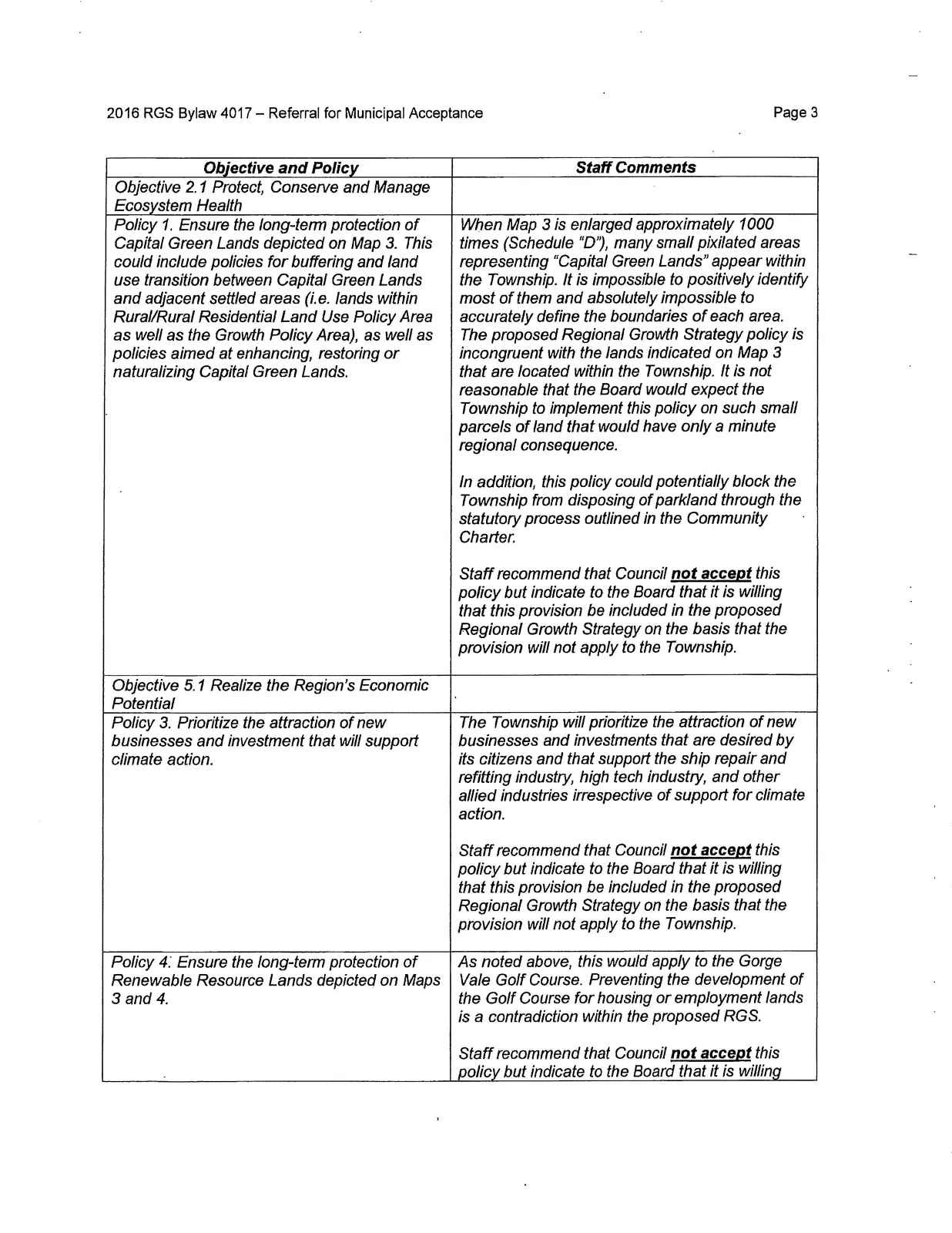
2016 RGS Bylaw 4017 — Referral for Municipal Acceptance Page 3 Objective and Policy Staff Comments Objective 2.1 Protect, Conserve and Manage Ecosystem Health Policy 1. Ensure the long-term protection of Capital Green Lands depicted on Map 3. This could include policies for buffering and land use transition between Capital Green Lands and adjacent settled areas (i.e. lands within Rural/Rural Residential Land Use Policy Area as well as the Growth Policy Area), as well as policies aimed at enhancing, restoring or naturalizing Capital Green Lands. When Map 3 is enlarged approximately 1000 times (Schedule "D"), many small pixilated areas representing "Capital Green Lands" appear within the Township. It is impossible to positively identify most of them and absolutely impossible to accurately define the boundaries of each area. The proposed Regional Growth Strategy policy is incongruent with the lands indicated on Map 3 that are located within the Township. It is not reasonable that the Board would expect the Township to implement this policy on such small parcels of land that would have only a minute regional consequence. In addition, this policy could potentially block the Township from disposing of parkland through the statutory process outlined in the Community . Charter. Staff recommend that Council not accept this policy but indicate to the Board that it/s willing that this provision be included in the proposed Regional Growth Strategy on the basis that the provision will not apply to the Township. Objective 5.1 Realize the Region's Economic Potential . Policy 3. Prioritize the attraction of new businesses and investment that will support climate action. The Township will prioritize the attraction of new businesses and investments that are desired by its citizens and that support the ship repair and refitting industry, high tech industry, and other allied industries irrespective of support for climate action. Staff recommend that Council not accept this policy but indicate to the Board that it is willing that this provision be included in the proposed Regional Growth Strategy on the basis that the provision will not apply to the Township. Policy 4: Ensure the long-term protection of Renewable Resource Lands depicted on Maps 3 and 4. As noted above, this would apply to the Gorge Vale Golf Course. Preventing the development of the Golf Course for housing or employment lands is a contradiction within the proposed RGS. Staff recommend that Council not accept this policy but indicate to the Board that it is willing Page 43 of 154 Page 43 of 154
Page 44
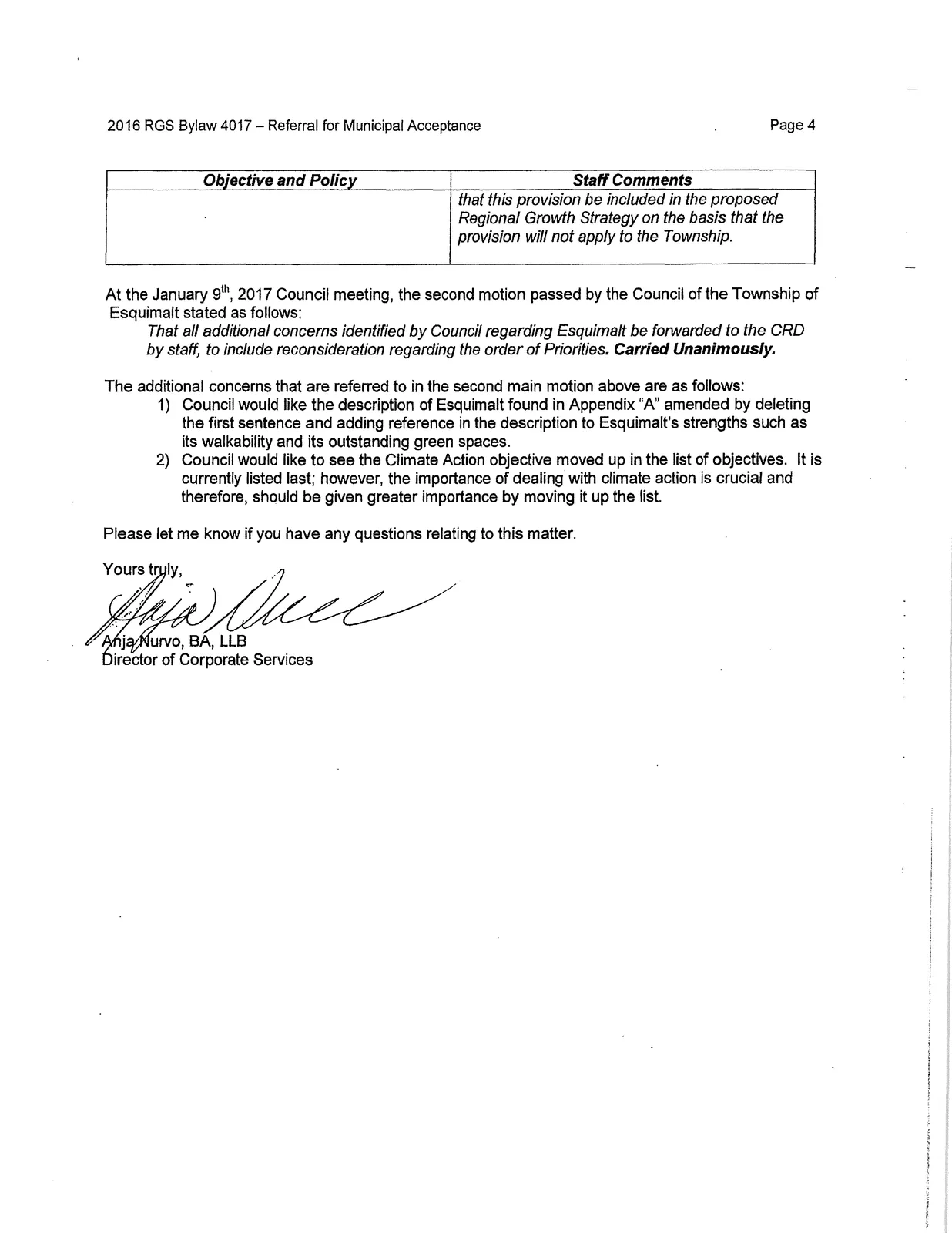
1 urvo, BA, LLB Yours tr ly, 2016 RGS Bylaw 4017 — Referral for Municipal Acceptance Page 4 Objective and Policy Staff Comments that this provision be included in the proposed Regional Growth Strategy on the basis that the provision will not apply to the Township. At the January 9th, 2017 Council meeting, the second motion passed by the Council of the Township of Esquimalt stated as follows: That all additional concerns identified by Council regarding Esquimalt be forwarded to the CRD by staff, to include reconsideration regarding the order of Priorities. Carried Unanimously. The additional concerns that are referred to in the second main motion above are as follows:
- Council would like the description of Esquimalt found in Appendix "A" amended by deleting the first sentence and adding reference in the description to Esquimalt's strengths such as its walkability and its outstanding green spaces.
- Council would like to see the Climate Action objective moved up in the list of objectives. It is currently listed last; however, the importance of dealing with climate action is crucial and therefore, should be given greater importance by moving it up the list. Please let me know if you have any questions relating to this matter. irector of Corporate Services Page 44 of 154 Page 44 of 154
Page 45
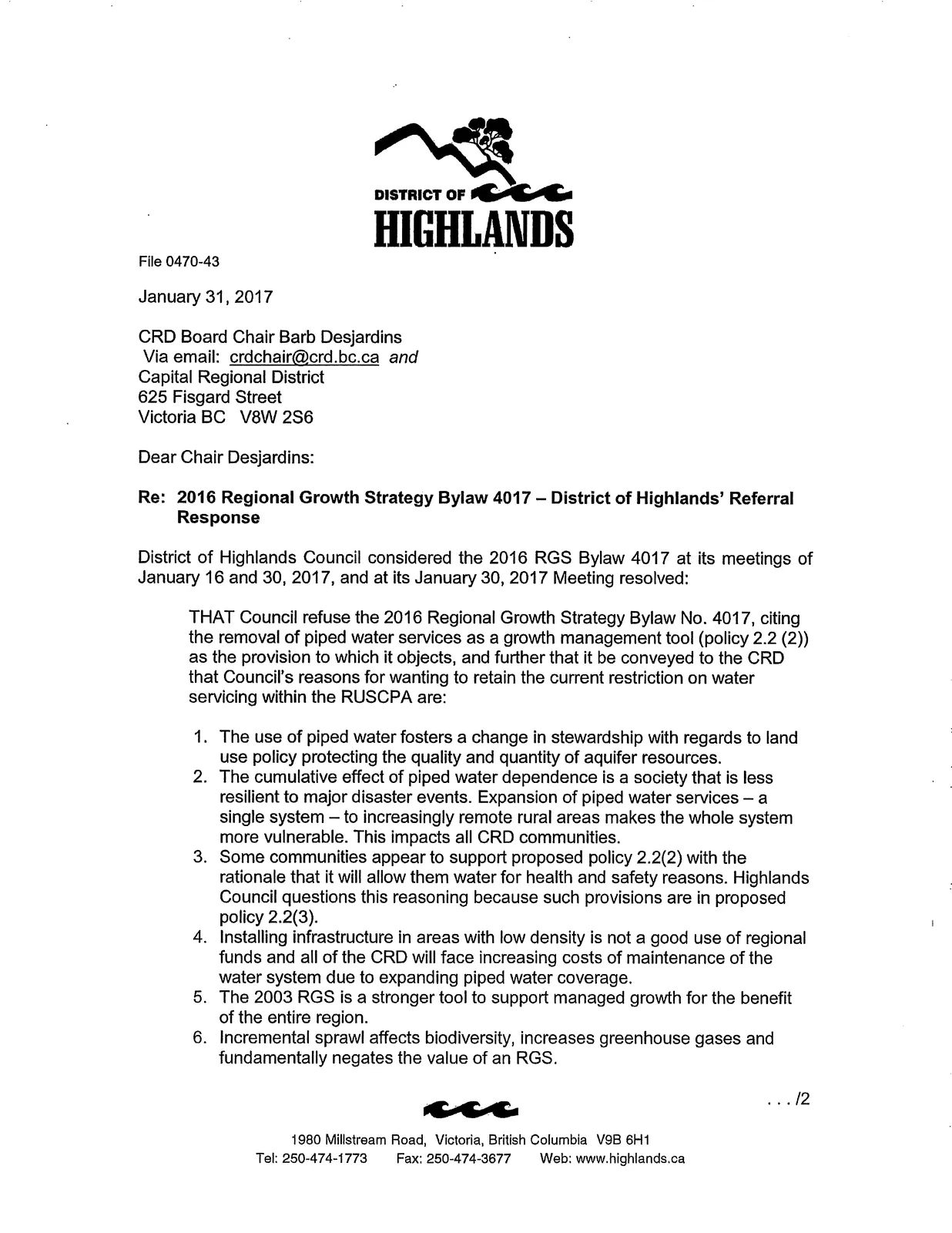
DISTRICT OF 010101601161 HIGHLANDS File 0470-43 January 31, 2017 CRD Board Chair Barb Desjardins Via email: crdchaircrd.bc.ca and Capital Regional District 625 Fisgard Street Victoria BC V8W 2S6 Dear Chair Desjardins: Re: 2016 Regional Growth Strategy Bylaw 4017 — District of Highlands' Referral Response District of Highlands Council considered the 2016 RGS Bylaw 4017 at its meetings of January 16 and 30, 2017, and at its January 30, 2017 Meeting resolved: THAT Council refuse the 2016 Regional Growth Strategy Bylaw No. 4017, citing the removal of piped water services as a growth management tool (policy 2.2 (2)) as the provision to which it objects, and further that it be conveyed to the CRD that Council's reasons for wanting to retain the current restriction on water servicing within the RUSCPA are:
- The use of piped water fosters a change in stewardship with regards to land use policy protecting the quality and quantity of aquifer resources.
- The cumulative effect of piped water dependence is a society that is less resilient to major disaster events. Expansion of piped water services — a single system — to increasingly remote rural areas makes the whole system more vulnerable. This impacts all CRD communities.
- Some communities appear to support proposed policy 2.2(2) with the rationale that it will allow them water for health and safety reasons. Highlands Council questions this reasoning because such provisions are in proposed policy 2.2(3).
- Installing infrastructure in areas with low density is not a good use of regional funds and all of the CRD will face increasing costs of maintenance of the water system due to expanding piped water coverage.
- The 2003 RGS is a stronger tool to support managed growth for the benefit of the entire region.
- Incremental sprawl affects biodiversity, increases greenhouse gases and fundamentally negates the value of an RGS. 04110604161 . . . /2 1980 Millstream Road, Victoria, British Columbia V9B 6H1 Tel: 250-474-1773 Fax: 250-474-3677 Web: www.highlands.ca Page 45 of 154 Page 45 of 154
Page 46
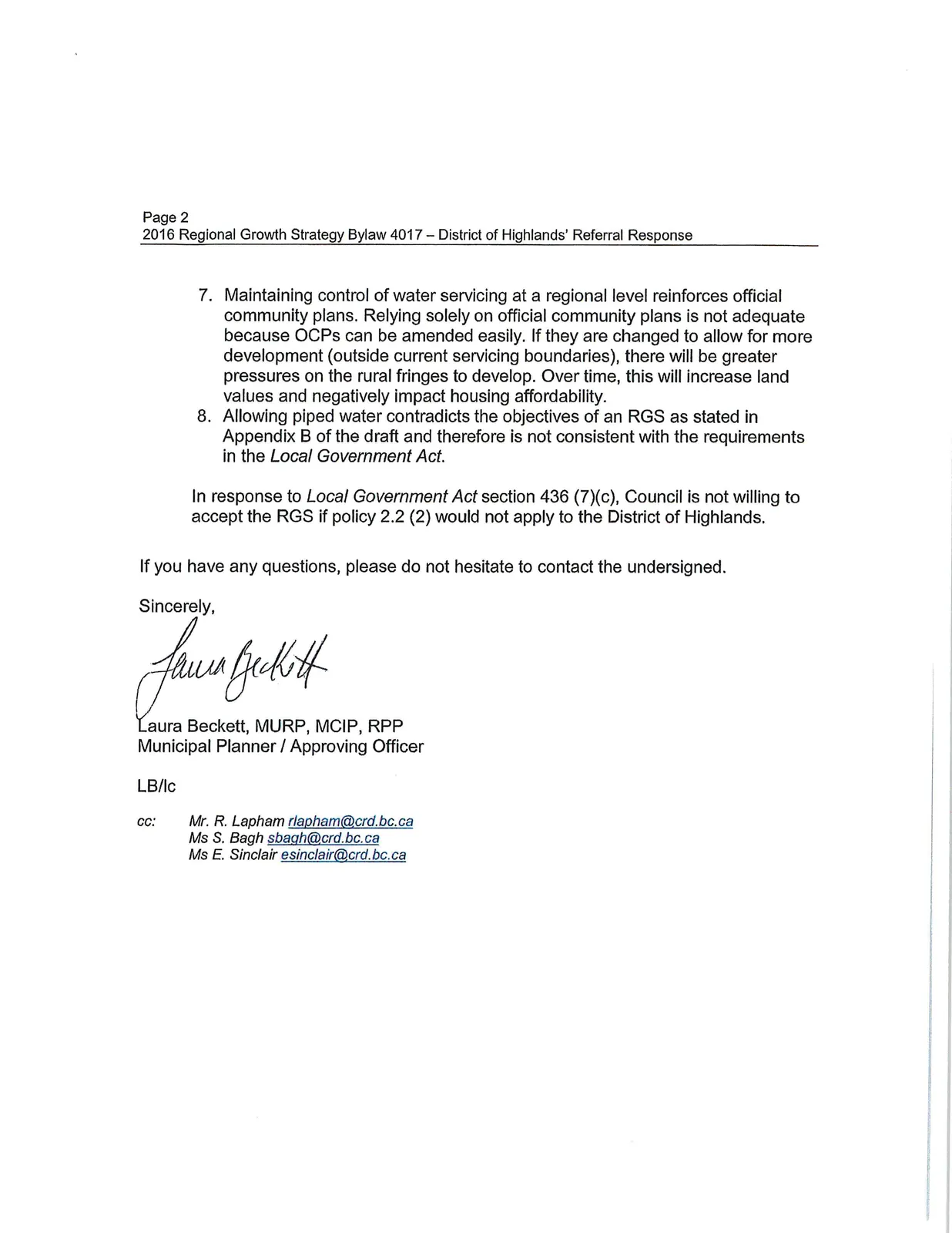
Page 2 2016 Regional Growth Strategy Bylaw 4017 — District of Highlands' Referral Response 7. Maintaining control of water servicing at a regional level reinforces official community plans. Relying solely on official community plans is not adequate because OCPs can be amended easily. If they are changed to allow for more development (outside current servicing boundaries), there will be greater pressures on the rural fringes to develop. Over time, this will increase land values and negatively impact housing affordability. 8. Allowing piped water contradicts the objectives of an RGS as stated in Appendix B of the draft and therefore is not consistent with the requirements in the Local Government Act. In response to Local Government Act section 436 (7)(c), Council is not willing to accept the RGS if policy 2.2 (2) would not apply to the District of Highlands. If you have any questions, please do not hesitate to contact the undersigned. Sincerely, Laura Beckett, MURP, MCIP, RPP Municipal Planner / Approving Officer LB/Ic cc: Mr. R. Lapham rlaphamcrd.bc.ca Ms S. Bagh sbaqhcrd.bc.ca Ms E. Sinclair esinclair@crd.bc.ca Page 46 of 154 Page 46 of 154
Page 47
City of Langford www.ci t yo a nglorcl. ca 2017/01/31 Capital Regional District Board 625 Fisgard St Victoria, BC V8W 2S6 Dear CRD Board members, RE: City of Langford response to the CRD Regional Growth Strategy referral Please be advised that at their Special Meeting held January 24th, 2017, that the Council for the City of Langford passed the following resolution with regards to the RGS: a) CRD —2016 Regional Growth Strategy Bylaw 4017 —for Municipal Acceptance
- Staff Report (Planning) MOVED BY: COUNCILLOR BLACK WELL SECONDED: COUNCILLOR SIFERT That Council accept the proposed new Regional Growth Strategy as contained in Bylaw No. 4017 and recommend its adoption to the CRD Board. CARRIED. Sincerely, Jim 8owden, Administrator 2nd Floor • 877 Goldstream Avenue Langford, BC Canada • V9B 2X8 T • 250-478-7882 F • 250-478-7864 Page 47 of 154 Page 47 of 154
Page 48
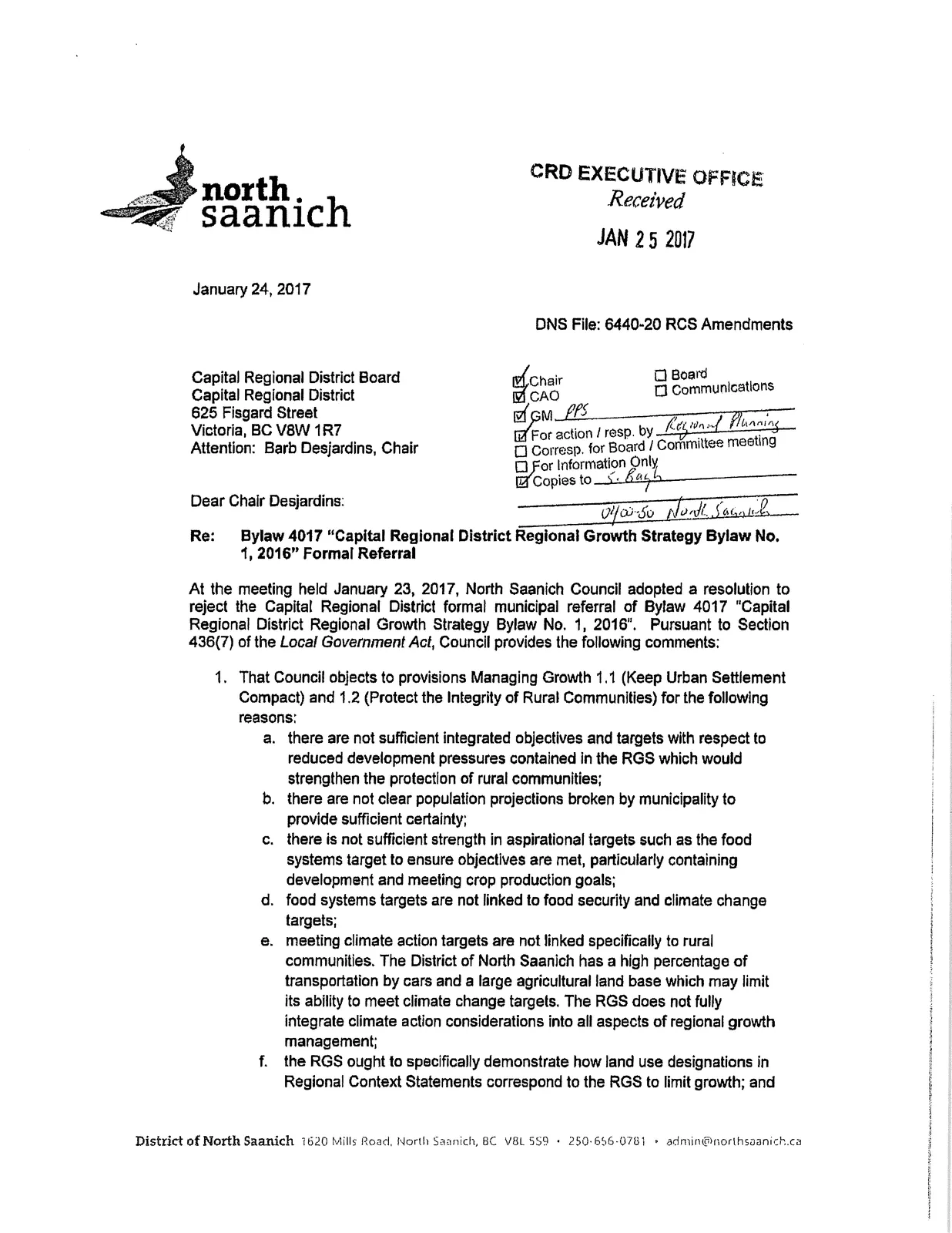
Chair CACI For action / resp. by (6 '''- 0 Gaffes!), for Board / Committee meeting 13Yor Information Only 0` Copies to ' a o Board O Communications north. saanich CRD EXECUTIVE OFFICE Received JAN 25 201? January 24, 2017 DNS File: 6440-20 RCS Amendments Capital Regional District Board Capital Regional District 625 Fisgard Street Victoria, BC V8W 1R7 Attention: Barb Desjardins, Chair Dear Chair Desjardins: Re: Bylaw 4017 "Capital Regional District Regional Growth Strategy Bylaw No. 1, 2016" Formal Referral At the meeting held January 23, 2017, North Saanich Council adopted a resolution to reject the Capital Regional District formal municipal referral of Bylaw 4017 "Capital Regional District Regional Growth Strategy Bylaw No. 1, 2016". Pursuant to Section 436(7) of the Local Government Act, Council provides the following comments:
- That Council objects to provisions Managing Growth 1.1 (Keep Urban Settlement Compact) and 1.2 (Protect the Integrity of Rural Communities) for the following reasons: a. there are not sufficient integrated objectives and targets with respect to reduced development pressures contained in the RGS which would strengthen the protection of rural communities; b. there are not clear population projections broken by municipality to provide sufficient certainty; c. there is not sufficient strength in aspirational targets such as the food systems target to ensure objectives are met, particularly containing development and meeting crop production goals; d. food systems targets are not linked to food security and climate change targets; e. meeting climate action targets are not linked specifically to rural communities. The District of North Saanich has a high percentage of transportation by cars and a large agricultural land base which may limit its ability to meet climate change targets. The RGS does not fully integrate climate action considerations into all aspects of regional growth management; f. the RGS ought to specifically demonstrate how land use designations in Regional Context Statements correspond to the RGS to limit growth; and District of North Saanich 1620 Mills Road, North Saanich, BC VOL 559 • 250.656-0781 • acimin@northsaanich.ca Page 48 of 154 Page 48 of 154
Page 49
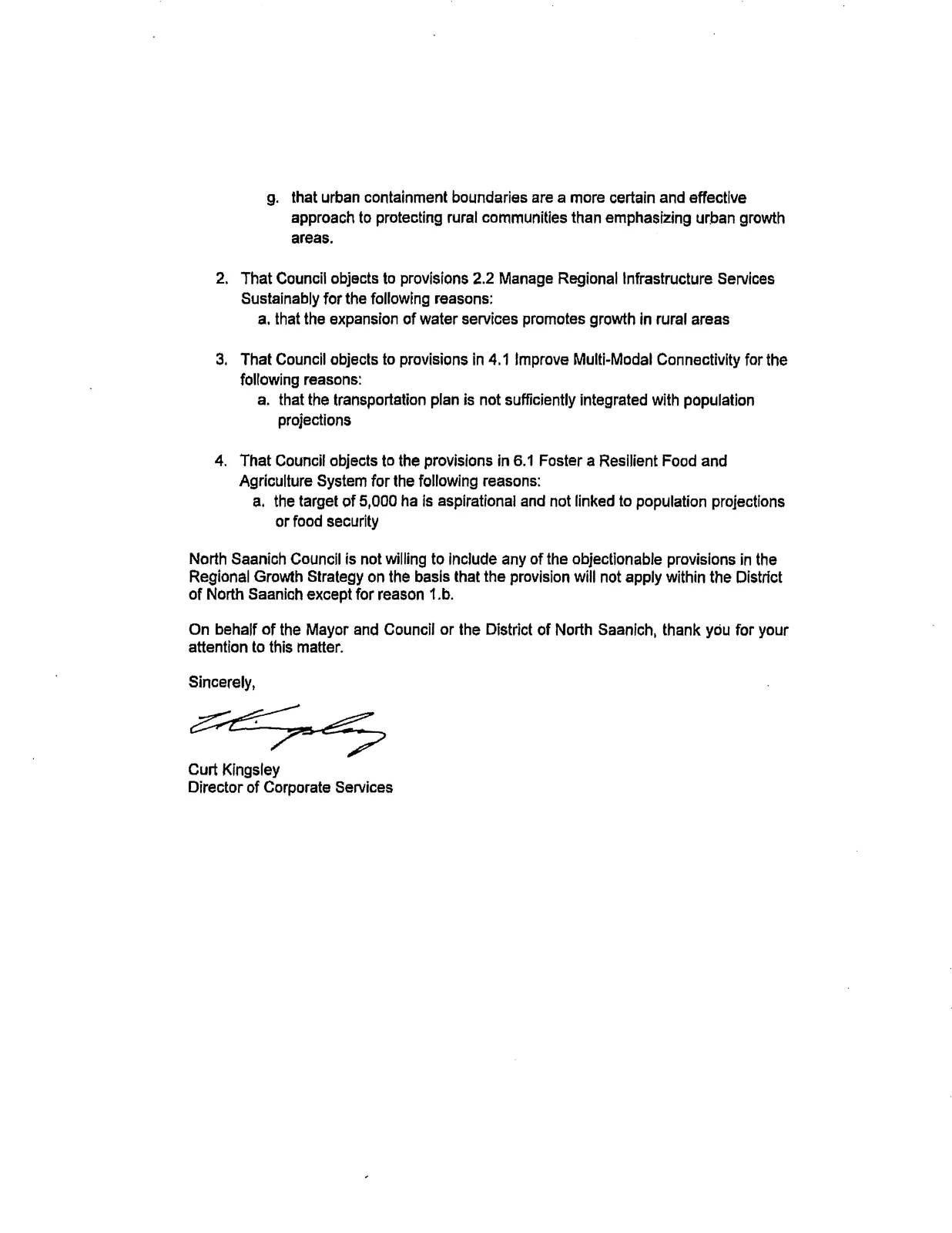
g. that urban containment boundaries are a more certain and effective approach to protecting rural communities than emphasizing urban growth areas. 2. That Council objects to provisions 2.2 Manage Regional Infrastructure Services Sustainably for the following reasons: a. that the expansion of water services promotes growth in rural areas 3. That Council objects to provisions in 4.1 Improve Multi-Modal Connectivity for the following reasons: a. that the transportation plan is not sufficiently integrated with population projections 4. That Council objects to the provisions in 6.1 Foster a Resilient Food and Agriculture System for the following reasons: a. the target of 5,000 ha is aspirational and not linked to population projections or food security North Saanich Council is not willing to include any of the objectionable provisions in the Regional Growth Strategy on the basis that the provision will not apply within the District of North Saanich except for reason I .b. On behalf of the Mayor and Council or the District of North Saanich, thank you for your attention to this matter. Sincerely, Curt Kingsley Director of Corporate Services Page 49 of 154 Page 49 of 154
Page 50
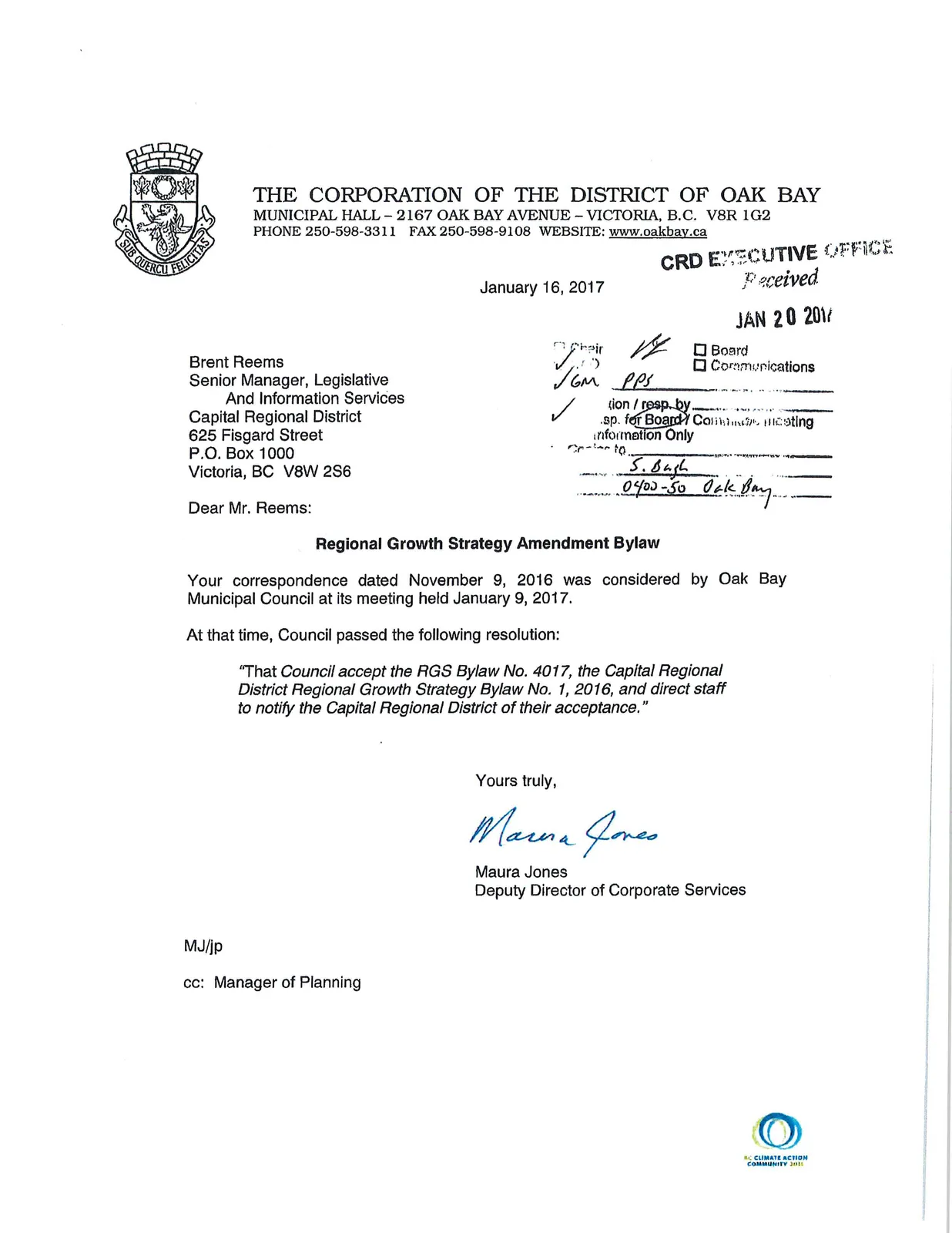
THE CORPORATION OF THE DISTRICT OF OAK BAY MUNICIPAL HALL — 2167 OAK BAY AVENUE — VICTORIA, B.C. V8R 1G2 PHONE 250-598-3311 FAX 250-598-9108 WEBSITE: www.oakbay.ca CRD E7,7CUTIVE OFFilCiE January 16, 2017 f7 eceiveci JAN 20 201( Board 0 Cor:lrrwri(>:Ations AA& /pi
don / jo,p .sp. f6 Boa Co ill,,,op,111:AIng ,nfoanation Only to
0'/D.) -So 0Ak Brent Reems Senior Manager, Legislative And Information Services Capital Regional District 625 Fisgard Street P.O. Box 1000 Victoria, BC V8W 2S6 Dear Mr. Reems: Regional Growth Strategy Amendment Bylaw Your correspondence dated November 9, 2016 was considered by Oak Bay Municipal Council at its meeting held January 9, 2017. At that time, Council passed the following resolution: 'That Council accept the RGS Bylaw No. 4017, the Capital Regional District Regional Growth Strategy Bylaw No. 1, 2016, and direct staff to notify the Capital Regional District of their acceptance." Yours truly, Maura Jones Deputy Director of Corporate Services MJ/jp cc: Manager of Planning CLIMATE ACTION COMMUNITY 1.11. Page 50 of 154 Page 50 of 154
Page 51
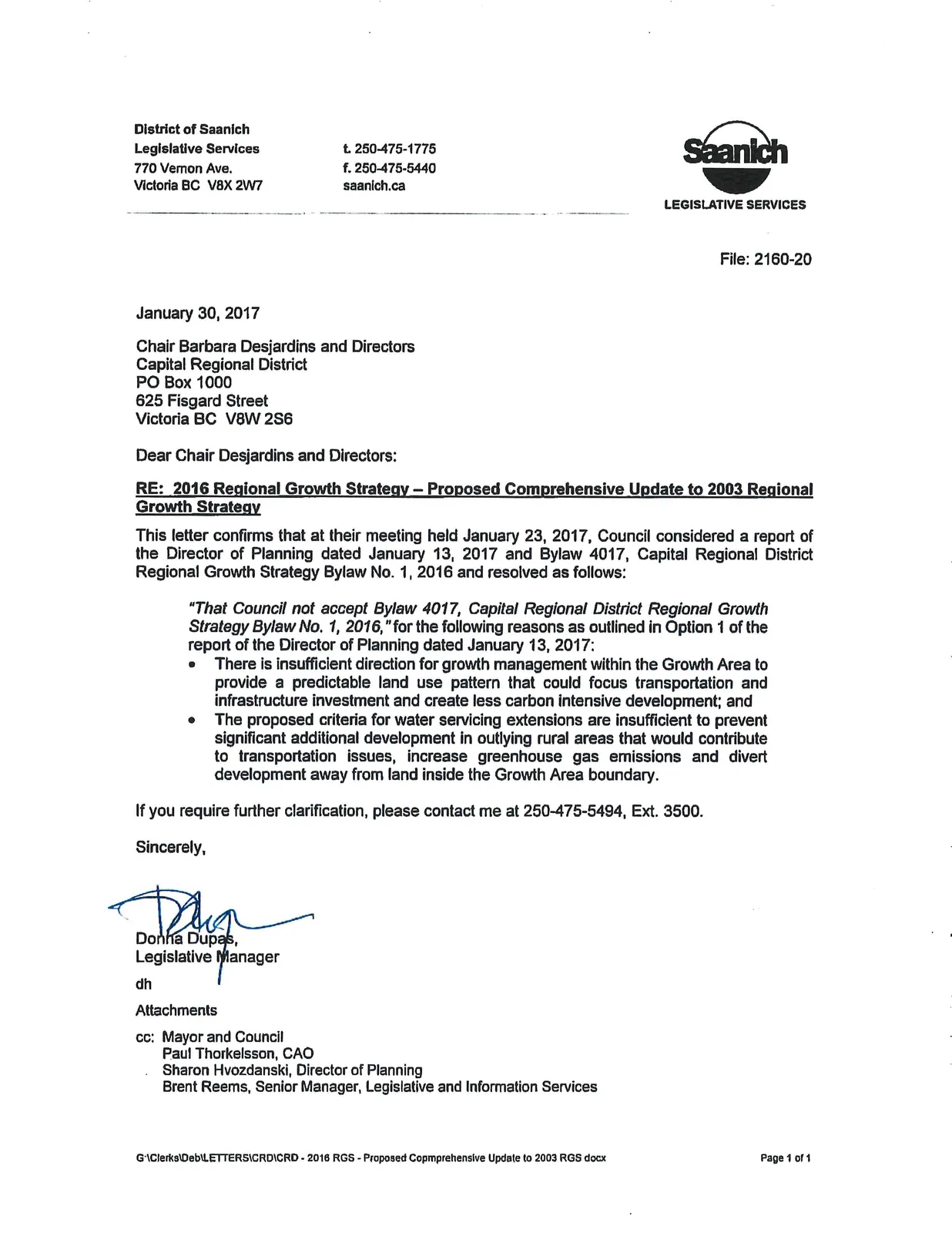
District of Saanich Legislative Services 770 Vernon Ave. Victoria BC V8X 2W7 L 250-475-1775 f. 250-475-5440 saanich.ca LEGISLATIVE SERVICES File: 2160-20 January 30, 2017 Chair Barbara Desjardins and Directors Capital Regional District PO Box 1000 625 Fisgard Street Victoria BC WIN 2S6 Dear Chair Desjardins and Directors: RE: 2016 Regional Growth Strategy — Proposed Comprehensive Update to 2003 Regional Growth Strategy This letter confirms that at their meeting held January 23, 2017, Council considered a report of the Director of Planning dated January 13, 2017 and Bylaw 4017, Capital Regional District Regional Growth Strategy Bylaw No. 1, 2016 and resolved as follows: "That Council not accept Bylaw 4017, Capital Regional District Regional Growth Strategy Bylaw No. 1, 2016," for the following reasons as outlined in Option 1 of the report of the Director of Planning dated January 13, 2017: • There is insufficient direction for growth management within the Growth Area to provide a predictable land use pattern that could focus transportation and infrastructure investment and create less carbon intensive development; and • The proposed criteria for water servicing extensions are insufficient to prevent significant additional development in outlying rural areas that would contribute to transportation issues, increase greenhouse gas emissions and divert development away from land inside the Growth Area boundary. If you require further clarification, please contact me at 250-475-5494, Ext. 3500. Sincerely, Do a Dup Legislative anager dh Attachments cc: Mayor and Council Paul Thorkelsson, CAO Sharon Hvozdanski, Director of Planning Brent Reems, Senior Manager, Legislative and Information Services GACIerkskDeb1LETTERS‘CREACRD - 2018 RGS - Proposed Copmprehensive Update to 2003 RGS docx Page lot 1 Page 51 of 154 Page 51 of 154
Page 52
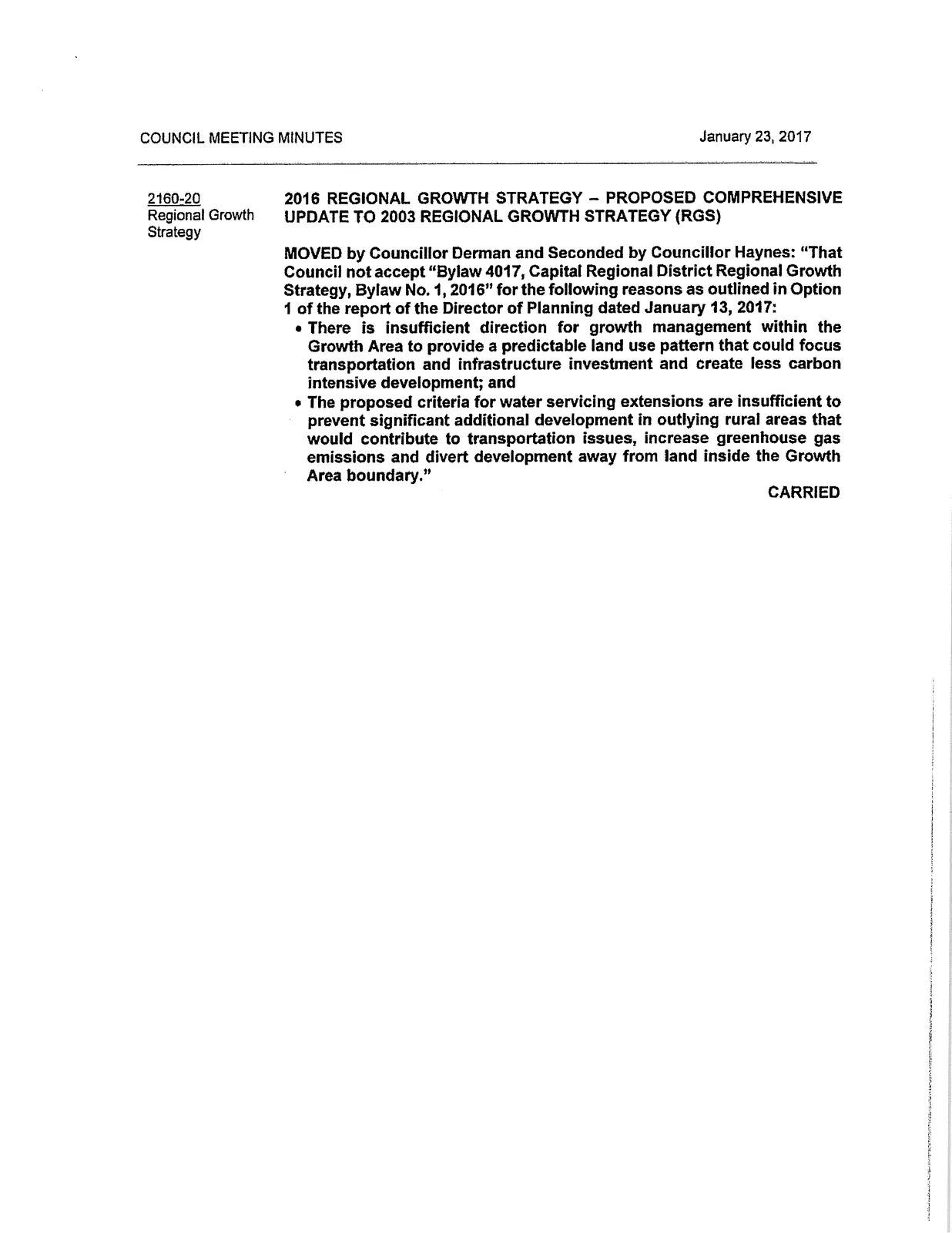
COUNCIL MEETING MINUTES January 23, 2017 2160-20 Regional Growth Strategy 2016 REGIONAL GROWTH STRATEGY — PROPOSED COMPREHENSIVE UPDATE TO 2003 REGIONAL GROWTH STRATEGY (RGS) MOVED by Councillor Derrnan and Seconded by Councillor Haynes: "That Council not accept "Bylaw 4017, Capital Regional District Regional Growth Strategy, Bylaw No. 1, 2016" for the following reasons as outlined in Option 1 of the report of the Director of Planning dated January 13, 2017: • There is insufficient direction for growth management within the Growth Area to provide a predictable land use pattern that could focus transportation and infrastructure investment and create less carbon intensive development; and • The proposed criteria for water servicing extensions are insufficient to prevent significant additional development in outlying rural areas that would contribute to transportation issues, increase greenhouse gas emissions and divert development away from land inside the Growth Area boundary." CARRIED Page 52 of 154 Page 52 of 154
Page 53
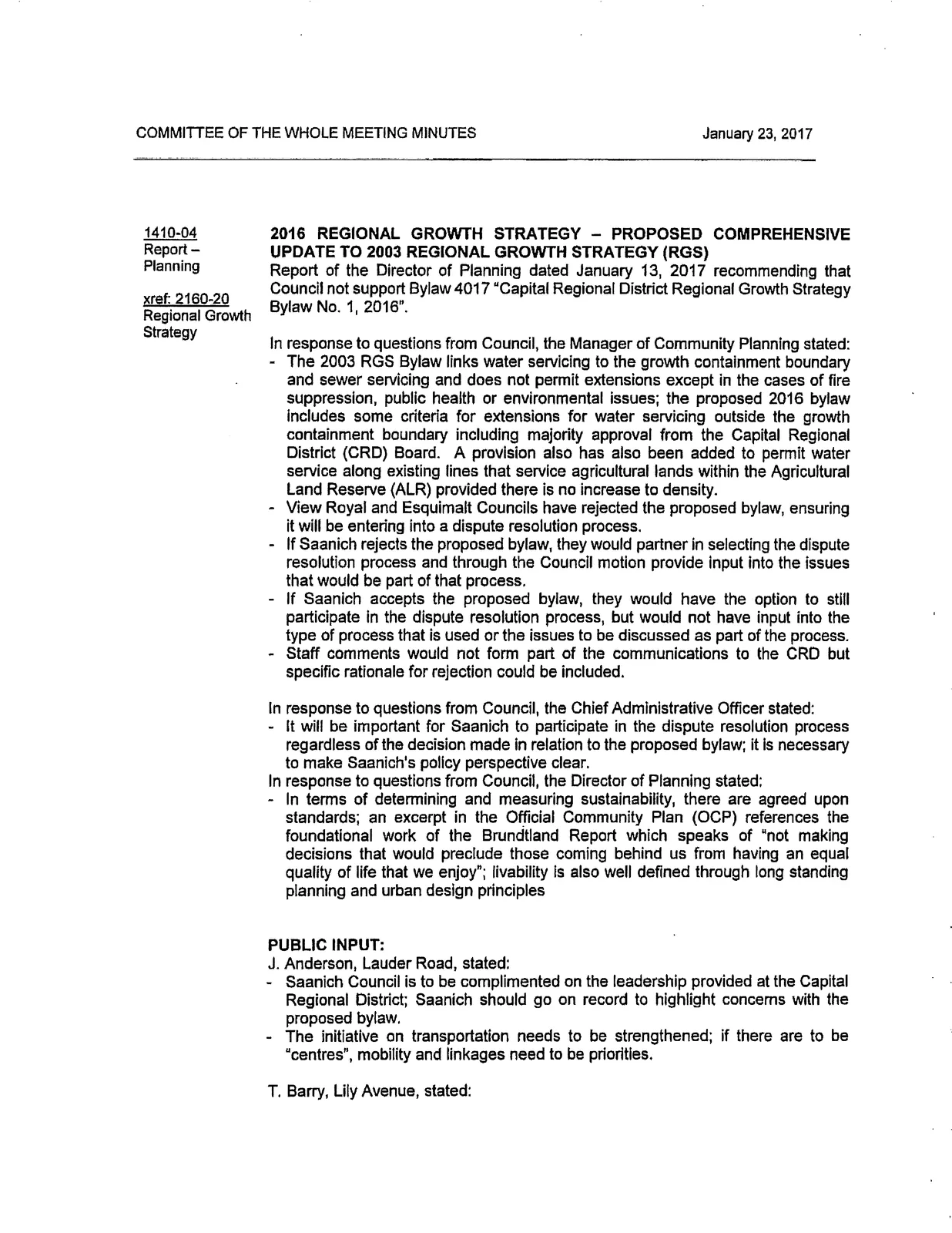
COMMITTEE OF THE WHOLE MEETING MINUTES January 23, 2017 2016 REGIONAL GROWTH STRATEGY — PROPOSED COMPREHENSIVE UPDATE TO 2003 REGIONAL GROWTH STRATEGY (RGS) Report of the Director of Planning dated January 13, 2017 recommending that Council not support Bylaw 4017 "Capital Regional District Regional Growth Strategy Bylaw No. 1, 2016". In response to questions from Council, the Manager of Community Planning stated:
- The 2003 RGS Bylaw links water servicing to the growth containment boundary and sewer servicing and does not permit extensions except in the cases of fire suppression, public health or environmental issues; the proposed 2016 bylaw includes some criteria for extensions for water servicing outside the growth containment boundary including majority approval from the Capital Regional District (CRD) Board. A provision also has also been added to permit water service along existing lines that service agricultural lands within the Agricultural Land Reserve (ALR) provided there is no increase to density. View Royal and Esquimalt Councils have rejected the proposed bylaw, ensuring it will be entering into a dispute resolution process.
- If Saanich rejects the proposed bylaw, they would partner in selecting the dispute resolution process and through the Council motion provide input into the issues that would be part of that process. If Saanich accepts the proposed bylaw, they would have the option to still participate in the dispute resolution process, but would not have input into the type of process that is used or the issues to be discussed as part of the process.
- Staff comments would not form part of the communications to the CRD but specific rationale for rejection could be included. In response to questions from Council, the Chief Administrative Officer stated:
- It will be important for Saanich to participate in the dispute resolution process regardless of the decision made in relation to the proposed bylaw; it is necessary to make Saanich's policy perspective clear. In response to questions from Council, the Director of Planning stated:
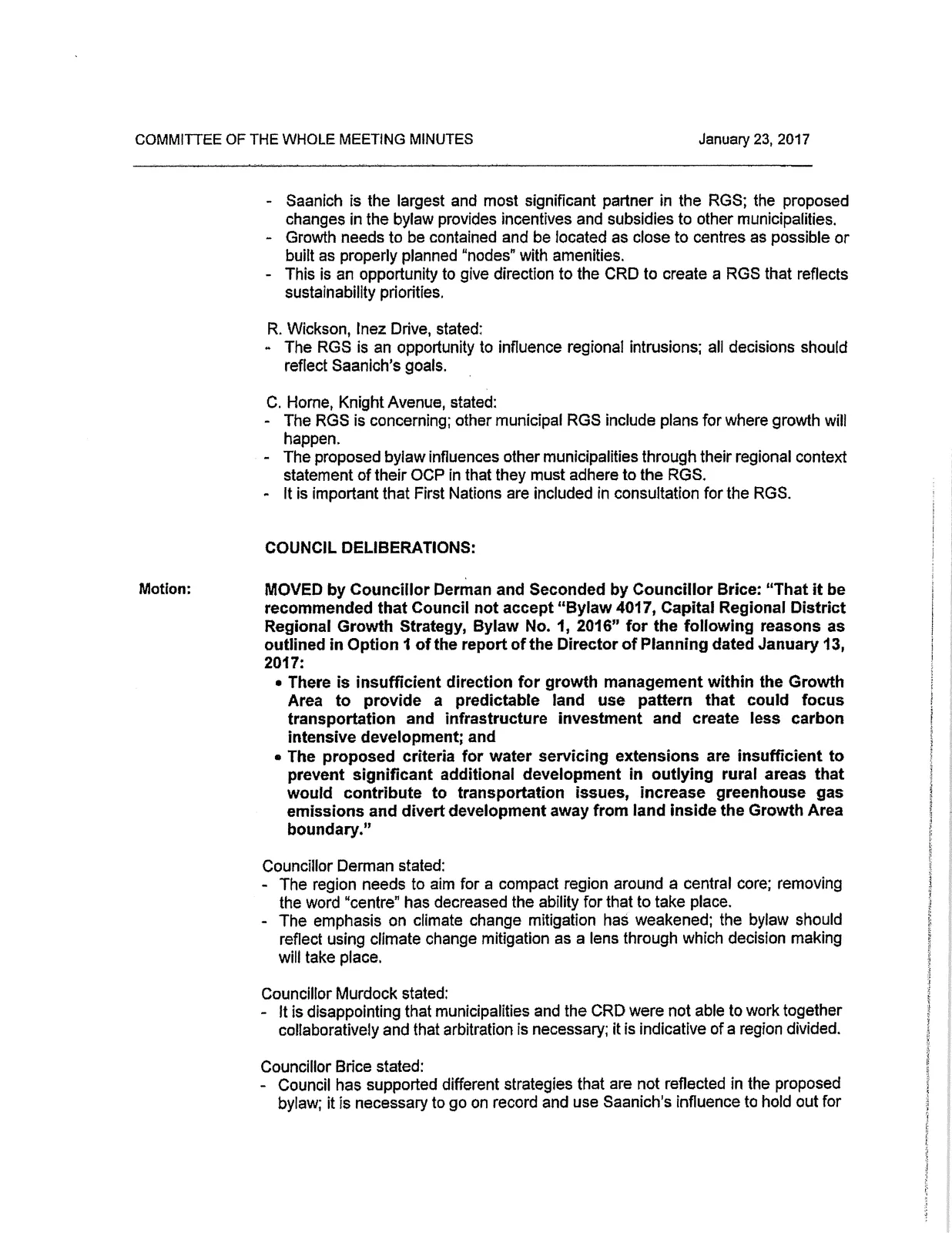
- In terms of determining and measuring sustainability, there are agreed upon standards; an excerpt in the Official Community Plan (0CP) references the foundational work of the Brundtland Report which speaks of "not making decisions that would preclude those coming behind us from having an equal quality of life that we enjoy"; livability is also well defined through long standing planning and urban design principles PUBLIC INPUT: J. Anderson, Lauder Road, stated: Saanich Council is to be complimented on the leadership provided at the Capital Regional District; Saanich should go on record to highlight concerns with the proposed bylaw,
- The initiative on transportation needs to be strengthened; if there are to be "centres", mobility and linkages need to be priorities. T. Barry, Lily Avenue, stated: 1410-04 Report— Planning xret 2160-20 Regional Growth Strategy Page 53 of 154 Page 53 of 154
Page 54
COMMITTEE OF THE WHOLE MEETING MINUTES January 23, 2017 Motion:
- Saanich is the largest and most significant partner in the RGS; the proposed changes in the bylaw provides incentives and subsidies to other municipalities.
- Growth needs to be contained and be located as close to centres as possible or built as properly planned "nodes" with amenities.
- This is an opportunity to give direction to the CRD to create a RGS that reflects sustain abi lity priorities. R. Wickson, Inez Drive, stated:
- The RGS is an opportunity to influence regional intrusions; all decisions should reflect Saanich's goals. C. Home, Knight Avenue, stated:
- The RGS is concerning; other municipal RGS include plans for where growth will happen.
- The proposed bylaw influences other municipalities through their regional context statement of their OCP in that they must adhere to the RGS.
- It is important that First Nations are included in consultation for the RGS. COUNCIL DELIBERATIONS: MOVED by Councillor Derman and Seconded by Councillor Brice: "That it be recommended that Council not accept "Bylaw 4017, Capital Regional District Regional Growth Strategy, Bylaw No. 1, 2016" for the following reasons as outlined in Option 1 of the report of the Director of Planning dated January 13, 2017: • There is insufficient direction for growth management within the Growth Area to provide a predictable land use pattern that could focus transportation and infrastructure investment and create less carbon intensive development; and • The proposed criteria for water servicing extensions are insufficient to prevent significant additional development in outlying rural areas that would contribute to transportation issues, increase greenhouse gas emissions and divert development away from land inside the Growth Area boundary." Councillor Derman stated:
- The region needs to aim for a compact region around a central core; removing the word "centre" has decreased the ability for that to take place.
- The emphasis on climate change mitigation has weakened; the bylaw should reflect using climate change mitigation as a lens through which decision making will take place. Councillor Murdock stated:
- It is disappointing that municipalities and the ORD were not able to work together collaboratively and that arbitration is necessary; it is indicative of a region divided. Councillor Brice stated:
- Council has supported different strategies that are not reflected in the proposed bylaw; it is necessary to go on record and use Saanich's influence to hold out for Page 54 of 154 Page 54 of 154
Page 55
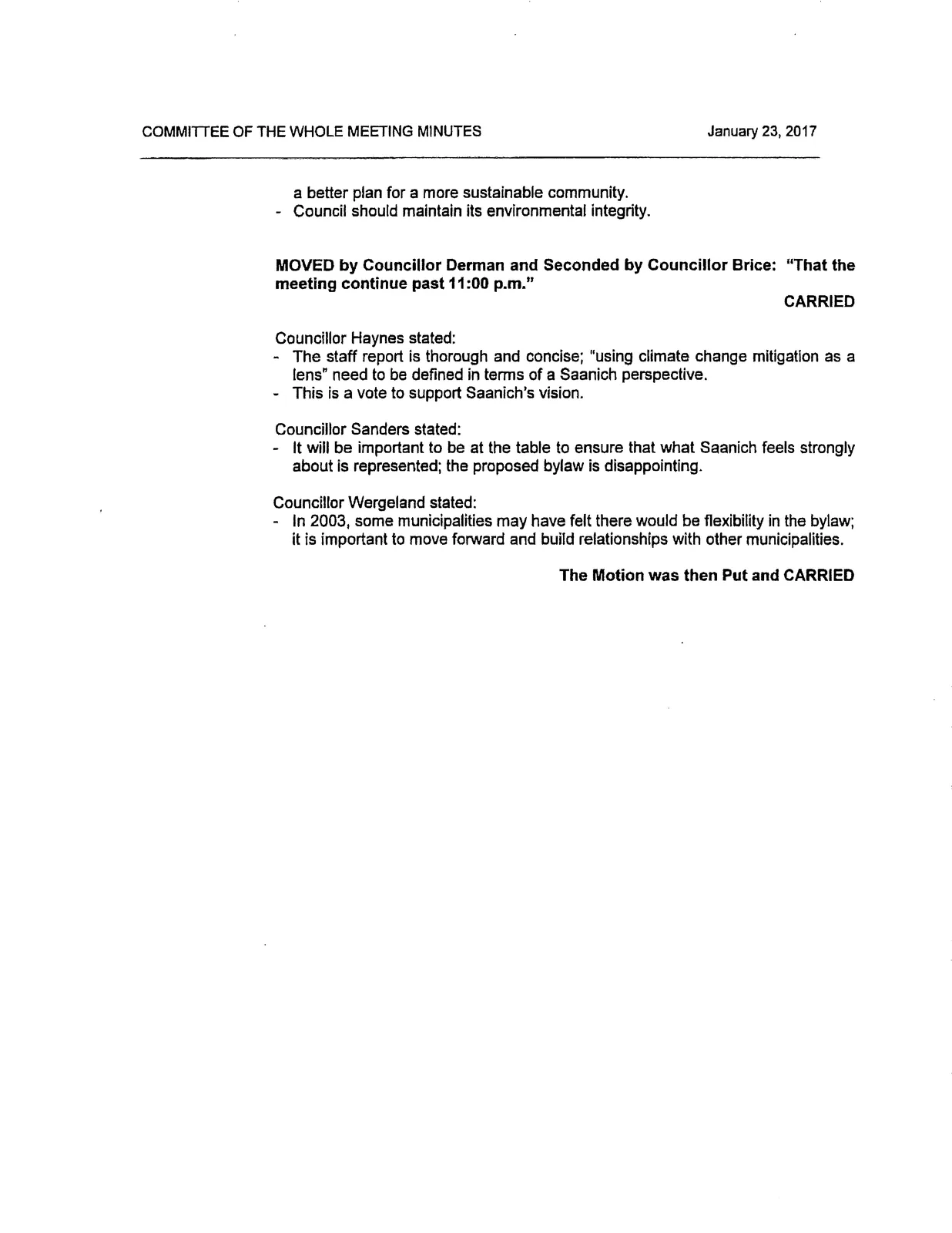
COMMITTEE OF THE WHOLE MEETING MINUTES January 23, 2017 a better plan for a more sustainable community.
- Council should maintain its environmental integrity. MOVED by Councillor Derman and Seconded by Councillor Brice: "That the meeting continue past 11:00 p.m." CARRIED Councillor Haynes stated:
- The staff report is thorough and concise; "using climate change mitigation as a lens" need to be defined in terms of a Saanich perspective.
- This is a vote to support Saanich's vision. Councillor Sanders stated:
- It will be important to be at the table to ensure that what Saanich feels strongly about is represented; the proposed bylaw is disappointing. Councillor Wergeland stated:
- In 2003, some municipalities may have felt there would be flexibility in the bylaw; it is important to move forward and build relationships with other municipalities. The Motion was then Put and CARRIED Page 55 of 154 Page 55 of 154
Page 56
) I c.3•- 2C
The Corporation of the District of Saanich 1111111,
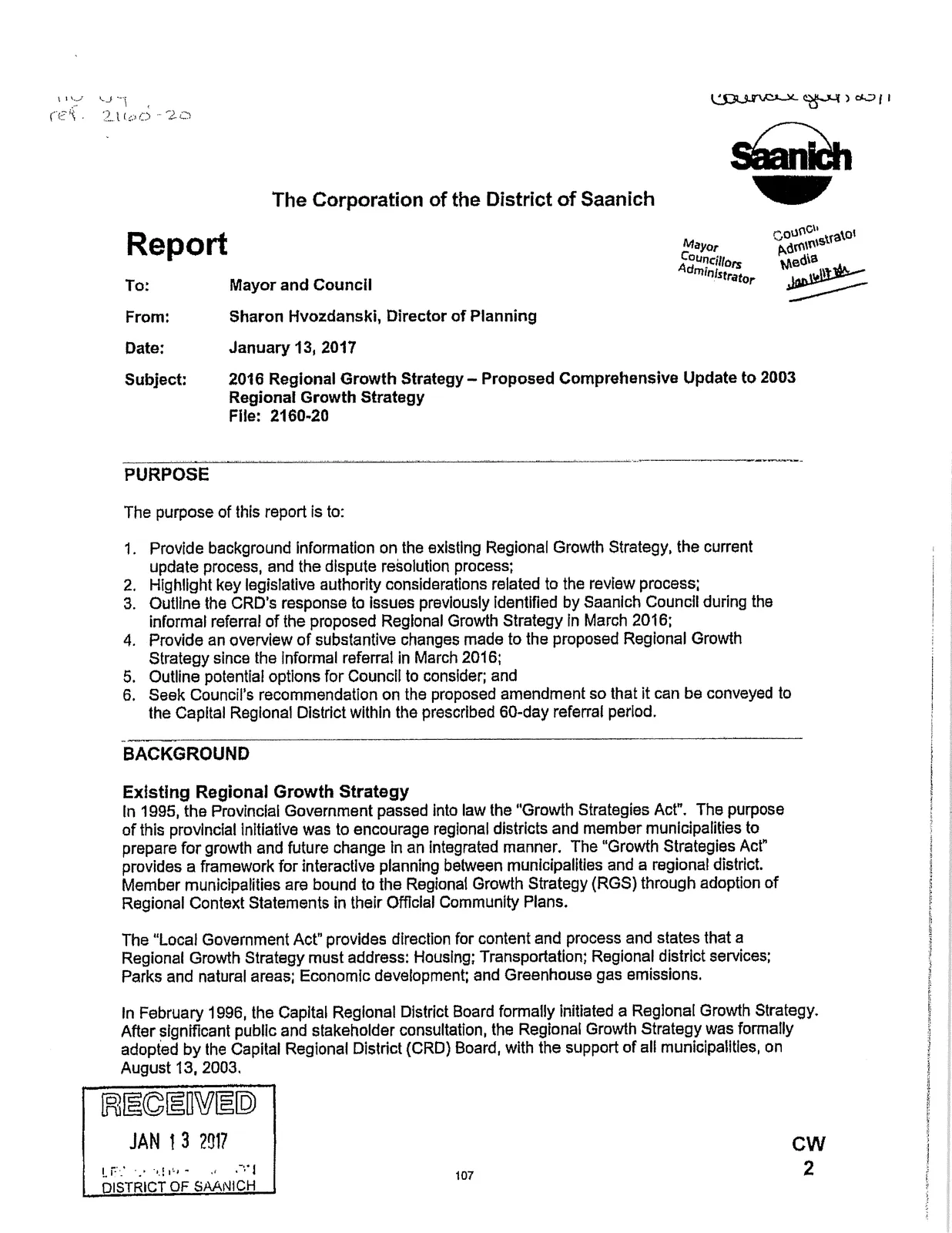
Mayor and Council Sharon Hvozdanski, Director of Planning January 13, 2017 2016 Regional Growth Strategy — Proposed Comprehensive Update to 2003 Regional Growth Strategy File: 2160-20 Report To: From: Date: Subject: Mayor coulicilfors Administrator Ltu media PURPOSE The purpose of this report is to:
- Provide background information on the existing Regional Growth Strategy, the current update process, and the dispute resolution process;
- Highlight key legislative authority considerations related to the review process;
- Outline the CRD's response to issues previously identified by Saanich Council during the informal referral of the proposed Regional Growth Strategy in March 2016;
- Provide an overview of substantive changes made to the proposed Regional Growth Strategy since the Informal referral in March 2016;
- Outline potential options for Council to consider; and
- Seek Council's recommendation on the proposed amendment so that it can be conveyed to the Capital Regional District within the prescribed 60-day referral period. BACKGROUND Existing Regional Growth Strategy In 1995, the Provincial Government passed into law the "Growth Strategies Act". The purpose of this provincial initiative was to encourage regional districts and member municipalities to prepare for growth and future change In an Integrated manner. The "Growth Strategies Act" provides a framework for interactive planning between municipalities and a regional district. Member municipalities are bound to the Regional Growth Strategy (RGS) through adoption of Regional Context Statements in their Official Community Plans. The "Local Government Act" provides direction for content and process and states that a Regional Growth Strategy must address: Housing; Transportation; Regional district services; Parks and natural areas; Economic development; and Greenhouse gas emissions. In February 1996, the Capital Regional District Board formally initiated a Regional Growth Strategy. After significant public and stakeholder consultation, the Regional Growth Strategy was formally adopted by the Capital Regional District (CRD) Board, with the support of all municipalities, on August 13, 2003. RECENIED JAN 13 2g17 LF: • DISTRICT OF SAANICH 107 CW 2 Page 56 of 154 Page 56 of 154
Page 57
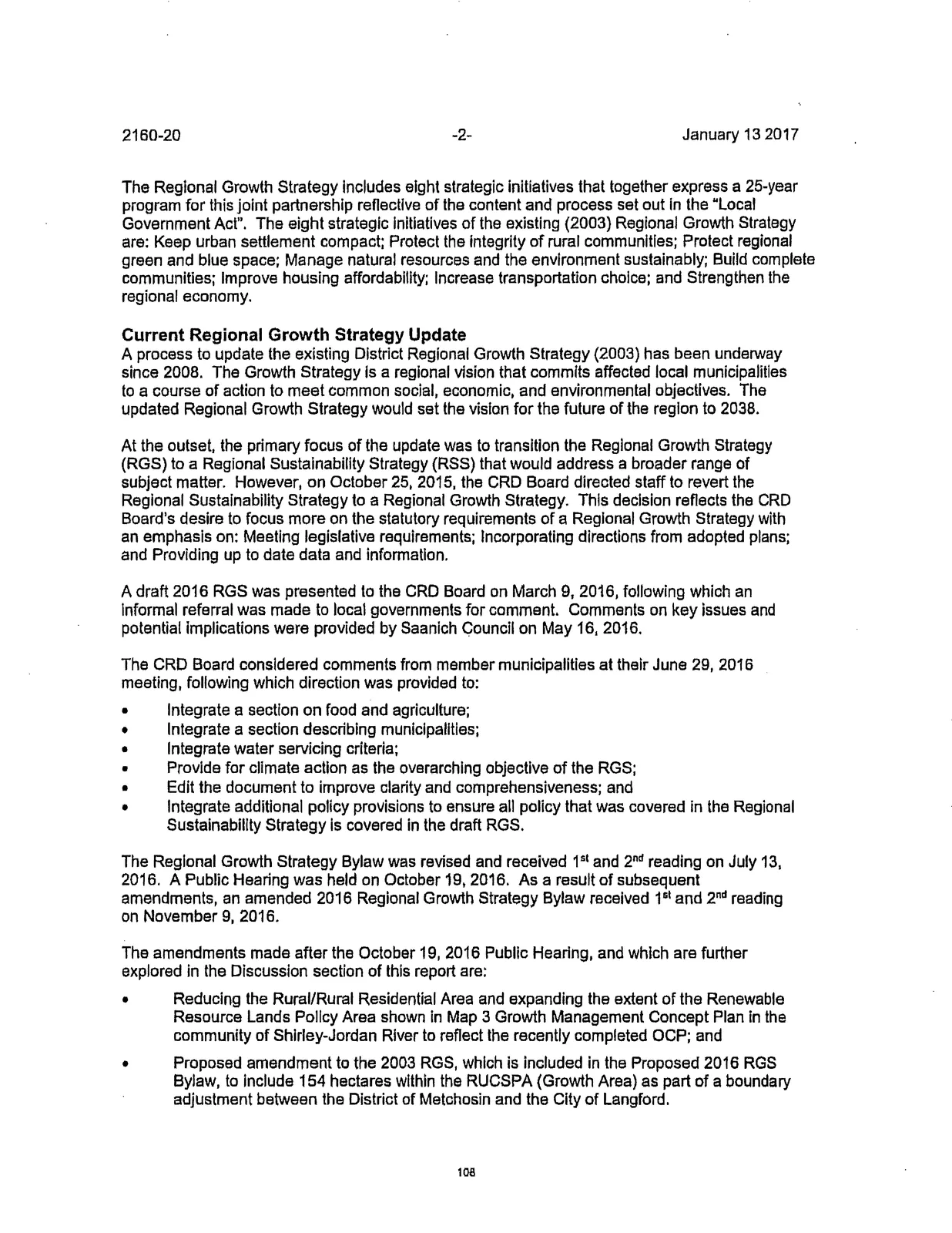
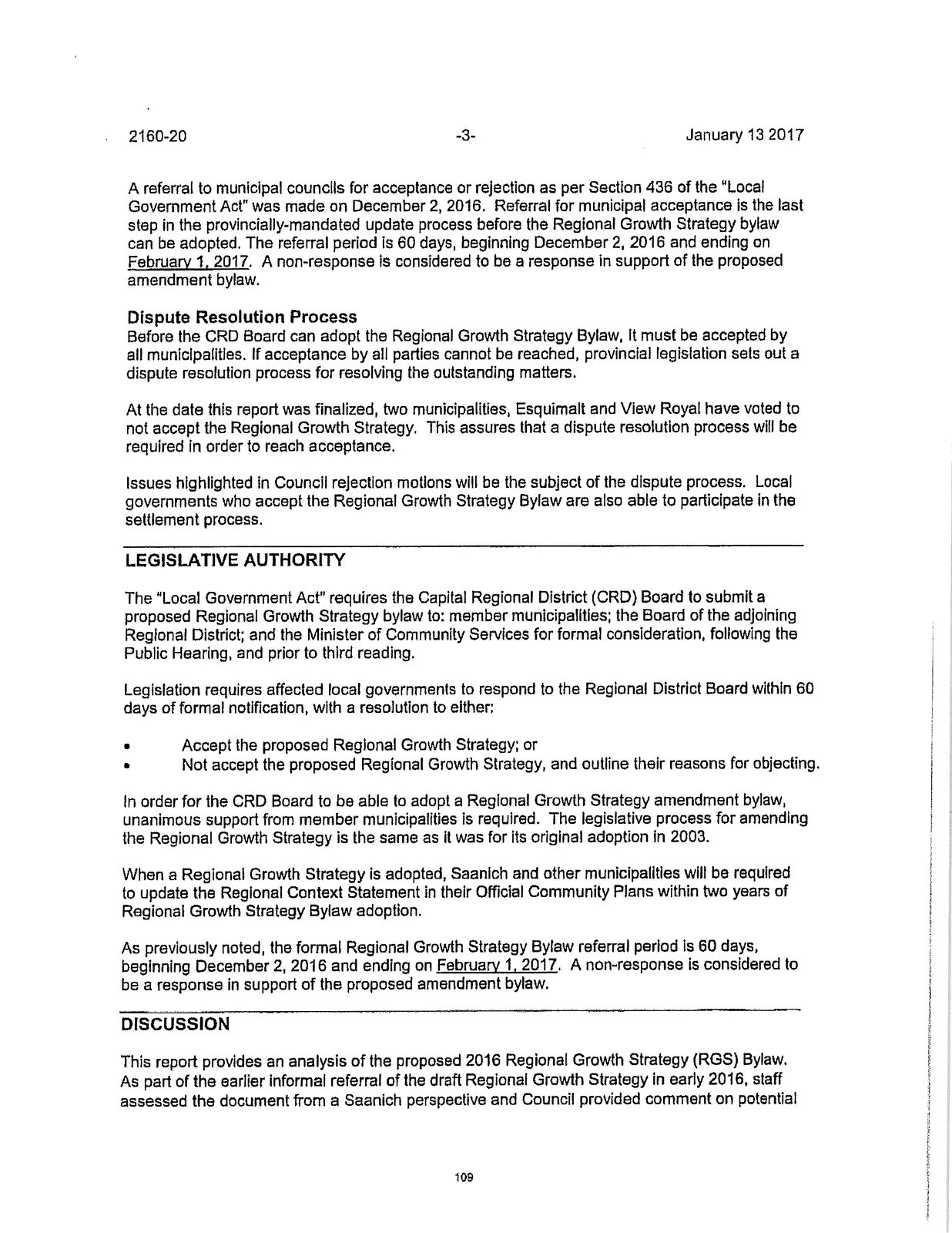
2160-20 -2- January 13 2017 The Regional Growth Strategy includes eight strategic initiatives that together express a 25-year program for this joint partnership reflective of the content and process set out in the "Local Government Act". The eight strategic Initiatives of the existing (2003) Regional Growth Strategy are: Keep urban settlement compact; Protect the integrity of rural communities; Protect regional green and blue space; Manage natural resources and the environment sustainably; Build complete communities; Improve housing affordability; Increase transportation choice; and Strengthen the regional economy. Current Regional Growth Strategy Update A process to update the existing District Regional Growth Strategy (2003) has been underway since 2008. The Growth Strategy is a regional vision that commits affected local municipalities to a course of action to meet common social, economic, and environmental objectives. The updated Regional Growth Strategy would set the vision for the future of the region to 2038. At the outset, the primary focus of the update was to transition the Regional Growth Strategy (RGS) to a Regional Sustainabillty Strategy (RSS) that would address a broader range of subject matter. However, on October 25, 2015, the CRD Board directed staff to revert the Regional Sustainability Strategy to a Regional Growth Strategy. This decision reflects the CRD Board's desire to focus more on the statutory requirements of a Regional Growth Strategy with an emphasis on; Meeting legislative requirements; incorporating directions from adopted plans; and Providing up to date data and information. A draft 2016 RGS was presented to the CRD Board on March 9, 2016, following which an informal referral was made to local governments for comment. Comments on key issues and potential implications were provided by Saanich Council on May 16, 2016. The CRD Board considered comments from member municipalities at their June 29, 2016 meeting, following which direction was provided to: • Integrate a section on food and agriculture; • Integrate a section describing municipalities; • Integrate water servicing criteria; • Provide for climate action as the overarching objective of the RGS; • Edit the document to improve clarity and comprehensiveness; and • Integrate additional policy provisions to ensure all policy that was covered in the Regional Sustainability Strategy is covered in the draft RGS. The Regional Growth Strategy Bylaw was revised and received 1st and 2nd reading on July 13, 2016. A Public Hearing was held on October 19, 2016. As a result of subsequent amendments, an amended 2016 Regional Growth Strategy Bylaw received 1st and 2nd reading on November 9, 2016. The amendments made after the October 19, 2016 Public Hearing, and which are further explored in the Discussion section of this report are: • Reducing the Rural/Rural Residential Area and expanding the extent of the Renewable Resource Lands Policy Area shown in Map 3 Growth Management Concept Plan in the community of Shirley-Jordan River to reflect the recently completed OCP; and • Proposed amendment to the 2003 RGS, which is included in the Proposed 2016 RGS Bylaw, to include 154 hectares within the RUCSPA (Growth Area) as part of a boundary • adjustment between the District of Metchosin and the City of Langford. 108 Page 57 of 154 Page 57 of 154
Page 58
2160-20 -3- January 13 2017 A referral to municipal councils for acceptance or rejection as per Section 436 of the "Local Government Act" was made on December 2, 2016. Referral for municipal acceptance is the last step in the provincially-mandated update process before the Regional Growth Strategy bylaw can be adopted. The referral period is 60 days, beginning December 2, 2016 and ending on February 1, 2017. A non-response is considered to be a response in support of the proposed amendment bylaw. Dispute Resolution Process Before the CRD Board can adopt the Regional Growth Strategy Bylaw, It must be accepted by all municipalities. If acceptance by all parties cannot be reached, provincial legislation sets out a dispute resolution process for resolving the outstanding matters. At the date this report was finalized, two municipalities, Esquimalt and View Royal have voted to not accept the Regional Growth Strategy. This assures that a dispute resolution process will be required in order to reach acceptance. Issues highlighted in Council rejection motions will be the subject of the dispute process. Local governments who accept the Regional Growth Strategy Bylaw are also able to participate in the settlement process. LEGISLATIVE AUTHORITY The "Local Government Act" requires the Capital Regional District (CRD) Board to submit a proposed Regional Growth Strategy bylaw to: member municipalities; the Board of the adjoining Regional District; and the Minister of Community Services for formal consideration, following the Public Hearing, and prior to third reading. Legislation requires affected local governments to respond to the Regional District Board within 60 days of formal notification, with a resolution to either: • Accept the proposed Regional Growth Strategy; or • Not accept the proposed Regional Growth Strategy, and outline their reasons for objecting. In order for the CRD Board to be able to adopt a Regional Growth Strategy amendment bylaw, unanimous support from member municipalities is required. The legislative process for amending the Regional Growth Strategy is the same as it was for its original adoption in 2003. When a Regional Growth Strategy is adopted, Saanich and other municipalities will be required to update the Regional Context Statement in their Official Community Plans within two years of Regional Growth Strategy Bylaw adoption. As previously noted, the formal Regional Growth Strategy Bylaw referral period is 60 days, beginning December 2, 2016 and ending on February 1, 2017, A non-response is considered to be a response in support of the proposed amendment bylaw. DISCUSSION This report provides an analysis of the proposed 2016 Regional Growth Strategy (RGS) Bylaw. As part of the earlier informal referral of the draft Regional Growth Strategy in early 2016, staff assessed the document from a Saanich perspective and Council provided comment on potential 109 Page 58 of 154 Page 58 of 154
Page 59
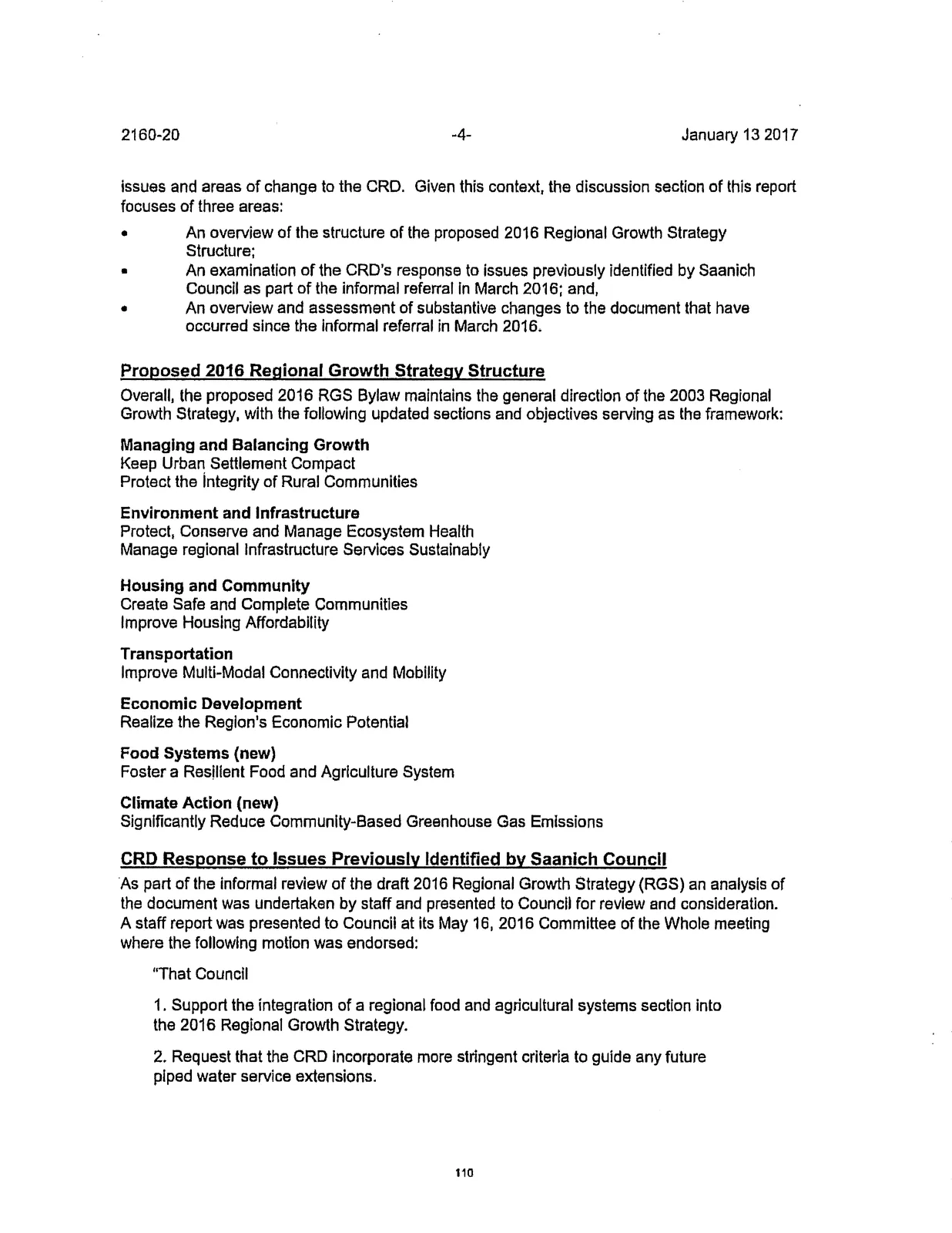
2160-20 -4- January 13 2017 issues and areas of change to the CRD. Given this context, the discussion section of this report focuses of three areas: • An overview of the structure of the proposed 2016 Regional Growth Strategy Structure; An examination of the CRD's response to issues previously identified by Saanich Council as part of the informal referral in March 2016; and, • An overview and assessment of substantive changes to the document that have occurred since the informal referral in March 2016. Proposed 2016 Regional Growth Strategy Structure Overall, the proposed 2016 RGS Bylaw maintains the general direction of the 2003 Regional Growth Strategy, with the following updated sections and objectives serving as the framework: Managing and Balancing Growth Keep Urban Settlement Compact Protect the Integrity of Rural Communities Environment and Infrastructure Protect, Conserve and Manage Ecosystem Health Manage regional Infrastructure Services Sustainably Housing and Community Create Safe and Complete Communities Improve Housing Affordability Transportation Improve Multi-Modal Connectivity and Mobility Economic Development Realize the Region's Economic Potential Food Systems (new) Foster a Resilient Food and Agriculture System Climate Action (new) Significantly Reduce Community-Based Greenhouse Gas Emissions CRD Response to Issues Previously Identified by Saanich Council As part of the informal review of the draft 2016 Regional Growth Strategy (RGS) an analysis of the document was undertaken by staff and presented to Council for review and consideration. A staff report was presented to Council at its May 16, 2016 Committee of the Whole meeting where the following motion was endorsed: "That Council
- Support the integration of a regional food and agricultural systems section into the 2016 Regional Growth Strategy.
- Request that the CRD incorporate more stringent criteria to guide any future piped water service extensions. 110 Page 59 of 154 Page 59 of 154
Page 60
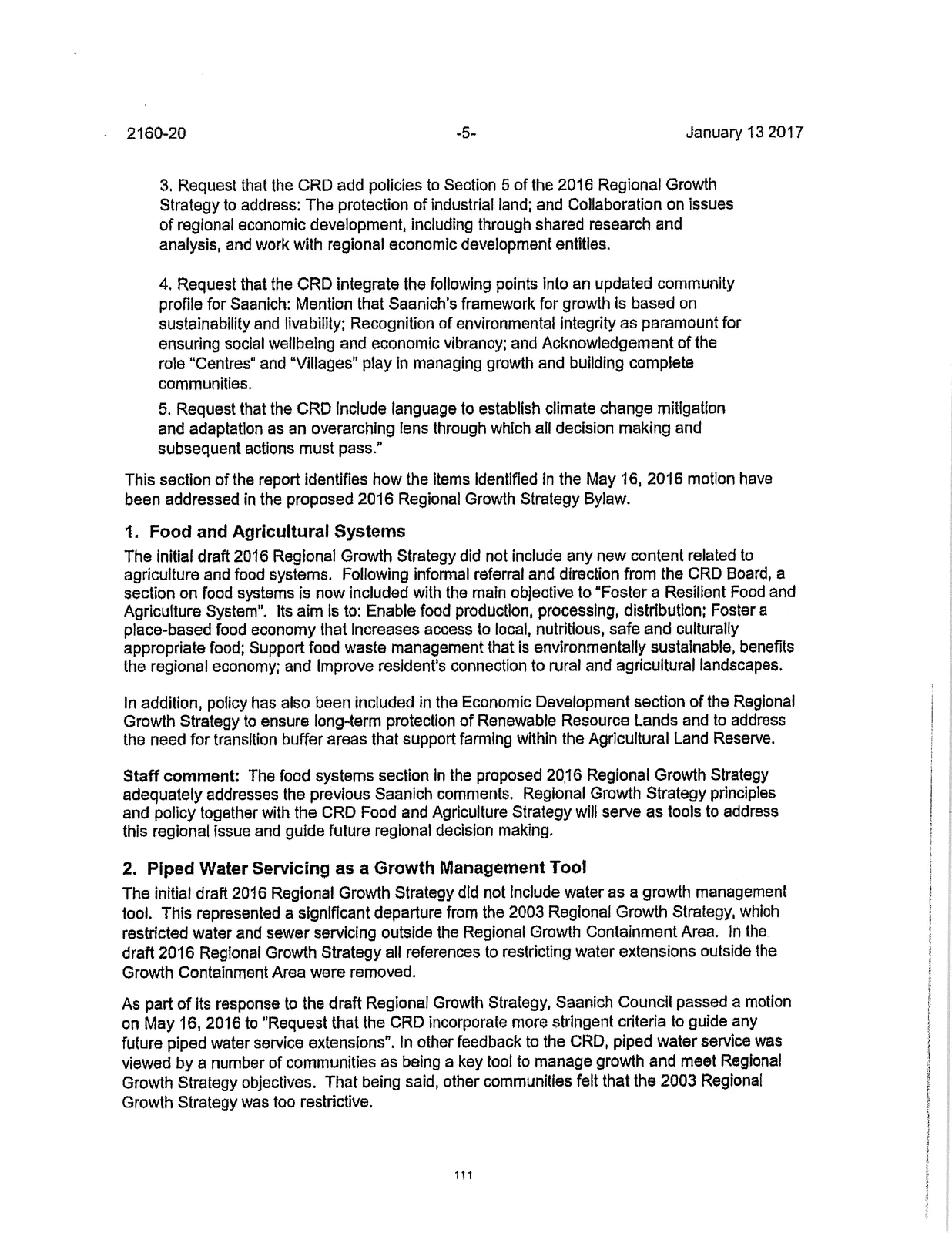
2160-20 -5- January 13 2017 3. Request that the CRD add policies to Section 5 of the 2016 Regional Growth Strategy to address: The protection of industrial land; and Collaboration on issues of regional economic development, including through shared research and analysis, and work with regional economic development entities. 4. Request that the ORD integrate the following points into an updated community profile for Saanich: Mention that Saanich's framework for growth is based on sustainability and livability; Recognition of environmental integrity as paramount for ensuring social wellbeing and economic vibrancy; and Acknowledgement of the role "Centres" and "Villages" play in managing growth and building complete communities. 5. Request that the CRC include language to establish climate change mitigation and adaptation as an overarching lens through which all decision making and subsequent actions must pass." This section of the report identifies how the items identified in the May 16, 2016 motion have been addressed in the proposed 2016 Regional Growth Strategy Bylaw.
- Food and Agricultural Systems The initial draft 2016 Regional Growth Strategy did not include any new content related to agriculture and food systems. Following informal referral and direction from the CRD Board, a section on food systems is now included with the main objective to "Foster a Resilient Food and Agriculture System". Its aim is to: Enable food production, processing, distribution; Foster a place-based food economy that Increases access to local, nutritious, safe and culturally appropriate food; Support food waste management that is environmentally sustainable, benefits the regional economy; and Improve resident's connection to rural and agricultural landscapes. In addition, policy has also been included in the Economic Development section of the Regional Growth Strategy to ensure long-term protection of Renewable Resource Lands and to address the need for transition buffer areas that support farming within the Agricultural Land Reserve. Staff comment: The food systems section in the proposed 2016 Regional Growth Strategy adequately addresses the previous Saanich comments. Regional Growth Strategy principles and policy together with the CRD Food and Agriculture Strategy will serve as tools to address this regional issue and guide future regional decision making.
- Piped Water Servicing as a Growth Management Tool The initial draft 2016 Regional Growth Strategy did not Include water as a growth management tool. This represented a significant departure from the 2003 Regional Growth Strategy, which restricted water and sewer servicing outside the Regional Growth Containment Area. In the draft 2016 Regional Growth Strategy all references to restricting water extensions outside the Growth Containment Area were removed. As part of its response to the draft Regional Growth Strategy, Saanich Council passed a motion on May 16, 2016 to "Request that the CRD incorporate more stringent criteria to guide any future piped water service extensions". In other feedback to the CRD, piped water service was viewed by a number of communities as being a key tool to manage growth and meet Regional Growth Strategy objectives. That being said, other communities felt that the 2003 Regional Growth Strategy was too restrictive. 111 Page 60 of 154 Page 60 of 154
Page 61
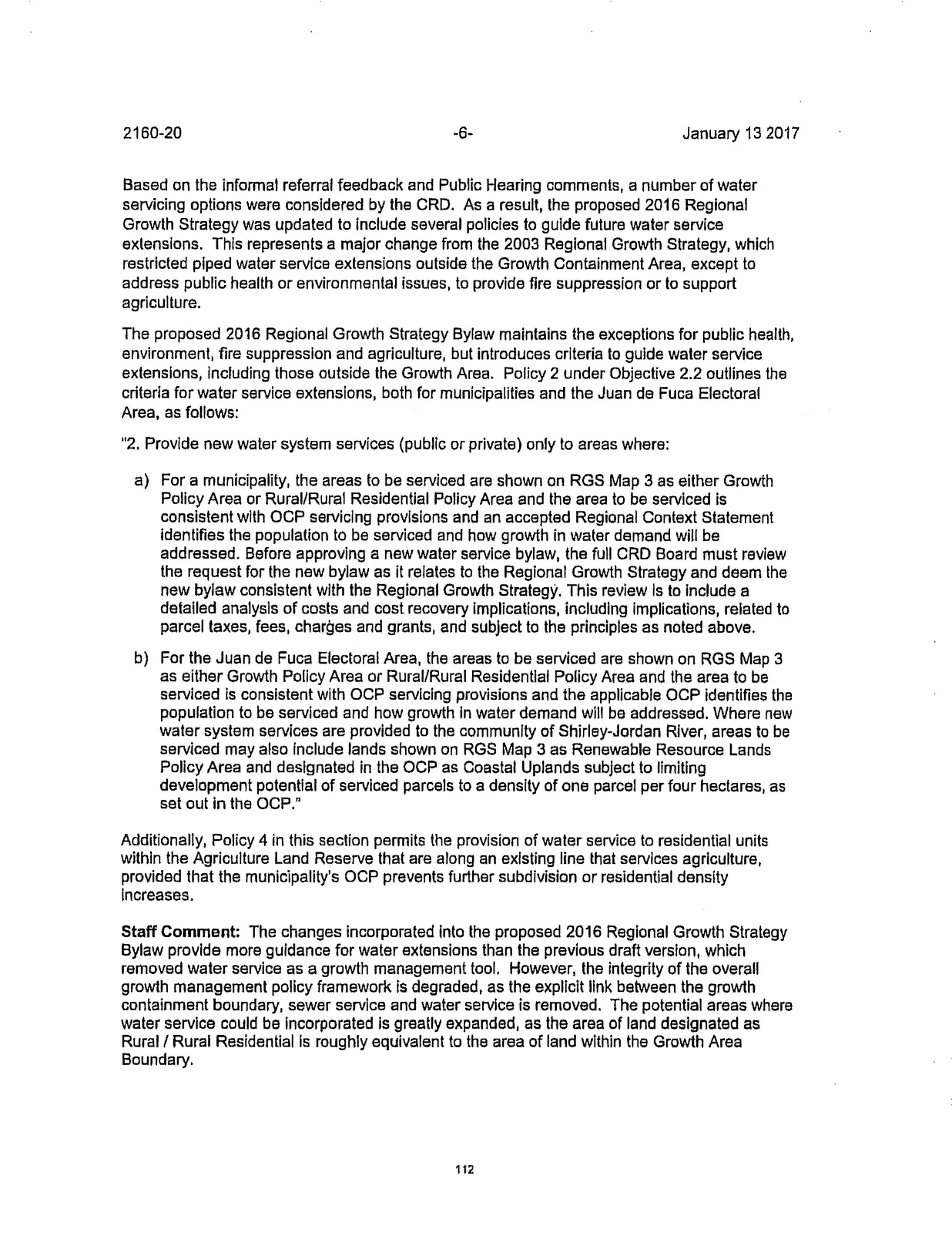
2160-20 -6- January 13 2017 Based on the informal referral feedback and Public Hearing comments, a number of water servicing options were considered by the CRD. As a result, the proposed 2016 Regional Growth Strategy was updated to include several policies to guide future water service extensions. This represents a major change from the 2003 Regional Growth Strategy, which restricted piped water service extensions outside the Growth Containment Area, except to address public health or environmental issues, to provide fire suppression or to support agriculture. The proposed 2016 Regional Growth Strategy Bylaw maintains the exceptions for public health, environment, fire suppression and agriculture, but introduces criteria to guide water service extensions, including those outside the Growth Area. Policy 2 under Objective 2.2 outlines the criteria for water service extensions, both for municipalities and the Juan de Fuca Electoral Area, as follows: "2. Provide new water system services (public or private) only to areas where: a) For a municipality, the areas to be serviced are shown on RGS Map 3 as either Growth Policy Area or Rural/Rural Residential Policy Area and the area to be serviced is consistent with OCP servicing provisions and an accepted Regional Context Statement identifies the population to be serviced and how growth in water demand will be addressed. Before approving a new water service bylaw, the full CRD Board must review the request for the new bylaw as it relates to the Regional Growth Strategy and deem the new bylaw consistent with the Regional Growth Strategy, This review is to include a detailed analysis of costs and cost recovery implications, including implications, related to parcel taxes, fees, chates and grants, and subject to the principles as noted above. b) For the Juan de Fuca Electoral Area, the areas to be serviced are shown on RGS Map 3 as either Growth Policy Area or Rural/Rural Residential Policy Area and the area to be serviced is consistent with OCP servicing provisions and the applicable OCP identifies the population to be serviced and how growth in water demand will be addressed. Where new water system services are provided to the community of Shirley-Jordan River, areas to be serviced may also Include lands shown on RGS Map 3 as Renewable Resource Lands Policy Area and designated in the OCP as Coastal Uplands subject to limiting development potential of serviced parcels to a density of one parcel per four hectares, as set out in the OCP." Additionally, Policy 4 in this section permits the provision of water service to residential units within the Agriculture Land Reserve that are along an existing line that services agriculture, provided that the municipality's OCP prevents further subdivision or residential density Increases. Staff Comment: The changes incorporated into the proposed 2016 Regional Growth Strategy Bylaw provide more guidance for water extensions than the previous draft version, which removed water service as a growth management tool. However, the integrity of the overall growth management policy framework is degraded, as the explicit link between the growth containment boundary, sewer service and water service is removed. The potential areas where water service could be incorporated is greatly expanded, as the area of land designated as Rural / Rural Residential is roughly equivalent to the area of land within the Growth Area Boundary. 112 Page 61 of 154 Page 61 of 154
Page 62
2160-20 -7- January 13 2017 For municipalities, expansion to water service would be evaluated based on adherence to the relevant municipal OCP and require an indication how future water demand would be addressed. Provisions are included to enable the CRD Board to review new water service bylaws for consistency with the Regional Growth Strategy, with information on costs and cost recovery to assist in their decision-making. This approach would enable a significant area of the region to potentially have access to piped water service. For the Juan de Fuca Electoral Area, similar requirements for consistency with local OCPs is required for expansion of water service, Additionally, in Shirley-Jordan River water service may be provided in areas designated as Renewable Resource lands, provided they are designated as Costal Uplands in the OCP, with a development limit of one parcel per four hectares. Similar to municipalities the CRD Board would need to approve new water service bylaws in the Juan de Fuca Electoral Area, Including similar language around CRD Board approval, as is noted for municipal extensions, would help to provide clarity around the approval process. While OCPs in the Juan de Fuca Electoral Area provide density limits, the provision of water service would increase the viability of development and increase the likelihood of densification in areas far from urban centres. Provisions to enable water service to residential properties along pre-existing water lines that service agricultural lands are supportable. This helps improve the overall sustainability of operation and maintenance of these lines and includes language to limit any future subdivision or density increases. Additionally, given that the core infrastructure already exists, significant capital expenditures would not be required. The criteria incorporated into the proposed Regional Growth Strategy Bylaw represent a move away from water as a growth management tool, but provides more guidance than the previous Regional Growth Strategy draft. This could have potential impacts for climate change, compact settlement patterns and fiscal sustainability of infrastructure systems. The availability of water service in Rural/Rural Residential areas will Increase the viability of development in these areas outside the regional Growth Area boundary and contribute to transportation issues, increase greenhouse gas emissions and work against the objective of keeping settlement compact. Generally, the delivery of infrastructure is more efficient and cost-effective In areas where there is a higher density of users. Servicing development with low density Is generally more costly, with overall system cost implications for operation and maintenance. 3. Economic Development Content The economic development section of the draft 2016 Regional Growth Strategy largely contained the contents of the 2003 Regional Growth Strategy minus the direction around the creation of an Economic Development Strategy. Saanich feedback during the informal referral suggested this content could be enhanced, including through directions around protection of industrial lands and collaboration on Issues of regional economic development. Resulting from feedback received following the informal review by local municipalities and direction to include content from the Regional Sustainability Strategy, a number of enhancements were included to the proposed 2016 Regional Growth Strategy document, namely: Prioritization of attracting businesses that will support climate action; Policies to support the food agriculture economy; and Policy to support regional collaboration on issues surrounding the supply and demand for employment lands. 113 Page 62 of 154 Page 62 of 154
Page 63
2160-20 -8- January 13 2017 Staff comment: Changes have been made to enhance the economic development section with respect to collaboration on regional issues, climate action and the agricultural economy. Though the protection of industrial lands is deemed as important from a Saanich and regional perspective, it is important to note that the CRD does not have a direct role in economic development or the ability to protect or ensure adequate supply of Industrial lands. In general, previous suggestions have been addressed within the scope of the CRD's mandate. 4. Community Profile Update The proposed 2016 Regional Growth Strategy includes updated profiles of all regional municipalities and electoral areas, reflecting input from municipalities during the Informal referral process. Saanich's profile reads as follows: "Environmental integrity is paramount to ensuring social wellbeing and economic vibrancy. Saanich remains a series of community focused neighbourhoods, within an urban containment boundary that clearly separates the urban area from the rural portion of the municipality. This growth framework is based on principles of sustalnability and livability. Rural Saanich forms part of the peninsula farm lands. Population increases are managed within the context of the local area planning process, where land use, density and development policies direct growth to "Centres" and "Villages" to build complete communities that encourage diversity of lifestyle, housing, economic and cultural opportunities." Staff comment: This revised statement is reflective of changes highlighted by Saanich during the informal review process and is consistent with the Saanich OCP vision. 5. Climate Change as an Overarching Lens The Council motion passed on May 16, 2016 Included comment to the CRD to "include language to establish climate change mitigation and adaptation as an overarching lens through which all decision making and subsequent actions must pass". The proposed 2016 Regional Growth Strategy Bylaw addresses this comment through revision of the Strategy's vision to note that "Our choices reflect our commitment to collective action on climate change". A figure that emphasizes Regional Growth Strategy interconnections has been introduced to show relationships between various parts of the Strategy and highlight climate change as the overarching lens that links all elements together. Additionally, policies have been added to address climate change mitigation and adaptation in various sections of the strategy, including Housing and Community and Economic Development. Staff Comment: The incorporation of a revised vision, text framing the objectives, new policies and a figure that highlights the primary role of climate change in framing directions helps to address previous Council comments. Ultimately, regional decision-making with respect to the Strategy's fundamental objectives and growth management framework will dictate how well climate change mitigation and adaptation are addressed. Substantive Changes to the RGS since the Informal Referral Process The proposed 2016 Regional Growth Strategy Bylaw includes a number of substantive changes that have been made since the informal referral process in March 2016. Some of these changes are the result of feedback from member municipalities and stakeholders, while others are in response to concurrent planning processes. Substantive changes for Council's review and consideration are as outlined below: 114 Page 63 of 154 Page 63 of 154
Page 64
2160-20 -9- January 13 2017 1. Changes to land use designations; 2. Revisions to designations In Shirley-Jordan River to align with their recently completed OCP; 3. Inclusion of portions of Port Renfrew in the Growth Area on Map 3; and 4. Expansion of the Growth Area to include 154 hectares as part of a municipal boundary adjustment to transfer the land from the District of Metchosin to the City of Langford.
- Changes to Land Use Designations The proposed 2016 Regional Growth Strategy Bylaw contains a number of changes to land use designations that have been made since the March 2016 draft Regional Growth Strategy was Informally referred for comment. These changes relate to Section 1 - Managing and Balancing Growth and Map 3 - Growth Management Concept Plan and are: • Change in designation terminology from "Regional Urban Containment and Servicing Policy Area" to "Growth Area"; • Removal of designation identifying Metropolitan Core and Major Centres; and • Removal of the Unprotected Green Space Designation and changes to the Rural/Rural Residential Designation. Change from "Urban Containment and Servicing Policy Area" to "Growth Area" Language in the Land Use Designation definitions and on Map 3 has been changed from "Regional Urban Containment and Servicing Policy Area" to "Growth Area". The rationale for the change is twofold. Firstly there Is a desire for simpler terminology. Secondly given the changes to water servicing policy there is no longer an explicit link between the provision of servicing and growth containment boundaries. Saanich staff is concerned over the change in terminology and the weakening of this fundamental approach to both growth management and sustainability. The term growth/urban containment conveys more strongly the Intent of focusing more dense development within a prescribed area. CRD staff indicated the name change reflects the CRD Board direction that water servicing not be used as a growth management tool. Removal of Reference to "Metropolitan Core and Major Centers" The existing 2003 Regional Growth Strategy and March 2016 draft Regional Growth Strategy both Identified the Metropolitan Core and eight Major Centres within the Growth Management Concept Plan Map. Of the eight Major Centres, five were either completely or partially in Saanich. The proposed 2016 Regional Growth Strategy Bylaw removes any reference or mapping of "Major Centres" and the "Metropolitan Core" and instead uses general criteria for complete communities and notes that future population and employment growth should be directed to areas that meet these objectives. In removing the defined growth hierarchy, the proposed Regional Growth Strategy defers to Individual municipal OCPs with respect to where population and employment centres should develop. This approach effectively diminishes the significant value of a regionally coordinated approach to growth management found in the current Regional Growth Strategy. 115 Page 64 of 154 Page 64 of 154
Page 65
2160-20 -10- January 13 2017 Without a coordinated and thoughtful regional approach to growth, it makes it more difficult to provide a predictable land use pattern that would allow for focus transportation and infrastructure investment and the creation of less carbon intensive development. Changes to Rural/Rural Residential Policy Area and Removal of Unprotected Green Space Policy Area Designation In the proposed 2016 Regional Growth Strategy Bylaw the previous designations of Rural/Rural Residential and Unprotected Green Space Policy Area have been folded into one designation, Rural/Rural Residential. In the existing 2003 Regional Growth Strategy, the Intent of the designations was largely the same, except that the Unprotected Green Space Policy Areas included areas identified in the Regional Green/Blue Space Strategy as areas of potential ecological value that may require protection through a variety of means such as Development Permit Areas. The language around identifying and protecting areas with ecosystem benefits through a variety of tools has been incorporated into the Rural/Rural Residential designation, reflecting the key emphasis of the Unprotected Green Space designation. The Environment and Infrastructure section also includes new principles to manage ecological resources and policies referring to the use of a variety of tools to protect, restore and enhance ecosystem health in general, as opposed to a specific link to the Unprotected Green Space designation. An additional change noted in the Rural / Rural Residential designation is with respect to commercial uses. Previously the designation noted that the area included "isolated local commercial and industrial land uses" in areas of predominantly rural character. The proposed 2016 Regional Growth Strategy Bylaw notes that "Commercial uses are local serving and such uses and other employment opportunities result in minimal Impact to the surrounding community and to the environment." There is a distinction here, as local serving could potentially have a much broader connotation than isolated local uses. Staff comment: By themselves, the changes to land use designations do not dramatically change the fundamental intent of the Regional Growth Strategy, as supporting policies, such as stating that new development in rural areas should not exceed 5% of all new dwelling units serve to make the objectives of the Regional Growth Strategy clear. However, in comparison to the existing 2003 Regional Growth Strategy, it would appear that the proposed 2016 Regional Growth Strategy, with Its loss of language around urban containment, removal of Major Centres and Metropolitan Core designations and removal of the Unprotected Green Space designation has a reduced emphasis on a regional and focused approach to sustainable growth management. 2. Shirley-Jordan River Land Use Designation Change The community of Shirley-Jordan River has been working on their Official Community Plan concurrently with the Regional Growth Strategy update. In earlier stages of the Regional Growth Strategy process, land use policy was still being developed for the Shirley-Jordan River area, therefore Regional Growth Strategy policy area designations were shown at their most expansive, pending the outcome of the Shirley-Jordan River planning process. 118 Page 65 of 154 Page 65 of 154
Page 66
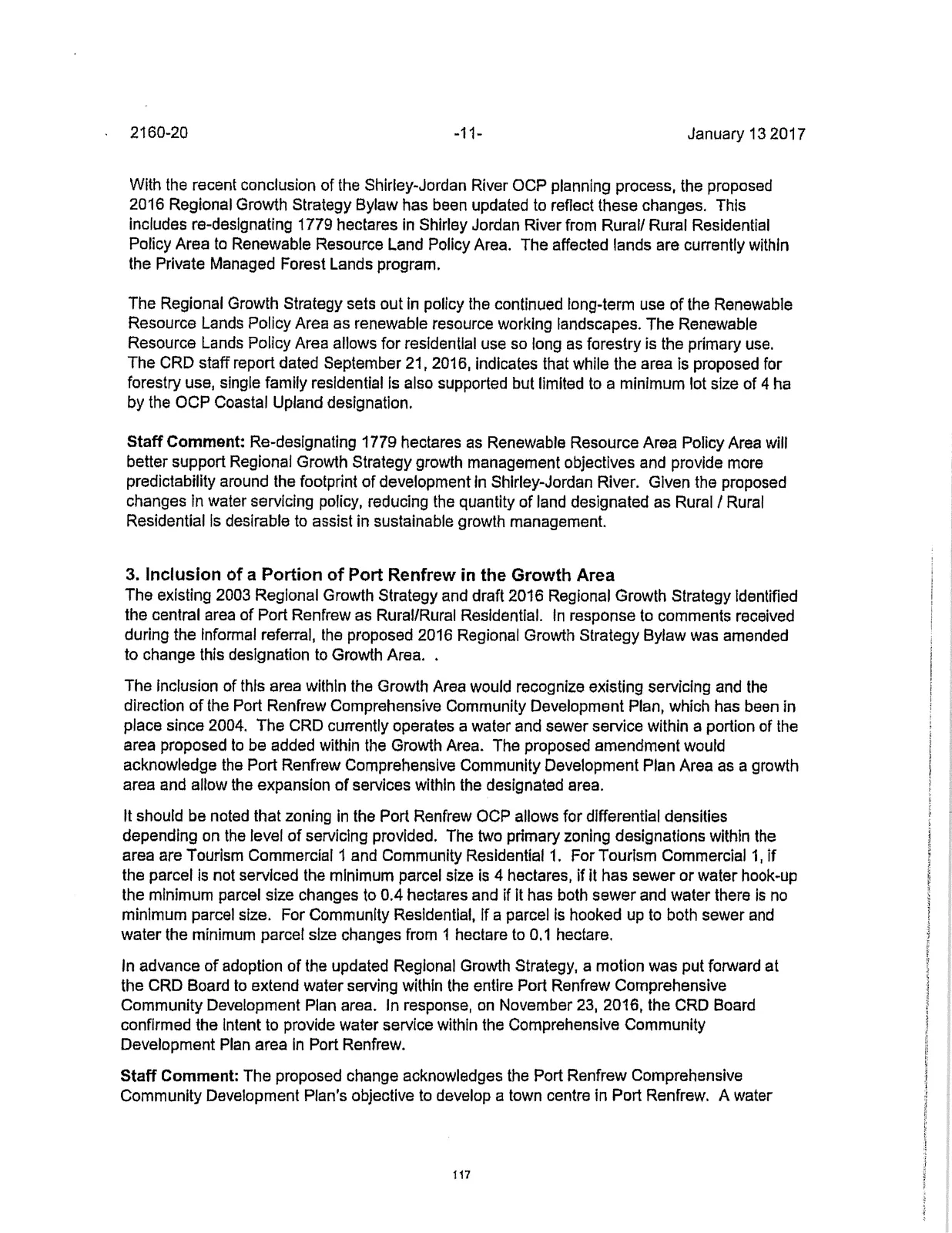
2160-20 -11- January 13 2017 With the recent conclusion of the Shirley-Jordan River OCP planning process, the proposed 2016 Regional Growth Strategy Bylaw has been updated to reflect these changes. This includes re-designating 1779 hectares in Shirley Jordan River from Rural/ Rural Residential Policy Area to Renewable Resource Land Policy Area. The affected lands are currently within the Private Managed Forest Lands program. The Regional Growth Strategy sets out In policy the continued long-term use of the Renewable Resource Lands Policy Area as renewable resource working landscapes. The Renewable Resource Lands Policy Area allows for residential use so long as forestry is the primary use. The CRD staff report dated September 21, 2016, indicates that while the area is proposed for forestry use, single family residential Is also supported but limited to a minimum lot size of 4 ha by the OCP Coastal Upland designation. Staff Comment: Re-designating 1779 hectares as Renewable Resource Area Policy Area will better support Regional Growth Strategy growth management objectives and provide more predictability around the footprint of development in Shirley-Jordan River. Given the proposed changes In water servicing policy, reducing the quantity of land designated as Rural / Rural Residential is desirable to assist in sustainable growth management. 3. Inclusion of a Portion of Port Renfrew in the Growth Area The existing 2003 Regional Growth Strategy and draft 2016 Regional Growth Strategy identified the central area of Port Renfrew as Rural/Rural Residential. In response to comments received during the Informal referral, the proposed 2016 Regional Growth Strategy Bylaw was amended to change this designation to Growth Area. . The Inclusion of this area within the Growth Area would recognize existing servicing and the direction of the Port Renfrew Comprehensive Community Development Plan, which has been in place since 2004. The CRD currently operates a water and sewer service within a portion of the area proposed to be added within the Growth Area. The proposed amendment would acknowledge the Port Renfrew Comprehensive Community Development Plan Area as a growth area and allow the expansion of services within the designated area. It should be noted that zoning in the Port Renfrew OCP allows for differential densities depending on the level of servicing provided. The two primary zoning designations within the area are Tourism Commercial 1 and Community Residential 1. For Tourism Commercial 1, if the parcel is not serviced the minimum parcel size is 4 hectares, if it has sewer or water hook-up the minimum parcel size changes to 0.4 hectares and if it has both sewer and water there is no minimum parcel size. For Community Residential, if a parcel is hooked up to both sewer and water the minimum parcel size changes from 1 hectare to 0.1 hectare. In advance of adoption of the updated Regional Growth Strategy, a motion was put forward at the CRD Board to extend water serving within the entire Port Renfrew Comprehensive Community Development Plan area. In response, on November 23, 2016, the CRD Board confirmed the Intent to provide water service within the Comprehensive Community Development Plan area in Port Renfrew. Staff Comment: The proposed change acknowledges the Port Renfrew Comprehensive Community Development Plan's objective to develop a town centre in Port Renfrew. A water 117 Page 66 of 154 Page 66 of 154
Page 67
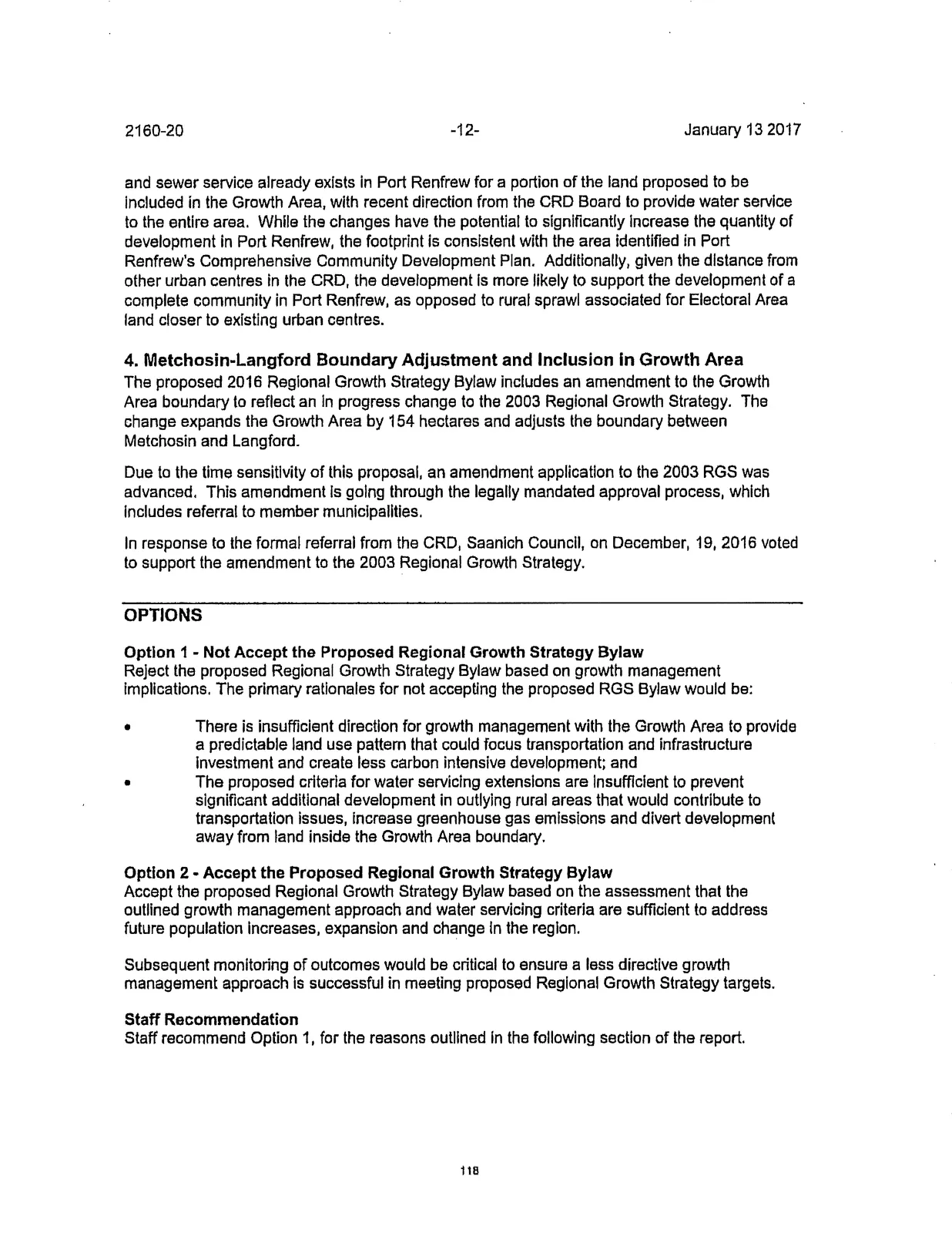
2160-20 -12- January 13 2017 and sewer service already exists in Port Renfrew for a portion of the land proposed to be included in the Growth Area, with recent direction from the CRD Board to provide water service to the entire area. While the changes have the potential to significantly increase the quantity of development in Port Renfrew, the footprint is consistent with the area identified in Port Renfrew's Comprehensive Community Development Plan. Additionally, given the distance from other urban centres in the CRD, the development is more likely to support the development of a complete community in Port Renfrew, as opposed to rural sprawl associated for Electoral Area land closer to existing urban centres. 4. Metchosin-Langford Boundary Adjustment and Inclusion in Growth Area The proposed 2016 Regional Growth Strategy Bylaw includes an amendment to the Growth Area boundary to reflect an in progress change to the 2003 Regional Growth Strategy. The change expands the Growth Area by 154 hectares and adjusts the boundary between Metchosin and Langford. Due to the time sensitivity of this proposal, an amendment application to the 2003 RGS was advanced, This amendment Is going through the legally mandated approval process, which includes referral to member municipalities. In response to the formal referral from the CRD, Saanich Council, an December, 19, 2016 voted to support the amendment to the 2003 Regional Growth Strategy. OPTIONS Option I - Not Accept the Proposed Regional Growth Strategy Bylaw Reject the proposed Regional Growth Strategy Bylaw based on growth management implications. The primary rationales for not accepting the proposed RGS Bylaw would be: • There is insufficient direction for growth management with the Growth Area to provide a predictable land use pattern that could focus transportation and infrastructure Investment and create less carbon intensive development; and The proposed criteria for water servicing extensions are Insufficient to prevent significant additional development in outlying rural areas that would contribute to transportation issues, increase greenhouse gas emissions and divert development away from land inside the Growth Area boundary. Option 2 - Accept the Proposed Regional Growth Strategy Bylaw Accept the proposed Regional Growth Strategy Bylaw based on the assessment that the outlined growth management approach and water servicing criteria are sufficient to address future population increases, expansion and change in the region. Subsequent monitoring of outcomes would be critical to ensure a less directive growth management approach is successful in meeting proposed Regional Growth Strategy targets. Staff Recommendation Staff recommend Option 1, for the reasons outlined in the following section of the report. 1 Page 67 of 154 Page 67 of 154
Page 68
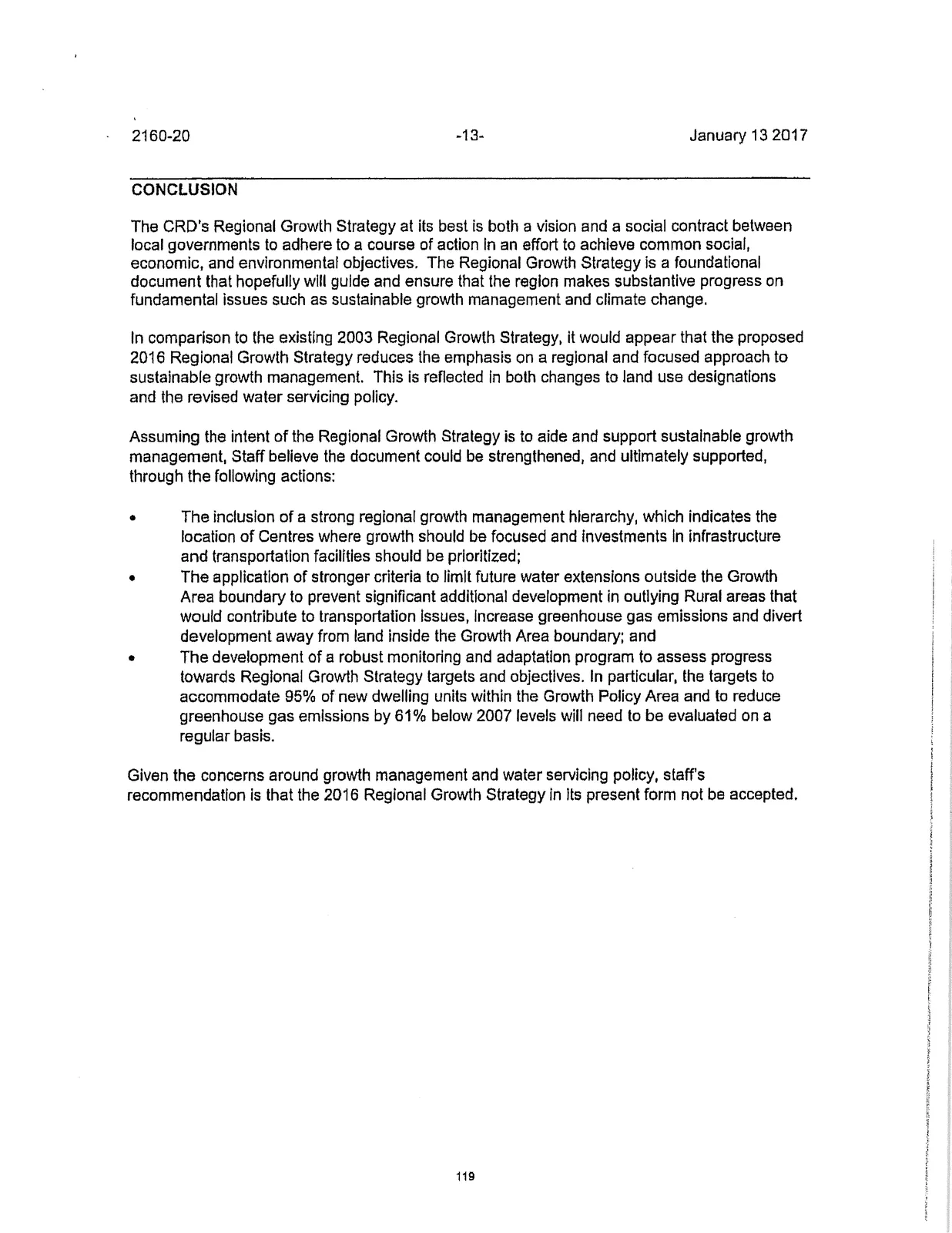
2160-20 -13- January 13 2017 CONCLUSION The CRID's Regional Growth Strategy at its best is both a vision and a social contract between local governments to adhere to a course of action In an effort to achieve common social, economic, and environmental objectives. The Regional Growth Strategy is a foundational document that hopefully will guide and ensure that the region makes substantive progress on fundamental issues such as sustainable growth management and climate change. In comparison to the existing 2003 Regional Growth Strategy, it would appear that the proposed 2016 Regional Growth Strategy reduces the emphasis on a regional and focused approach to sustainable growth management. This is reflected in both changes to land use designations and the revised water servicing policy. Assuming the intent of the Regional Growth Strategy is to aide and support sustainable growth management, Staff believe the document could be strengthened, and ultimately supported, through the following actions: • The inclusion of a strong regional growth management hierarchy, which indicates the location of Centres where growth should be focused and investments In infrastructure and transportation facilities should be prioritized; • The application of stronger criteria to limit future water extensions outside the Growth Area boundary to prevent significant additional development in outlying Rural areas that would contribute to transportation issues, increase greenhouse gas emissions and divert development away from land inside the Growth Area boundary; and • The development of a robust monitoring and adaptation program to assess progress towards Regional Growth Strategy targets and objectives. In particular, the targets to accommodate 95% of new dwelling units within the Growth Policy Area and to reduce greenhouse gas emissions by 61% below 2007 levels will need to be evaluated on a regular basis. Given the concerns around growth management and water servicing policy, staffs recommendation is that the 2016 Regional Growth Strategy in Its present form not be accepted. 119 Page 68 of 154 Page 68 of 154
Page 69
Report prepared by: Silvia x °sit°, Planner Report prepared & reviewed b
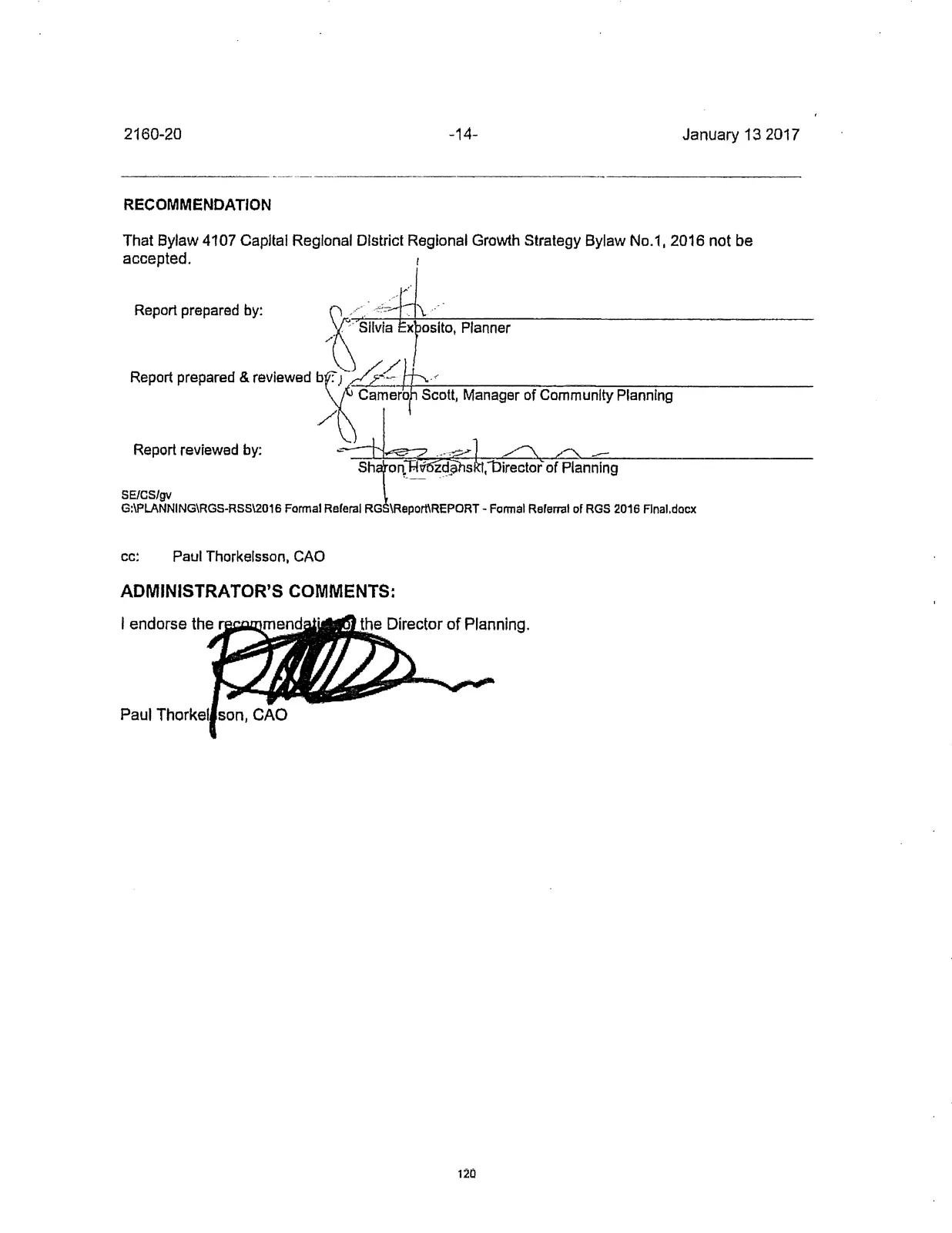
Camero Scott, Manager of Community Planning Report reviewed by: zda skilDirector of Planning 2160-20 -14- January 13 2017 RECOMMENDATION That Bylaw 4107 Capital Regional District Regional Growth Strategy Bylaw No.1, 2016 not be accepted. SEJCS/gv GAPLANNING\RGS-RSSI2016 Formal Referal RG tReport\REPORT - Formal Referral of RGS 2016 Flnal,docx cc: Paul Thorkelsson, CAO ADMINISTRATOR'S COMMENTS: I endorse the mend the Director of Planning. Paul "Markel son, CAO 120 Page 69 of 154 Page 69 of 154
Page 70
January 25, 2017 VIA EMAIL: breemsPcrd.bc.ca
Brent Reems Corporate Officer & Senior Manager Capital Regional District 625 Fisgard Street, P.O. Box 1000 Victoria, BC V8W 256 Sandi Nelson Corporate Officer TOWN OF SIDNEY 2440 Sidney Avenue, Sidney, British Columbia V8L 1Y7 Phone: 250-656-1184 Fax: 250-655-4508 Email: townhallAsidney.ca Website: www.sidney.ca CRD EXECUTIVE OFFICE* Received E6Thair CAO 0a JAN 2 § 2: rd
0 17 0 Communications G
21KFor z action / rasp by
R2li
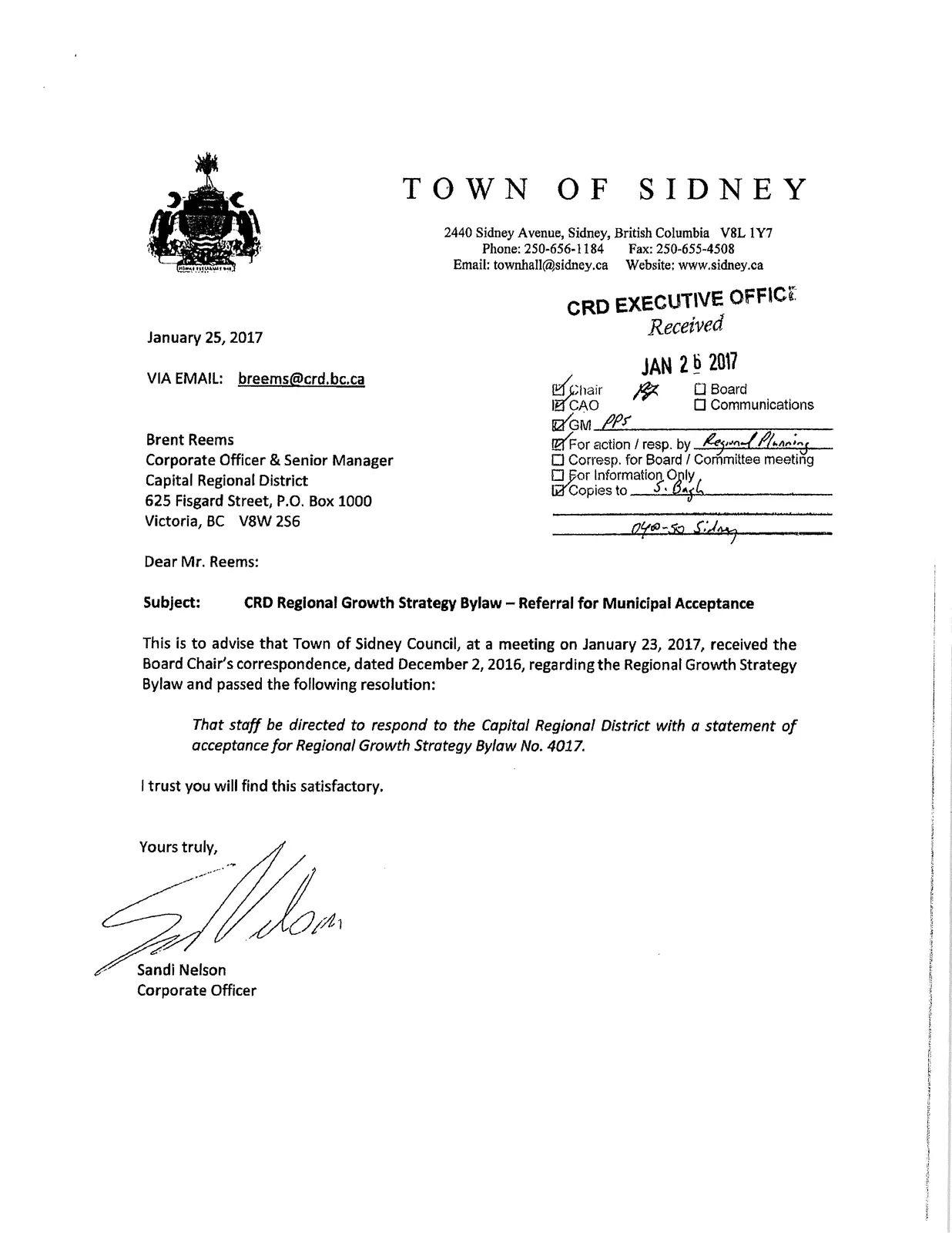
0 Corresp. for Board 1 Committee meeting _E_Uor Informatior), OIy U.", Copies to DAIL, r*‘60-. Dear Mr. Reems: Subject: CRD Regional Growth Strategy Bylaw — Referral for Municipal Acceptance This is to advise that Town of Sidney Council, at a meeting on January 23, 2017, received the Board Chair's correspondence, dated December 2, 2016, regarding the Regional Growth Strategy Bylaw and passed the following resolution: That staff be directed to respond to the Capital Regional District with a statement of acceptance for Regional Growth Strategy Bylaw No. 401Z I trust you will find this satisfactory. Page 70 of 154 Page 70 of 154
Page 71
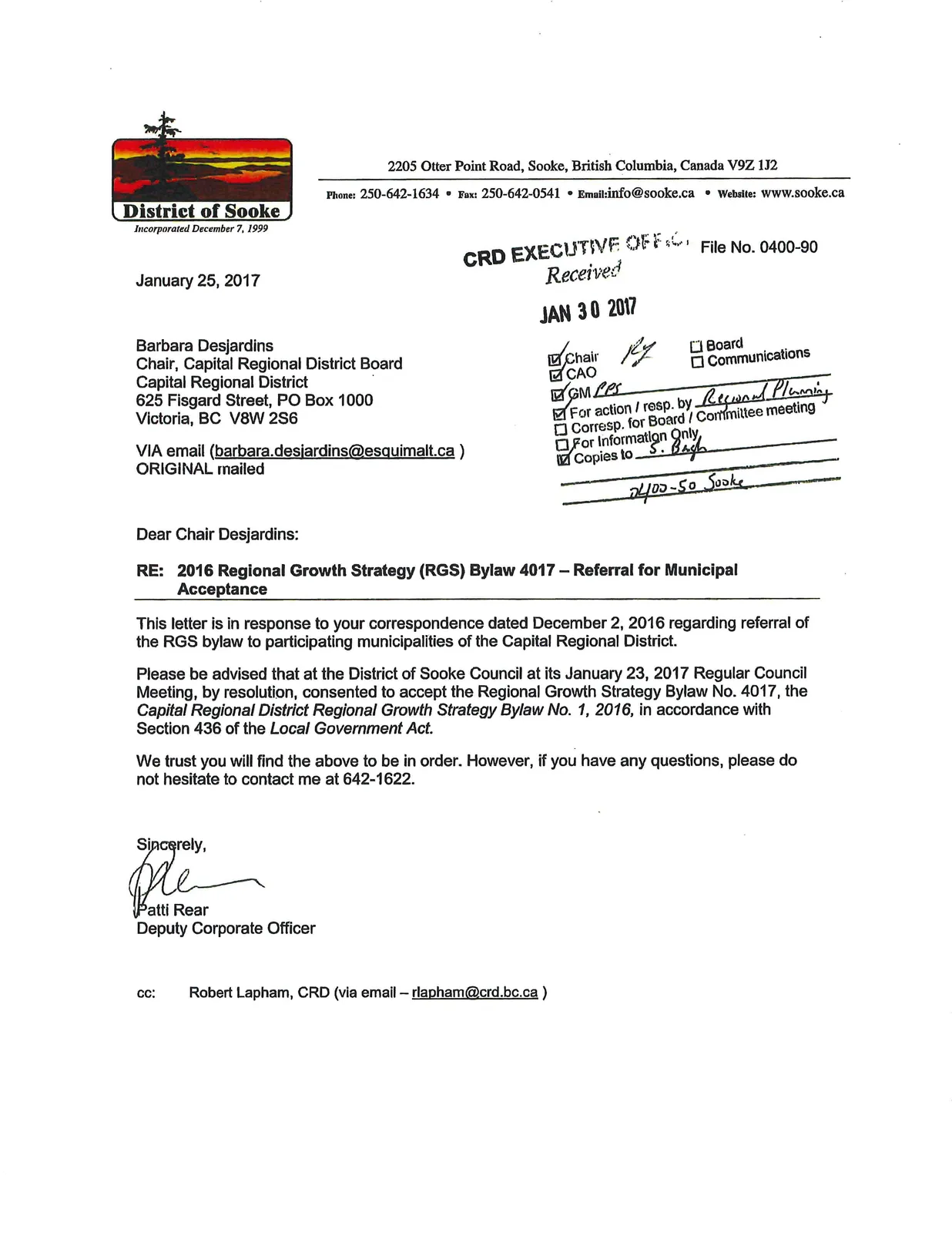
2205 Otter Point Road, Sooke, British Columbia, Canada V9Z 112 Phone: 250-642-1634 • Fax 250-642-0541 • Emaikinfo@sooke.ca • Website: www.sooke.ca Incorporated December 7, 1999 January 25, 2017 cRD XE uTP/F. Ot'i" c`-' File No. 0400-90 Ec Received JAN 30 2017 Barbara Desjardins Chair, Capital Regional District Board Capital Regional District 625 Fisgard Street, PO Box 1000 Victoria, BC V8W 2S6 VIA email (barbara.desiardins@esquimalt.ca ) ORIGINAL mailed tthAt. .Board 0 Communications For action I resp. by 0 Corresp. for Board / Col mittee meeting y or Informatl9n Copies to a • Dear Chair Desjardins: RE: 2016 Regional Growth Strategy (RGS) Bylaw 4017 — Referral for Municipal Acceptance This letter is in response to your correspondence dated December 2, 2016 regarding referral of the RGS bylaw to participating municipalities of the Capital Regional District. Please be advised that at the District of Sooke Council at its January 23, 2017 Regular Council Meeting, by resolution, consented to accept the Regional Growth Strategy Bylaw No. 4017, the Capital Regional District Regional Growth Strategy Bylaw No. 1, 2016, in accordance with Section 436 of the Local Government Act We trust you will find the above to be in order. However, if you have any questions, please do not hesitate to contact me at 642-1622. S' rely, atti Rear Deputy Corporate Officer cc: Robert Lapham, CRD (via email — rlaoham(äcrd.bc.ca ) Page 71 of 154 Page 71 of 154
Page 72
CITY OF VICTORIA Legislative and Regulatory Services Department Legislative Services #1 Centennial Square 'victoria British Columbia VSlitr 1P3 Tel (250) 361-0571 Fax (250) 361-0348 wYmvictoxia.ca January 31, 2017 Ms. Signe Bagh Senior Manager, Regional and Strategic Planning 625 Fisgard Street Victoria, BC V8W 1R7 Dear Ms. Bagh: Re: Regional Growth Strategy Formal Referrals I am writing to advise you that Victoria City Council passed the following resolution at the January 26, 2017 Council meeting: That Council advise the Capital Regional District (CRD) Board that the City of Victoria accepts CRD Bylaw No. 4017 to enact the 2016 Regional Growth Strategy for the Capital Region. If you require further information concerning this matter, please contact Robert Batallas, Senior Planner, at 250.361.0286. You truly, ns C ates City Clerk :Plm cc: J. Tinney, Director, Sustainable Planning and Community Development The City of Victoria recognizes the Songhees and Esquimalt Nations in whose traditional territories we live and work "Hay swx qa" Page 72 of 154 Page 72 of 154
Page 73
TOWN OF VIEW ROYAL 45 View Royal Avenue, Victoria. BC, Canada V9B iA6 Ph. 250-479-6800 • Fx. 250-727-9551 • E. info@viewroyal.ca • www.viewroyal.ca January 31, 2017 The following resolution was passed by View Royal Council at its regular meeting held January 17, 2017: "THAT "Capital Regional District Regional Growth Strategy Bylaw No. 1, 2016" not be accepted; AND THAT Council objects to Map 3: Regional Growth Management Concept Plan and policy statements relating to the definitions of the land use designations as they imply a hierarchy between the Regional Growth Strategy and Local Government planning, and due to errors on the map as it pertains to View Royal as illustrated in the staff report dated January 3, 2017; AND FURTHER THAT Council objects to provisions 2.2.2 and 2.2.4 for the following reasons: • that provision of water service will increase sprawl in rural areas and is contrary to the objectives of the overall Regional Growth Strategy which supports complete and compact communities; • that additional development on rural and resource lands is at the expense of development on lands within the Urban Containment Boundary; • that additional residential development on rural and resource lands will contribute to further transportation challenges in the region, and does not allow for efficient public transportation, increases greenhouse gas emissions, and does not provide for jobs/housing balance; • that rural development will further contribute to GHG emissions by freeing a high-carbon built form." I hereby certify the above to be a true copy of the resolution carried by Council of the Town of View Royal on January 17, 2017. Dated at Victoria, British Columbia, this 31st day of January, 2017. 2i3oc,6Lm . Elena Bolster Deputy Corporate Officer C: Recycled Paper Page 73 of 154 Page 73 of 154
Page 74
APPENDIX t2 EXTRACTS FROM LOCAL GOVERNMENT ACT AND REGIONAL GROWTH STRATEGIES REGULATION (BC REG 192198) Copyright (c) Queen's Printer, Victoria, British Columbia, Canada License Disclaimer This Act is Current to January 18, 2017 LOCAL GOVERNMENT ACT Acceptance by affected local governments 436 (1) Before it is adopted, a regional growth strategy must be accepted by the affected local governments or, failing acceptance, become binding on the affected local governments under section 440 (6) [settlement of regional growth strategy in acceptance not otherwise reached]. (2) Acceptance of a regional growth strategy by an affected local government must be done by resolution of the local government. (3) For the purposes of this section, before third reading of the bylaw to adopt a regional growth strategy, the board must submit the regional growth strategy to the following: (a) the council of each municipality all or part of which is covered by the regional growth strategy; (b) the board of directors of the South Coast British Columbia Transportation Authority if the regional growth strategy is for the Greater Vancouver Regional District; (c) the board of each regional district that is adjoining an area to which the regional growth strategy is to apply; (d) the facilitator or, if no facilitator for the regional growth strategy has been designated, the minister. Page 74 of 154 Page 74 of 154
Page 75
(4) After receiving a proposed regional growth strategy under subsection (3), each affected local government must (a) review the regional growth strategy in the context of any official community plans and regional growth strategies for its jurisdiction, both those that are current and those that are in preparation, and in the context of any other matters that affect its jurisdiction, and (b) subject to an extension by the facilitator under section 438 (3), within 60 days of receipt either (i) accept the regional growth strategy, or (ii) respond, by resolution, to the proposing board indicating that the local government refuses to accept the regional growth strategy. (5) An acceptance under subsection (4) (b) becomes effective (a) when all affected local governments have accepted the regional growth strategy, or (b) at the end of the period for acceptance or refusal under that subsection if, at the end of that period, all affected local governments have not accepted the regional growth strategy. (6) If an affected local government fails to act under subsection (4) (b) within the period for acceptance or refusal, the local government is deemed to have accepted the regional growth strategy. (7) In the resolution under subsection (4) (b) (ii), the affected local government must indicate (a) each provision to which it objects, (b) the reasons for its objection, and (c) whether it is willing that a provision to which it objects be included in the regional growth strategy on the basis that the provision will not apply to its jurisdiction, as referred to in section 432 (2). Page 75 of 154 Page 75 of 154
Page 76
(8) An affected local government is deemed to have accepted any provision of the regional growth strategy to which it does not indicate an objection under subsection (7). (9) All affected local governments are entitled to participate in any non-binding resolution processes used to resolve an objection or anticipated objection by an affected local government. (10) If an area in a regional district is incorporated as a new municipality and the regional district has adopted a regional growth strategy for all or part of the area of the new municipality, the regional growth strategy is binding on that new municipality. Resolution of anticipated objections 438 (1) Before the end of the 60 days referred to in section 436 (4) (b) [time for acceptance or refusal], the facilitator may require the proposing board and the affected local governments to identify any issues on which they anticipate that acceptance may not be reached. (2) If an issue is identified under subsection (1), (a) the facilitator may require the proposing board and the affected local governments to send representatives to a meeting convened by the facilitator for the purpose of clarifying the issues involved and encouraging their resolution, and (b) the proposing board and the affected local governments must provide information as requested by the facilitator and must otherwise cooperate with the facilitator in fulfilling his or her responsibilities. (3) For the purposes of this section, the facilitator may extend the period for acceptance or refusal under section 436 (4) (b) before or after the end of that period. Resolution of refusal to accept
- The proposing board must notify the minister in writing if an affected local government refuses to accept a proposed regional growth strategy. Page 76 of 154 Page 76 of 154
Page 77
(2) After being notified under subsection (1), the minister must (a) require a non-binding resolution process to attempt to reach acceptance on the regional growth strategy, or (b) if satisfied that resolution using a non-binding resolution process under paragraph (a) is unlikely, direct that the regional growth strategy is to be settled under section 440. (3) If requiring a non-binding resolution process under subsection (2) (a), the minister (a) must, at the time of requiring the non-binding resolution process, specify a time period within which the parties must begin the resolution process, and (b) may, before or after the resolution process has begun, specify a time period within which the parties must conclude the resolution process. (4) The choice of non-binding resolution process under subsection (2) (a) is to be determined by agreement between the proposing board and the affected local government or governments that refused to accept the regional growth strategy but, if the minister considers that these parties will not be able to reach agreement, the minister must direct which process is to be used. (5) Any affected local government may participate in a non-binding resolution process under this section. (6) Unless otherwise agreed by these parties, the fees of any neutral person participating in the non-binding resolution process and the administrative costs of the process, other than the costs incurred by the parties participating in the process, are to be shared proportionally between the proposing board and the affected local governments that participate in the process on the basis of the converted value of land and improvements in their jurisdictions. (7) An affected local government is deemed to have accepted the provisions of the regional growth strategy that were not changed as a result of a resolution process under subsection (2) (a). (8) The following apply if changes to a regional growth strategy are proposed as a result of a resolution process under subsection (2) (a): Page 77 of 154 Page 77 of 154
Page 78
(a) the regional growth strategy must be submitted again to the affected local governments for acceptance, subject to paragraph (b) of this subsection, in accordance with section 436; (b) an affected local government may not indicate an objection to a provision it is deemed to have accepted under section 436 (8) [no previous objection to provision] or subsection (7) of this section. (9) If acceptance is not reached within 60 days after a non-binding resolution process under this section is concluded, the regional growth strategy must be settled in accordance with section 440 unless the proposing board and the affected local governments can reach agreement on the provisions of the regional growth strategy before the settlement process is completed. Settlement of regional growth strategy if acceptance not otherwise reached 440 (1) If acceptance by affected local governments cannot otherwise be reached under this Part, the regional growth strategy is to be settled by one of the following: (a) peer panel settlement in accordance with section 441 (1); (b) final proposal arbitration in accordance with section 441 (2); (c) full arbitration in accordance with section 441 (3). (2) If more than one affected local government has refused to accept a regional growth strategy, whether the refusals are in relation to the same or different issues, the regional growth strategy is to be settled for all affected local governments in the same settlement proceedings. (3) The choice of process for settlement is to be determined by agreement between the proposing board and the affected local government or governments that refused to accept the regional growth strategy but, if the minister considers that these parties will not be able to reach agreement, the minister must direct which process is to be used. (4) Any affected local government may participate in a settlement process under section 441. (5) During the 60 days after the provisions of a regional growth strategy are settled under section 441, the proposing board and the affected local Page 78 of 154 Page 78 of 154
Page 79
governments may agree on the acceptance of a regional growth strategy that differs from the one settled. (6) At the end of the period under subsection (5), unless agreement is reached as referred to in that subsection, the provisions of a regional growth strategy as settled under section 441 become binding on the proposing board and all affected local governments, whether or not they participated in the settlement process. Options for settlement process 441 (1) As one option, the provisions of a regional growth strategy may be settled by a peer panel as follows: (a) the panel is to be composed of 3 persons selected from the applicable list prepared under section 442 (1); (b) the selection of the panel is to be done by agreement between the proposing board and the affected local government or governments that refused to accept the regional growth strategy or, if the minister considers that these parties will not be able to reach agreement, by the minister; (c) subject to the regulations, the panel may conduct the proceedings in the manner it determines; (d) the panel must settle the disputed issues of the regional growth strategy and may make any changes to the provisions of the regional growth strategy that it considers necessary to resolve those issues; (e) the panel must give written reasons for its decision if this is requested by the proposing board or an affected local government before the panel retires to make its decision. (2) As a second option, the provisions of a regional growth strategy may be settled by final proposal arbitration by a single arbitrator as follows: (a) the arbitrator is to be selected from the applicable list prepared under section 442 (1); (b) the selection of the arbitrator is to be done by agreement between the proposing board and the affected local government or governments that refused to accept the regional growth strategy or, if Page 79 of 154 Page 79 of 154
Page 80
the minister considers that these parties will not be able to reach agreement, by the minister; (c) subject to the regulations, the arbitrator must conduct the proceedings on the basis of a review of written documents and written submissions only, and must determine each disputed issue by selecting one of the final written proposals for resolving that issue submitted by one of the participating parties; (d) the provisions of the regional growth strategy will be as settled by the arbitrator after incorporation of the final proposals selected by the arbitrator under paragraph (c); (e) no written reasons are to be provided by the arbitrator. (3) As a third option, the provisions of a regional growth strategy may be settled by full arbitration by a single arbitrator as follows: (a) the arbitrator is to be selected from the applicable list prepared under section 442 (1); (b) the selection of the arbitrator is to be done by agreement between the proposing board and the affected local government or governments that refused to accept the regional growth strategy or, if the minister considers that these parties will not be able to reach agreement, by the minister; (c) subject to the regulations, the arbitrator may conduct the proceedings in the manner he or she determines; (d) the provisions of the regional growth strategy will be as settled by the arbitrator, who is not restricted in his or her decision to submissions made by the parties on the disputed issues; (e) the arbitrator must give written reasons for the decision. General provisions regarding settlement process 442 (1) Lists of persons who may act on a panel under section 441 (1), as an arbitrator under section 441 (2) or as an arbitrator under section 441 (3) are to be prepared by the minister in consultation with representatives of the Union of British Columbia Municipalities. Page 80 of 154 Page 80 of 154
Page 81
(2) Persons who may be included on a list for a panel under section 441 (1) are persons who are or have been elected officials of a local government or who, in the opinion of the minister, have appropriate experience in relation to local government matters. (3) In the case of a specific regional growth strategy, a person may not be appointed to a panel or as an arbitrator if the person is, or was at any time since the regional growth strategy was initiated, an elected official of the proposing board or of an affected local government for the regional growth strategy. (4) Subject to a direction by the panel or arbitrator or to an agreement between the parties, the fees and reasonable and necessary expenses of the members of a peer panel or arbitrator and the administrative costs of the process, other than the costs incurred by the parties participating in the process, are to be shared proportionally between the proposing board and the affected local governments that participate in the process on the basis of the converted value of land and improvements in their jurisdictions. (5) The directors of the electoral areas to which the regional growth strategy is proposed to apply and the Provincial government may make representations in the settlement process, subject to any conditions set by the panel or arbitrator. (6) The time limit for bringing any judicial review of a decision of a panel or arbitrator under section 441 is the end of the period for agreement under section 440 (5) [60 days after provisions settled by panel or arbitrator]. (7) The minister may make regulations regarding settlement processes under section 441, which may be different for different settlement processes, including regulations (a) respecting matters that a panel or arbitrator may or must consider, (b) respecting the authority of a panel or arbitrator to settle a regional growth strategy, and (c) respecting the authority of a panel or arbitrator to require the cooperation of local governments in relation to the settlement processes. Page 81 of 154 Page 81 of 154
Page 82
Adoption of regional growth strategy 443 (1) A regional growth strategy must be adopted by bylaw. (2) As soon as practicable after adopting a regional growth strategy, the board must send a copy of the regional growth strategy to (a) the affected local governments, (b) any greater boards and improvement districts within the regional district, and (c) the minister. Requirement to adopt finalized regional growth strategy 444 (1) If a proposed regional growth strategy has been accepted by the affected local governments or has become binding under section 440 (6), but has not been adopted by the proposing board, on the recommendation of the minister, the Lieutenant Governor in Council may, by order, specify a time period within which the board must adopt the regional growth strategy. (2) If the board does not adopt the regional growth strategy within the time period specified under subsection (1), the Lieutenant Governor in Council may, by order, deem the regional growth strategy to have been adopted by the board, in which case it applies as if it had been adopted by a valid bylaw of the board. 1 i Page 82 of 154 Page 82 of 154
Page 83
Copyright (c) Queen's Printer, License Victoria, British Columbia, Canada Disclaimer B.C. Reg. 192/98 Deposited June 5, 1998 M220/98 Local Government Act REGIONAL GROWTH STRATEGIES REGULATION Definitions 1 In this regulation: "Act" means the Local Government Act; "eligible party" means (a) the proposing board of a regional growth strategy that has not been accepted, (b) any local government affected by a regional growth strategy that has not been accepted, and (c) any other party which is entitled by agreement of the participating parties to participate in a settlement process for a regional growth strategy that has not been accepted; "facilitator" means a facilitator as defined in section 848 of the Act; "neutral" means a person appointed as a member of a peer panel under section 861 (1) of the Act or as a single arbitrator under section 861 (2) or (3) of the Act; "participating party" means an eligible party that has given notice under section 9, 17 or 22 in respect of a particular regional growth strategy. Application 2 (1) This regulation applies to all settlement processes conducted under section 861 of the Act. Page 83 of 154 Page 83 of 154
Page 84
(2) The Commercial Arbitration Act does not apply to a settlement process conducted under section 861 of the Act. Part 1 — General Selection of option 3 (1) The proposing board and the local governments that refused to accept a regional growth strategy must agree on the settlement process option they wish to employ under section 861 of the Act no later than (a) 84 days after a non-binding resolution process under section 859 of the Act is concluded without acceptance of the regional growth strategy, or (b) 28 days after the minister gives a direction under section 859 (2) (b) of the Act that the regional growth strategy is to be settled under section 860 of the Act. (2) Within the applicable time period specified in subsection (1), the board and local governments must, in writing, advise (a) the facilitator, or if no facilitator has been appointed, the minister, and (b) all other eligible parties, of the agreement reached under that subsection. (3) On request, the minister may extend the applicable time periods in subsection (1) if the minister believes that an extension may facilitate agreement. Statement of independence and impartiality 4 (1) Before a person may be selected as a neutral, a signed statement that he or she knows of no circumstances likely to give rise to justifiable doubts as to his or her independence or impartiality in the regional growth strategy under consideration must be provided by the person to (a) the board, Page 84 of 154 Page 84 of 154
Page 85
(b) the local governments that are eligible to select that person under section 861 of the Act, and (c) the facilitator, or if no facilitator has been appointed, the minister. (2) If circumstances likely to give rise to justifiable doubts as to his or her independence or impartiality in the regional growth strategy under consideration arise after the selection, a neutral must immediately disclose these circumstances to (a) the participating parties, and (b) the facilitator or, if no facilitator has been appointed, the minister. Appointment of neutrals 5 (1) No later than 28 days after the settlement process option has been determined, the proposing board and the local governments that refused to accept the regional growth strategy must select, as applicable, from the lists under section 862 (1) of the Act, (a) the 3 neutrals to act as members of the peer panel, or (b) the neutral to act as arbitrator. (2) Within the applicable time period specified in subsection (1), the board and local governments must, in writing, advise the facilitator or, if no facilitator has been appointed, the minister, of the selection made under that subsection. (3) Once selected, the peer panel or the neutral who will act as an arbitrator must immediately notify all eligible parties of their selection. (4) On request, the minister may extend the time period in subsection (1) if an extension would facilitate agreement. (5) On application of a participating party before conclusion of a settlement process, the court may revoke the appointment of a neutral if the court is satisfied that the neutral has, in the discharge of the neutral's obligations under this regulation, Page 85 of 154 Page 85 of 154
Page 86
(a) breached section 4, 6, 23 or 31(1), (b) behaved in a corrupt or fraudulent manner, (c) shown bias, (d) exceeded his or her powers, or (e) failed to observe the rules of natural justice. (6) A neutral who resigns, is unable or refuses to act or whose appointment is revoked under subsection (5) must be replaced under this regulation by another neutral. Obligations of neutrals 6 (1) A neutral must be and remain at all times wholly independent and impartial and must not act as an advocate in the settlement process for any eligible party. (2) Except to the extent expressly permitted under this regulation, a neutral must not have any written or oral communications with any eligible party respecting the substantive issues in a settlement process without full communication of this information to all participating parties. Obligations of eligible parties 7 Except to the extent expressly permitted under this regulation, an eligible party must not have any written or oral communications respecting the substantive issues in a settlement process without full communication of this information to all eligible parties. Part 2— Peer Panel Intent 8 (1) Part 2 applies to all peer panel settlement processes selected by the parties or directed by the minister under section 860 (3) of the Act. (2) In this Part, "settlement process" means a peer panel settlement process. Participating parties Page 86 of 154 Page 86 of 154
Page 87
9 (1) An eligible party must, in writing, advise the chair of the peer panel, the proposing board and all affected local governments within 14 days of the date of the selection of the last member of the peer panel (a) that the eligible party intends to be a participating party in the settlement process, (b) of the name, address and telephone number of the individual who represents that party, and (c) of the name, address and telephone number of that individual's alternate. (2) On request, the peer panel may extend the time for an eligible party to give notice under subsection (1) if that party's participation would assist in the settlement of the regional growth strategy and may be accommodated within the time limits imposed under this Part for making a decision. Peer panel 10 (1) The members of the peer panel must appoint one of the members to act as chair of the panel. (2) All final decisions to resolve the disputed issues respecting the regional growth strategy must be made by a majority decision of the panel. (3) The chair of the peer panel may make rulings not described by subsection (2) respecting the settlement process. Meetings 11 (1) Subject to any directions of the peer panel, the meetings of the settlement process, excluding any meetings held by and for the members of the peer panel only, are open to the public. (2) Recordings must not be made of the meetings of the settlement process but handwritten notes may be kept. (3) The facilitator may attend and observe any part of the settlement process excluding any meetings held by and for the members of the peer panel only. Page 87 of 154 Page 87 of 154
Page 88
Procedure 12 (1) The peer panel must convene a preliminary meeting, in person or by conference call, with the participating parties within 21 days of the selection of the last panel member to (a) identify the disputed issues in the regional growth strategy, (b) investigate opportunities for reaching agreement, (c) discuss the role to be played by the peer panel, the procedure to be followed and whether written reasons will be requested, and (d) set any time periods within which certain actions must be taken. (2) After consultation with the participating parties, the peer panel must give the parties written directions on the manner of conduct of the proceedings as soon as possible after the preliminary meeting. (3) If the peer panel decides to hold oral hearings, the hearings must be held on consecutive business days and, if the participating parties agree, on consecutive days other than business days. (4) If the settlement process includes the presentation of information by experts or other persons to the peer panel, the peer panel may limit the number of persons who may be called to give presentations and may set time limits for the presentations. (5) After consultation with the participating parties, the peer panel may request the attendance of, and a presentation by, any person who may be of assistance to the panel in making its decision. (6) The peer panel is not required to apply the legal rules of evidence and must determine the relevance and materiality of the presentations. Facilitating role 13 (1) Unless the participating parties agree otherwise, if the peer panel is endeavouring to facilitate settlement discussions, the members of the peer panel, separately or together, may hold private meetings with any or all of the Page 88 of 154 Page 88 of 154
Page 89
participating parties and information provided by the participating parties during those meetings should not be considered confidential. (2) During its efforts to facilitate settlement discussions, the members of the peer panel may make suggestions to the participating parties for resolution of the disputed issues, but these suggestions are not to be construed as a decision of the peer panel and are for the purpose only of facilitating settlement by agreement of the parties. (3) If the peer panel's efforts to facilitate an agreement on the disputed issues are unsuccessful within 35 days after the date of the selection of the last panel member, the peer panel must cease such activities and conduct the settlement process in such a manner as to enable it to make a decision on the disputed issues as required by the Act and this regulation. Notice to retire 14 (1) In order to provide an opportunity to make a request for written reasons as permitted under section 861 of the Act, the peer panel must give the participating parties advance notice of its intent to retire to make its decision. (2) Any submissions by the participating parties on the allocation of fees, costs and expenses of the settlement process must be received by the peer panel before it retires to make its decision. Decision 15 (1) Unless the participating parties agree on a regional growth strategy during the settlement process or the minister extends the time period, the peer panel must settle the disputed issues of the regional growth strategy, including giving any written reasons requested under section 861 of the Act, within 70 days from the date the last peer panel member was selected. (2) The peer panel must give its decision settling the disputed issues in the regional growth strategy in writing and provide copies of it to all the participating parties and the facilitator or, if no facilitator was appointed by the minister, to the minister. Page 89 of 154 Page 89 of 154
Page 90
Part 3— Final Proposal Arbitration Intent 16 (1) Part 3 applies to all final proposal settlement processes selected by the parties or directed by the minister under section 860 (3) of the Act. (2) In this Part, "settlement process" means the final proposal arbitration process. Participating parties 17 (1) An eligible party must, in writing, advise the arbitrator, the proposing board and all affected local governments within 14 days of the date of the selection of the arbitrator (a) that the eligible party intends to be a participating party in the settlement process, (b) of the name, address and telephone number of the individual who represents that party, and (c) of the name, address and telephone number of that individual's alternate. (2) On request, the arbitrator may extend the time for an eligible party to give notice if that party's participation would assist in the settlement of the regional growth strategy and may be accommodated within the time limits imposed under this Part for making a decision. No meetings 18 The arbitrator must not meet with or discuss any aspect of the disputed issues with the participating parties or any other person and the arbitrator is restricted solely to consideration of the written submissions and proposals filed by the participating parties. Identification of disputed issues 19 (1) Within 28 days of the date of selection of the arbitrator, all participating parties must submit to the arbitrator a jointly prepared and agreed to statement which Page 90 of 154 Page 90 of 154
Page 91
clearly and succinctly identifies the disputed issues in the regional growth strategy. (2) Within 42 days of selection of the arbitrator, each of the participating parties must make a submission to the arbitrator and to the other participating parties which (a) addresses all or any of the disputed issues identified in subsection (1) and no other issues, (b) explains the position the participating party takes on each disputed issue it intends to address, (c) includes any documents on which it relies, (d) makes only one specific proposal to finally resolve a disputed issue, which proposal must be presented as specific wording to be included in the regional growth strategy, and (e) addresses the issue of allocation of fees, costs and expenses of the settlement process, if any submission on this issue is intended. (3) The participating parties may not revise or amend their submission after it has been presented to the arbitrator nor may they rebut or refute any information contained in any other participating party's submission. (4) Nothing in subsection (3) must be construed to limit, in any way, any settlement discussions which the participating parties may wish to carry on during the time period in which the arbitrator is considering his or her decision. Decisions 20 (1) Unless the participating parties agree on a regional growth strategy during the settlement process or the minister extends the time period, the arbitrator must settle the disputed issues of the regional growth strategy within 63 days of the date of his or her selection. (2) The arbitrator must select, in respect of each disputed issue, one of the final proposals submitted under section 19 and Page 91 of 154 Page 91 of 154
Page 92
(a) the selection of a final proposal on a disputed issue submitted by one participating party does not preclude the selection of a final proposal on another disputed issue submitted by another participating party, and (b) the arbitrator may not alter the terms of a final proposal in selecting the final proposal. (3) The arbitrator must give the selections under subsection (2) in writing and provide signed and dated copies of them to all participating parties and the facilitator or, if no facilitator was appointed by the minister, to the minister. Part 4— Full Arbitration Settlement Process Intent 21 (1) Part 4 applies to all full arbitration settlement processes selected by the parties or directed by the minister under section 860 (3) of the Act. (2) In this Part, "settlement process" means the full arbitration settlement process. Participating parties 22 (1) An eligible party must, in writing, advise the arbitrator, the proposing board and all affected local governments within 14 days of the date of the selection of the arbitrator (a) that the eligible party intends to be a participating party in the settlement process, (b) of the name, address and telephone number of the individual who represents that party, and (c) of the name, address and telephone number of that individual's alternate. (2) On request, the arbitrator may extend the time for an eligible party to give notice if that party's participation would assist in the settlement of the regional growth strategy and may be accommodated within the time limits imposed under this Part for making a decision. Page 92 of 154 Page 92 of 154
Page 93
Communications 23 (1) A copy of all written communications between the arbitrator and a participating party must be given to the other participating parties at the same time. (2) There must not be any oral communications between a participating party and the arbitrator with respect to the disputed issues unless it is made in the presence of all participating parties or their legal counsel. (3) Copies of all documents exchanged between the participating parties as required under this Part must be given to the arbitrator. Objections to process 24 (1) A participating party must state any objections to any aspect of the settlement process or to the conduct of the other participating parties or the arbitrator at the earliest possible time. (2) The arbitrator may refuse to consider an objection if a party fails to comply with subsection (1). Commencement of settlement process 26 For purposes of the calculation of time under this Part, the settlement process is considered to commence on the date the arbitrator is selected. Change of arbitrator 26 An arbitrator replaced under this regulation by another arbitrator must rehear any matter to be decided respecting the disputed issues that has not been decided by the former arbitrator respecting those issues. Powers of the arbitrator 27 (1) Subject to any limitations in this Part or any agreement reached by the participating parties, the arbitrator may conduct the settlement process in any manner the arbitrator considers appropriate, but each party must be treated fairly and must be given full opportunity to present its case. (2) The arbitrator may rule on his or her jurisdiction. (3) The arbitrator may Page 93 of 154 Page 93 of 154
Page 94
(a) adjourn the proceedings from time to time to facilitate settlement discussions between the parties or for any other reasonable purpose, (b) order inspection of documents, exhibits or other property at any location, (c) order the recording of any oral hearing or meeting, (d) limit the number of witnesses in any oral hearing and the manner and method of cross-examination of them, and (e) if the arbitrator considers it just and appropriate in the circumstances, extend or shorten a period of time (i) required in this Part, except the period of time specified under section 35 (1), or (ii) fixed or determined by the arbitrator. Preliminary meeting 28 (1) The arbitrator must convene a preliminary meeting, in person or by conference call, with the participating parties within 21 days of his or her selection to (a) identify the disputed issues in the regional growth strategy, (b) discuss the procedure to be followed, and (c) set any time periods within which certain actions must be taken. (2) Subject to any agreements reached by the parties and any mandatory provision of this regulation, the arbitrator must give the parties written directions on the manner of conduct of the proceedings as soon as possible after the preliminary meeting. (3) If the arbitrator decides to hold oral hearings, the hearings must be held on consecutive business days and, if the participating parties agree, on consecutive days other than business days. Exchange of statements Page 94 of 154 Page 94 of 154
Page 95
29 (1) The participating parties must exchange written statements of their respective positions on the disputed issues in the following manner: (a) a participating party that refused to accept the regional growth strategy (known as the claiming party) must give a submission outlining the matters in dispute, a discussion of its perspective on the issue and the solution requested, not later than 28 days after the preliminary meeting is held under section 28; (b) a participating party, other than those referred to in paragraph (a) (known as the responding party) must give a submission outlining its responses to the claiming party's submission, not later than 14 days after receiving the claiming party's submission. (2) A participating party must attach to its submission under subsection (1) a list of documents (a) on which the party intends to rely, and (b) which describes each document by kind, date, author, addressee and subject matter. (3) At any time, the arbitrator may allow a participating party to amend or add to any submission made under this section, including the list of documents, unless (a) the amendment or addition goes beyond the terms of the settlement process, or (b) another participating party would be prejudiced by the delay in making the amendment or addition. Disclosure 30 (1) The arbitrator may order a participating party to produce, within a specified time, any documents which (a) have not been listed under section 29, (b) a participating party has in its care, custody or control, and Page 95 of 154 Page 95 of 154
Page 96
(c) the arbitrator considers to be relevant. (2) A participating party must allow any other participating party the necessary access at reasonable times to inspect and take copies of all documents that the former party has listed in section 29. (3) Not later than 21 days before any oral hearing commences, each participating party must give the other participating parties and the arbitrator (a) the name and address of any witness it intends to call and a written summary of the witness's evidence, and (b) in the case of an expert witness, a written statement or report prepared by the expert witness. (4) Not later than 14 days before any oral hearing commences, each participating party must give to the other participating parties and the arbitrator an assembly of all documents to be introduced at the hearing. Hearings and meetings 31 (1) The arbitrator must give the participating parties reasonable written notice of any oral hearings and meetings. (2) Subject to any directions of the arbitrator, the hearings and meetings of the arbitration are open to the public. (3) The arbitrator may direct that a record be kept of the settlement process. (4) The facilitator may attend and observe any part of the settlement process. Evidence 32 (1) All oral evidence must be taken in the presence of the arbitrator and all the parties unless a participating party is absent by default or has waived the right to be present. (2) If the arbitrator considers it just and reasonable to do so, the arbitrator may permit a document to be introduced at the oral hearing which was not previously listed under section 29, but the arbitrator may take that failure Page 96 of 154 Page 96 of 154
Page 97
into account when fixing the costs to be awarded in the settlement process. (3) If the arbitrator permits the evidence of a witness to be presented as a written statement, the other participating parties may require that witness to be made available for cross examination at the oral hearing. Default of parties 33 (1) If a responding party fails to provide the statement required in section 29 (1) (b), the arbitrator must (a) continue the settlement process, and (b) require the claiming party to present such evidence to support its submission as the arbitrator may require before making a decision. (2) The arbitrator may continue the settlement process and make a decision based on the evidence presented if a participating party fails to (a) appear at a scheduled oral hearing, or (b) produce any evidence. Close of hearings 34 (1) The arbitrator must close any oral hearings if (a) the participating parties advise they have no further evidence to give or submissions to make, or (b) the arbitrator considers further hearings to be unnecessary or inappropriate. (2) Subject to any time requirements under this Part, if the arbitrator considers it to be just and appropriate to do so, the arbitrator may reopen the oral hearings at any time before making a decision. Page 97 of 154 Page 97 of 154
Page 98
Decision 35 (1) Unless the participating parties agree on a regional growth strategy during the settlement process or the minister extends the time, the arbitrator must make a decision as soon as possible and, in any event, not later than 28 days after (a) any oral hearings have been closed, or (b) if no oral hearings have been held, the last written submission has been made. (2) The decision of the arbitrator must be in writing, contain the specific wording of the provisions of the regional growth strategy, state the reasons on which it is based and be signed and dated. (3) The arbitrator must give a copy of the decision to each participating party and the facilitator or, if no facilitator was appointed by the minister, to the minister. Amendments and corrections to the award 36 (1) The arbitrator may amend or vary a decision settling the provisions of the regional growth strategy to correct (a) a clerical or typographical error, or (b) an accidental error, slip, omission or other similar mistake. (2) An application by a participating party to the arbitrator to amend or vary a decision under subsection (1) must be made within 7 days after that party receives the decision. (3) Not later than 7 days after receiving the decision, a participating party may apply to the arbitrator for clarification of the provisions of the settled regional growth strategy, and the arbitrator may amend that part of his or her decision if the arbitrator considers that the amendment will clarify it. (4) For the purposes of subsection (2) or (3), the arbitrator must not amend or vary the decision, without the consent of all participating parties, more than 14 days after all parties have received it. Page 98 of 154 Page 98 of 154
Page 99
(5) Subsection (3) does not apply to the reasons given by the arbitrator in making his or her decision on the provisions of the regional growth strategy. Page 99 of 154 Page 99 of 154